 Add to Chrome
 Add to Firefox
 Add to Edge
Beyond Prompts: Unconditional 3D Inversion for Out-of-Distribution Shapes
Apr 16, 2026
Text-driven inversion of generative models is a core paradigm for manipulating 2D or 3D content, unlocking numerous applications such as text-based editing, style transfer, or inverse problems. However, it relies on the assumption that generative models remain sensitive to natural language prompts. We demonstrate that for state-of-the-art native text-to-3D generative models, this assumption often collapses. We identify a critical failure mode where generation trajectories are drawn into latent ``sink traps'': regions where the model becomes insensitive to prompt modifications. In these regimes, changes to the input text fail to alter internal representations in a way that alters the output geometry. Crucially, we observe that this is not a limitation of the model's \textit{geometric} expressivity; the same generative models possess the ability to produce a vast diversity of shapes but, as we demonstrate, become insensitive to out-of-distribution \textit{text} guidance. We investigate this behavior by analyzing the sampling trajectories of the generative model, and find that complex geometries can still be represented and produced by leveraging the model's unconditional generative prior. This leads to a more robust framework for text-based 3D shape editing that bypasses latent sinks by decoupling a model's geometric representation power from its linguistic sensitivity. Our approach addresses the limitations of current 3D pipelines and enables high-fidelity semantic manipulation of out-of-distribution 3D shapes. Project webpage: https://daidedou.sorpi.fr/publication/beyondprompts

SceneTeract: Agentic Functional Affordances and VLM Grounding in 3D Scenes
Mar 31, 2026Embodied AI depends on interactive 3D environments that support meaningful activities for diverse users, yet assessing their functional affordances remains a core challenge. We introduce SceneTeract, a framework that verifies 3D scene functionality under agent-specific constraints. Our core contribution is a grounded verification engine that couples high-level semantic reasoning with low-level geometric checks. SceneTeract decomposes complex activities into sequences of atomic actions and validates each step against accessibility requirements (e.g., reachability, clearance, and navigability) conditioned on an embodied agent profile, using explicit physical and geometric simulations. We deploy SceneTeract to perform an in-depth evaluation of (i) synthetic indoor environments, uncovering frequent functional failures that prevent basic interactions, and (ii) the ability of frontier Vision-Language Models (VLMs) to reason about and predict functional affordances, revealing systematic mismatches between semantic confidence and physical feasibility even for the strongest current models. Finally, we leverage SceneTeract as a reward engine for VLM post-training, enabling scalable distillation of geometric constraints into reasoning models. We release the SceneTeract verification suite and data to bridge perception and physical reality in embodied 3D scene understanding.
DeBaRA: Denoising-Based 3D Room Arrangement Generation
Sep 26, 2024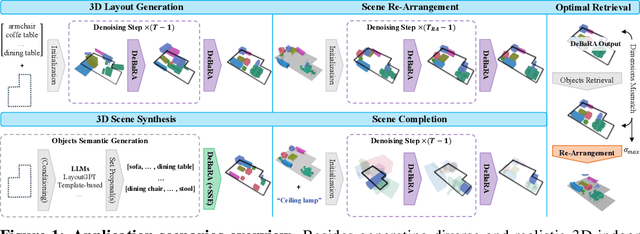
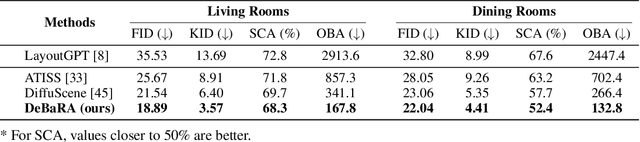
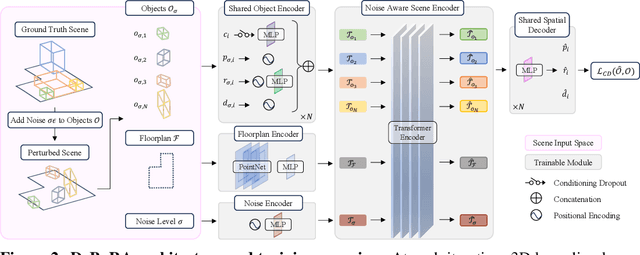
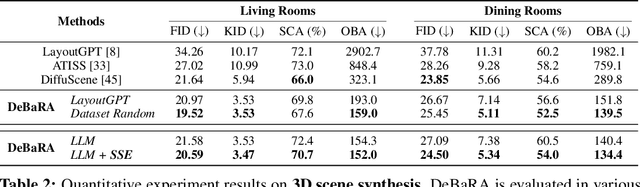
Generating realistic and diverse layouts of furnished indoor 3D scenes unlocks multiple interactive applications impacting a wide range of industries. The inherent complexity of object interactions, the limited amount of available data and the requirement to fulfill spatial constraints all make generative modeling for 3D scene synthesis and arrangement challenging. Current methods address these challenges autoregressively or by using off-the-shelf diffusion objectives by simultaneously predicting all attributes without 3D reasoning considerations. In this paper, we introduce DeBaRA, a score-based model specifically tailored for precise, controllable and flexible arrangement generation in a bounded environment. We argue that the most critical component of a scene synthesis system is to accurately establish the size and position of various objects within a restricted area. Based on this insight, we propose a lightweight conditional score-based model designed with 3D spatial awareness at its core. We demonstrate that by focusing on spatial attributes of objects, a single trained DeBaRA model can be leveraged at test time to perform several downstream applications such as scene synthesis, completion and re-arrangement. Further, we introduce a novel Self Score Evaluation procedure so it can be optimally employed alongside external LLM models. We evaluate our approach through extensive experiments and demonstrate significant improvement upon state-of-the-art approaches in a range of scenarios.