 Add to Chrome
 Add to Firefox
 Add to Edge
Invert4TVG: A Temporal Video Grounding Framework with Inversion Tasks for Enhanced Action Understanding
Aug 10, 2025
Temporal Video Grounding (TVG) seeks to localize video segments matching a given textual query. Current methods, while optimizing for high temporal Intersection-over-Union (IoU), often overfit to this metric, compromising semantic action understanding in the video and query, a critical factor for robust TVG. To address this, we introduce Inversion Tasks for TVG (Invert4TVG), a novel framework that enhances both localization accuracy and action understanding without additional data. Our approach leverages three inversion tasks derived from existing TVG annotations: (1) Verb Completion, predicting masked action verbs in queries from video segments; (2) Action Recognition, identifying query-described actions; and (3) Video Description, generating descriptions of video segments that explicitly embed query-relevant actions. These tasks, integrated with TVG via a reinforcement learning framework with well-designed reward functions, ensure balanced optimization of localization and semantics. Experiments show our method outperforms state-of-the-art approaches, achieving a 7.1\% improvement in R1@0.7 on Charades-STA for a 3B model compared to Time-R1. By inverting TVG to derive query-related actions from segments, our approach strengthens semantic understanding, significantly raising the ceiling of localization accuracy.

A Two-Stage Lightweight Framework for Efficient Land-Air Bimodal Robot Autonomous Navigation
Jul 30, 2025Land-air bimodal robots (LABR) are gaining attention for autonomous navigation, combining high mobility from aerial vehicles with long endurance from ground vehicles. However, existing LABR navigation methods are limited by suboptimal trajectories from mapping-based approaches and the excessive computational demands of learning-based methods. To address this, we propose a two-stage lightweight framework that integrates global key points prediction with local trajectory refinement to generate efficient and reachable trajectories. In the first stage, the Global Key points Prediction Network (GKPN) was used to generate a hybrid land-air keypoint path. The GKPN includes a Sobel Perception Network (SPN) for improved obstacle detection and a Lightweight Attention Planning Network (LAPN) to improves predictive ability by capturing contextual information. In the second stage, the global path is segmented based on predicted key points and refined using a mapping-based planner to create smooth, collision-free trajectories. Experiments conducted on our LABR platform show that our framework reduces network parameters by 14\% and energy consumption during land-air transitions by 35\% compared to existing approaches. The framework achieves real-time navigation without GPU acceleration and enables zero-shot transfer from simulation to reality during
JAM: Keypoint-Guided Joint Prediction after Classification-Aware Marginal Proposal for Multi-Agent Interaction
Jul 23, 2025Predicting the future motion of road participants is a critical task in autonomous driving. In this work, we address the challenge of low-quality generation of low-probability modes in multi-agent joint prediction. To tackle this issue, we propose a two-stage multi-agent interactive prediction framework named \textit{keypoint-guided joint prediction after classification-aware marginal proposal} (JAM). The first stage is modeled as a marginal prediction process, which classifies queries by trajectory type to encourage the model to learn all categories of trajectories, providing comprehensive mode information for the joint prediction module. The second stage is modeled as a joint prediction process, which takes the scene context and the marginal proposals from the first stage as inputs to learn the final joint distribution. We explicitly introduce key waypoints to guide the joint prediction module in better capturing and leveraging the critical information from the initial predicted trajectories. We conduct extensive experiments on the real-world Waymo Open Motion Dataset interactive prediction benchmark. The results show that our approach achieves competitive performance. In particular, in the framework comparison experiments, the proposed JAM outperforms other prediction frameworks and achieves state-of-the-art performance in interactive trajectory prediction. The code is available at https://github.com/LinFunster/JAM to facilitate future research.
Robust Brain Tumor Segmentation with Incomplete MRI Modalities Using Hölder Divergence and Mutual Information-Enhanced Knowledge Transfer
Jul 02, 2025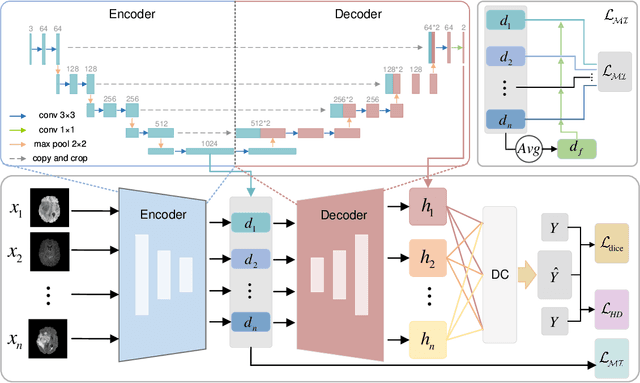
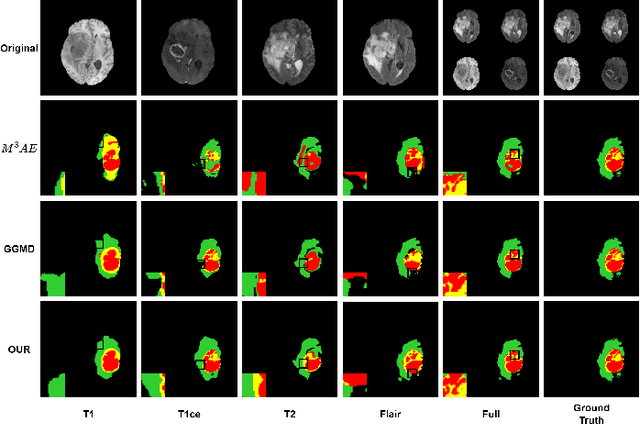
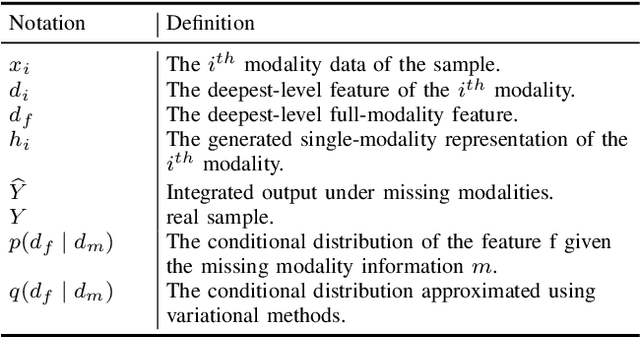
Multimodal MRI provides critical complementary information for accurate brain tumor segmentation. However, conventional methods struggle when certain modalities are missing due to issues such as image quality, protocol inconsistencies, patient allergies, or financial constraints. To address this, we propose a robust single-modality parallel processing framework that achieves high segmentation accuracy even with incomplete modalities. Leveraging Holder divergence and mutual information, our model maintains modality-specific features while dynamically adjusting network parameters based on the available inputs. By using these divergence- and information-based loss functions, the framework effectively quantifies discrepancies between predictions and ground-truth labels, resulting in consistently accurate segmentation. Extensive evaluations on the BraTS 2018 and BraTS 2020 datasets demonstrate superior performance over existing methods in handling missing modalities.
QFFT, Question-Free Fine-Tuning for Adaptive Reasoning
Jun 15, 2025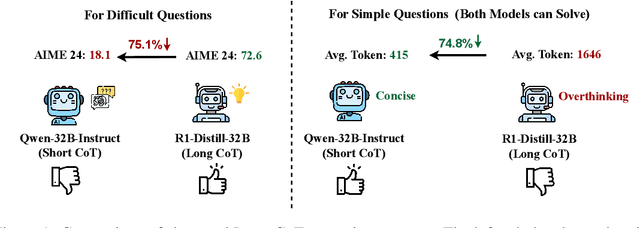
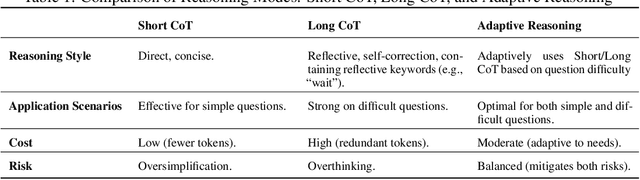
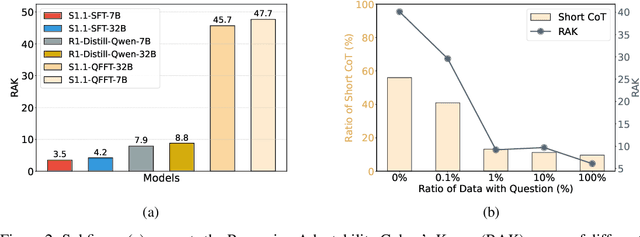
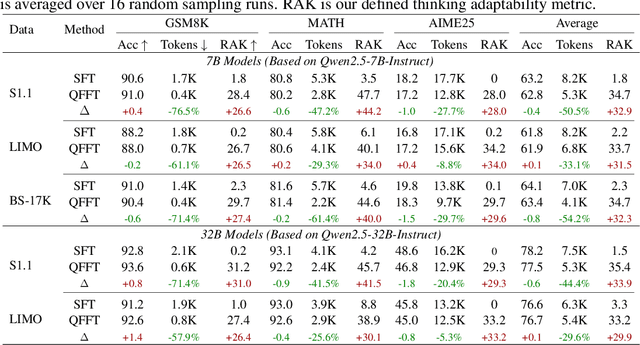
Recent advancements in Long Chain-of-Thought (CoT) reasoning models have improved performance on complex tasks, but they suffer from overthinking, which generates redundant reasoning steps, especially for simple questions. This paper revisits the reasoning patterns of Long and Short CoT models, observing that the Short CoT patterns offer concise reasoning efficiently, while the Long CoT patterns excel in challenging scenarios where the Short CoT patterns struggle. To enable models to leverage both patterns, we propose Question-Free Fine-Tuning (QFFT), a fine-tuning approach that removes the input question during training and learns exclusively from Long CoT responses. This approach enables the model to adaptively employ both reasoning patterns: it prioritizes the Short CoT patterns and activates the Long CoT patterns only when necessary. Experiments on various mathematical datasets demonstrate that QFFT reduces average response length by more than 50\%, while achieving performance comparable to Supervised Fine-Tuning (SFT). Additionally, QFFT exhibits superior performance compared to SFT in noisy, out-of-domain, and low-resource scenarios.
Automatic Robustness Stress Testing of LLMs as Mathematical Problem Solvers
Jun 05, 2025Large language models (LLMs) have achieved distinguished performance on various reasoning-intensive tasks. However, LLMs might still face the challenges of robustness issues and fail unexpectedly in some simple reasoning tasks. Previous works evaluate the LLM robustness with hand-crafted templates or a limited set of perturbation rules, indicating potential data contamination in pre-training or fine-tuning datasets. In this work, inspired by stress testing in software engineering, we propose a novel framework, Automatic Robustness Checker (AR-Checker), to generate mathematical problem variants that maintain the semantic meanings of the original one but might fail the LLMs. The AR-Checker framework generates mathematical problem variants through multi-round parallel streams of LLM-based rewriting and verification. Our framework can generate benchmark variants dynamically for each LLM, thus minimizing the risk of data contamination. Experiments on GSM8K and MATH-500 demonstrate the strong performance of AR-Checker on mathematical tasks. We also evaluate AR-Checker on benchmarks beyond mathematics, including MMLU, MMLU-Pro, and CommonsenseQA, where it also achieves strong performance, further proving the effectiveness of AR-Checker.
RD-UIE: Relation-Driven State Space Modeling for Underwater Image Enhancement
May 02, 2025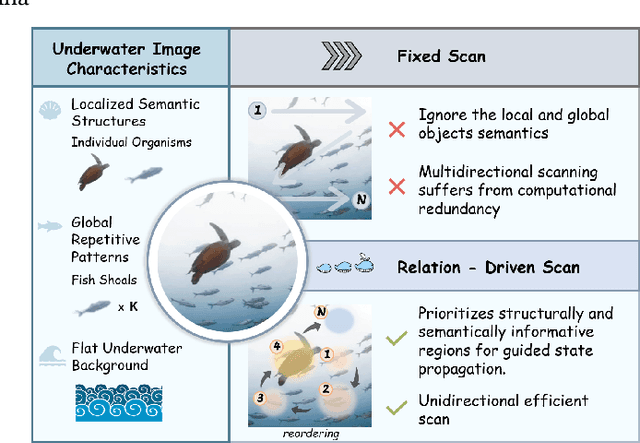
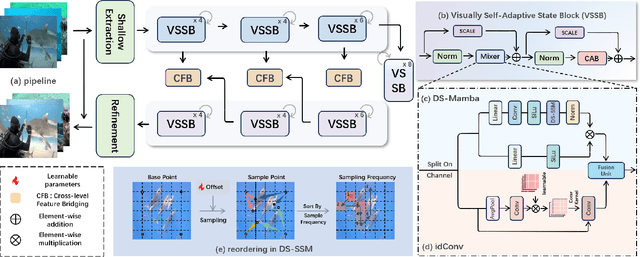
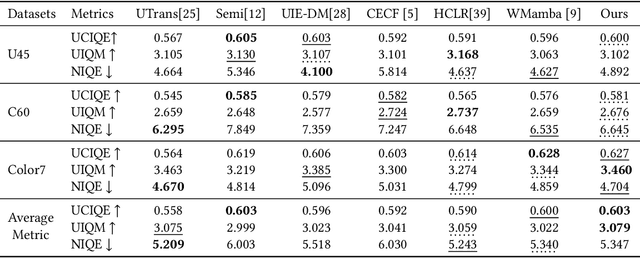
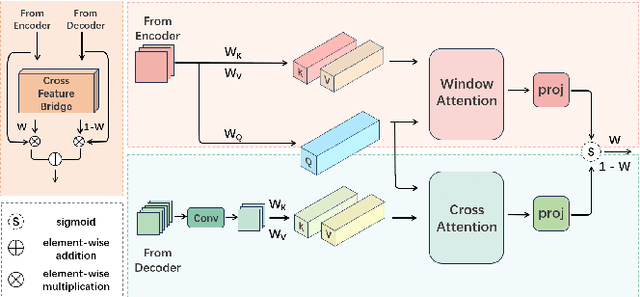
Underwater image enhancement (UIE) is a critical preprocessing step for marine vision applications, where wavelength-dependent attenuation causes severe content degradation and color distortion. While recent state space models like Mamba show potential for long-range dependency modeling, their unfolding operations and fixed scan paths on 1D sequences fail to adapt to local object semantics and global relation modeling, limiting their efficacy in complex underwater environments. To address this, we enhance conventional Mamba with the sorting-based scanning mechanism that dynamically reorders scanning sequences based on statistical distribution of spatial correlation of all pixels. In this way, it encourages the network to prioritize the most informative components--structural and semantic features. Upon building this mechanism, we devise a Visually Self-adaptive State Block (VSSB) that harmonizes dynamic sorting of Mamba with input-dependent dynamic convolution, enabling coherent integration of global context and local relational cues. This exquisite design helps eliminate global focus bias, especially for widely distributed contents, which greatly weakens the statistical frequency. For robust feature extraction and refinement, we design a cross-feature bridge (CFB) to adaptively fuse multi-scale representations. These efforts compose the novel relation-driven Mamba framework for effective UIE (RD-UIE). Extensive experiments on underwater enhancement benchmarks demonstrate RD-UIE outperforms the state-of-the-art approach WMamba in both quantitative metrics and visual fidelity, averagely achieving 0.55 dB performance gain on the three benchmarks. Our code is available at https://github.com/kkoucy/RD-UIE/tree/main
MuseFace: Text-driven Face Editing via Diffusion-based Mask Generation Approach
Mar 31, 2025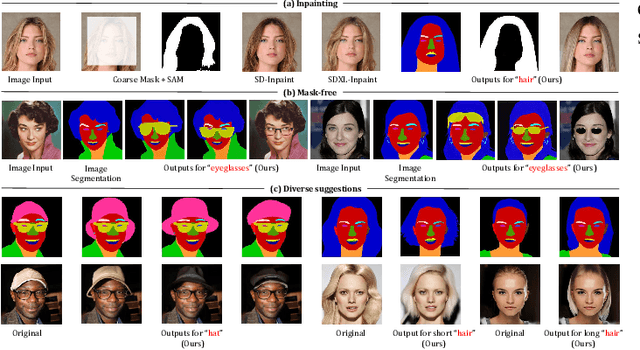
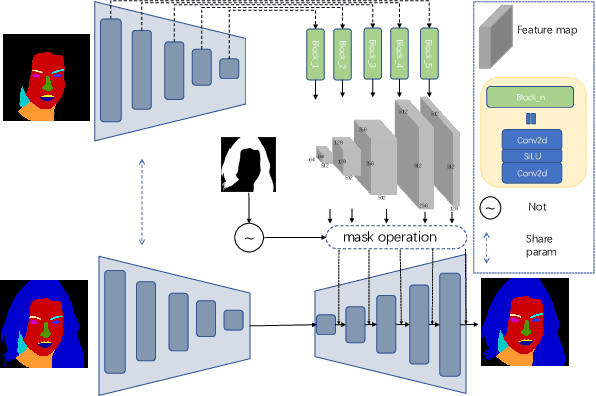
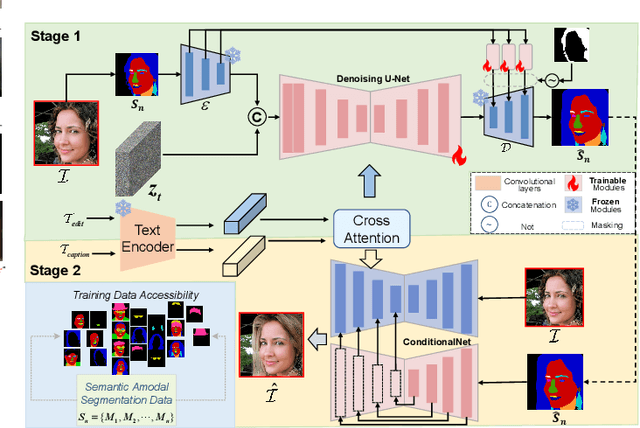
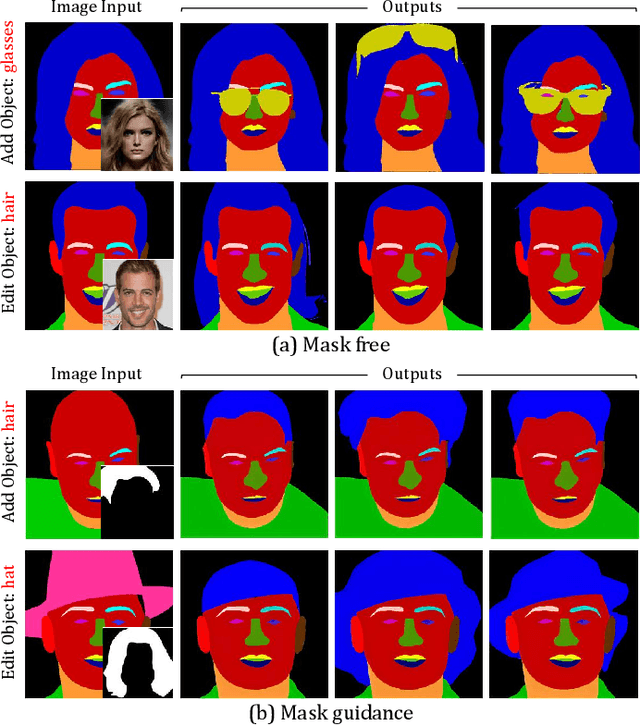
Face editing modifies the appearance of face, which plays a key role in customization and enhancement of personal images. Although much work have achieved remarkable success in text-driven face editing, they still face significant challenges as none of them simultaneously fulfill the characteristics of diversity, controllability and flexibility. To address this challenge, we propose MuseFace, a text-driven face editing framework, which relies solely on text prompt to enable face editing. Specifically, MuseFace integrates a Text-to-Mask diffusion model and a semantic-aware face editing model, capable of directly generating fine-grained semantic masks from text and performing face editing. The Text-to-Mask diffusion model provides \textit{diversity} and \textit{flexibility} to the framework, while the semantic-aware face editing model ensures \textit{controllability} of the framework. Our framework can create fine-grained semantic masks, making precise face editing possible, and significantly enhancing the controllability and flexibility of face editing models. Extensive experiments demonstrate that MuseFace achieves superior high-fidelity performance.
Object Isolated Attention for Consistent Story Visualization
Mar 30, 2025Open-ended story visualization is a challenging task that involves generating coherent image sequences from a given storyline. One of the main difficulties is maintaining character consistency while creating natural and contextually fitting scenes--an area where many existing methods struggle. In this paper, we propose an enhanced Transformer module that uses separate self attention and cross attention mechanisms, leveraging prior knowledge from pre-trained diffusion models to ensure logical scene creation. The isolated self attention mechanism improves character consistency by refining attention maps to reduce focus on irrelevant areas and highlight key features of the same character. Meanwhile, the isolated cross attention mechanism independently processes each character's features, avoiding feature fusion and further strengthening consistency. Notably, our method is training-free, allowing the continuous generation of new characters and storylines without re-tuning. Both qualitative and quantitative evaluations show that our approach outperforms current methods, demonstrating its effectiveness.
UniSync: A Unified Framework for Audio-Visual Synchronization
Mar 20, 2025Precise audio-visual synchronization in speech videos is crucial for content quality and viewer comprehension. Existing methods have made significant strides in addressing this challenge through rule-based approaches and end-to-end learning techniques. However, these methods often rely on limited audio-visual representations and suboptimal learning strategies, potentially constraining their effectiveness in more complex scenarios. To address these limitations, we present UniSync, a novel approach for evaluating audio-visual synchronization using embedding similarities. UniSync offers broad compatibility with various audio representations (e.g., Mel spectrograms, HuBERT) and visual representations (e.g., RGB images, face parsing maps, facial landmarks, 3DMM), effectively handling their significant dimensional differences. We enhance the contrastive learning framework with a margin-based loss component and cross-speaker unsynchronized pairs, improving discriminative capabilities. UniSync outperforms existing methods on standard datasets and demonstrates versatility across diverse audio-visual representations. Its integration into talking face generation frameworks enhances synchronization quality in both natural and AI-generated content.