 Add to Chrome
 Add to Firefox
 Add to Edge
Toward Semantic Communication for Real-time Mobile 3D Reconstruction
Jul 17, 2026
Real-time mobile 3D reconstruction is fundamental to many emerging applications such as autonomous navigation and digital twin construction, where a moving platform continuously captures an image stream and transmit to a computing server for scene understanding. Unlike offline reconstruction, camera poses and scene geometry are estimated on-the-fly during acquisition, making multi-view consistency a real-time requirement and rendering geometric estimation highly sensitive to communication-induced distortions. Semantic communication (SemCom) transmits compact semantic information, offering a promising way to preserve task-critical data over unreliable links. However, existing designs are optimized at the image or single-view level and without providing explicit reliability information for geometric estimation, limiting their applicability to real-time mobile 3D reconstruction. In this context, we propose a SemCom framework for real-time mobile 3D reconstruction. The framework includes a semantic transceiver that outputs a reconstructed image alongside a pixel-wise confidence map, quantifying the reliability of each region. We further introduce a confidence-guided geometric estimation method, incorporating confidence into RANSAC-based pose initialization and bundle adjustment to reduce the influence of unreliable regions and enhance robustness under noisy channels. Simulations show that, compared to existing SemCom and traditional seperate source and channel coding, our framework maintains high image quality while significantly improving pose estimation accuracy and 3D structural consistency.

Clustered Codebook Quantization for 2D Gaussian-based Image Compression
Jul 06, 2026Gaussian-based image representations effectively model image content using compact parametric primitives while preserving high visual fidelity, yet storing a large number of floating-point parameters per primitive degrades rate-distortion efficiency at higher fidelity targets. To improve the rate-distortion performance in Gaussian representation, we present our Cluster-Guided Vector Quantization (CGVQ), a Gaussian primitive based image compression method. Our key idea is to partition Gaussian parameters further into homogeneous groups prior to quantization, enabling higher compression efficiency and accurate parameter reconstruction. In practice, our extensive experiments show that CGVQ decreases the bpp by 20% with respect to our baseline, while maintaining on-par visual quality
A Survey on Semantic Communication for Vision: Categories, Frameworks, Enabling Techniques, and Applications
Jan 29, 2026Semantic communication (SemCom) emerges as a transformative paradigm for traffic-intensive visual data transmission, shifting focus from raw data to meaningful content transmission and relieving the increasing pressure on communication resources. However, to achieve SemCom, challenges are faced in accurate semantic quantization for visual data, robust semantic extraction and reconstruction under diverse tasks and goals, transceiver coordination with effective knowledge utilization, and adaptation to unpredictable wireless communication environments. In this paper, we present a systematic review of SemCom for visual data transmission (SemCom-Vision), wherein an interdisciplinary analysis integrating computer vision (CV) and communication engineering is conducted to provide comprehensive guidelines for the machine learning (ML)-empowered SemCom-Vision design. Specifically, this survey first elucidates the basics and key concepts of SemCom. Then, we introduce a novel classification perspective to categorize existing SemCom-Vision approaches as semantic preservation communication (SPC), semantic expansion communication (SEC), and semantic refinement communication (SRC) based on communication goals interpreted through semantic quantization schemes. Moreover, this survey articulates the ML-based encoder-decoder models and training algorithms for each SemCom-Vision category, followed by knowledge structure and utilization strategies. Finally, we discuss potential SemCom-Vision applications.
Robust Brain Tumor Segmentation with Incomplete MRI Modalities Using Hölder Divergence and Mutual Information-Enhanced Knowledge Transfer
Jul 02, 2025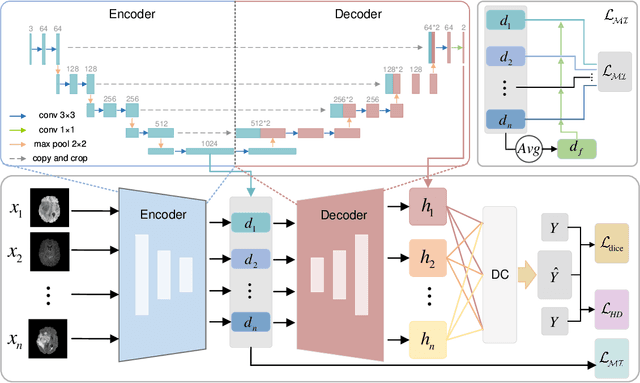
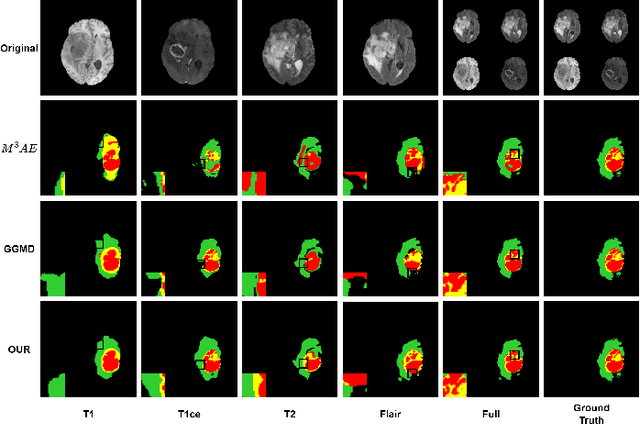
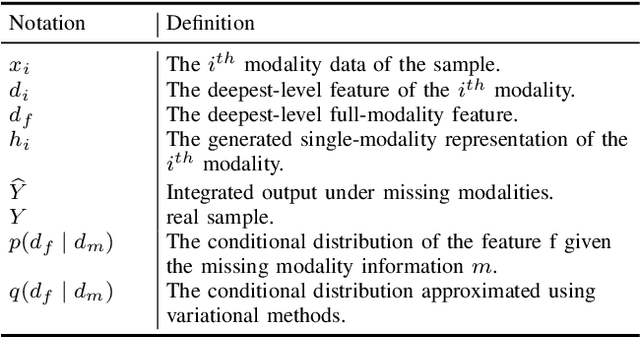
Multimodal MRI provides critical complementary information for accurate brain tumor segmentation. However, conventional methods struggle when certain modalities are missing due to issues such as image quality, protocol inconsistencies, patient allergies, or financial constraints. To address this, we propose a robust single-modality parallel processing framework that achieves high segmentation accuracy even with incomplete modalities. Leveraging Holder divergence and mutual information, our model maintains modality-specific features while dynamically adjusting network parameters based on the available inputs. By using these divergence- and information-based loss functions, the framework effectively quantifies discrepancies between predictions and ground-truth labels, resulting in consistently accurate segmentation. Extensive evaluations on the BraTS 2018 and BraTS 2020 datasets demonstrate superior performance over existing methods in handling missing modalities.
A semantic communication-based workload-adjustable transceiver for wireless AI-generated content (AIGC) delivery
Mar 24, 2025With the significant advances in generative AI (GAI) and the proliferation of mobile devices, providing high-quality AI-generated content (AIGC) services via wireless networks is becoming the future direction. However, the primary challenges of AIGC service delivery in wireless networks lie in unstable channels, limited bandwidth resources, and unevenly distributed computational resources. In this paper, we employ semantic communication (SemCom) in diffusion-based GAI models to propose a Resource-aware wOrkload-adjUstable TransceivEr (ROUTE) for AIGC delivery in dynamic wireless networks. Specifically, to relieve the communication resource bottleneck, SemCom is utilized to prioritize semantic information of the generated content. Then, to improve computational resource utilization in both edge and local and reduce AIGC semantic distortion in transmission, modified diffusion-based models are applied to adjust the computing workload and semantic density in cooperative content generation. Simulations verify the superiority of our proposed ROUTE in terms of latency and content quality compared to conventional AIGC approaches.
Robust Divergence Learning for Missing-Modality Segmentation
Nov 13, 2024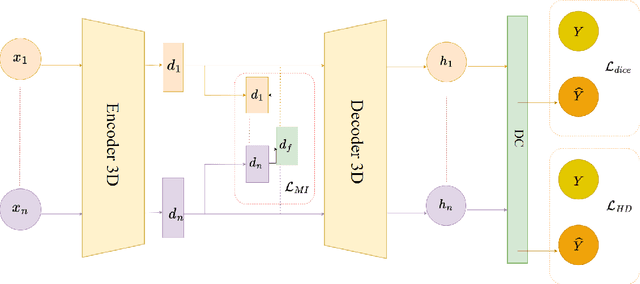

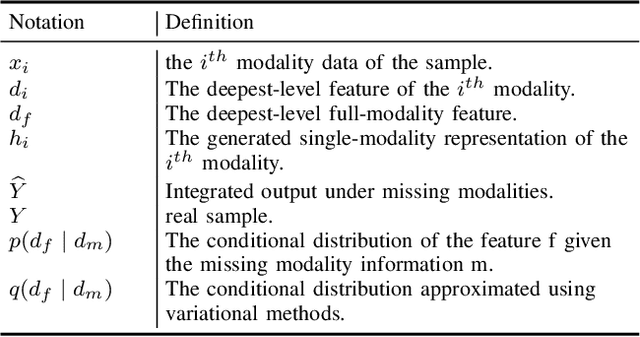

Multimodal Magnetic Resonance Imaging (MRI) provides essential complementary information for analyzing brain tumor subregions. While methods using four common MRI modalities for automatic segmentation have shown success, they often face challenges with missing modalities due to image quality issues, inconsistent protocols, allergic reactions, or cost factors. Thus, developing a segmentation paradigm that handles missing modalities is clinically valuable. A novel single-modality parallel processing network framework based on H\"older divergence and mutual information is introduced. Each modality is independently input into a shared network backbone for parallel processing, preserving unique information. Additionally, a dynamic sharing framework is introduced that adjusts network parameters based on modality availability. A H\"older divergence and mutual information-based loss functions are used for evaluating discrepancies between predictions and labels. Extensive testing on the BraTS 2018 and BraTS 2020 datasets demonstrates that our method outperforms existing techniques in handling missing modalities and validates each component's effectiveness.
A Wireless AI-Generated Content (AIGC) Provisioning Framework Empowered by Semantic Communication
Oct 26, 2023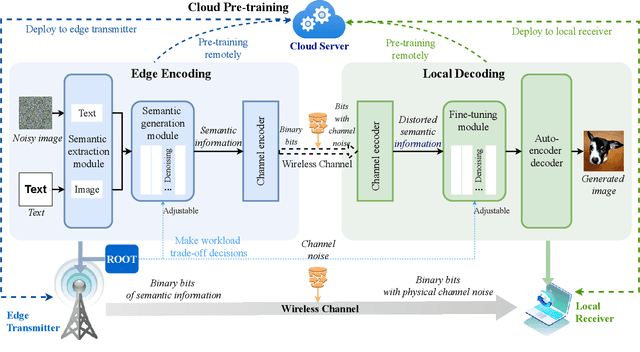
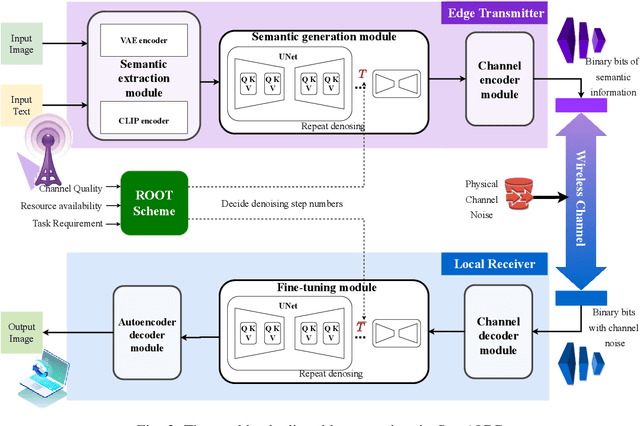
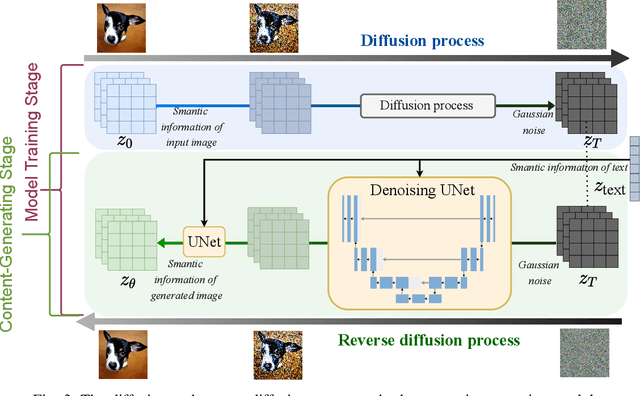
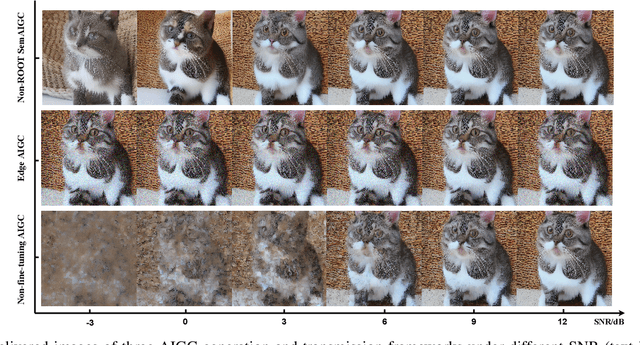
Generative AI applications are recently catering to a vast user base by creating diverse and high-quality AI-generated content (AIGC). With the proliferation of mobile devices and rapid growth of mobile traffic, providing ubiquitous access to high-quality AIGC services via wireless communication networks is becoming the future direction for AIGC products. However, it is challenging to provide optimal AIGC services in wireless networks with unstable channels, limited bandwidth resources, and unevenly distributed computational resources. To tackle these challenges, we propose a semantic communication (SemCom)-empowered AIGC (SemAIGC) generation and transmission framework, where only semantic information of the content rather than all the binary bits should be extracted and transmitted by using SemCom. Specifically, SemAIGC integrates diffusion-based models within the semantic encoder and decoder for efficient content generation and flexible adjustment of the computing workload of both transmitter and receiver. Meanwhile, we devise a resource-aware workload trade-off (ROOT) scheme into the SemAIGC framework to intelligently decide transmitter/receiver workload, thus adjusting the utilization of computational resource according to service requirements. Simulations verify the superiority of our proposed SemAIGC framework in terms of latency and content quality compared to conventional approaches.
WiserVR: Semantic Communication Enabled Wireless Virtual Reality Delivery
Nov 02, 2022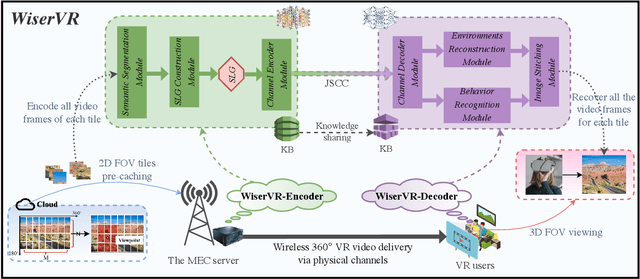
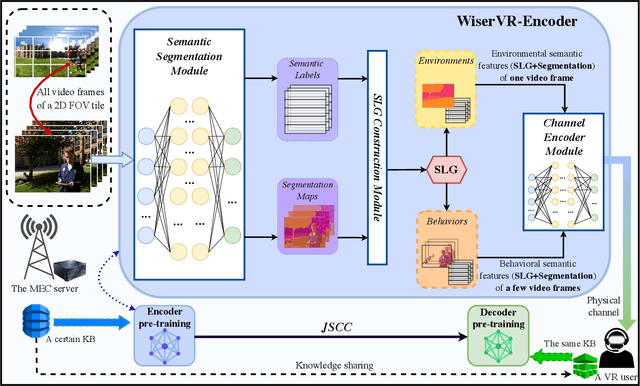
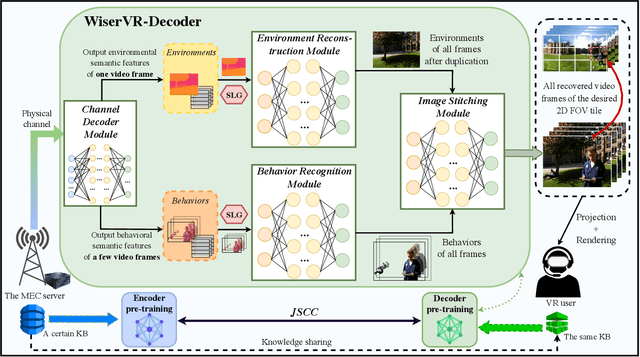
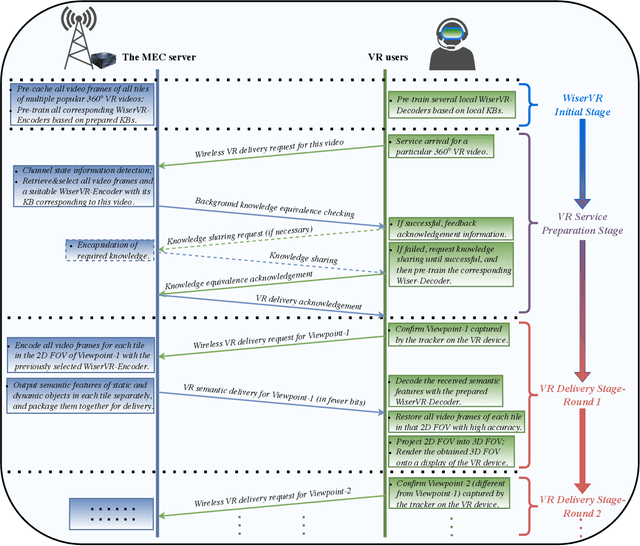
Virtual reality (VR) over wireless is expected to be one of the killer applications in next-generation communication networks. Nevertheless, the huge data volume along with stringent requirements on latency and reliability under limited bandwidth resources makes untethered wireless VR delivery increasingly challenging. Such bottlenecks, therefore, motivate this work to seek the potential of using semantic communication, a new paradigm that promises to significantly ease the resource pressure, for efficient VR delivery. To this end, we propose a novel framework, namely WIreless SEmantic deliveRy for VR (WiserVR), for delivering consecutive 360{\deg} video frames to VR users. Specifically, deep learning-based multiple modules are well-devised for the transceiver in WiserVR to realize high-performance feature extraction and semantic recovery. Among them, we dedicatedly develop a concept of semantic location graph and leverage the joint-semantic-channel-coding method with knowledge sharing to not only substantially reduce communication latency, but also to guarantee adequate transmission reliability and resilience under various channel states. Moreover, implementation of WiserVR is presented, followed by corresponding initial simulations for performance evaluation compared with benchmarks. Finally, we discuss several open issues and offer feasible solutions to unlock the full potential of WiserVR.