 Add to Chrome
 Add to Firefox
 Add to Edge
TR-GS: High-Fidelity Sparse-View CT Volumetric Rendering via t-Distribution Gaussian Splatting and Ray-Confidence Modeling
Aug 17, 2026
High-fidelity 3D medical visualization supports applications such as clinical assessment and surgical planning. Sparse-view computed tomography (CT) can reduce projection requirements and associated radiation exposure, but limited observations may introduce structural artifacts and reconstruction uncertainty. Although 3D Gaussian Splatting (3DGS) provides an efficient explicit representation for volumetric rendering, existing CT methods based on standard Gaussian primitives may be sensitive to unreliable observations under sparse-view acquisition. We present TR-GS, a Gaussian-splatting framework for sparse view CT volumetric rendering. TR-GS replaces standard Gaussian primitives with projectable Student's t-distribution primitives and introduces a ray-confidence model that regulates their degrees of freedom according to local ray observability. Confidence-guided 3D wavelet regularization is further used to balance high-frequency detail preservation and noise suppression. This work is licensed under a Creative Commons Attribution 4.0 International License. Experiments on synthetic and real-world datasets show that TR-GS improves over representative baselines in most evaluated settings and remains competitive in the remaining cases. The resulting volumetric representations may support downstream medical multimedia applications, including XR-based visualization and interactive clinical rendering.

GSTurb: Gaussian Splatting for Atmospheric Turbulence Mitigation
Feb 26, 2026Atmospheric turbulence causes significant image degradation due to pixel displacement (tilt) and blur, particularly in long-range imaging applications. In this paper, we propose a novel framework for atmospheric turbulence mitigation, GSTurb, which integrates optical flow-guided tilt correction and Gaussian splatting for modeling non-isoplanatic blur. The framework employs Gaussian parameters to represent tilt and blur, and optimizes them across multiple frames to enhance restoration. Experimental results on the ATSyn-static dataset demonstrate the effectiveness of our method, achieving a peak PSNR of 27.67 dB and SSIM of 0.8735. Compared to the state-of-the-art method, GSTurb improves PSNR by 1.3 dB (a 4.5% increase) and SSIM by 0.048 (a 5.8% increase). Additionally, on real datasets, including the TSRWGAN Real-World and CLEAR datasets, GSTurb outperforms existing methods, showing significant improvements in both qualitative and quantitative performance. These results highlight that combining optical flow-guided tilt correction with Gaussian splatting effectively enhances image restoration under both synthetic and real-world turbulence conditions. The code for this method will be available at https://github.com/DuhlLiamz/3DGS_turbulence/tree/main.
A Two-Stage Lightweight Framework for Efficient Land-Air Bimodal Robot Autonomous Navigation
Jul 30, 2025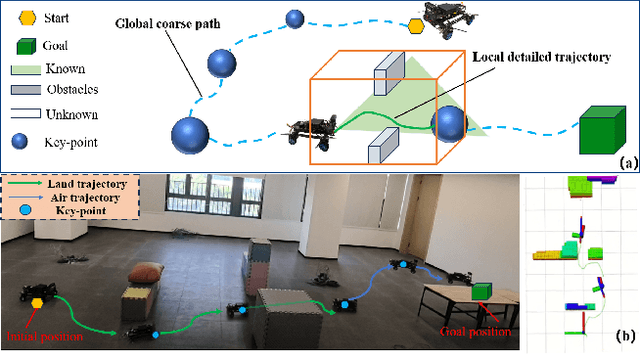
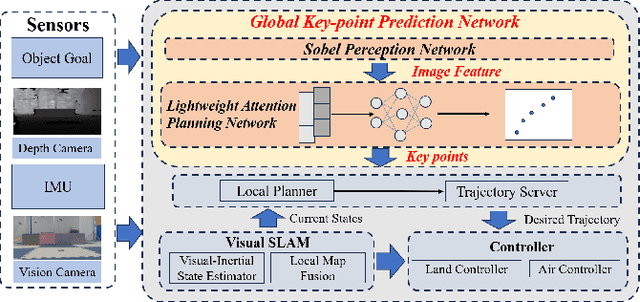
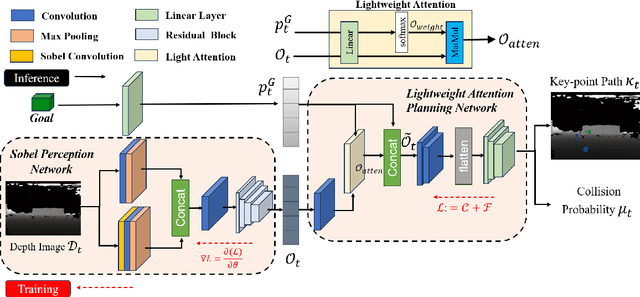
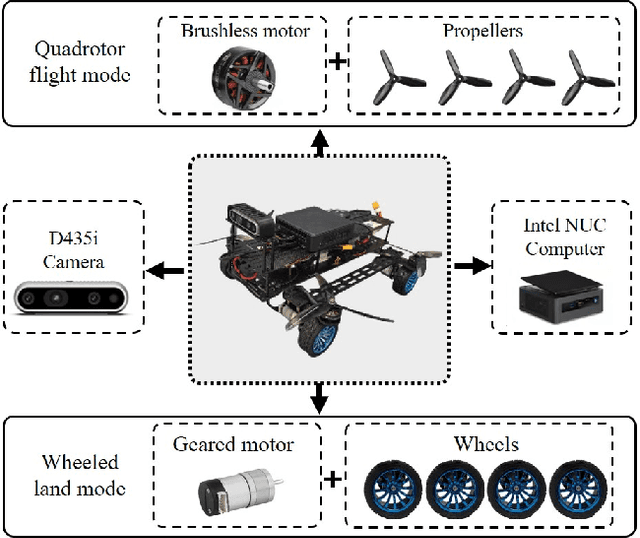
Land-air bimodal robots (LABR) are gaining attention for autonomous navigation, combining high mobility from aerial vehicles with long endurance from ground vehicles. However, existing LABR navigation methods are limited by suboptimal trajectories from mapping-based approaches and the excessive computational demands of learning-based methods. To address this, we propose a two-stage lightweight framework that integrates global key points prediction with local trajectory refinement to generate efficient and reachable trajectories. In the first stage, the Global Key points Prediction Network (GKPN) was used to generate a hybrid land-air keypoint path. The GKPN includes a Sobel Perception Network (SPN) for improved obstacle detection and a Lightweight Attention Planning Network (LAPN) to improves predictive ability by capturing contextual information. In the second stage, the global path is segmented based on predicted key points and refined using a mapping-based planner to create smooth, collision-free trajectories. Experiments conducted on our LABR platform show that our framework reduces network parameters by 14\% and energy consumption during land-air transitions by 35\% compared to existing approaches. The framework achieves real-time navigation without GPU acceleration and enables zero-shot transfer from simulation to reality during