 Add to Chrome
 Add to Firefox
 Add to Edge
Merging LoRAs like Playing LEGO: Pushing the Modularity of LoRA to Extremes Through Rank-Wise Clustering
Sep 24, 2024
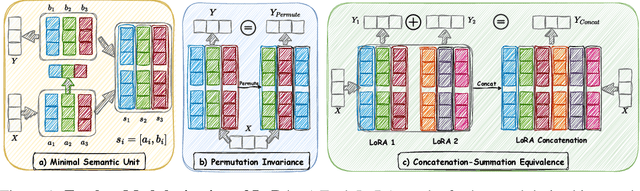
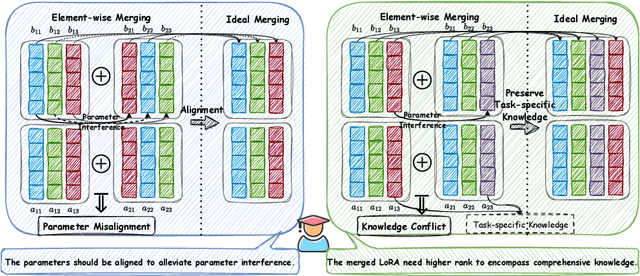
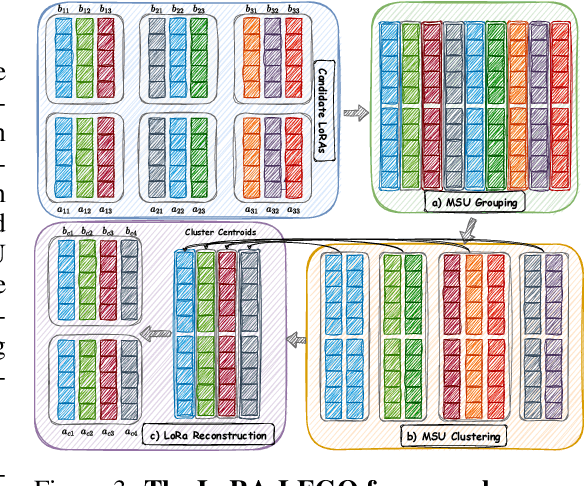
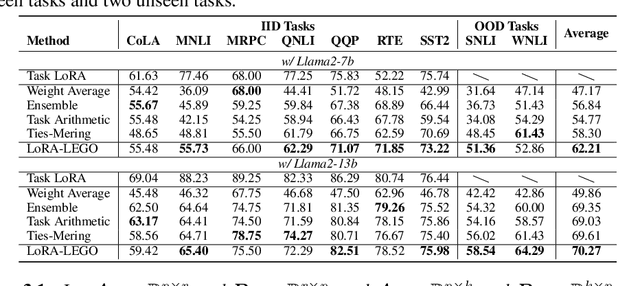
Low-Rank Adaptation (LoRA) has emerged as a popular technique for fine-tuning large language models (LLMs) to various domains due to its modular design and widespread availability on platforms like Huggingface. This modularity has sparked interest in combining multiple LoRAs to enhance LLM capabilities. However, existing methods for LoRA composition primarily focus on task-specific adaptations that require additional training, and current model merging techniques often fail to fully leverage LoRA's modular nature, leading to parameter interference and performance degradation. In this paper, we investigate the feasibility of disassembling and reassembling multiple LoRAs at a finer granularity, analogous to assembling LEGO blocks. We introduce the concept of Minimal Semantic Units (MSUs), where the parameters corresponding to each rank in LoRA function as independent units. These MSUs demonstrate permutation invariance and concatenation-summation equivalence properties, enabling flexible combinations to create new LoRAs. Building on these insights, we propose the LoRA-LEGO framework. This framework conducts rank-wise parameter clustering by grouping MSUs from different LoRAs into $k$ clusters. The centroid of each cluster serves as a representative MSU, enabling the assembly of a merged LoRA with an adjusted rank of $k$. Additionally, we apply a dual reweighting strategy to optimize the scale of the merged LoRA. Experiments across various benchmarks demonstrate that our method outperforms existing approaches in LoRA merging.

STCMOT: Spatio-Temporal Cohesion Learning for UAV-Based Multiple Object Tracking
Sep 17, 2024


Multiple object tracking (MOT) in Unmanned Aerial Vehicle (UAV) videos is important for diverse applications in computer vision. Current MOT trackers rely on accurate object detection results and precise matching of target reidentification (ReID). These methods focus on optimizing target spatial attributes while overlooking temporal cues in modelling object relationships, especially for challenging tracking conditions such as object deformation and blurring, etc. To address the above-mentioned issues, we propose a novel Spatio-Temporal Cohesion Multiple Object Tracking framework (STCMOT), which utilizes historical embedding features to model the representation of ReID and detection features in a sequential order. Concretely, a temporal embedding boosting module is introduced to enhance the discriminability of individual embedding based on adjacent frame cooperation. While the trajectory embedding is then propagated by a temporal detection refinement module to mine salient target locations in the temporal field. Extensive experiments on the VisDrone2019 and UAVDT datasets demonstrate our STCMOT sets a new state-of-the-art performance in MOTA and IDF1 metrics. The source codes are released at https://github.com/ydhcg-BoBo/STCMOT.
RexUniNLU: Recursive Method with Explicit Schema Instructor for Universal NLU
Sep 09, 2024


Information Extraction (IE) and Text Classification (CLS) serve as the fundamental pillars of NLU, with both disciplines relying on analyzing input sequences to categorize outputs into pre-established schemas. However, there is no existing encoder-based model that can unify IE and CLS tasks from this perspective. To fully explore the foundation shared within NLU tasks, we have proposed a Recursive Method with Explicit Schema Instructor for Universal NLU. Specifically, we firstly redefine the true universal information extraction (UIE) with a formal formulation that covers almost all extraction schemas, including quadruples and quintuples which remain unsolved for previous UIE models. Then, we expands the formulation to all CLS and multi-modal NLU tasks. Based on that, we introduce RexUniNLU, an universal NLU solution that employs explicit schema constraints for IE and CLS, which encompasses all IE and CLS tasks and prevent incorrect connections between schema and input sequence. To avoid interference between different schemas, we reset the position ids and attention mask matrices. Extensive experiments are conducted on IE, CLS in both English and Chinese, and multi-modality, revealing the effectiveness and superiority. Our codes are publicly released.
Zero-Shot Paragraph-level Handwriting Imitation with Latent Diffusion Models
Sep 01, 2024
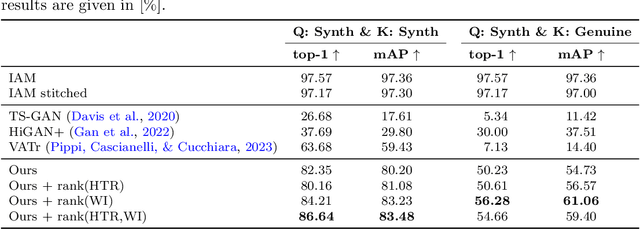

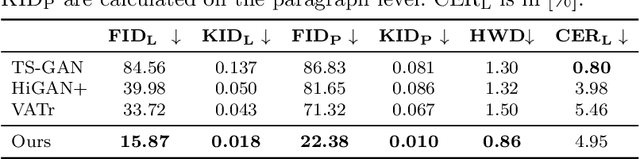
The imitation of cursive handwriting is mainly limited to generating handwritten words or lines. Multiple synthetic outputs must be stitched together to create paragraphs or whole pages, whereby consistency and layout information are lost. To close this gap, we propose a method for imitating handwriting at the paragraph level that also works for unseen writing styles. Therefore, we introduce a modified latent diffusion model that enriches the encoder-decoder mechanism with specialized loss functions that explicitly preserve the style and content. We enhance the attention mechanism of the diffusion model with adaptive 2D positional encoding and the conditioning mechanism to work with two modalities simultaneously: a style image and the target text. This significantly improves the realism of the generated handwriting. Our approach sets a new benchmark in our comprehensive evaluation. It outperforms all existing imitation methods at both line and paragraph levels, considering combined style and content preservation.
Semantic Alignment for Multimodal Large Language Models
Aug 23, 2024


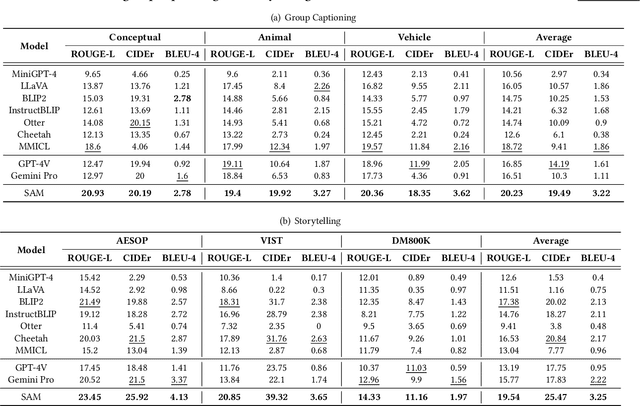
Research on Multi-modal Large Language Models (MLLMs) towards the multi-image cross-modal instruction has received increasing attention and made significant progress, particularly in scenarios involving closely resembling images (e.g., change captioning). Existing MLLMs typically follow a two-step process in their pipelines: first, extracting visual tokens independently for each input image, and then aligning these visual tokens from different images with the Large Language Model (LLM) in its textual feature space. However, the independent extraction of visual tokens for each image may result in different semantics being prioritized for different images in the first step, leading to a lack of preservation of linking information among images for subsequent LLM analysis. This issue becomes more serious in scenarios where significant variations exist among the images (e.g., visual storytelling). To address this challenge, we introduce Semantic Alignment for Multi-modal large language models (SAM). By involving the bidirectional semantic guidance between different images in the visual-token extraction process, SAM aims to enhance the preservation of linking information for coherent analysis and align the semantics of different images before feeding them into LLM. As the test bed, we propose a large-scale dataset named MmLINK consisting of 69K samples. Different from most existing datasets for MLLMs fine-tuning, our MmLINK dataset comprises multi-modal instructions with significantly diverse images. Extensive experiments on the group captioning task and the storytelling task prove the effectiveness of our SAM model, surpassing the state-of-the-art methods by a large margin (+37% for group captioning and +22% for storytelling on CIDEr score). Project page: https://mccartney01.github.io/SAM.
Causal Agent based on Large Language Model
Aug 13, 2024Large language models (LLMs) have achieved significant success across various domains. However, the inherent complexity of causal problems and causal theory poses challenges in accurately describing them in natural language, making it difficult for LLMs to comprehend and use them effectively. Causal methods are not easily conveyed through natural language, which hinders LLMs' ability to apply them accurately. Additionally, causal datasets are typically tabular, while LLMs excel in handling natural language data, creating a structural mismatch that impedes effective reasoning with tabular data. This lack of causal reasoning capability limits the development of LLMs. To address these challenges, we have equipped the LLM with causal tools within an agent framework, named the Causal Agent, enabling it to tackle causal problems. The causal agent comprises tools, memory, and reasoning modules. In the tools module, the causal agent applies causal methods to align tabular data with natural language. In the reasoning module, the causal agent employs the ReAct framework to perform reasoning through multiple iterations with the tools. In the memory module, the causal agent maintains a dictionary instance where the keys are unique names and the values are causal graphs. To verify the causal ability of the causal agent, we established a benchmark consisting of four levels of causal problems: variable level, edge level, causal graph level, and causal effect level. We generated a test dataset of 1.3K using ChatGPT-3.5 for these four levels of issues and tested the causal agent on the datasets. Our methodology demonstrates remarkable efficacy on the four-level causal problems, with accuracy rates all above 80%. For further insights and implementation details, our code is accessible via the GitHub repository https://github.com/Kairong-Han/Causal_Agent.
Generalized Encouragement-Based Instrumental Variables for Counterfactual Regression
Aug 10, 2024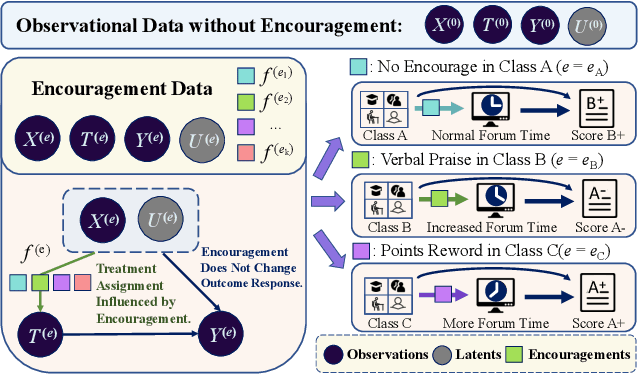
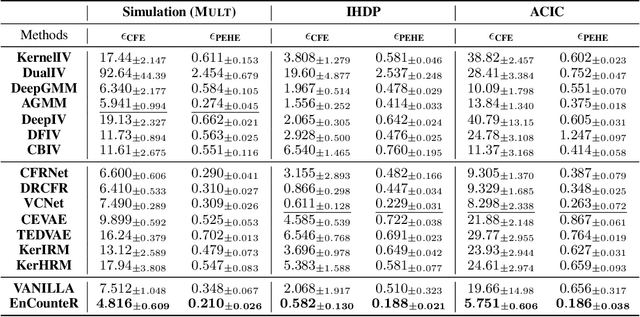
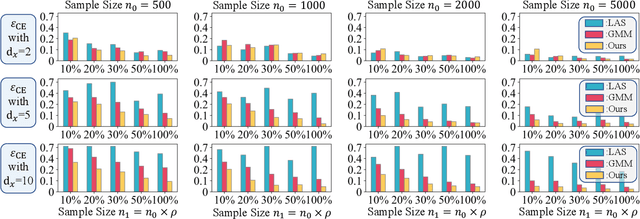
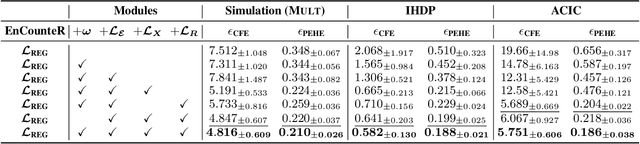
In causal inference, encouragement designs (EDs) are widely used to analyze causal effects, when randomized controlled trials (RCTs) are impractical or compliance to treatment cannot be perfectly enforced. Unlike RCTs, which directly allocate treatments, EDs randomly assign encouragement policies that positively motivate individuals to engage in a specific treatment. These random encouragements act as instrumental variables (IVs), facilitating the identification of causal effects through leveraging exogenous perturbations in discrete treatment scenarios. However, real-world applications of encouragement designs often face challenges such as incomplete randomization, limited experimental data, and significantly fewer encouragements compared to treatments, hindering precise causal effect estimation. To address this, this paper introduces novel theories and algorithms for identifying the Conditional Average Treatment Effect (CATE) using variations in encouragement. Further, by leveraging both observational and encouragement data, we propose a generalized IV estimator, named Encouragement-based Counterfactual Regression (EnCounteR), to effectively estimate the causal effects. Extensive experiments on both synthetic and real-world datasets demonstrate the superiority of EnCounteR over existing methods.
Semantic Codebook Learning for Dynamic Recommendation Models
Jul 31, 2024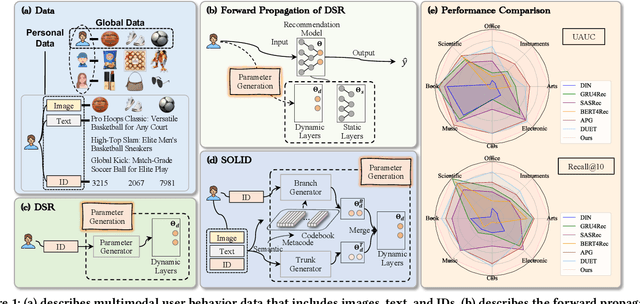
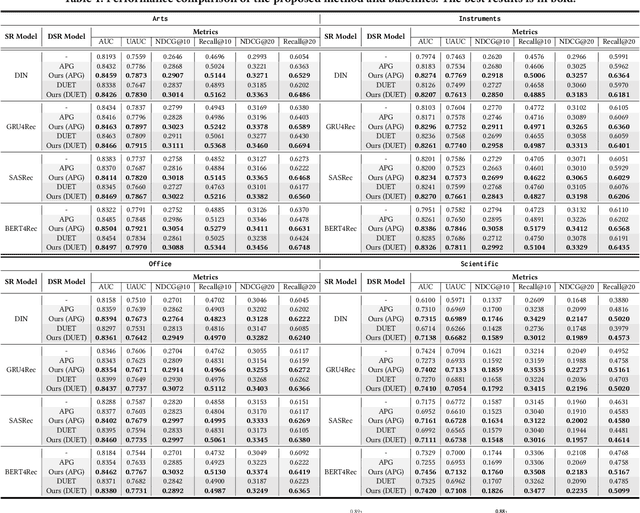
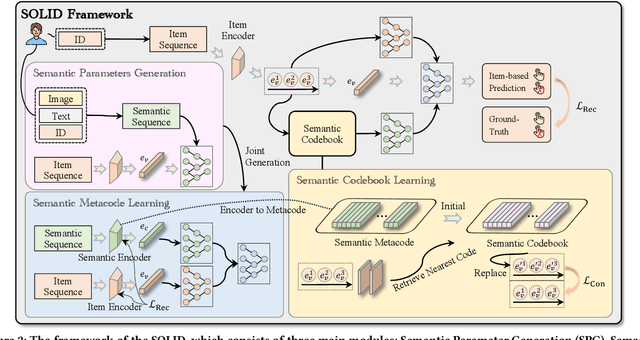
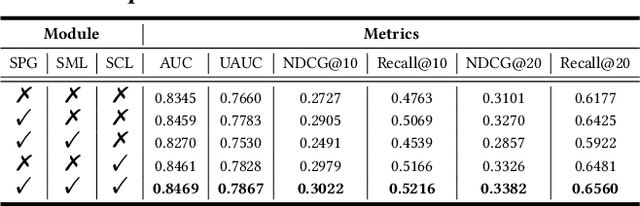
Dynamic sequential recommendation (DSR) can generate model parameters based on user behavior to improve the personalization of sequential recommendation under various user preferences. However, it faces the challenges of large parameter search space and sparse and noisy user-item interactions, which reduces the applicability of the generated model parameters. The Semantic Codebook Learning for Dynamic Recommendation Models (SOLID) framework presents a significant advancement in DSR by effectively tackling these challenges. By transforming item sequences into semantic sequences and employing a dual parameter model, SOLID compresses the parameter generation search space and leverages homogeneity within the recommendation system. The introduction of the semantic metacode and semantic codebook, which stores disentangled item representations, ensures robust and accurate parameter generation. Extensive experiments demonstrates that SOLID consistently outperforms existing DSR, delivering more accurate, stable, and robust recommendations.
Knowledge Fused Recognition: Fusing Hierarchical Knowledge for Image Recognition through Quantitative Relativity Modeling and Deep Metric Learning
Jul 30, 2024Image recognition is an essential baseline for deep metric learning. Hierarchical knowledge about image classes depicts inter-class similarities or dissimilarities. Effective fusion of hierarchical knowledge about image classes to enhance image recognition remains a challenging topic to advance. In this paper, we propose a novel deep metric learning based method to effectively fuse hierarchical prior knowledge about image classes and enhance image recognition performances in an end-to-end supervised regression manner. Existing deep metric learning incorporated image classification mainly exploits qualitative relativity between image classes, i.e., whether sampled images are from the same class. A new triplet loss function term that exploits quantitative relativity and aligns distances in model latent space with those in knowledge space is also proposed and incorporated in the proposed dual-modality fusion method. Experimental results indicate that the proposed method enhanced image recognition performances and outperformed baseline and existing methods on CIFAR-10, CIFAR-100, Mini-ImageNet, and ImageNet-1K datasets.
APE: Active Learning-based Tooling for Finding Informative Few-shot Examples for LLM-based Entity Matching
Jul 29, 2024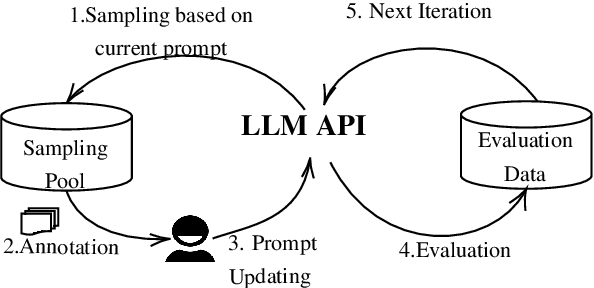
Prompt engineering is an iterative procedure often requiring extensive manual effort to formulate suitable instructions for effectively directing large language models (LLMs) in specific tasks. Incorporating few-shot examples is a vital and effective approach to providing LLMs with precise instructions, leading to improved LLM performance. Nonetheless, identifying the most informative demonstrations for LLMs is labor-intensive, frequently entailing sifting through an extensive search space. In this demonstration, we showcase a human-in-the-loop tool called APE (Active Prompt Engineering) designed for refining prompts through active learning. Drawing inspiration from active learning, APE iteratively selects the most ambiguous examples for human feedback, which will be transformed into few-shot examples within the prompt. The demo recording can be found with the submission or be viewed at https://youtu.be/OwQ6MQx53-Y.