 Add to Chrome
 Add to Firefox
 Add to Edge
Beyond Heuristic Tuning: Power-Calibrated LLM Watermarking
Jul 06, 2026
Logit-based watermarking is a widely used mechanism for identifying LLM generated content, yet its effectiveness is governed by a fundamental trade-off between detectability and semantic distortion. Existing analyses provide limited guidance for principled hyperparameter selection, leaving practical deployments reliant on heuristic tuning. In this work, we develop a power-calibrated statistical framework that establishes explicit quantitative relationships between watermark hyperparameters, detection power, and distortion. This characterization transforms watermark design into a guided optimization problem. Building on these results, we derive practical parameter selection procedures that achieve optimal tradeoffs under constraints. Extensive experiments across multiple language models and datasets validate the theory and demonstrate that the proposed framework consistently identifies Pareto-optimal points.

When Should Service Agents Reconsider? Difficulty-Routed Control in Customer-Service Operations
Jul 01, 2026Autonomous customer-service agents are shifting from conversational interfaces toward operational execution roles: they retrieve firm records, apply service policies, and execute backend writes such as refunds, cancellations, exchanges, order modifications, and reservation changes. This shift creates a service-control problem: firms must keep routine service fast and low-friction while preventing operational errors on requests where customer instructions, policy constraints, firm records, and backend writes interact. We propose a difficulty-routed service-control architecture that asks when service agents should reconsider before acting. A lightweight router keeps routine sessions on a low-cost baseline path and routes operationally coupled sessions to an escalated workflow. The escalated path uses conflict-aware communication and write-triggered reconsideration to concentrate deliberation and safeguards before consequential backend writes, rather than applying additional control uniformly across all service sessions. We evaluate the architecture on human-verified retail and airline tasks from $τ^{2}$-bench. In retail, the method improves reliability consistently on service requests with operational conflict. Routing evidence shows that stronger control is directed toward conflicted requests rather than broadly applied to routine ones. Dialogue and tool-use profiles suggest that gains do not come from indiscriminate interaction expansion or broader tool chains; instead, added turns and tool calls support evidence gathering, write separation, and pre-write reconsideration. Case-level evidence shows that the escalated workflow preserves fallback plans, binds retrieved records to the correct action, sequences writes, and decomposes multi-entity requests. Airline results extend the same service-control logic to reservation operations.
Primary ICD Category Prediction using LLM-based Probing
Jun 27, 2026Objective: ICD codes are central to reimbursement, research, and population health surveillance, yet automated coding systems often struggle to integrate diagnostic signals from both clinical narratives and structured electronic health record (EHR) variables. We evaluated whether frozen medical large language model (LLM) representations can serve as a shared embedding space for multimodal primary diagnosis category prediction. Materials and Methods: We constructed a MIMIC-IV cohort of 13,645 admissions from the 10 most frequent primary ICD-10 codes, consolidated into seven categories. Structured variables were serialized into clinical narratives and combined with leakage-pruned discharge notes. Using a frozen MedFound-Llama3-8B-finetuned backbone, we extracted hidden states from five transformer layers and trained linear probes for structured-only, unstructured-only, and combined inputs, comparing against XGBoost and information-matched PLM-ICD baselines and evaluating MIMIC-III adaptation with a compact bottleneck adapter. Results: The combined probe performed best on MIMIC-IV (87.69% strict; 91.45% medical accuracy), exceeding both single-modality probes and baselines. The structured-only probe outperformed its standard baseline by 6.19 points in medical accuracy. Diagnostic information became increasingly linearly separable in deeper layers, and a 2M-parameter adapter restored cross-dataset transfer to MIMIC-III using only 5% of target labels. Discussion: LLM embeddings can unify structured and narrative EHR information for multimodal diagnosis prediction, supporting efficient reuse of clinical representations across modalities and datasets through a small representation-level module. Conclusion: Multimodal probing of frozen medical LLM representations provides a practical approach for studying EHR modalities and adapting clinical representations across datasets.
P2S: Probabilistic Process Supervision for General-Domain Reasoning Question Answering
Jan 28, 2026While reinforcement learning with verifiable rewards (RLVR) has advanced LLM reasoning in structured domains like mathematics and programming, its application to general-domain reasoning tasks remains challenging due to the absence of verifiable reward signals. To this end, methods like Reinforcement Learning with Reference Probability Reward (RLPR) have emerged, leveraging the probability of generating the final answer as a reward signal. However, these outcome-focused approaches neglect crucial step-by-step supervision of the reasoning process itself. To address this gap, we introduce Probabilistic Process Supervision (P2S), a novel self-supervision framework that provides fine-grained process rewards without requiring a separate reward model or human-annotated reasoning steps. During reinforcement learning, P2S synthesizes and filters a high-quality reference reasoning chain (gold-CoT). The core of our method is to calculate a Path Faithfulness Reward (PFR) for each reasoning step, which is derived from the conditional probability of generating the gold-CoT's suffix, given the model's current reasoning prefix. Crucially, this PFR can be flexibly integrated with any outcome-based reward, directly tackling the reward sparsity problem by providing dense guidance. Extensive experiments on reading comprehension and medical Question Answering benchmarks show that P2S significantly outperforms strong baselines.
Towards Stepwise Domain Knowledge-Driven Reasoning Optimization and Reflection Improvement
Apr 12, 2025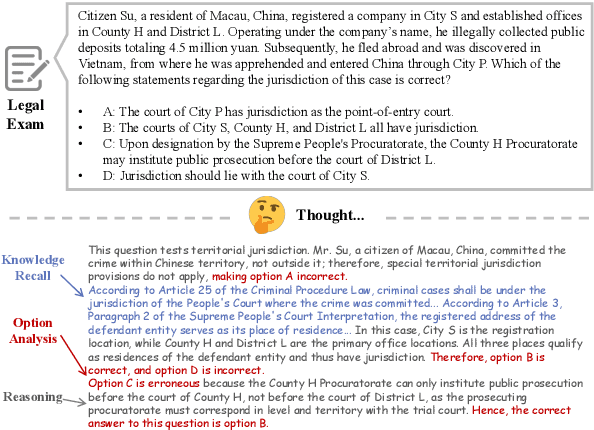
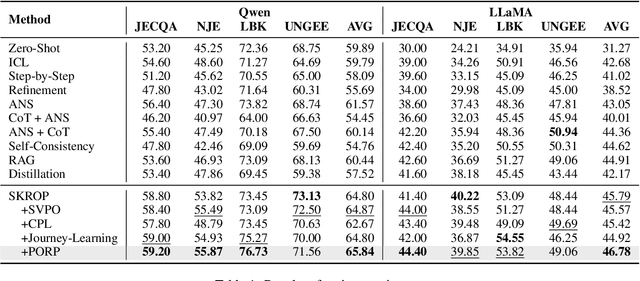
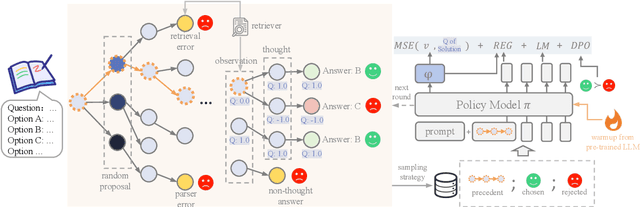
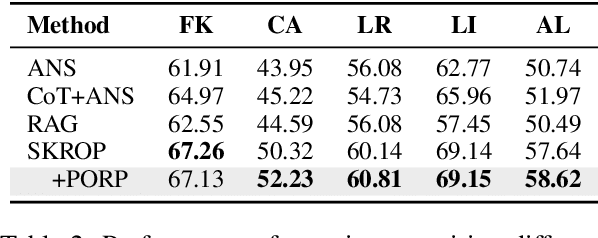
Recently, stepwise supervision on Chain of Thoughts (CoTs) presents an enhancement on the logical reasoning tasks such as coding and math, with the help of Monte Carlo Tree Search (MCTS). However, its contribution to tasks requiring domain-specific expertise and knowledge remains unexplored. Motivated by the interest, we identify several potential challenges of vanilla MCTS within this context, and propose the framework of Stepwise Domain Knowledge-Driven Reasoning Optimization, employing the MCTS algorithm to develop step-level supervision for problems that require essential comprehension, reasoning, and specialized knowledge. Additionally, we also introduce the Preference Optimization towards Reflection Paths, which iteratively learns self-reflection on the reasoning thoughts from better perspectives. We have conducted extensive experiments to evaluate the advantage of the methodologies. Empirical results demonstrate the effectiveness on various legal-domain problems. We also report a diverse set of valuable findings, hoping to encourage the enthusiasm to the research of domain-specific LLMs and MCTS.
Learning to Solve Domain-Specific Calculation Problems with Knowledge-Intensive Programs Generator
Dec 12, 2024Domain Large Language Models (LLMs) are developed for domain-specific tasks based on general LLMs. But it still requires professional knowledge to facilitate the expertise for some domain-specific tasks. In this paper, we investigate into knowledge-intensive calculation problems. We find that the math problems to be challenging for LLMs, when involving complex domain-specific rules and knowledge documents, rather than simple formulations of terminologies. Therefore, we propose a pipeline to solve the domain-specific calculation problems with Knowledge-Intensive Programs Generator more effectively, named as KIPG. It generates knowledge-intensive programs according to the domain-specific documents. For each query, key variables are extracted, then outcomes which are dependent on domain knowledge are calculated with the programs. By iterative preference alignment, the code generator learns to improve the logic consistency with the domain knowledge. Taking legal domain as an example, we have conducted experiments to prove the effectiveness of our pipeline, and extensive analysis on the modules. We also find that the code generator is also adaptable to other domains, without training on the new knowledge.
Gold Panning in Vocabulary: An Adaptive Method for Vocabulary Expansion of Domain-Specific LLMs
Oct 02, 2024
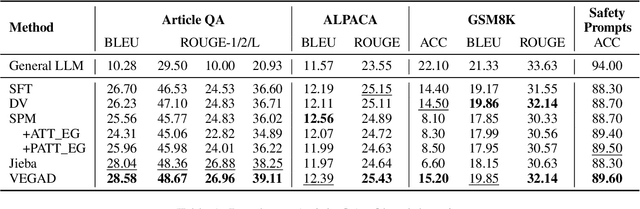
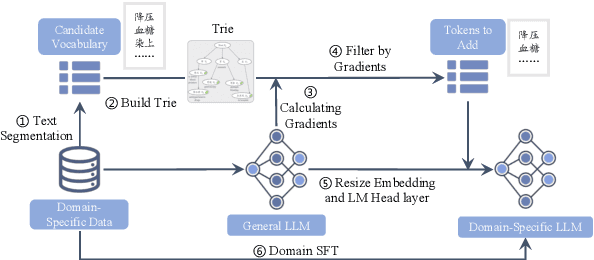
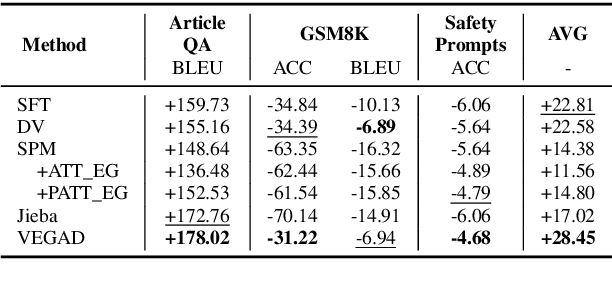
While Large Language Models (LLMs) demonstrate impressive generation abilities, they frequently struggle when it comes to specialized domains due to their limited domain-specific knowledge. Studies on domain-specific LLMs resort to expanding the vocabulary before fine-tuning on domain-specific corpus, aiming to decrease the sequence length and enhance efficiency during decoding, without thoroughly investigating the results of vocabulary expansion to LLMs over different domains. Our pilot study reveals that expansion with only a subset of the entire vocabulary may lead to superior performance. Guided by the discovery, this paper explores how to identify a vocabulary subset to achieve the optimal results. We introduce VEGAD, an adaptive method that automatically identifies valuable words from a given domain vocabulary. Our method has been validated through experiments on three Chinese datasets, demonstrating its effectiveness. Additionally, we have undertaken comprehensive analyses of the method. The selection of a optimal subset for expansion has shown to enhance performance on both domain-specific tasks and general tasks, showcasing the potential of VEGAD.
RexUniNLU: Recursive Method with Explicit Schema Instructor for Universal NLU
Sep 09, 2024


Information Extraction (IE) and Text Classification (CLS) serve as the fundamental pillars of NLU, with both disciplines relying on analyzing input sequences to categorize outputs into pre-established schemas. However, there is no existing encoder-based model that can unify IE and CLS tasks from this perspective. To fully explore the foundation shared within NLU tasks, we have proposed a Recursive Method with Explicit Schema Instructor for Universal NLU. Specifically, we firstly redefine the true universal information extraction (UIE) with a formal formulation that covers almost all extraction schemas, including quadruples and quintuples which remain unsolved for previous UIE models. Then, we expands the formulation to all CLS and multi-modal NLU tasks. Based on that, we introduce RexUniNLU, an universal NLU solution that employs explicit schema constraints for IE and CLS, which encompasses all IE and CLS tasks and prevent incorrect connections between schema and input sequence. To avoid interference between different schemas, we reset the position ids and attention mask matrices. Extensive experiments are conducted on IE, CLS in both English and Chinese, and multi-modality, revealing the effectiveness and superiority. Our codes are publicly released.
More Than Catastrophic Forgetting: Integrating General Capabilities For Domain-Specific LLMs
May 28, 2024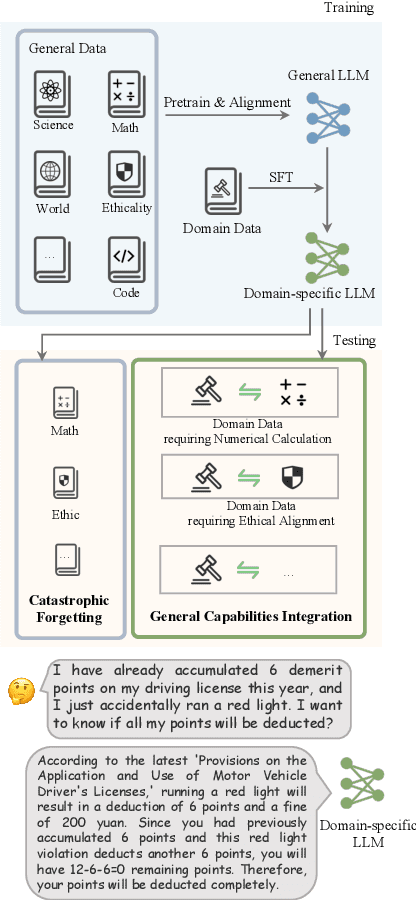
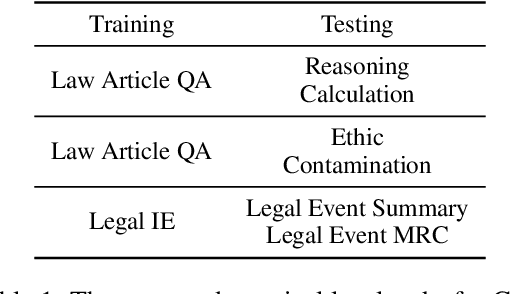
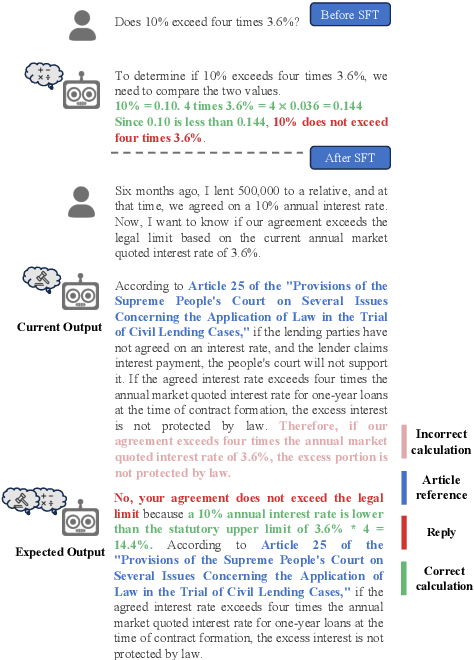
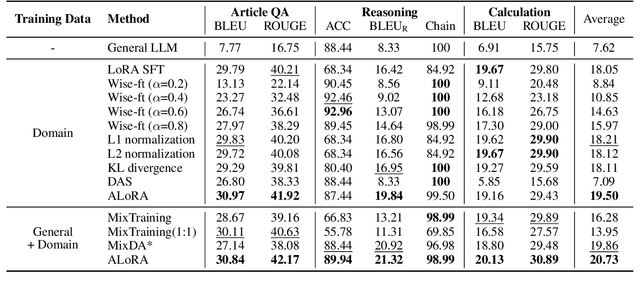
The performance on general tasks decreases after Large Language Models (LLMs) are fine-tuned on domain-specific tasks, the phenomenon is known as Catastrophic Forgetting (CF). However, this paper presents a further challenge for real application of domain-specific LLMs beyond CF, called General Capabilities Integration (GCI), which necessitates the integration of both the general capabilities and domain knowledge within a single instance. The objective of GCI is not merely to retain previously acquired general capabilities alongside new domain knowledge, but to harmonize and utilize both sets of skills in a cohesive manner to enhance performance on domain-specific tasks. Taking legal domain as an example, we carefully design three groups of training and testing tasks without lacking practicability, and construct the corresponding datasets. To better incorporate general capabilities across domain-specific scenarios, we introduce ALoRA, which utilizes a multi-head attention module upon LoRA, facilitating direct information transfer from preceding tokens to the current one. This enhancement permits the representation to dynamically switch between domain-specific knowledge and general competencies according to the attention. Extensive experiments are conducted on the proposed tasks. The results exhibit the significance of our setting, and the effectiveness of our method.
Evolving Knowledge Distillation with Large Language Models and Active Learning
Mar 11, 2024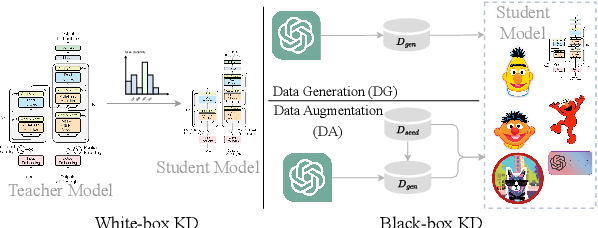
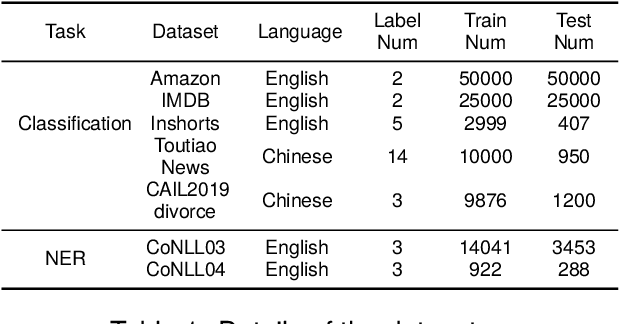
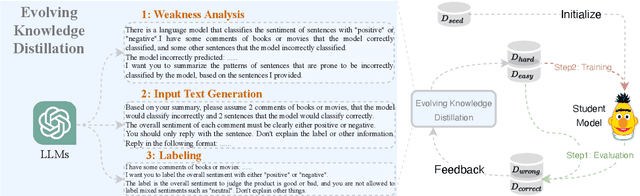
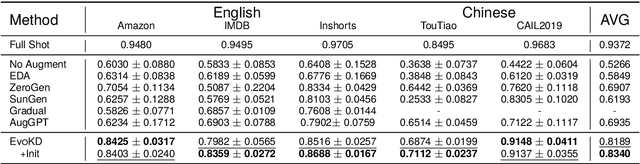
Large language models (LLMs) have demonstrated remarkable capabilities across various NLP tasks. However, their computational costs are prohibitively high. To address this issue, previous research has attempted to distill the knowledge of LLMs into smaller models by generating annotated data. Nonetheless, these works have mainly focused on the direct use of LLMs for text generation and labeling, without fully exploring their potential to comprehend the target task and acquire valuable knowledge. In this paper, we propose EvoKD: Evolving Knowledge Distillation, which leverages the concept of active learning to interactively enhance the process of data generation using large language models, simultaneously improving the task capabilities of small domain model (student model). Different from previous work, we actively analyze the student model's weaknesses, and then synthesize labeled samples based on the analysis. In addition, we provide iterative feedback to the LLMs regarding the student model's performance to continuously construct diversified and challenging samples. Experiments and analysis on different NLP tasks, namely, text classification and named entity recognition show the effectiveness of EvoKD.