 Add to Chrome
 Add to Firefox
 Add to Edge
REBA: A Revealed Belief Automaton Framework for Online Planning in Continuous POMDPs
Jun 20, 2026
Online planning in continuous partially observable Markov decision processes (POMDPs) using $ω$-regular specifications requires handling continuous belief dynamics within the finite symbolic memory in order to track temporal progress. Existing methods based on either direct search in belief space or predefined discrete abstractions suffer from drawbacks, e.g., lack of symbolic memory for long-horizon logical progress or difficult to certify from noisy online beliefs. As such, obtaining reliable symbolic states online from continuous observations remains a challenge. To address this issue, we introduce the Revealed Belief Automaton (REBA), an event-driven framework that advances the research from global belief-space discretization to a fundamental new way of thinking, namely online certification of revelation events. Specifically, we propose an online revelation method that, through information-theoretic gates, can dynamically analyse and establish belief abstraction from the continuous belief space by discovering reliable anchors among noisy beliefs. We then develop an incremental topology adaptation mechanism over the certified anchors to realise the online finite Belief Automaton. By combining with the $ω$-regular specification, REBA is able to support formal parity policy synthesis without a predefined discrete abstraction, which in turn can guide the Monte Carlo Tree Search process to perform online search beyond its local horizon. In addition, we design an error decomposition analysis which can assess the effectiveness and reliability of this discrete guidance for the underlying continuous POMDP. Empirical evaluations in patrolling and navigation scenarios show that REBA matches or exceeds all evaluated baselines, with primary metric gains of +17.0\% to +47.4\% over state-of-the-art approaches.

StreamingTalker: Audio-driven 3D Facial Animation with Autoregressive Diffusion Model
Nov 19, 2025


This paper focuses on the task of speech-driven 3D facial animation, which aims to generate realistic and synchronized facial motions driven by speech inputs. Recent methods have employed audio-conditioned diffusion models for 3D facial animation, achieving impressive results in generating expressive and natural animations. However, these methods process the whole audio sequences in a single pass, which poses two major challenges: they tend to perform poorly when handling audio sequences that exceed the training horizon and will suffer from significant latency when processing long audio inputs. To address these limitations, we propose a novel autoregressive diffusion model that processes input audio in a streaming manner. This design ensures flexibility with varying audio lengths and achieves low latency independent of audio duration. Specifically, we select a limited number of past frames as historical motion context and combine them with the audio input to create a dynamic condition. This condition guides the diffusion process to iteratively generate facial motion frames, enabling real-time synthesis with high-quality results. Additionally, we implemented a real-time interactive demo, highlighting the effectiveness and efficiency of our approach. We will release the code at https://zju3dv.github.io/StreamingTalker/.
Generalized Encouragement-Based Instrumental Variables for Counterfactual Regression
Aug 10, 2024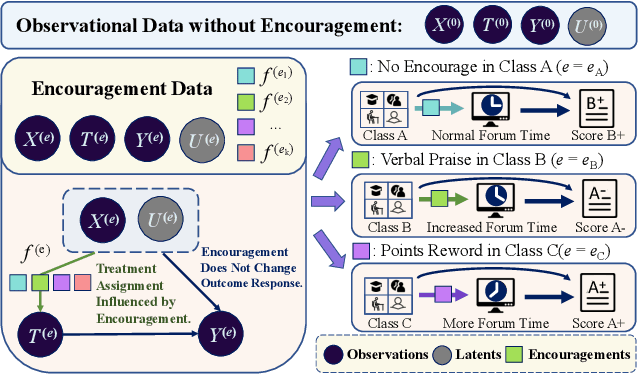
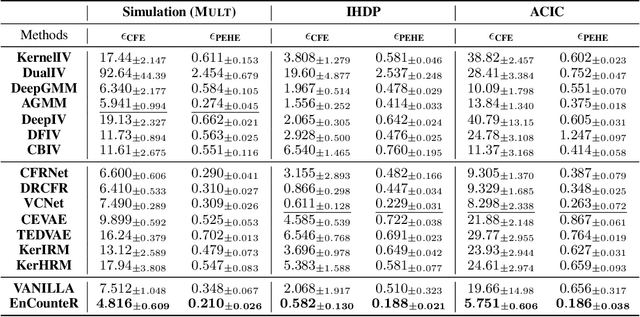
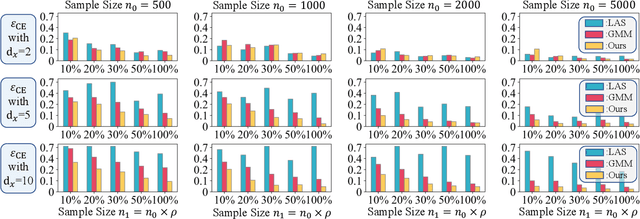
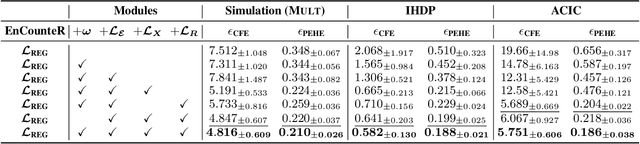
In causal inference, encouragement designs (EDs) are widely used to analyze causal effects, when randomized controlled trials (RCTs) are impractical or compliance to treatment cannot be perfectly enforced. Unlike RCTs, which directly allocate treatments, EDs randomly assign encouragement policies that positively motivate individuals to engage in a specific treatment. These random encouragements act as instrumental variables (IVs), facilitating the identification of causal effects through leveraging exogenous perturbations in discrete treatment scenarios. However, real-world applications of encouragement designs often face challenges such as incomplete randomization, limited experimental data, and significantly fewer encouragements compared to treatments, hindering precise causal effect estimation. To address this, this paper introduces novel theories and algorithms for identifying the Conditional Average Treatment Effect (CATE) using variations in encouragement. Further, by leveraging both observational and encouragement data, we propose a generalized IV estimator, named Encouragement-based Counterfactual Regression (EnCounteR), to effectively estimate the causal effects. Extensive experiments on both synthetic and real-world datasets demonstrate the superiority of EnCounteR over existing methods.
Semi-supervised Anomaly Detection via Adaptive Reinforcement Learning-Enabled Method with Causal Inference for Sensor Signals
May 16, 2024Semi-supervised anomaly detection for sensor signals is critical in ensuring system reliability in smart manufacturing. However, existing methods rely heavily on data correlation, neglecting causality and leading to potential misinterpretations due to confounding factors. Moreover, while current reinforcement learning-based methods can effectively identify known and unknown anomalies with limited labeled samples, these methods still face several challenges, such as under-utilization of priori knowledge, lack of model flexibility, and deficient reward feedback during environmental interactions. To address the above problems, this paper innovatively constructs a counterfactual causal reinforcement learning model, termed Triple-Assisted Causal Reinforcement Learning Anomaly Detector (Tri-CRLAD). The model leverages causal inference to extract the intrinsic causal feature in data, enhancing the agent's utilization of prior knowledge and improving its generalization capability. In addition, Tri-CRLAD features a triple decision support mechanism, including a sampling strategy based on historical similarity, an adaptive threshold smoothing adjustment strategy, and an adaptive decision reward mechanism. These mechanisms further enhance the flexibility and generalization ability of the model, enabling it to effectively respond to various complex and dynamically changing environments. Experimental results across seven diverse sensor signal datasets demonstrate that Tri-CRLAD outperforms nine state-of-the-art baseline methods. Notably, Tri-CRLAD achieves up to a 23\% improvement in anomaly detection stability with minimal known anomaly samples, highlighting its potential in semi-supervised anomaly detection scenarios. Our code is available at https://github.com/Aoudsung/Tri-CRLAD.