 Add to Chrome
 Add to Firefox
 Add to Edge
EgoExoMoCap: Distributed Ego-Exo Human Motion Capture
Jul 17, 2026
Human motion capture from head-mounted devices (HMDs) offers a scalable way to acquire real-world human motion and interaction data, which is crucial for applications in embodied AI and VR/AR. Existing approaches focus on either egocentric body tracking, estimating the motion of the subject wearing the device, or exocentric tracking, capturing the movements of people in the wearer's surroundings. So far, these two paradigms have largely been explored in isolation. In this paper, we propose a novel distributed framework that jointly leverages ego- and exocentric multi-modal signals for human motion estimation from HMDs. Unlike traditional motion capture systems requiring bulky multi-camera setups or obtrusive mocap suits, our approach, EgoExoMoCap, is as simple as two (or more) people, each wearing a pair of smart glasses. The method leverages head (plus potentially wrist) tracking signals for accurate estimation of global motion in the 3D world and combines context-aware image features based on DINOv3 to achieve robustness in the presence of noise and occlusions. Extensive experiments on two in-the-wild datasets show that our approach can robustly reconstruct motion even in challenging scenarios.

GIRAF: Towards Generalizable Human Interactions with Articulated Objects
Jul 08, 2026Synthesizing realistic full-body human interactions with articulated objects is a fundamental challenge for embodied AI and graphics, with applications in robotics training and virtual agents. Existing models remain limited: some focus on simple activities with static objects, while others restrict attention to hand-only manipulation. This leaves open the problem of generating coordinated full-body motion that approaches, manipulates, and moves articulated objects in a realistic and generalizable way. The key difficulty lies in reasoning jointly about locomotion, fine-grained contact, and object articulation. Models must capture subtle hand-object correspondences that transfer across object geometries, while also producing seamless transitions from navigation to manipulation. At the same time, the scarcity of large-scale paired motion-scene data makes it difficult to generalize across diverse object positions and shapes. We introduce a text-conditioned diffusion model that addresses these challenges through three core ideas: an object-centric representation that unifies hand-object contact with object surfaces, a mixed-domain training strategy that balances locomotion and interaction, and a contact-based augmentation scheme that expands training diversity. Through experiments, our method demonstrated strong generalization to unseen object configurations, surpassing current state-of-the-art methods.
Dancing Points: Synthesizing Ballroom Dancing with Three-Point Inputs
Jan 05, 2026Ballroom dancing is a structured yet expressive motion category. Its highly diverse movement and complex interactions between leader and follower dancers make the understanding and synthesis challenging. We demonstrate that the three-point trajectory available from a virtual reality (VR) device can effectively serve as a dancer's motion descriptor, simplifying the modeling and synthesis of interplay between dancers' full-body motions down to sparse trajectories. Thanks to the low dimensionality, we can employ an efficient MLP network to predict the follower's three-point trajectory directly from the leader's three-point input for certain types of ballroom dancing, addressing the challenge of modeling high-dimensional full-body interaction. It also prevents our method from overfitting thanks to its compact yet explicit representation. By leveraging the inherent structure of the movements and carefully planning the autoregressive procedure, we show a deterministic neural network is able to translate three-point trajectories into a virtual embodied avatar, which is typically considered under-constrained and requires generative models for common motions. In addition, we demonstrate this deterministic approach generalizes beyond small, structured datasets like ballroom dancing, and performs robustly on larger, more diverse datasets such as LaFAN. Our method provides a computationally- and data-efficient solution, opening new possibilities for immersive paired dancing applications. Code and pre-trained models for this paper are available at https://peizhuoli.github.io/dancing-points.
SCENIC: Scene-aware Semantic Navigation with Instruction-guided Control
Dec 20, 2024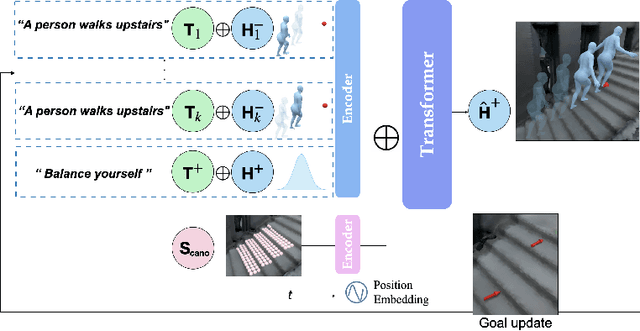
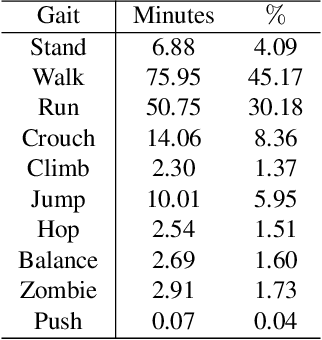
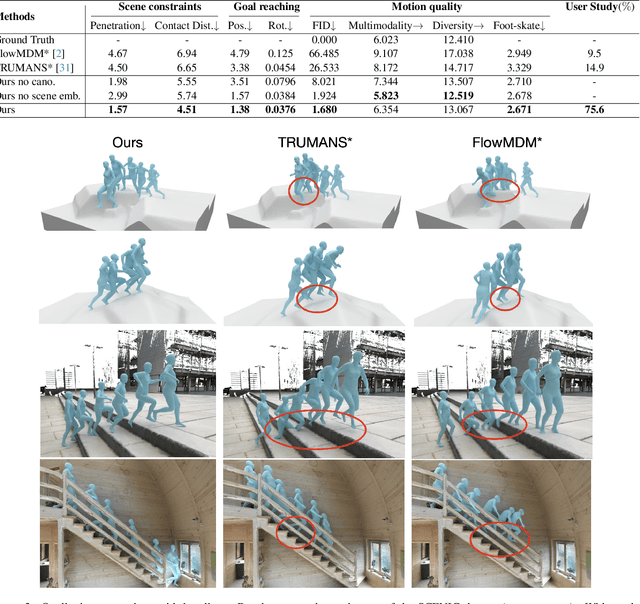
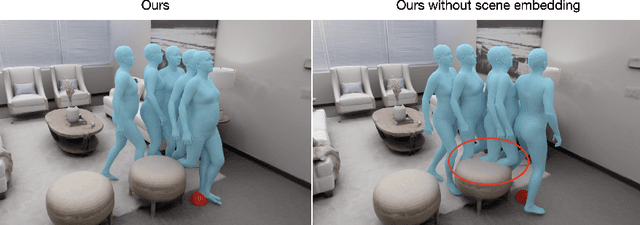
Synthesizing natural human motion that adapts to complex environments while allowing creative control remains a fundamental challenge in motion synthesis. Existing models often fall short, either by assuming flat terrain or lacking the ability to control motion semantics through text. To address these limitations, we introduce SCENIC, a diffusion model designed to generate human motion that adapts to dynamic terrains within virtual scenes while enabling semantic control through natural language. The key technical challenge lies in simultaneously reasoning about complex scene geometry while maintaining text control. This requires understanding both high-level navigation goals and fine-grained environmental constraints. The model must ensure physical plausibility and precise navigation across varied terrain, while also preserving user-specified text control, such as ``carefully stepping over obstacles" or ``walking upstairs like a zombie." Our solution introduces a hierarchical scene reasoning approach. At its core is a novel scene-dependent, goal-centric canonicalization that handles high-level goal constraint, and is complemented by an ego-centric distance field that captures local geometric details. This dual representation enables our model to generate physically plausible motion across diverse 3D scenes. By implementing frame-wise text alignment, our system achieves seamless transitions between different motion styles while maintaining scene constraints. Experiments demonstrate our novel diffusion model generates arbitrarily long human motions that both adapt to complex scenes with varying terrain surfaces and respond to textual prompts. Additionally, we show SCENIC can generalize to four real-scene datasets. Our code, dataset, and models will be released at \url{https://virtualhumans.mpi-inf.mpg.de/scenic/}.
CHOICE: Coordinated Human-Object Interaction in Cluttered Environments for Pick-and-Place Actions
Dec 09, 2024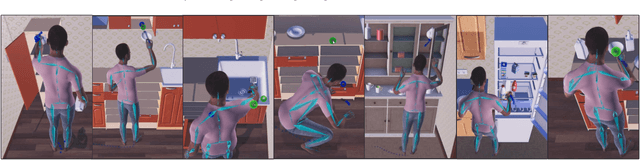
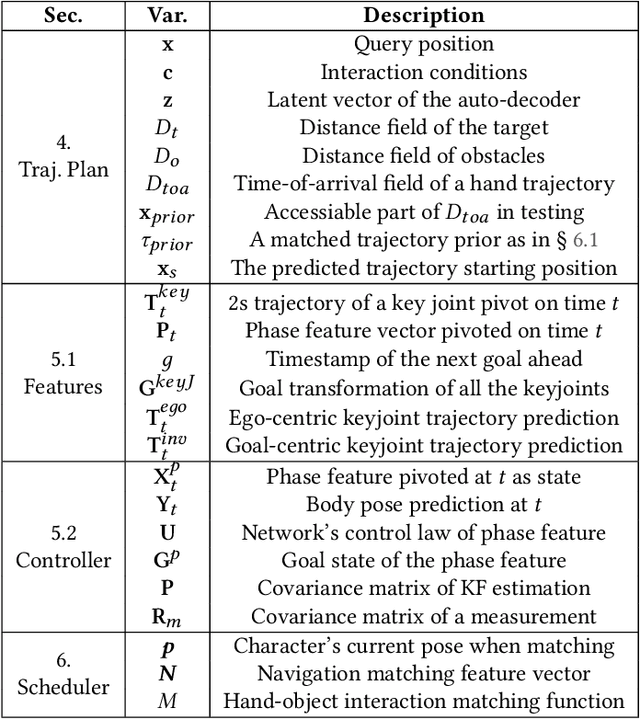
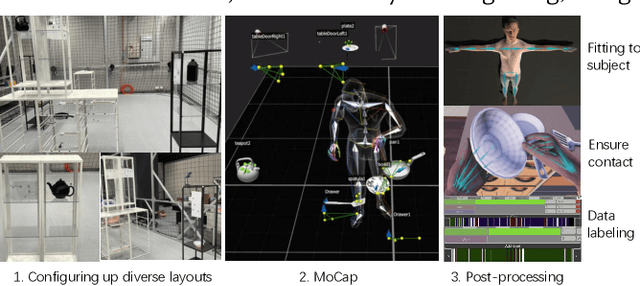
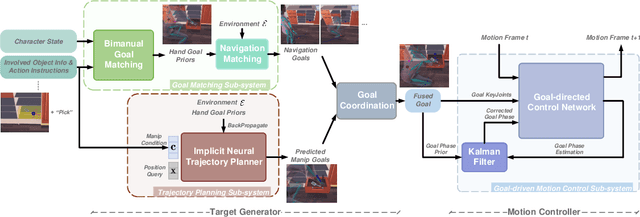
Animating human-scene interactions such as pick-and-place tasks in cluttered, complex layouts is a challenging task, with objects of a wide variation of geometries and articulation under scenarios with various obstacles. The main difficulty lies in the sparsity of the motion data compared to the wide variation of the objects and environments as well as the poor availability of transition motions between different tasks, increasing the complexity of the generalization to arbitrary conditions. To cope with this issue, we develop a system that tackles the interaction synthesis problem as a hierarchical goal-driven task. Firstly, we develop a bimanual scheduler that plans a set of keyframes for simultaneously controlling the two hands to efficiently achieve the pick-and-place task from an abstract goal signal such as the target object selected by the user. Next, we develop a neural implicit planner that generates guidance hand trajectories under diverse object shape/types and obstacle layouts. Finally, we propose a linear dynamic model for our DeepPhase controller that incorporates a Kalman filter to enable smooth transitions in the frequency domain, resulting in a more realistic and effective multi-objective control of the character.Our system can produce a wide range of natural pick-and-place movements with respect to the geometry of objects, the articulation of containers and the layout of the objects in the scene.
FORCE: Dataset and Method for Intuitive Physics Guided Human-object Interaction
Mar 17, 2024
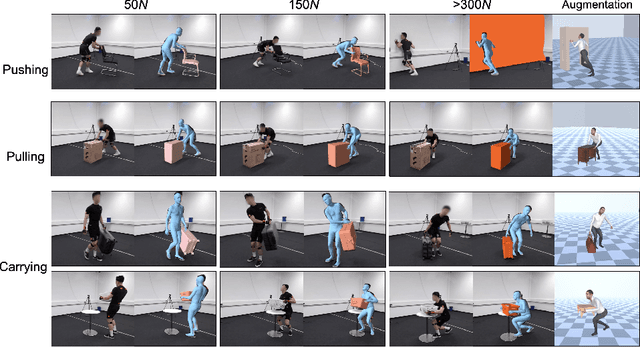

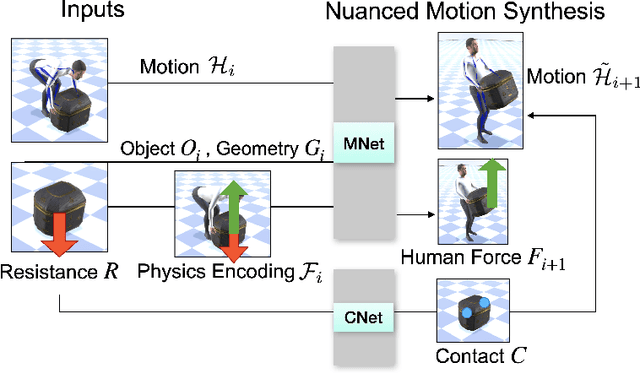
Interactions between human and objects are influenced not only by the object's pose and shape, but also by physical attributes such as object mass and surface friction. They introduce important motion nuances that are essential for diversity and realism. Despite advancements in recent kinematics-based methods, this aspect has been overlooked. Generating nuanced human motion presents two challenges. First, it is non-trivial to learn from multi-modal human and object information derived from both the physical and non-physical attributes. Second, there exists no dataset capturing nuanced human interactions with objects of varying physical properties, hampering model development. This work addresses the gap by introducing the FORCE model, a kinematic approach for synthesizing diverse, nuanced human-object interactions by modeling physical attributes. Our key insight is that human motion is dictated by the interrelation between the force exerted by the human and the perceived resistance. Guided by a novel intuitive physics encoding, the model captures the interplay between human force and resistance. Experiments also demonstrate incorporating human force facilitates learning multi-class motion. Accompanying our model, we contribute the FORCE dataset. It features diverse, different-styled motion through interactions with varying resistances.
Uncertainty Estimation in Instance Segmentation with Star-convex Shapes
Sep 19, 2023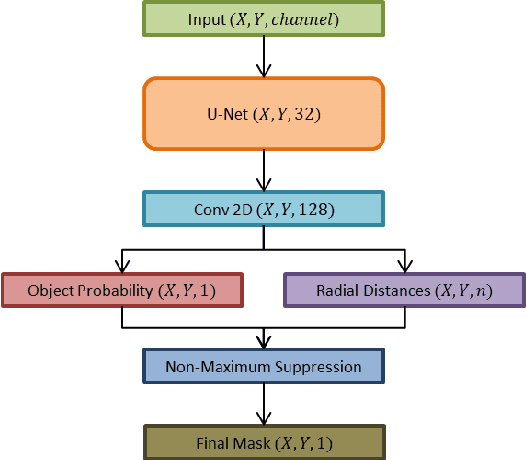
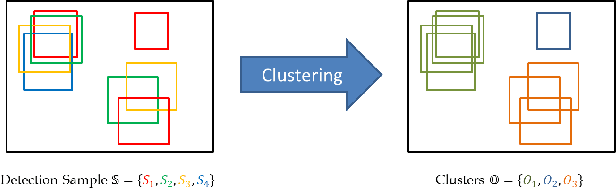
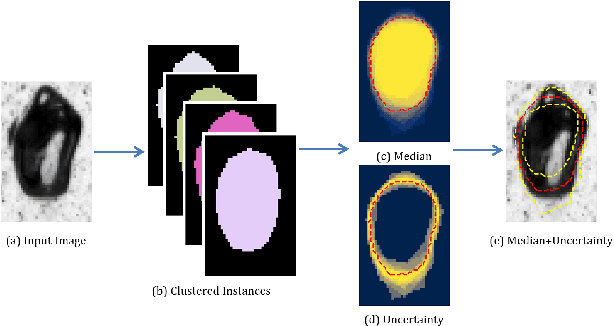
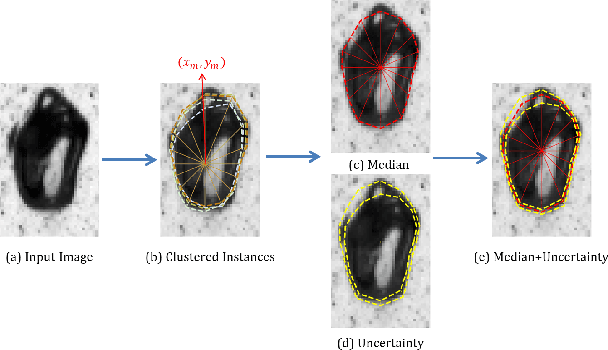
Instance segmentation has witnessed promising advancements through deep neural network-based algorithms. However, these models often exhibit incorrect predictions with unwarranted confidence levels. Consequently, evaluating prediction uncertainty becomes critical for informed decision-making. Existing methods primarily focus on quantifying uncertainty in classification or regression tasks, lacking emphasis on instance segmentation. Our research addresses the challenge of estimating spatial certainty associated with the location of instances with star-convex shapes. Two distinct clustering approaches are evaluated which compute spatial and fractional certainty per instance employing samples by the Monte-Carlo Dropout or Deep Ensemble technique. Our study demonstrates that combining spatial and fractional certainty scores yields improved calibrated estimation over individual certainty scores. Notably, our experimental results show that the Deep Ensemble technique alongside our novel radial clustering approach proves to be an effective strategy. Our findings emphasize the significance of evaluating the calibration of estimated certainties for model reliability and decision-making.
Motion In-Betweening with Phase Manifolds
Aug 24, 2023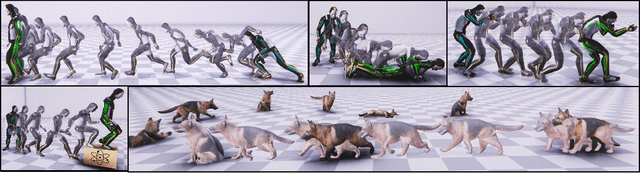
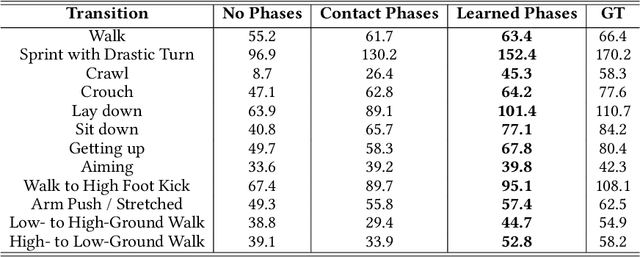
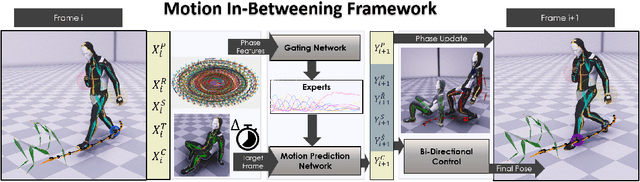

This paper introduces a novel data-driven motion in-betweening system to reach target poses of characters by making use of phases variables learned by a Periodic Autoencoder. Our approach utilizes a mixture-of-experts neural network model, in which the phases cluster movements in both space and time with different expert weights. Each generated set of weights then produces a sequence of poses in an autoregressive manner between the current and target state of the character. In addition, to satisfy poses which are manually modified by the animators or where certain end effectors serve as constraints to be reached by the animation, a learned bi-directional control scheme is implemented to satisfy such constraints. The results demonstrate that using phases for motion in-betweening tasks sharpen the interpolated movements, and furthermore stabilizes the learning process. Moreover, using phases for motion in-betweening tasks can also synthesize more challenging movements beyond locomotion behaviors. Additionally, style control is enabled between given target keyframes. Our proposed framework can compete with popular state-of-the-art methods for motion in-betweening in terms of motion quality and generalization, especially in the existence of long transition durations. Our framework contributes to faster prototyping workflows for creating animated character sequences, which is of enormous interest for the game and film industry.
* 17 pages, 11 figures, conference
Hierarchical Planning and Control for Box Loco-Manipulation
Jun 15, 2023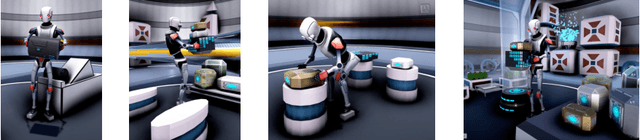

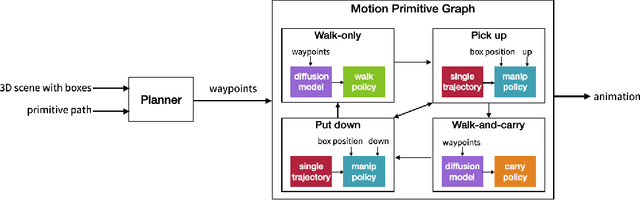

Humans perform everyday tasks using a combination of locomotion and manipulation skills. Building a system that can handle both skills is essential to creating virtual humans. We present a physically-simulated human capable of solving box rearrangement tasks, which requires a combination of both skills. We propose a hierarchical control architecture, where each level solves the task at a different level of abstraction, and the result is a physics-based simulated virtual human capable of rearranging boxes in a cluttered environment. The control architecture integrates a planner, diffusion models, and physics-based motion imitation of sparse motion clips using deep reinforcement learning. Boxes can vary in size, weight, shape, and placement height. Code and trained control policies are provided.
QuestEnvSim: Environment-Aware Simulated Motion Tracking from Sparse Sensors
Jun 09, 2023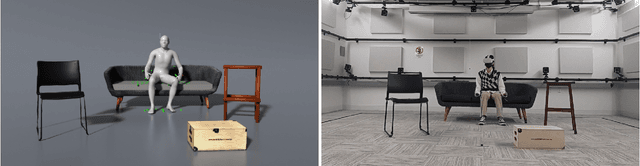
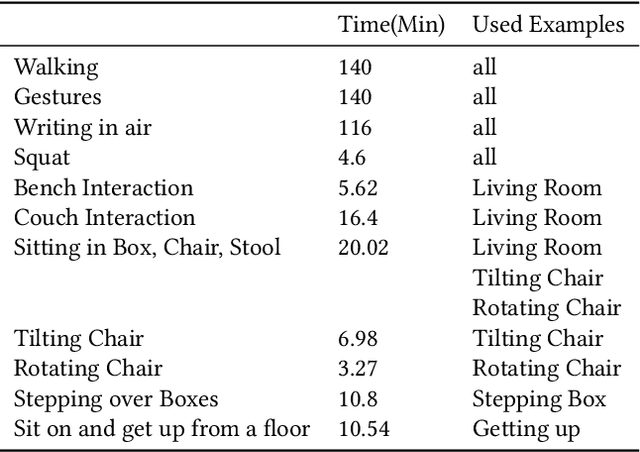


Replicating a user's pose from only wearable sensors is important for many AR/VR applications. Most existing methods for motion tracking avoid environment interaction apart from foot-floor contact due to their complex dynamics and hard constraints. However, in daily life people regularly interact with their environment, e.g. by sitting on a couch or leaning on a desk. Using Reinforcement Learning, we show that headset and controller pose, if combined with physics simulation and environment observations can generate realistic full-body poses even in highly constrained environments. The physics simulation automatically enforces the various constraints necessary for realistic poses, instead of manually specifying them as in many kinematic approaches. These hard constraints allow us to achieve high-quality interaction motions without typical artifacts such as penetration or contact sliding. We discuss three features, the environment representation, the contact reward and scene randomization, crucial to the performance of the method. We demonstrate the generality of the approach through various examples, such as sitting on chairs, a couch and boxes, stepping over boxes, rocking a chair and turning an office chair. We believe these are some of the highest-quality results achieved for motion tracking from sparse sensor with scene interaction.