 Add to Chrome
 Add to Firefox
 Add to Edge
DGH: Dynamic Gaussian Hair
Dec 18, 2025
The creation of photorealistic dynamic hair remains a major challenge in digital human modeling because of the complex motions, occlusions, and light scattering. Existing methods often resort to static capture and physics-based models that do not scale as they require manual parameter fine-tuning to handle the diversity of hairstyles and motions, and heavy computation to obtain high-quality appearance. In this paper, we present Dynamic Gaussian Hair (DGH), a novel framework that efficiently learns hair dynamics and appearance. We propose: (1) a coarse-to-fine model that learns temporally coherent hair motion dynamics across diverse hairstyles; (2) a strand-guided optimization module that learns a dynamic 3D Gaussian representation for hair appearance with support for differentiable rendering, enabling gradient-based learning of view-consistent appearance under motion. Unlike prior simulation-based pipelines, our approach is fully data-driven, scales with training data, and generalizes across various hairstyles and head motion sequences. Additionally, DGH can be seamlessly integrated into a 3D Gaussian avatar framework, enabling realistic, animatable hair for high-fidelity avatar representation. DGH achieves promising geometry and appearance results, providing a scalable, data-driven alternative to physics-based simulation and rendering.

MHR: Momentum Human Rig
Nov 19, 2025We present MHR, a parametric human body model that combines the decoupled skeleton/shape paradigm of ATLAS with a flexible, modern rig and pose corrective system inspired by the Momentum library. Our model enables expressive, anatomically plausible human animation, supporting non-linear pose correctives, and is designed for robust integration in AR/VR and graphics pipelines.
ANIM: Accurate Neural Implicit Model for Human Reconstruction from a single RGB-D image
Mar 18, 2024


Recent progress in human shape learning, shows that neural implicit models are effective in generating 3D human surfaces from limited number of views, and even from a single RGB image. However, existing monocular approaches still struggle to recover fine geometric details such as face, hands or cloth wrinkles. They are also easily prone to depth ambiguities that result in distorted geometries along the camera optical axis. In this paper, we explore the benefits of incorporating depth observations in the reconstruction process by introducing ANIM, a novel method that reconstructs arbitrary 3D human shapes from single-view RGB-D images with an unprecedented level of accuracy. Our model learns geometric details from both multi-resolution pixel-aligned and voxel-aligned features to leverage depth information and enable spatial relationships, mitigating depth ambiguities. We further enhance the quality of the reconstructed shape by introducing a depth-supervision strategy, which improves the accuracy of the signed distance field estimation of points that lie on the reconstructed surface. Experiments demonstrate that ANIM outperforms state-of-the-art works that use RGB, surface normals, point cloud or RGB-D data as input. In addition, we introduce ANIM-Real, a new multi-modal dataset comprising high-quality scans paired with consumer-grade RGB-D camera, and our protocol to fine-tune ANIM, enabling high-quality reconstruction from real-world human capture.
RoHM: Robust Human Motion Reconstruction via Diffusion
Jan 16, 2024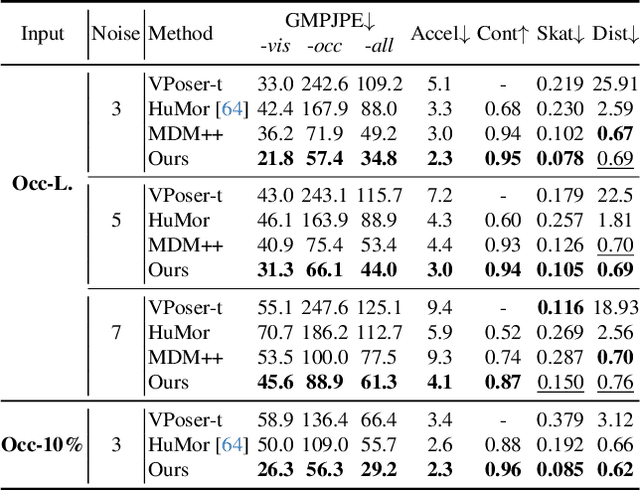

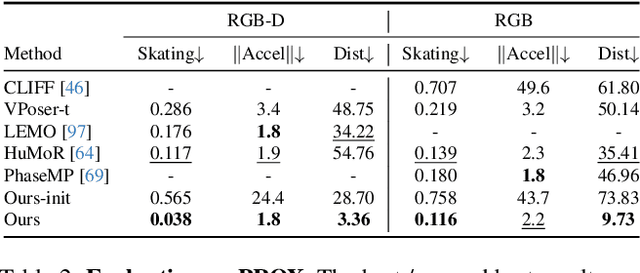

We propose RoHM, an approach for robust 3D human motion reconstruction from monocular RGB(-D) videos in the presence of noise and occlusions. Most previous approaches either train neural networks to directly regress motion in 3D or learn data-driven motion priors and combine them with optimization at test time. The former do not recover globally coherent motion and fail under occlusions; the latter are time-consuming, prone to local minima, and require manual tuning. To overcome these shortcomings, we exploit the iterative, denoising nature of diffusion models. RoHM is a novel diffusion-based motion model that, conditioned on noisy and occluded input data, reconstructs complete, plausible motions in consistent global coordinates. Given the complexity of the problem -- requiring one to address different tasks (denoising and infilling) in different solution spaces (local and global motion) -- we decompose it into two sub-tasks and learn two models, one for global trajectory and one for local motion. To capture the correlations between the two, we then introduce a novel conditioning module, combining it with an iterative inference scheme. We apply RoHM to a variety of tasks -- from motion reconstruction and denoising to spatial and temporal infilling. Extensive experiments on three popular datasets show that our method outperforms state-of-the-art approaches qualitatively and quantitatively, while being faster at test time. The code will be available at https://sanweiliti.github.io/ROHM/ROHM.html.
HISR: Hybrid Implicit Surface Representation for Photorealistic 3D Human Reconstruction
Dec 28, 2023


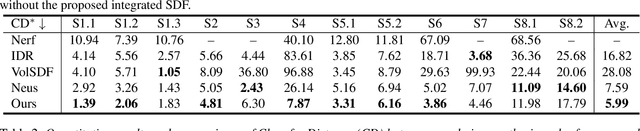
Neural reconstruction and rendering strategies have demonstrated state-of-the-art performances due, in part, to their ability to preserve high level shape details. Existing approaches, however, either represent objects as implicit surface functions or neural volumes and still struggle to recover shapes with heterogeneous materials, in particular human skin, hair or clothes. To this aim, we present a new hybrid implicit surface representation to model human shapes. This representation is composed of two surface layers that represent opaque and translucent regions on the clothed human body. We segment different regions automatically using visual cues and learn to reconstruct two signed distance functions (SDFs). We perform surface-based rendering on opaque regions (e.g., body, face, clothes) to preserve high-fidelity surface normals and volume rendering on translucent regions (e.g., hair). Experiments demonstrate that our approach obtains state-of-the-art results on 3D human reconstructions, and also shows competitive performances on other objects.
NSF: Neural Surface Fields for Human Modeling from Monocular Depth
Aug 30, 2023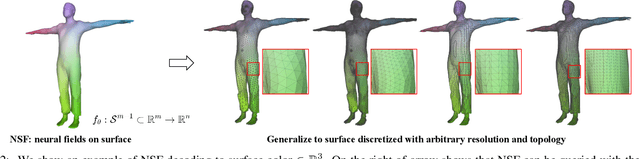
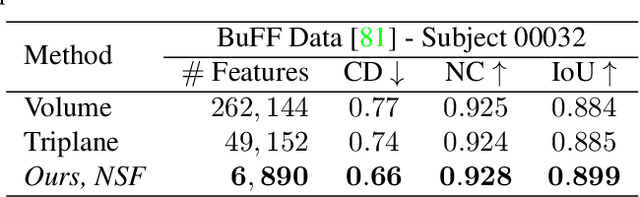
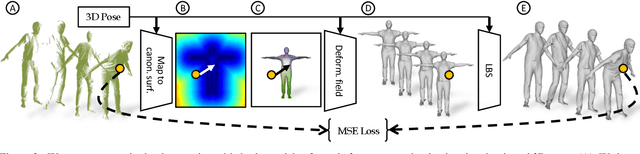
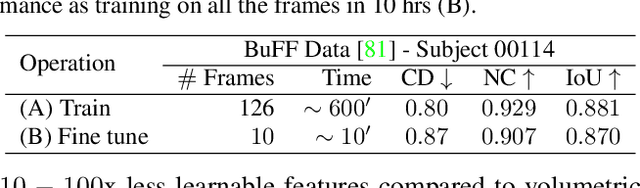
Obtaining personalized 3D animatable avatars from a monocular camera has several real world applications in gaming, virtual try-on, animation, and VR/XR, etc. However, it is very challenging to model dynamic and fine-grained clothing deformations from such sparse data. Existing methods for modeling 3D humans from depth data have limitations in terms of computational efficiency, mesh coherency, and flexibility in resolution and topology. For instance, reconstructing shapes using implicit functions and extracting explicit meshes per frame is computationally expensive and cannot ensure coherent meshes across frames. Moreover, predicting per-vertex deformations on a pre-designed human template with a discrete surface lacks flexibility in resolution and topology. To overcome these limitations, we propose a novel method `\keyfeature: Neural Surface Fields' for modeling 3D clothed humans from monocular depth. NSF defines a neural field solely on the base surface which models a continuous and flexible displacement field. NSF can be adapted to the base surface with different resolution and topology without retraining at inference time. Compared to existing approaches, our method eliminates the expensive per-frame surface extraction while maintaining mesh coherency, and is capable of reconstructing meshes with arbitrary resolution without retraining. To foster research in this direction, we release our code in project page at: https://yuxuan-xue.com/nsf.
VIVE3D: Viewpoint-Independent Video Editing using 3D-Aware GANs
Mar 28, 2023We introduce VIVE3D, a novel approach that extends the capabilities of image-based 3D GANs to video editing and is able to represent the input video in an identity-preserving and temporally consistent way. We propose two new building blocks. First, we introduce a novel GAN inversion technique specifically tailored to 3D GANs by jointly embedding multiple frames and optimizing for the camera parameters. Second, besides traditional semantic face edits (e.g. for age and expression), we are the first to demonstrate edits that show novel views of the head enabled by the inherent properties of 3D GANs and our optical flow-guided compositing technique to combine the head with the background video. Our experiments demonstrate that VIVE3D generates high-fidelity face edits at consistent quality from a range of camera viewpoints which are composited with the original video in a temporally and spatially consistent manner.
Snipper: A Spatiotemporal Transformer for Simultaneous Multi-Person 3D Pose Estimation Tracking and Forecasting on a Video Snippet
Jul 13, 2022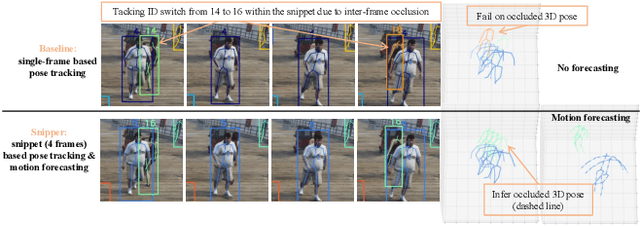
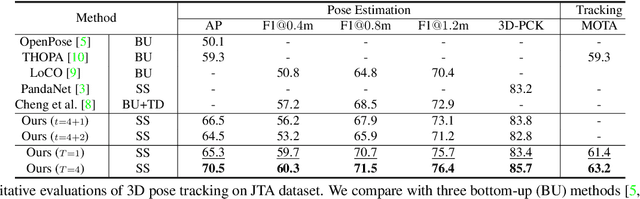
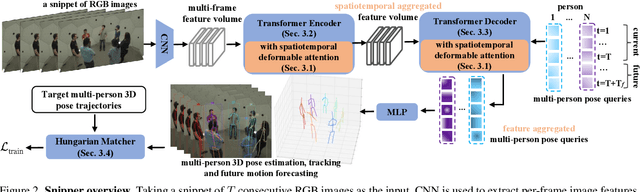
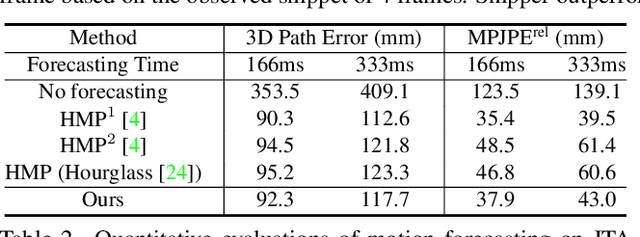
Multi-person pose understanding from RGB videos includes three complex tasks: pose estimation, tracking and motion forecasting. Among these three tasks, pose estimation and tracking are correlated, and tracking is crucial to motion forecasting. Most existing works either focus on a single task or employ cascaded methods to solve each individual task separately. In this paper, we propose Snipper, a framework to perform multi-person 3D pose estimation, tracking and motion forecasting simultaneously in a single inference. Specifically, we first propose a deformable attention mechanism to aggregate spatiotemporal information from video snippets. Building upon this deformable attention, a visual transformer is learned to encode the spatiotemporal features from multi-frame images and to decode informative pose features to update multi-person pose queries. Last, these queries are regressed to predict multi-person pose trajectories and future motions in one forward pass. In the experiments, we show the effectiveness of Snipper on three challenging public datasets where a generic model rivals specialized state-of-art baselines for pose estimation, tracking, and forecasting. Code is available at https://github.com/JimmyZou/Snipper
BodyMap: Learning Full-Body Dense Correspondence Map
May 18, 2022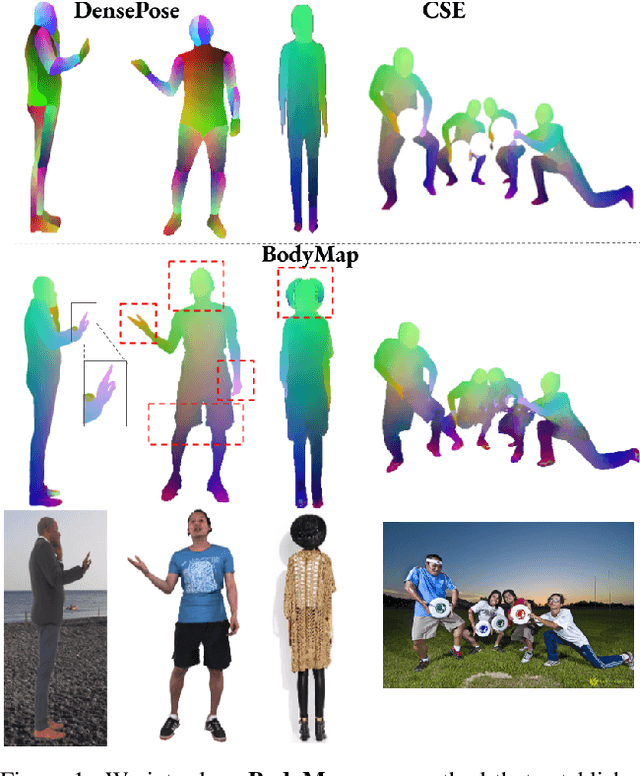
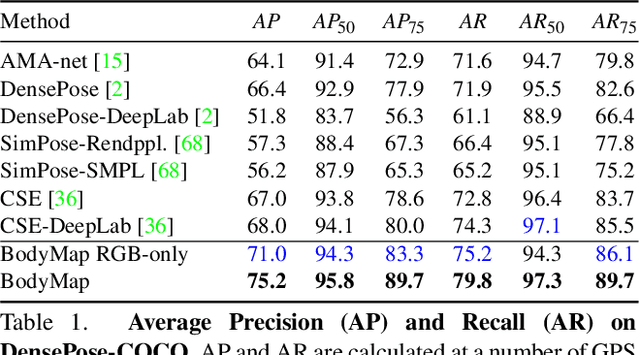
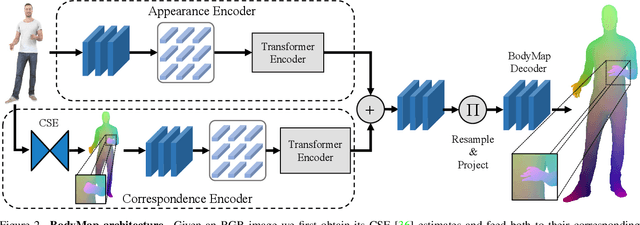
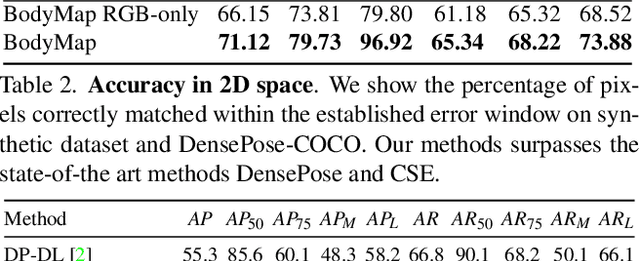
Dense correspondence between humans carries powerful semantic information that can be utilized to solve fundamental problems for full-body understanding such as in-the-wild surface matching, tracking and reconstruction. In this paper we present BodyMap, a new framework for obtaining high-definition full-body and continuous dense correspondence between in-the-wild images of clothed humans and the surface of a 3D template model. The correspondences cover fine details such as hands and hair, while capturing regions far from the body surface, such as loose clothing. Prior methods for estimating such dense surface correspondence i) cut a 3D body into parts which are unwrapped to a 2D UV space, producing discontinuities along part seams, or ii) use a single surface for representing the whole body, but none handled body details. Here, we introduce a novel network architecture with Vision Transformers that learn fine-level features on a continuous body surface. BodyMap outperforms prior work on various metrics and datasets, including DensePose-COCO by a large margin. Furthermore, we show various applications ranging from multi-layer dense cloth correspondence, neural rendering with novel-view synthesis and appearance swapping.
ARCH++: Animation-Ready Clothed Human Reconstruction Revisited
Aug 17, 2021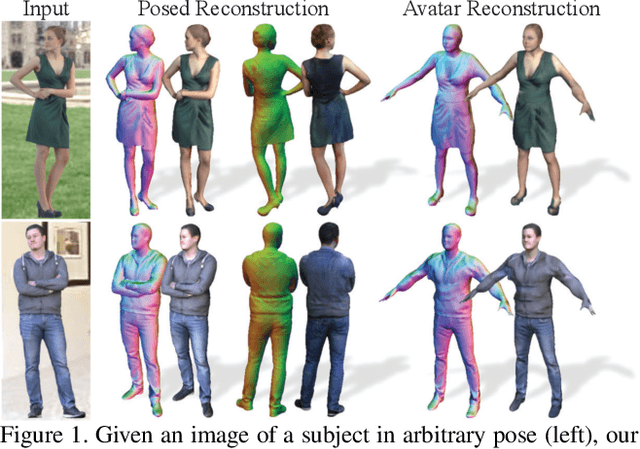

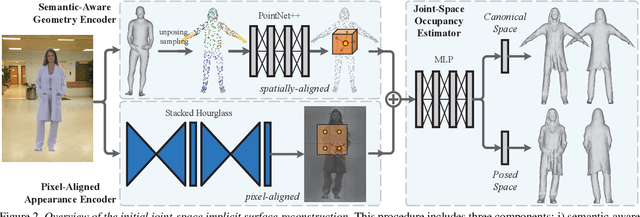
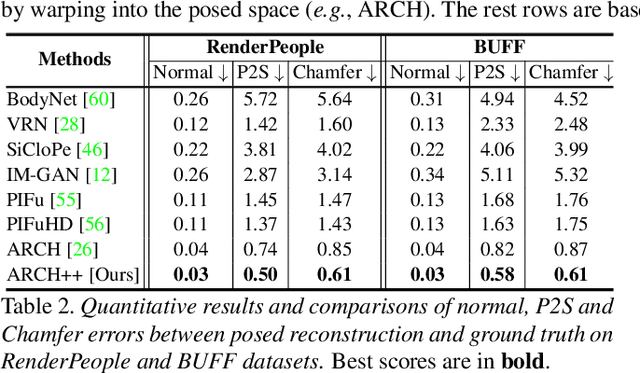
We present ARCH++, an image-based method to reconstruct 3D avatars with arbitrary clothing styles. Our reconstructed avatars are animation-ready and highly realistic, in both the visible regions from input views and the unseen regions. While prior work shows great promise of reconstructing animatable clothed humans with various topologies, we observe that there exist fundamental limitations resulting in sub-optimal reconstruction quality. In this paper, we revisit the major steps of image-based avatar reconstruction and address the limitations with ARCH++. First, we introduce an end-to-end point based geometry encoder to better describe the semantics of the underlying 3D human body, in replacement of previous hand-crafted features. Second, in order to address the occupancy ambiguity caused by topological changes of clothed humans in the canonical pose, we propose a co-supervising framework with cross-space consistency to jointly estimate the occupancy in both the posed and canonical spaces. Last, we use image-to-image translation networks to further refine detailed geometry and texture on the reconstructed surface, which improves the fidelity and consistency across arbitrary viewpoints. In the experiments, we demonstrate improvements over the state of the art on both public benchmarks and user studies in reconstruction quality and realism.