 Add to Chrome
 Add to Firefox
 Add to Edge
LLMRouter: Unified Infrastructure for Developing, Evaluating, and Deploying LLM Routers
Aug 07, 2026
No single large language model (LLM) is optimal across all queries and budget constraints, making model routing essential for cost-effective deployment. Existing routers adopt diverse formulations and implementations, making fair comparison and extension difficult. We present a unified formulation of LLM routing as a sequential decision process characterized by five components: context encoders, model encoders, scoring functions, decision rules, and learning signals, covering single-turn, multi-turn, and personalized routing. Based on this formulation, we develop an automated pipeline for constructing routing supervision and evaluating routers jointly on response quality and inference cost. The resulting benchmark, xRouteBench, spans generic LLM, memory-augmented, vision, time-series, and personalized routing tasks. We further introduce LLMRouter, an open-source modular infrastructure with more than 16 representative routers. Our empirical study shows that learned routers outperform the strongest fixed-model baseline by 14.6% relatively, lightweight routers become more competitive under tight cost constraints, and user-conditioned routing consistently improves personalization.

Reinforcement Learning with Evolving Rubrics as Rewards for Audio Reasoning
Aug 03, 2026Audio reasoning is essential for machine understanding of the acoustic world. Reinforcement learning with verifiable rewards can elicit such reasoning, yet existing reward designs are complementary in their limitations: outcome-based rewards supervise only the final answer and let the model reach it without attending to the audio, whereas process-based rewards score the reasoning itself but rely on coarse, hand-crafted, and fixed criteria that neither adapt to each question nor stay grounded in the acoustic evidence. Moreover, questions differ in what they demand, with some hinging on perception and others on multi-step reasoning, and any static criterion weakens as the policy improves. Supervising the reasoning process with fine-grained, audio-grounded, and adaptive rewards is therefore crucial, yet challenging since such rewards are impractical to design by hand for every sample. To this end, we introduce AudioRubrics, a reinforcement learning framework that supervises audio reasoning with self-evolving, audio-grounded rubric rewards. AudioRubrics synthesizes per-sample rubrics from the raw waveform and, conditioned on the model's own rollouts, regenerates and reweights criteria per group, supplying a continuous learning signal that keeps targeting the current policy's weaknesses as static criteria saturate. Comprehensive evaluations across three audio reasoning benchmarks reveal that AudioRubrics substantially outperforms a wide range of open-source and training-based baselines. Furthermore, our analysis shows that the gains scale with the capability of the rubric generator and judge, and AudioRubrics converges to a stable reasoning length that avoids both degenerate collapse and unbounded growth. The improvement in audio perception further demonstrates the effectiveness of anchoring supervision in the acoustic evidence. Our project page is available at https://audiorubrics.github.io.
Weak-to-Strong On-Policy Distillation
Jul 28, 2026On-policy distillation (OPD), which aligns a student with the teacher's token-level distribution on the student's own rollouts, is an effective paradigm for transferring capabilities across LLMs. Prevailing approaches assume a teacher at least as capable as the student: they either distill a larger model into a smaller one, which fails at the frontier where no larger teacher exists, or consolidate multiple domain experts trained from a shared base, which requires costly training at the student's scale. We introduce Weak-to-Strong On-Policy Distillation (W2S-OPD), a simple yet effective OPD framework that improves the strong student by distilling from multiple weak models. W2S-OPD constructs a proxy teacher in logit space from a contrast pair of a positive and a negative model, both smaller than the student and cheap to obtain. Their logit difference isolates the capability direction, which is added to the student's own base model, yielding a proxy teacher that couples this direction while staying distributionally adjacent to the student. The student then distills it by minimizing the per-token reverse KL on its own rollouts. We instantiate the contrast pair as i) a post-RL expert against its pre-RL initialization, isolating the skill RL instills, ii) a larger against a smaller base model, isolating the capability from scale, and iii) a small base model with correct versus wrong hints, isolating the instance-level direction toward the solution. Across four math and three code benchmarks, W2S-OPD outperforms OPD, enables the student to surpass the domain teacher, and keeps improving the student even when every supervision source is weaker. Analysis shows different contrasts yield distinct signals: the post-RL and hint contrasts emphasize reasoning frameworks, while the scale contrast emphasizes the solving procedure. Our code will be available at https://github.com/Yu-Fangxu/W2S-OPD.
TSRouter: Dynamic Modality-Model Selection for Time Series Reasoning
Jul 09, 2026Time series reasoning is essential for real-world problem-solving. While both Large Language Models (LLMs) and Vision-Language Models (VLMs) can reason about time-series data, their capabilities are complementary: LLMs process time series as text sequences and thus preserve exact numerical understanding, but struggle with global patterns, whereas VLMs efficiently capture these patterns by visualizing time series but may lose fine-grained details. Moreover, models vary significantly in task-specific expertise and inference costs. Dynamically selecting the most suitable modality and model for each query is therefore crucial, yet challenging because it requires modeling the complex interactions among tasks, queries, modalities, and models, which carry rich contextual signals. To this end, we introduce TSRouter, a graph-based dynamic routing framework. TSRouter constructs a heterogeneous graph of task, query, modality, and model nodes to contextualize the interactions among query characteristics, modality attributes, and model capabilities. TSRouter formulates routing as a candidate scoring problem, where each modality-model pair is evaluated based on user-defined performance-cost preferences to select the optimal candidate. Comprehensive evaluations on 4 distinct time series reasoning tasks reveal that TSRouter substantially outperforms diverse baselines with 16\% to 46\% relative improvements. Furthermore, TSRouter demonstrates robust zero-shot plug-and-play generalization to unseen models and novel tasks and preserves high performance while reducing computational overhead through cost-aware optimization. Our code is available at https://github.com/tianyi-lab/TSRouter.
FlowBank: Query-Adaptive Agentic Workflows Optimization through Precompute-and-Reuse
Jun 09, 2026Large Language Model (LLM)-based multi-agent systems are increasingly powerful, but current agentic workflow optimization paradigms make an unsatisfying trade-off. Task-level methods spend substantial offline compute yet deploy only a single workflow, leaving complementary candidates unused, while query-level methods synthesize a new workflow per query at substantial inference cost. Our motivating analysis shows these paradigms are more complementary than competing: workflows discovered during offline search often solve different subsets of queries, and many queries handled by expensive query-level generation can already be solved by cheaper precomputed workflows. This suggests a different objective: rather than searching for one universally best workflow or regenerating one per instance, we should build a compact bank of reusable, complementary workflows and select among them adaptively at inference time. Doing so requires solving three coupled problems: generating complementary rather than redundant candidates, compressing them into a small deployable portfolio, and assigning each query to the right workflow under a performance-cost trade-off. To this end, we present FlowBank, a three-stage framework for portfolio-based agentic workflow optimization. Diversifying proposes DiverseFlow to steer search toward under-covered queries and produce a high-coverage candidate pool. Curating proposes CuraFlow to compress this pool into a compact portfolio with minimal redundancy. Matching casts deployment as edge-value prediction on a query-workflow bipartite graph and routes each incoming query to the portfolio member with the best predicted utility. Across five benchmarks, FlowBank achieves the highest average score among the evaluated methods while remaining cost-competitive, improving over the strongest automated and handcrafted baselines by 4.26% and 14.92% relative, respectively.
TSRBench: A Comprehensive Multi-task Multi-modal Time Series Reasoning Benchmark for Generalist Models
Jan 26, 2026Time series data is ubiquitous in real-world scenarios and crucial for critical applications ranging from energy management to traffic control. Consequently, the ability to reason over time series is a fundamental skill for generalist models to solve practical problems. However, this dimension is notably absent from existing benchmarks of generalist models. To bridge this gap, we introduce TSRBench, a comprehensive multi-modal benchmark designed to stress-test the full spectrum of time series reasoning capabilities. TSRBench features: i) a diverse set of 4125 problems from 14 domains, and is categorized into 4 major dimensions: Perception, Reasoning, Prediction, and Decision-Making. ii) 15 tasks from the 4 dimensions evaluating essential reasoning capabilities (e.g., numerical reasoning). Through extensive experiments, we evaluated over 30 leading proprietary and open-source LLMs, VLMs, and TSLLMs within TSRBench. Our findings reveal that: i) scaling laws hold for perception and reasoning but break down for prediction; ii) strong reasoning does not guarantee accurate context-aware forecasting, indicating a decoupling between semantic understanding and numerical prediction; and iii) despite the complementary nature of textual and visual represenations of time series as inputs, current multimodal models fail to effectively fuse them for reciprocal performance gains. TSRBench provides a standardized evaluation platform that not only highlights existing challenges but also offers valuable insights to advance generalist models. Our code and dataset are available at https://tsrbench.github.io/.
ArrowGEV: Grounding Events in Video via Learning the Arrow of Time
Jan 10, 2026Grounding events in videos serves as a fundamental capability in video analysis. While Vision-Language Models (VLMs) are increasingly employed for this task, existing approaches predominantly train models to associate events with timestamps in the forward video only. This paradigm hinders VLMs from capturing the inherent temporal structure and directionality of events, thereby limiting robustness and generalization. To address this limitation, inspired by the arrow of time in physics, which characterizes the intrinsic directionality of temporal processes, we propose ArrowGEV, a reinforcement learning framework that explicitly models temporal directionality in events to improve both event grounding and temporal directionality understanding in VLMs. Specifically, we categorize events into time-sensitive (e.g., putting down a bag) and time-insensitive (e.g., holding a towel in the left hand). The former denote events whose reversal substantially alters their meaning, while the latter remain semantically unchanged under reversal. For time-sensitive events, ArrowGEV introduces a reward that encourages VLMs to discriminate between forward and backward videos, whereas for time-insensitive events, it enforces consistent grounding across both directions. Extensive experiments demonstrate that ArrowGEV not only improves grounding precision and temporal directionality recognition, but also enhances general video understanding and reasoning ability.
ArcMemo: Abstract Reasoning Composition with Lifelong LLM Memory
Sep 04, 2025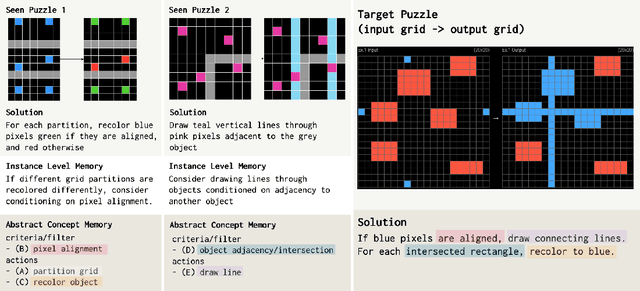
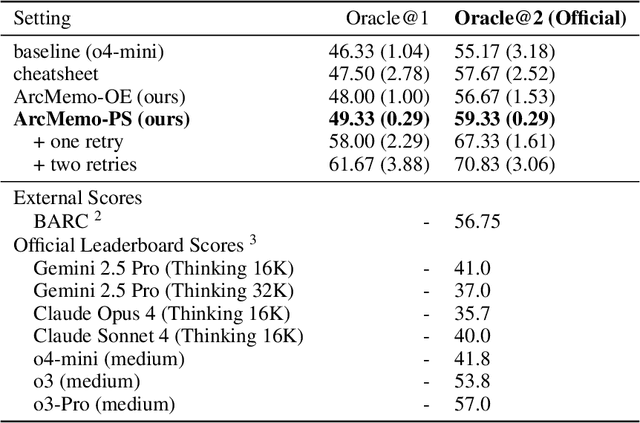
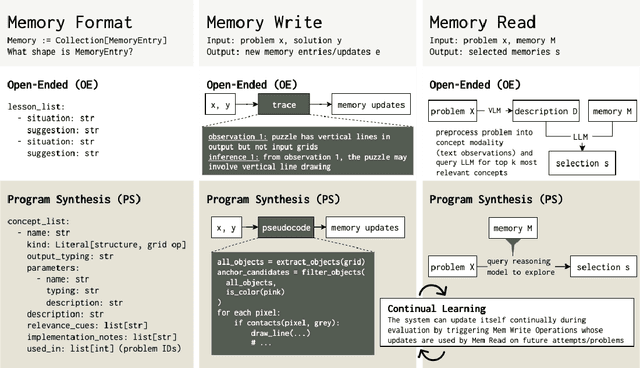
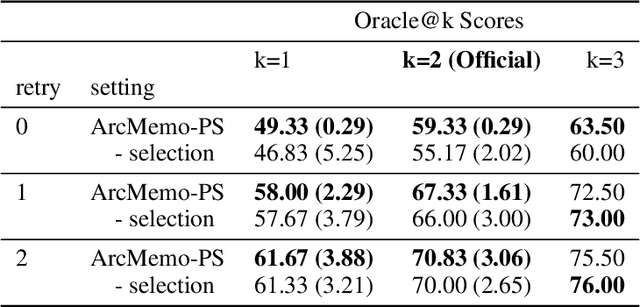
While inference-time scaling enables LLMs to carry out increasingly long and capable reasoning traces, the patterns and insights uncovered during these traces are immediately discarded once the context window is reset for a new query. External memory is a natural way to persist these discoveries, and recent work has shown clear benefits for reasoning-intensive tasks. We see an opportunity to make such memories more broadly reusable and scalable by moving beyond instance-based memory entries (e.g. exact query/response pairs, or summaries tightly coupled with the original problem context) toward concept-level memory: reusable, modular abstractions distilled from solution traces and stored in natural language. For future queries, relevant concepts are selectively retrieved and integrated into the prompt, enabling test-time continual learning without weight updates. Our design introduces new strategies for abstracting takeaways from rollouts and retrieving entries for new queries, promoting reuse and allowing memory to expand with additional experiences. On the challenging ARC-AGI benchmark, our method yields a 7.5% relative gain over a strong no-memory baseline with performance continuing to scale with inference compute. We find abstract concepts to be the most consistent memory design, outscoring the baseline at all tested inference compute scales. Moreover, we confirm that dynamically updating memory during test-time outperforms an otherwise identical fixed memory setting with additional attempts, supporting the hypothesis that solving more problems and abstracting more patterns to memory enables further solutions in a form of self-improvement. Code available at https://github.com/matt-seb-ho/arc_memo.
PersuasiveToM: A Benchmark for Evaluating Machine Theory of Mind in Persuasive Dialogues
Feb 28, 2025The ability to understand and predict the mental states of oneself and others, known as the Theory of Mind (ToM), is crucial for effective social interactions. Recent research has emerged to evaluate whether Large Language Models (LLMs) exhibit a form of ToM. Although recent studies have evaluated ToM in LLMs, existing benchmarks focus predominantly on physical perception with principles guided by the Sally-Anne test in synthetic stories and conversations, failing to capture the complex psychological activities of mental states in real-life social interactions. To mitigate this gap, we propose PersuasiveToM, a benchmark designed to evaluate the ToM abilities of LLMs in persuasive dialogues. Our framework introduces two categories of questions: (1) ToM Reasoning, assessing the capacity of LLMs to track evolving mental states (e.g., desire shifts in persuadees), and (2) ToM Application, evaluating whether LLMs can take advantage of inferred mental states to select effective persuasion strategies (e.g., emphasize rarity) and evaluate the effectiveness of persuasion strategies. Experiments across eight state-of-the-art LLMs reveal that while models excel on multiple questions, they struggle to answer questions that need tracking the dynamics and shifts of mental states and understanding the mental states in the whole dialogue comprehensively. Our aim with PersuasiveToM is to allow an effective evaluation of the ToM reasoning ability of LLMs with more focus on complex psychological activities. Our code is available at https://github.com/Yu-Fangxu/PersuasiveToM.
Flow of Reasoning: Efficient Training of LLM Policy with Divergent Thinking
Jun 09, 2024
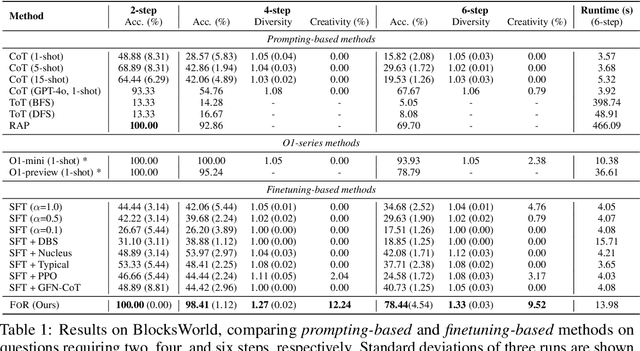


Divergent thinking, the cognitive process of generating diverse solutions, is a hallmark of human creativity and problem-solving. For machines, sampling diverse solution trajectories in complex reasoning problems is crucial for robust outcomes, data augmentation, and enhanced model generalization. Large language models (LLMs) often struggle with generating high-quality, diverse reasoning. While supervised fine-tuning helps with quality, it requires extensive supervision data to capture the full diversity of solutions. Alternatively, reinforcement learning methods like PPO aim to find limited highest-reward solutions while neglecting the solution diversity, akin to convergent thinking. To address these limitations, we propose Flow of Reasoning (FoR) -- an efficient LLM training approach enabling diverse reasoning with minimal data. FoR formulates multi-step LLM reasoning as a Markovian flow from an initial state to terminal states. The formulation allows to adapt principled GFlowNet approaches to train the LLM as a policy, which is able to sample multiple reasoning paths with probabilities proportional to the unnormalized reward. Empirical results show that, with limited training data (e.g., 15 examples), FoR can discover diverse high-quality solutions that excel greatly beyond current state-of-the-art methods across three tasks, including embodied reasoning (BlocksWorld), math puzzle solving (Game24), and logical reasoning (PrOntoQA). Code is available at https://github.com/Yu-Fangxu/FoR.