 Add to Chrome
 Add to Firefox
 Add to Edge
Reinforcement Learning with Evolving Rubrics as Rewards for Audio Reasoning
Aug 03, 2026
Audio reasoning is essential for machine understanding of the acoustic world. Reinforcement learning with verifiable rewards can elicit such reasoning, yet existing reward designs are complementary in their limitations: outcome-based rewards supervise only the final answer and let the model reach it without attending to the audio, whereas process-based rewards score the reasoning itself but rely on coarse, hand-crafted, and fixed criteria that neither adapt to each question nor stay grounded in the acoustic evidence. Moreover, questions differ in what they demand, with some hinging on perception and others on multi-step reasoning, and any static criterion weakens as the policy improves. Supervising the reasoning process with fine-grained, audio-grounded, and adaptive rewards is therefore crucial, yet challenging since such rewards are impractical to design by hand for every sample. To this end, we introduce AudioRubrics, a reinforcement learning framework that supervises audio reasoning with self-evolving, audio-grounded rubric rewards. AudioRubrics synthesizes per-sample rubrics from the raw waveform and, conditioned on the model's own rollouts, regenerates and reweights criteria per group, supplying a continuous learning signal that keeps targeting the current policy's weaknesses as static criteria saturate. Comprehensive evaluations across three audio reasoning benchmarks reveal that AudioRubrics substantially outperforms a wide range of open-source and training-based baselines. Furthermore, our analysis shows that the gains scale with the capability of the rubric generator and judge, and AudioRubrics converges to a stable reasoning length that avoids both degenerate collapse and unbounded growth. The improvement in audio perception further demonstrates the effectiveness of anchoring supervision in the acoustic evidence. Our project page is available at https://audiorubrics.github.io.

Weak-to-Strong On-Policy Distillation
Jul 28, 2026On-policy distillation (OPD), which aligns a student with the teacher's token-level distribution on the student's own rollouts, is an effective paradigm for transferring capabilities across LLMs. Prevailing approaches assume a teacher at least as capable as the student: they either distill a larger model into a smaller one, which fails at the frontier where no larger teacher exists, or consolidate multiple domain experts trained from a shared base, which requires costly training at the student's scale. We introduce Weak-to-Strong On-Policy Distillation (W2S-OPD), a simple yet effective OPD framework that improves the strong student by distilling from multiple weak models. W2S-OPD constructs a proxy teacher in logit space from a contrast pair of a positive and a negative model, both smaller than the student and cheap to obtain. Their logit difference isolates the capability direction, which is added to the student's own base model, yielding a proxy teacher that couples this direction while staying distributionally adjacent to the student. The student then distills it by minimizing the per-token reverse KL on its own rollouts. We instantiate the contrast pair as i) a post-RL expert against its pre-RL initialization, isolating the skill RL instills, ii) a larger against a smaller base model, isolating the capability from scale, and iii) a small base model with correct versus wrong hints, isolating the instance-level direction toward the solution. Across four math and three code benchmarks, W2S-OPD outperforms OPD, enables the student to surpass the domain teacher, and keeps improving the student even when every supervision source is weaker. Analysis shows different contrasts yield distinct signals: the post-RL and hint contrasts emphasize reasoning frameworks, while the scale contrast emphasizes the solving procedure. Our code will be available at https://github.com/Yu-Fangxu/W2S-OPD.
Rushes: A Human Preference Dataset for Pluralistic Alignment
Jul 22, 2026We introduce Rushes, a dataset and benchmark for studying revealed human engagement preferences in interactive narrative environments. Rushes is collected through a game interface where users interact with AI-generated branching narratives and select one choice from a small, explicit candidate set at each decision point. Each interaction logs the full candidate set, the user's choice, and the evolving narrative context, yielding time-ordered trajectories with persistent user-level identifiers. Rushes contains 44,226 decision events from 8,167 unique users across six games, capturing sequential, personalized engagement behavior rather than static judgments. We show that user choices exhibit structured, non-random patterns, quantified by a low choice entropy relative to a uniform baseline. We position Rushes as a diagnostic benchmark for pluralistic alignment and demonstrate a robust Engagement Gap: state-of-the-art LLMs, including GPT-5, fail to outperform simple baselines. While classical Matrix Factorization (SVD) captures measurable personalized signal (37.7%), frontier LLMs (34.23%) struggle to even match the Popularity Baseline (36.4%) on event-level choice prediction. This gap suggests that single, population-level objectives, like those used in modern RLHF, appear insufficient to capture heterogeneous, context-dependent engagement signals. As a result, even highly capable models default to majority preferences rather than adapting to individual trajectories. We release Rushes to support research into pluralistic alignment and sequential decision-making in generative systems. The full code for the platform and dataset will be available here: https://github.com/microsoft/rushes
GFlowRL: Scaling Distribution-Matching RL to Large Language Models
Jul 15, 2026Generative Flow Networks (GFlowNets) offer a promising alternative to reward-maximizing reinforcement learning (RL) for large reasoning models, encouraging diverse reasoning paths by matching reward distributions rather than collapsing to dominant modes. Recent work shows promise on math and code, but scaling GFlowNet-style RL to modern post-training pipelines remains difficult: as model size, rollout horizon, reward noise, and distributed-systems complexity grow together, a learned prompt-conditional partition function becomes a source of gradient instability and engineering overhead rather than a useful normalizer. Through systematic analysis, we find that the learned partition function, previously treated as essential, can be replaced by an in-batch Monte Carlo estimate computed from the rollout group already required for training. We propose GFlowRL, a streamlined GFlowNet-style RL algorithm that removes the auxiliary partition network entirely while preserving the reward-distribution-matching objective, completed by two stabilizers: importance-sampling correction for rollout/trainer drift and asymmetric flow-gap clipping for outlier residuals. GFlowRL exceeds all counterparts on math, code, and adversarial red-teaming benchmarks, reaching a Codeforces rating of 2048 at the 14B scale (within 25 Elo of o3-mini) and attaining the highest average ASR@1 on AdvBench and HarmBench, outperforming the previous SOTA multi-turn attacker in a regime where FlowRL, a prior GFlowNet-style method, diverges. The same recipe transfers to all evaluated MoE configurations up to 235B parameters, where FlowRL again fails to converge. To our knowledge, GFlowRL is the first GFlowNet-style RL algorithm to scale stably across both dense and sparse architectures. Code will be at: https://github.com/microsoft/gflowrl
Sonar-GPS Fusion for Seabed Mapping in Turbid Shallow Waters with an Autonomous Surface Vehicle
May 03, 2026Accurate seabed mapping is essential for habitat monitoring and infrastructure inspection. In turbid, shallow coastal waters, such as shellfish aquaculture farms, the effectiveness of traditional optical methods is limited. Autonomous surface vehicles (ASVs) equipped with forward-looking sonar (FLS) offer a promising alternative. However, existing sonar-based systems face challenges in achieving fine resolution mapping over long trajectories due to low-resolution positioning measurements and accumulated drift over long trajectories. In this paper, we present a drift-resilient seabed mapping framework that integrates local FLS frame alignment using the Fourier-Mellin transform (FMT) with global trajectory optimization based on an extended Kalman filter (EKF) that fuses global positioning system (GPS), inertial measurement unit (IMU), and compass data. A variance-based image blending strategy is used to further reduce visual artifacts in overlapping regions. Field trials on a structured oyster farm site show that our framework helps reduce drift in RMSE by 9.5% relative to the FMT-only baseline. This framework also enables sub-meter reconstruction accuracy and preservation of high-resolution textures needed for oyster inventory estimation within the mapped areas.
MineNPC-Task: Task Suite for Memory-Aware Minecraft Agents
Jan 08, 2026We present \textsc{MineNPC-Task}, a user-authored benchmark and evaluation harness for testing memory-aware, mixed-initiative LLM agents in open-world \emph{Minecraft}. Rather than relying on synthetic prompts, tasks are elicited from formative and summative co-play with expert players, normalized into parametric templates with explicit preconditions and dependency structure, and paired with machine-checkable validators under a bounded-knowledge policy that forbids out-of-world shortcuts. The harness captures plan/act/memory events-including plan previews, targeted clarifications, memory reads and writes, precondition checks, and repair attempts and reports outcomes relative to the total number of attempted subtasks, derived from in-world evidence. As an initial snapshot, we instantiate the framework with GPT-4o and evaluate \textbf{216} subtasks across \textbf{8} experienced players. We observe recurring breakdown patterns in code execution, inventory/tool handling, referencing, and navigation, alongside recoveries supported by mixed-initiative clarifications and lightweight memory. Participants rated interaction quality and interface usability positively, while highlighting the need for stronger memory persistence across tasks. We release the complete task suite, validators, logs, and harness to support transparent, reproducible evaluation of future memory-aware embodied agents.
Adversarial Distilled Retrieval-Augmented Guarding Model for Online Malicious Intent Detection
Sep 18, 2025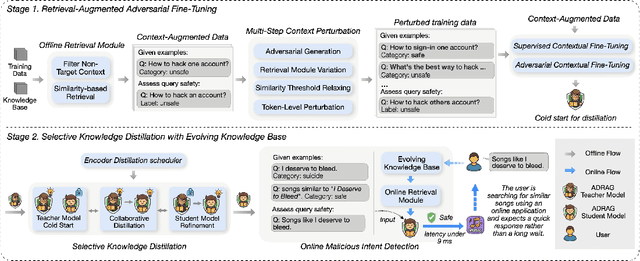
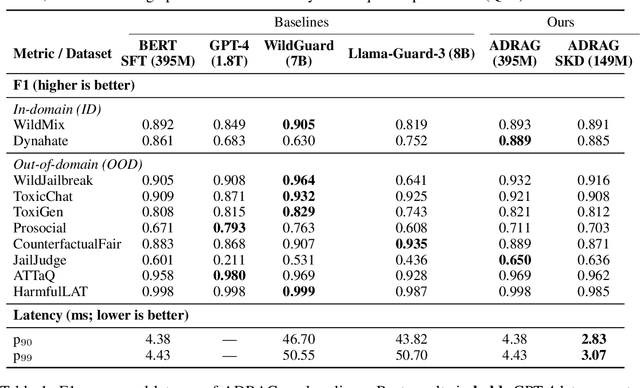
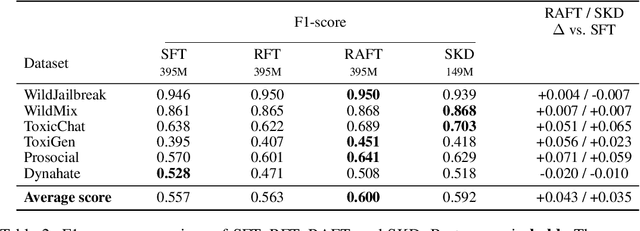
With the deployment of Large Language Models (LLMs) in interactive applications, online malicious intent detection has become increasingly critical. However, existing approaches fall short of handling diverse and complex user queries in real time. To address these challenges, we introduce ADRAG (Adversarial Distilled Retrieval-Augmented Guard), a two-stage framework for robust and efficient online malicious intent detection. In the training stage, a high-capacity teacher model is trained on adversarially perturbed, retrieval-augmented inputs to learn robust decision boundaries over diverse and complex user queries. In the inference stage, a distillation scheduler transfers the teacher's knowledge into a compact student model, with a continually updated knowledge base collected online. At deployment, the compact student model leverages top-K similar safety exemplars retrieved from the online-updated knowledge base to enable both online and real-time malicious query detection. Evaluations across ten safety benchmarks demonstrate that ADRAG, with a 149M-parameter model, achieves 98.5% of WildGuard-7B's performance, surpasses GPT-4 by 3.3% and Llama-Guard-3-8B by 9.5% on out-of-distribution detection, while simultaneously delivering up to 5.6x lower latency at 300 queries per second (QPS) in real-time applications.
PARC: Physics-based Augmentation with Reinforcement Learning for Character Controllers
May 06, 2025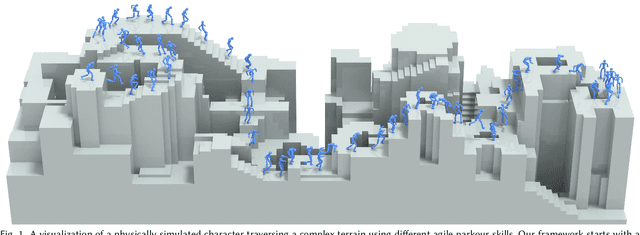
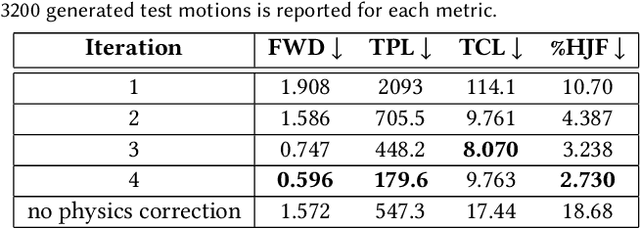
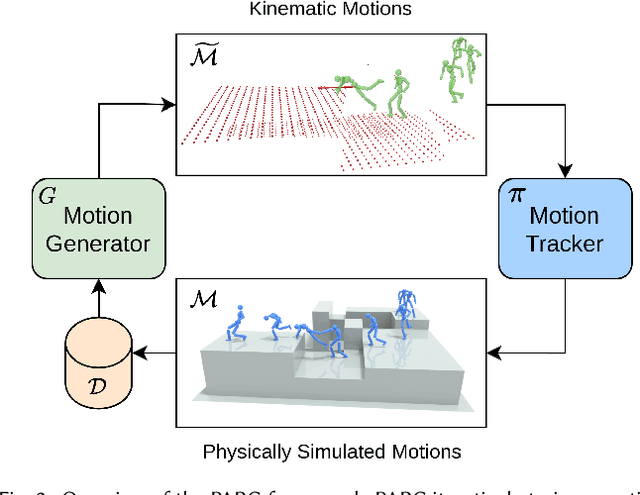
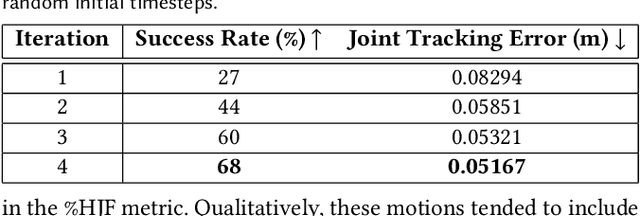
Humans excel in navigating diverse, complex environments with agile motor skills, exemplified by parkour practitioners performing dynamic maneuvers, such as climbing up walls and jumping across gaps. Reproducing these agile movements with simulated characters remains challenging, in part due to the scarcity of motion capture data for agile terrain traversal behaviors and the high cost of acquiring such data. In this work, we introduce PARC (Physics-based Augmentation with Reinforcement Learning for Character Controllers), a framework that leverages machine learning and physics-based simulation to iteratively augment motion datasets and expand the capabilities of terrain traversal controllers. PARC begins by training a motion generator on a small dataset consisting of core terrain traversal skills. The motion generator is then used to produce synthetic data for traversing new terrains. However, these generated motions often exhibit artifacts, such as incorrect contacts or discontinuities. To correct these artifacts, we train a physics-based tracking controller to imitate the motions in simulation. The corrected motions are then added to the dataset, which is used to continue training the motion generator in the next iteration. PARC's iterative process jointly expands the capabilities of the motion generator and tracker, creating agile and versatile models for interacting with complex environments. PARC provides an effective approach to develop controllers for agile terrain traversal, which bridges the gap between the scarcity of motion data and the need for versatile character controllers.
Performance Assessment of Feature Detection Methods for 2-D FS Sonar Imagery
Sep 11, 2024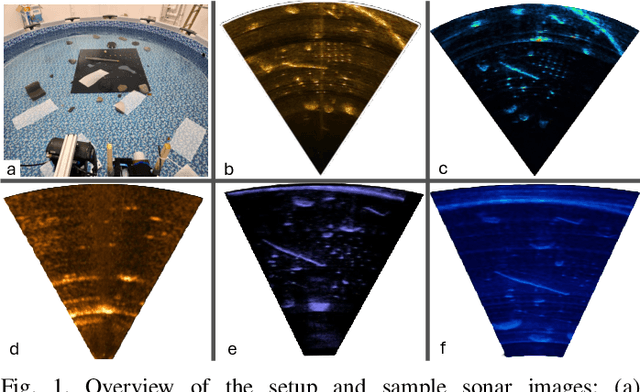
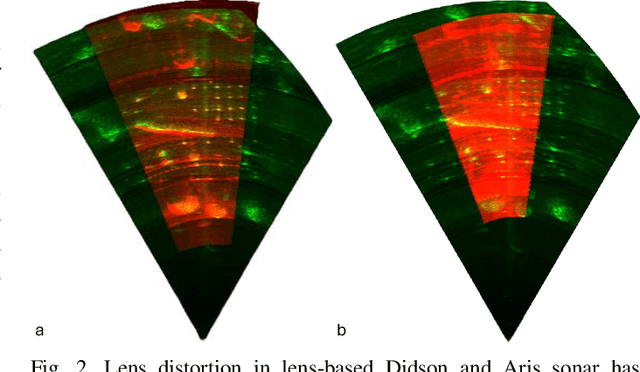

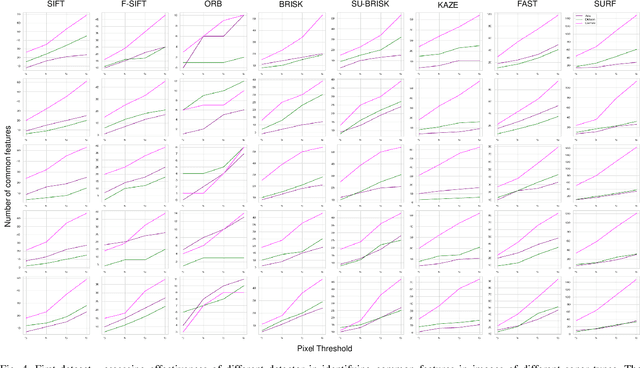
Underwater robot perception is crucial in scientific subsea exploration and commercial operations. The key challenges include non-uniform lighting and poor visibility in turbid environments. High-frequency forward-look sonar cameras address these issues, by providing high-resolution imagery at maximum range of tens of meters, despite complexities posed by high degree of speckle noise, and lack of color and texture. In particular, robust feature detection is an essential initial step for automated object recognition, localization, navigation, and 3-D mapping. Various local feature detectors developed for RGB images are not well-suited for sonar data. To assess their performances, we evaluate a number of feature detectors using real sonar images from five different sonar devices. Performance metrics such as detection accuracy, false positives, and robustness to variations in target characteristics and sonar devices are applied to analyze the experimental results. The study would provide a deeper insight into the bottlenecks of feature detection for sonar data, and developing more effective methods
Collaborative Quest Completion with LLM-driven Non-Player Characters in Minecraft
Jul 03, 2024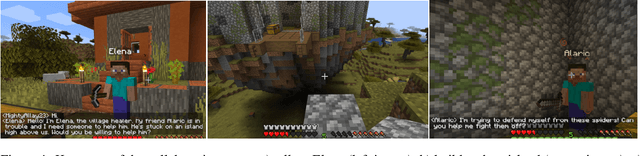
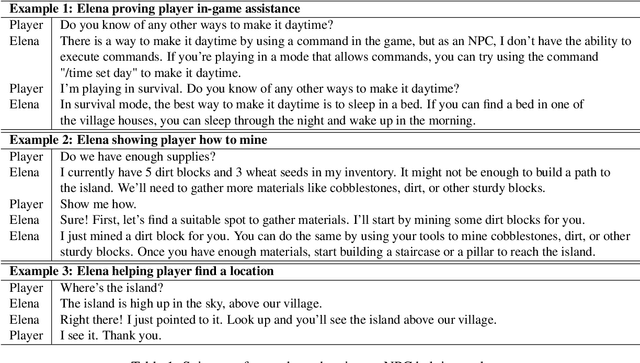

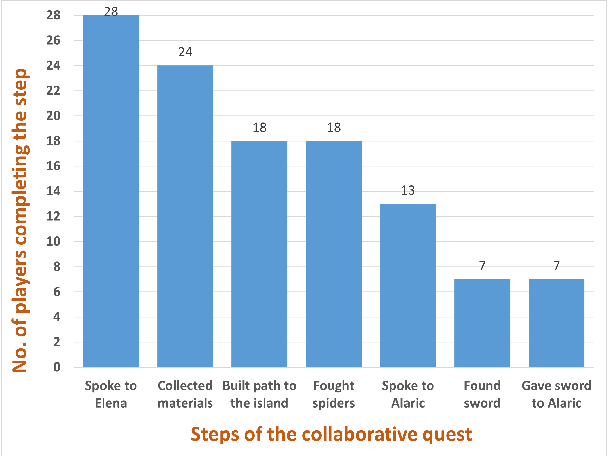
The use of generative AI in video game development is on the rise, and as the conversational and other capabilities of large language models continue to improve, we expect LLM-driven non-player characters (NPCs) to become widely deployed. In this paper, we seek to understand how human players collaborate with LLM-driven NPCs to accomplish in-game goals. We design a minigame within Minecraft where a player works with two GPT4-driven NPCs to complete a quest. We perform a user study in which 28 Minecraft players play this minigame and share their feedback. On analyzing the game logs and recordings, we find that several patterns of collaborative behavior emerge from the NPCs and the human players. We also report on the current limitations of language-only models that do not have rich game-state or visual understanding. We believe that this preliminary study and analysis will inform future game developers on how to better exploit these rapidly improving generative AI models for collaborative roles in games.
* Accepted at Wordplay workshop at ACL 2024