 Add to Chrome
 Add to Firefox
 Add to Edge
KNOWPLAN: Knowledge-Driven AI Agents for Smart Degree Pathway Planning
Aug 06, 2026
Planning a degree from official university sources requires solving two problems in order. The institution's curriculum must first be reconstructed from catalogs, departmental pages, JSON endpoints, and PDFs that share no schema, and only then can a student-specific path be optimized under prerequisite logic and overlapping requirement constraints. Coupling the two lets each failure mode hide the other, because a planner that drives its own crawling never learns facts its current plan does not need. We present KnowPlan, which enforces an extraction-first boundary and measures the interface between the stages rather than assuming it. CatalogBrowse explores with no access to any user profile. It scores legal actions by lower-confidence expected marginal gain over a finite set of atomic catalog obligations per unit of source access, parses deterministically through platform adapters with a span-constrained clause-to-AST model fallback, and terminates on a closure certificate over index, schema, provenance, and reference completeness instead of a reward threshold. Its output contract is three provenance-linked JSON documents. DegreeMap consumes only those documents. It compiles them into a typed requirement hypergraph and optimizes lexicographically with CP-SAT over hard feasibility, completion horizon, load and risk, personalized utility, and option value, so that each stage optimizes inside the previous stage's proven optimum and stays certifiable within the solver budget. Across a 100-university broad track and a six-school dense track, CatalogBrowse reaches 96.2% inventory recall and 88.7% masked-source recovery at 47% less source access than an exhaustive crawler, DegreeMap holds 100.0% hard feasibility while improving personalized utility by +0.066 over the strongest baseline, and the full pipeline certifies 99.5% of requests with a utility gap to the privileged gold graph of 0.015.

JetSpec: Breaking the Scaling Ceiling of Speculative Decoding with Parallel Tree Drafting
Jun 25, 2026Speculative decoding (SD) accelerates autoregressive Large Language Models (LLMs) by drafting multiple tokens and verifying them in parallel, but it faces a scaling limitation: increasing the draft budget improves speed only when acceptance remains high and drafting overhead stays low. This ceiling has been difficult to break because prior head-based SD methods face a causality-efficiency dilemma. Autoregressive drafters produce path-conditioned candidates that are effective for tree speculative decoding with higher acceptance length, but their drafting cost grows with tree depth. Bidirectional block-diffusion drafters generate all positions in one pass, but their branch-agnostic marginals can form individually plausible yet mutually inconsistent trees, wasting budget and reducing acceptance. We propose JetSpec, a head-based SD framework that combines one-forward drafting efficiency with branch-wise causal conditioning. JetSpec trains a causal parallel draft head over fused hidden states from the frozen target model, producing candidate trees whose scores align with the target model's autoregressive factorization. This enables JetSpec to convert larger draft budgets into longer accepted prefixes and higher end-to-end speedup. Across math, coding, and chat benchmarks on dense and MoE Qwen3 models, JetSpec consistently outperforms bidirectional-head and tree-based SD baselines. On H100 GPUs, JetSpec achieves up to 9.64x speedup on MATH-500 and 4.58x on open-ended conversational workloads, with further latency gains demonstrated through vLLM integration under realistic serving loads. Our code and models are available at https://github.com/hao-ai-lab/JetSpec.
JetFlow: Breaking the Scaling Ceiling of Speculative Decoding with Parallel Tree Drafting
Jun 16, 2026Speculative decoding (SD) accelerates autoregressive Large Language Models (LLMs) by drafting multiple tokens and verifying them in parallel, but it faces a scaling limitation: increasing the draft budget improves speed only when acceptance remains high and drafting overhead stays low. This ceiling has been difficult to break because prior head-based SD methods face a causality-efficiency dilemma. Autoregressive drafters produce path-conditioned candidates that are effective for tree speculative decoding with higher acceptance length, but their drafting cost grows with tree depth. Bidirectional block-diffusion drafters generate all positions in one pass, but their branch-agnostic marginals can form individually plausible yet mutually inconsistent trees, wasting budget and reducing acceptance. We propose JetFlow, a head-based SD framework that combines one-forward drafting efficiency with branch-wise causal conditioning. JetFlow trains a causal parallel draft head over fused hidden states from the frozen target model, producing candidate trees whose scores align with the target model's autoregressive factorization. This enables JetFlow to convert larger draft budgets into longer accepted prefixes and higher end-to-end speedup. Across math, coding, and chat benchmarks on dense and MoE Qwen3 models, JetFlow consistently outperforms bidirectional-head and tree-based SD baselines. On H100 GPUs, JetFlow achieves up to 9.64x speedup on MATH-500 and 4.58x on open-ended conversational workloads, with further latency gains demonstrated through vLLM integration under realistic serving loads. Our code and models are available at https://github.com/hao-ai-lab/JetFlow.
ArcMemo: Abstract Reasoning Composition with Lifelong LLM Memory
Sep 04, 2025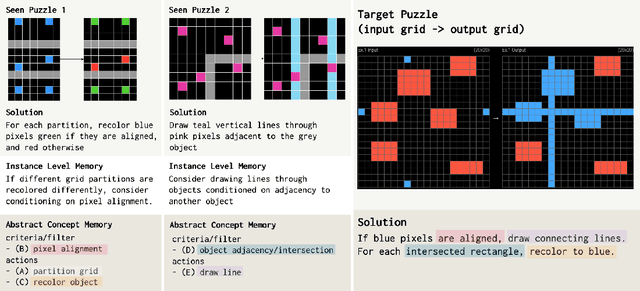
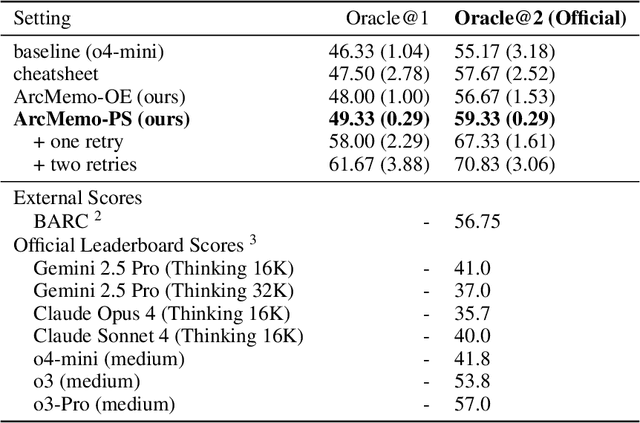
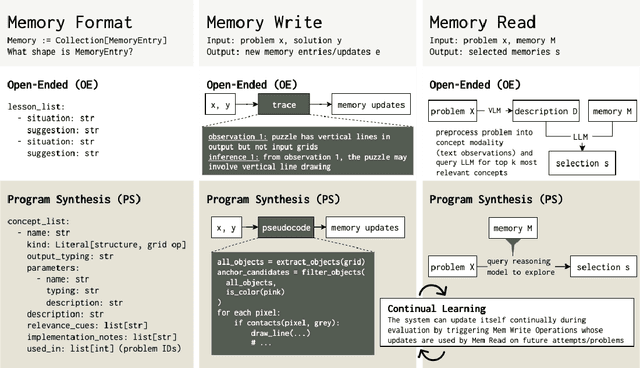
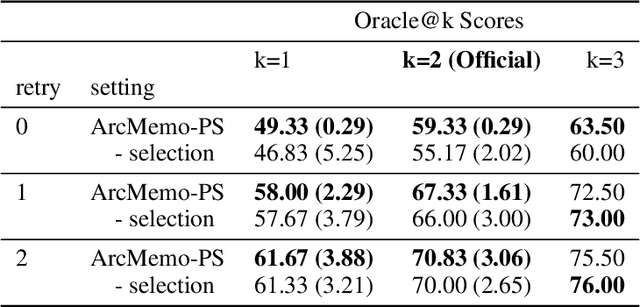
While inference-time scaling enables LLMs to carry out increasingly long and capable reasoning traces, the patterns and insights uncovered during these traces are immediately discarded once the context window is reset for a new query. External memory is a natural way to persist these discoveries, and recent work has shown clear benefits for reasoning-intensive tasks. We see an opportunity to make such memories more broadly reusable and scalable by moving beyond instance-based memory entries (e.g. exact query/response pairs, or summaries tightly coupled with the original problem context) toward concept-level memory: reusable, modular abstractions distilled from solution traces and stored in natural language. For future queries, relevant concepts are selectively retrieved and integrated into the prompt, enabling test-time continual learning without weight updates. Our design introduces new strategies for abstracting takeaways from rollouts and retrieving entries for new queries, promoting reuse and allowing memory to expand with additional experiences. On the challenging ARC-AGI benchmark, our method yields a 7.5% relative gain over a strong no-memory baseline with performance continuing to scale with inference compute. We find abstract concepts to be the most consistent memory design, outscoring the baseline at all tested inference compute scales. Moreover, we confirm that dynamically updating memory during test-time outperforms an otherwise identical fixed memory setting with additional attempts, supporting the hypothesis that solving more problems and abstracting more patterns to memory enables further solutions in a form of self-improvement. Code available at https://github.com/matt-seb-ho/arc_memo.