 Add to Chrome
 Add to Firefox
 Add to Edge
SafeCA: Safe Cross-Attention Localization and Regulation for Text-to-Video Jailbreak Defense
Aug 11, 2026
Text-to-Video (T2V) generative models are vulnerable to jailbreak attacks in real-world deployment, leading them to produce harmful or inappropriate content. Existing defense approaches mainly rely on input filtering or reconstruction, which not only incur high computational latency but also tend to distort semantics. To address these issues, we experimentally and systematically analyze the differences between clean and jailbreak samples in the cross-attention feature space, revealing for the first time a cumulative separation effect and a progressively increasing trend of linear separability between the two during the diffusion process. Based on this insight, we propose SafeCA, a feature-level defense mechanism for safe cross-attention localization and regularization. Firstly, we identify key defensive regions and values through attention stability analysis using cross-attention features collected from clean prompts within a single inference. Secondly, SafeCA mitigates anomalous activations via attention masking with energy normalization and introduces a lightweight semantic-space adapter to redirect abnormal semantic flows. Furthermore, we detect and suppress potentially malicious tokens by back-propagating feature anomaly signals to the input cue words, thereby enhancing the deployability of the defense in commercial models. Experimental results show that SafeCA reduces the jailbreak success rate by about 20% on mainstream T2V models, adds almost no inference overhead (+0.1s), and maintains good text-video semantic consistency. Overall, SafeCA provides an architecture-level, deployable protection paradigm for T2V generation models.

CASIAL: Geometric Distortion Robust Image Watermarking
Jul 29, 2026Deep learning-based watermarking has shown strong robustness against non-geometric distortions, yet its performance under geometric transformations remains limited. Such transformations induce two fundamental failure modes: region removal, such as cropping or masking, which eliminates the information carried by removed pixels, and desynchronization, such as scaling or rotation, which misaligns pixel positions and disrupts decoding. We argue that achieving geometric robustness requires two essential properties: (1) global spread of the watermark message, ensuring resilience even when large regions are removed, and (2) geometry-invariant representations, enabling decoding to remain synchronized despite spatial transformations. Building on these insights, we propose CASIAL, a geometric distortion-robust watermarking framework with cover image-aware message spreading (CAS) strategy and invariance alignment learning (IAL) module. CAS tightly couples watermark bits with cover image features and distributes them adaptively across the entire image, enhancing per-pixel information capacity and robustness to region removal. IAL leverages spatial attention to capture cross-pixel dependencies and align perturbed features into a shared geometry-invariant representation space, mitigating failures due to desynchronization. Across six challenging geometric transformations, CASIAL achieves substantially stronger robustness than eleven prior baselines while preserving high visual quality. It also maintains competitive performance under six signal distortions and four photometric transformations. Notably, although trained only with white-box distortions, CASIAL also exhibits strong transfer robustness to unseen black-box distortions. Comprehensive experiments demonstrate the broad robustness and superior visual quality of our method.
ResGuard: Enhancing Robustness Against Known Original Attacks in Deep Watermarking
Apr 04, 2026Deep learning-based image watermarking commonly adopts an "Encoder-Noise Layer-Decoder" (END) architecture to improve robustness against random channel distortions, yet it often overlooks intentional manipulations introduced by adversaries with additional knowledge. In this paper, we revisit this paradigm and expose a critical yet underexplored vulnerability: the Known Original Attack (KOA), where an adversary has access to multiple original-watermarked image pairs, enabling various targeted suppression strategies. We show that even a simple residual-based removal approach, namely estimating an embedding residual from known pairs and subtracting it from unseen watermarked images, can almost completely remove the watermark while preserving visual quality. This vulnerability stems from the insufficient image dependency of residuals produced by END frameworks, which makes them transferable across images. To address this, we propose ResGuard, a plug-and-play module that enhances KOA robustness by enforcing image-dependent embedding. Its core lies in a residual specificity enhancement loss, which encourages residuals to be tightly coupled with their host images and thus improves image dependency. Furthermore, an auxiliary KOA noise layer injects residual-style perturbations during training, allowing the decoder to remain reliable under stronger embedding inconsistencies. Integrated into existing frameworks, ResGuard boosts KOA robustness, improving average watermark extraction accuracy from 59.87% to 99.81%.
SpikySpace: A Spiking State Space Model for Energy-Efficient Time Series Forecasting
Jan 02, 2026Time-series forecasting often operates under tight power and latency budgets in fields like traffic management, industrial condition monitoring, and on-device sensing. These applications frequently require near real-time responses and low energy consumption on edge devices. Spiking neural networks (SNNs) offer event-driven computation and ultra-low power by exploiting temporal sparsity and multiplication-free computation. Yet existing SNN-based time-series forecasters often inherit complex transformer blocks, thereby losing much of the efficiency benefit. To solve the problem, we propose SpikySpace, a spiking state-space model (SSM) that reduces the quadratic cost in the attention block to linear time via selective scanning. Further, we replace dense SSM updates with sparse spike trains and execute selective scans only on spike events, thereby avoiding dense multiplications while preserving the SSM's structured memory. Because complex operations such as exponentials and divisions are costly on neuromorphic chips, we introduce simplified approximations of SiLU and Softplus to enable a neuromorphic-friendly model architecture. In matched settings, SpikySpace reduces estimated energy consumption by 98.73% and 96.24% compared to two state-of-the-art transformer based approaches, namely iTransformer and iSpikformer, respectively. In standard time series forecasting datasets, SpikySpace delivers competitive accuracy while substantially reducing energy cost and memory traffic. As the first full spiking state-space model, SpikySpace bridges neuromorphic efficiency with modern sequence modeling, marking a practical and scalable path toward efficient time series forecasting systems.
Tracing the Origin of Adversarial Attack for Forensic Investigation and Deterrence
Dec 31, 2022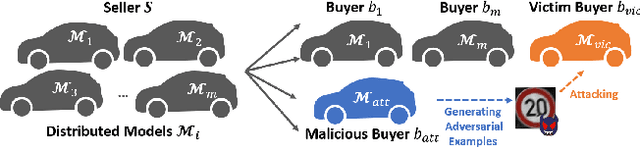
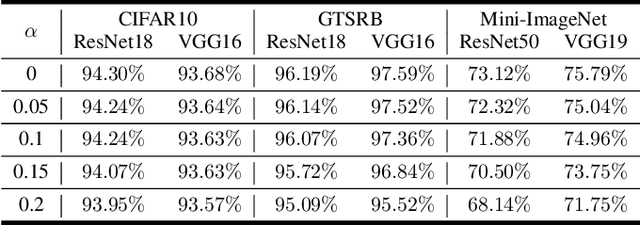
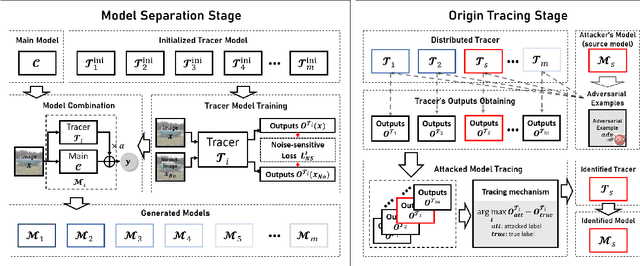
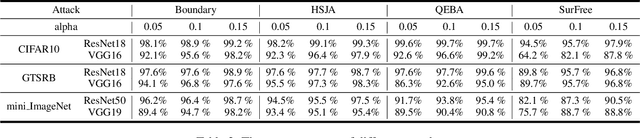
Deep neural networks are vulnerable to adversarial attacks. In this paper, we take the role of investigators who want to trace the attack and identify the source, that is, the particular model which the adversarial examples are generated from. Techniques derived would aid forensic investigation of attack incidents and serve as deterrence to potential attacks. We consider the buyers-seller setting where a machine learning model is to be distributed to various buyers and each buyer receives a slightly different copy with same functionality. A malicious buyer generates adversarial examples from a particular copy $\mathcal{M}_i$ and uses them to attack other copies. From these adversarial examples, the investigator wants to identify the source $\mathcal{M}_i$. To address this problem, we propose a two-stage separate-and-trace framework. The model separation stage generates multiple copies of a model for a same classification task. This process injects unique characteristics into each copy so that adversarial examples generated have distinct and traceable features. We give a parallel structure which embeds a ``tracer'' in each copy, and a noise-sensitive training loss to achieve this goal. The tracing stage takes in adversarial examples and a few candidate models, and identifies the likely source. Based on the unique features induced by the noise-sensitive loss function, we could effectively trace the potential adversarial copy by considering the output logits from each tracer. Empirical results show that it is possible to trace the origin of the adversarial example and the mechanism can be applied to a wide range of architectures and datasets.