 Add to Chrome
 Add to Firefox
 Add to Edge
See, Plan, Rewind: Progress-Aware Vision-Language-Action Models for Robust Robotic Manipulation
Mar 10, 2026
Measurement of task progress through explicit, actionable milestones is critical for robust robotic manipulation. This progress awareness enables a model to ground its current task status, anticipate verifiable intermediate states, and detect and recover from failures when progress stalls. To embody this capability, we introduce See, Plan, Rewind (SPR), a progress-aware vision-language-action framework that dynamically grounds language instructions into a sequence of spatial subgoals. SPR operates through a continuous core cycle, Seeing the current state and upcoming milestone, Planning a trajectory towards the next 2D waypoint, and Rewinding to a recoverable state upon failure by monitoring progress against the expected sequence. This closed-loop approach enables robust error correction without requiring additional training data or auxiliary models. Extensive experiments demonstrate the framework's effectiveness, generalization and robustness: SPR outperforms the MolmoAct baseline by 5\% on the LIBERO benchmark. On the challenging LIBERO-Plus benchmark with unseen instructions and initial states, SPR achieves state-of-the-art robustness with the smallest performance drop, surpassing OpenVLA-OFT and UniVLA, demonstrating superior out-of-distribution robustness.

AttacKG+:Boosting Attack Knowledge Graph Construction with Large Language Models
May 08, 2024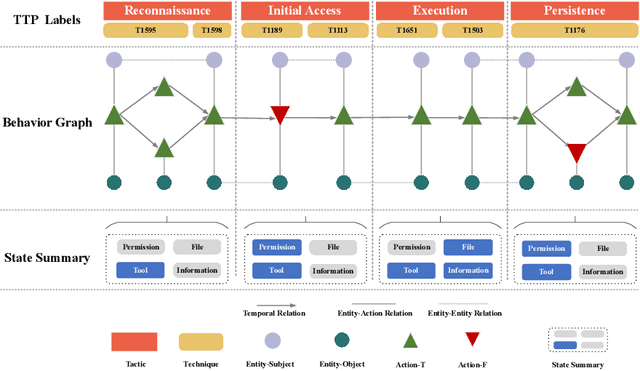
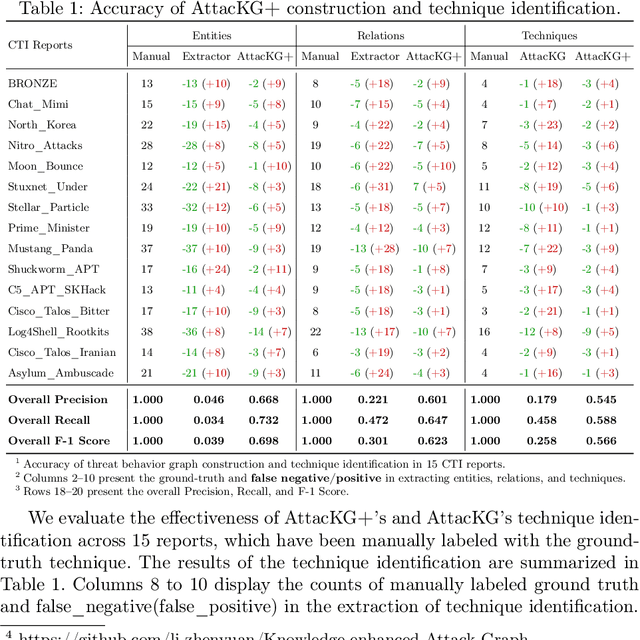
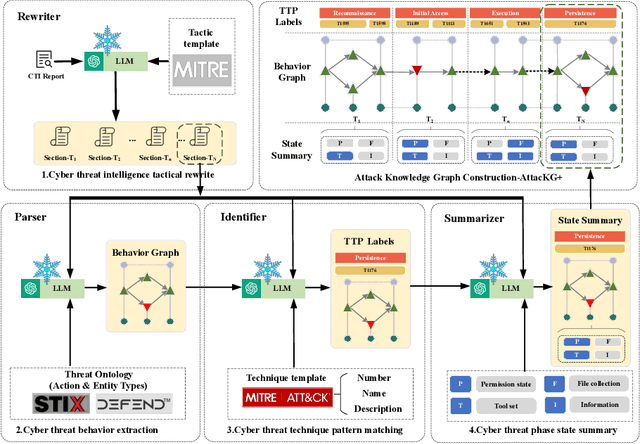
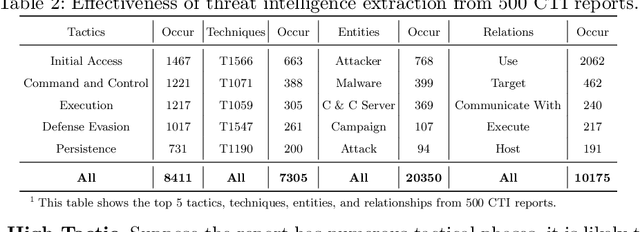
Attack knowledge graph construction seeks to convert textual cyber threat intelligence (CTI) reports into structured representations, portraying the evolutionary traces of cyber attacks. Even though previous research has proposed various methods to construct attack knowledge graphs, they generally suffer from limited generalization capability to diverse knowledge types as well as requirement of expertise in model design and tuning. Addressing these limitations, we seek to utilize Large Language Models (LLMs), which have achieved enormous success in a broad range of tasks given exceptional capabilities in both language understanding and zero-shot task fulfillment. Thus, we propose a fully automatic LLM-based framework to construct attack knowledge graphs named: AttacKG+. Our framework consists of four consecutive modules: rewriter, parser, identifier, and summarizer, each of which is implemented by instruction prompting and in-context learning empowered by LLMs. Furthermore, we upgrade the existing attack knowledge schema and propose a comprehensive version. We represent a cyber attack as a temporally unfolding event, each temporal step of which encapsulates three layers of representation, including behavior graph, MITRE TTP labels, and state summary. Extensive evaluation demonstrates that: 1) our formulation seamlessly satisfies the information needs in threat event analysis, 2) our construction framework is effective in faithfully and accurately extracting the information defined by AttacKG+, and 3) our attack graph directly benefits downstream security practices such as attack reconstruction. All the code and datasets will be released upon acceptance.