 Add to Chrome
 Add to Firefox
 Add to Edge
Proposition from the Perspective of Chinese Language: A Chinese Proposition Classification Evaluation Benchmark
Sep 18, 2023
Existing propositions often rely on logical constants for classification. Compared with Western languages that lean towards hypotaxis such as English, Chinese often relies on semantic or logical understanding rather than logical connectives in daily expressions, exhibiting the characteristics of parataxis. However, existing research has rarely paid attention to this issue. And accurately classifying these propositions is crucial for natural language understanding and reasoning. In this paper, we put forward the concepts of explicit and implicit propositions and propose a comprehensive multi-level proposition classification system based on linguistics and logic. Correspondingly, we create a large-scale Chinese proposition dataset PEACE from multiple domains, covering all categories related to propositions. To evaluate the Chinese proposition classification ability of existing models and explore their limitations, We conduct evaluations on PEACE using several different methods including the Rule-based method, SVM, BERT, RoBERTA, and ChatGPT. Results show the importance of properly modeling the semantic features of propositions. BERT has relatively good proposition classification capability, but lacks cross-domain transferability. ChatGPT performs poorly, but its classification ability can be improved by providing more proposition information. Many issues are still far from being resolved and require further study.

Unifying Robustness and Fidelity: A Comprehensive Study of Pretrained Generative Methods for Speech Enhancement in Adverse Conditions
Sep 16, 2023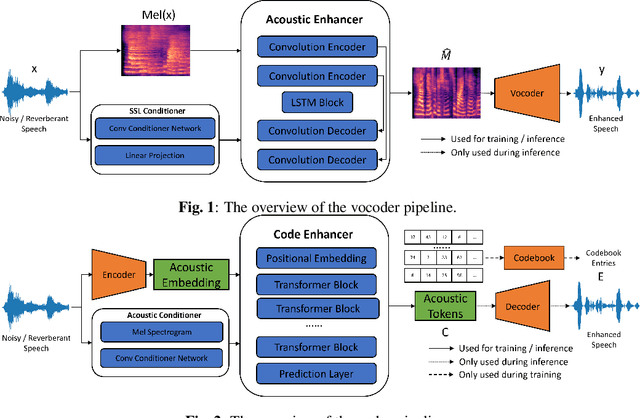
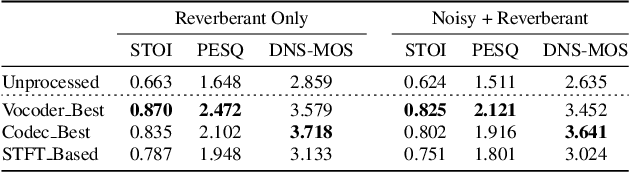
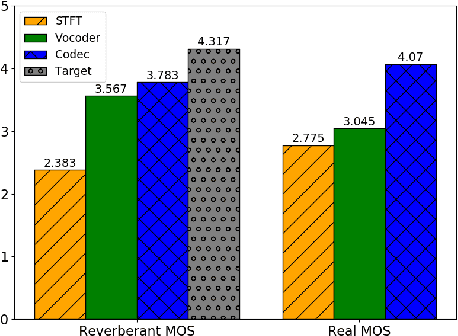
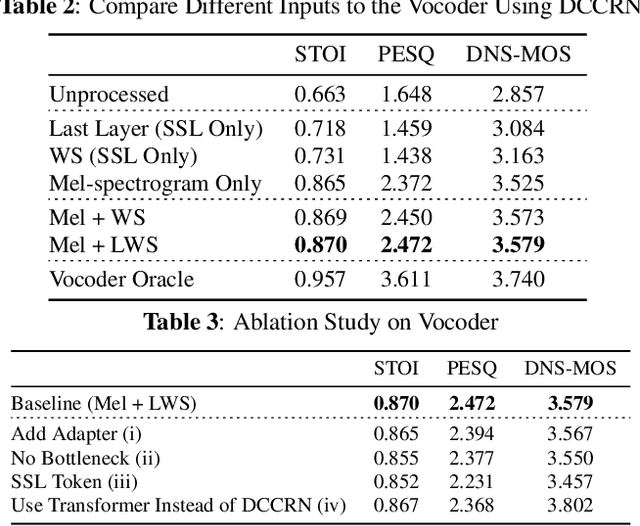
Enhancing speech signal quality in adverse acoustic environments is a persistent challenge in speech processing. Existing deep learning based enhancement methods often struggle to effectively remove background noise and reverberation in real-world scenarios, hampering listening experiences. To address these challenges, we propose a novel approach that uses pre-trained generative methods to resynthesize clean, anechoic speech from degraded inputs. This study leverages pre-trained vocoder or codec models to synthesize high-quality speech while enhancing robustness in challenging scenarios. Generative methods effectively handle information loss in speech signals, resulting in regenerated speech that has improved fidelity and reduced artifacts. By harnessing the capabilities of pre-trained models, we achieve faithful reproduction of the original speech in adverse conditions. Experimental evaluations on both simulated datasets and realistic samples demonstrate the effectiveness and robustness of our proposed methods. Especially by leveraging codec, we achieve superior subjective scores for both simulated and realistic recordings. The generated speech exhibits enhanced audio quality, reduced background noise, and reverberation. Our findings highlight the potential of pre-trained generative techniques in speech processing, particularly in scenarios where traditional methods falter. Demos are available at https://whmrtm.github.io/SoundResynthesis.
LASER: LLM Agent with State-Space Exploration for Web Navigation
Sep 15, 2023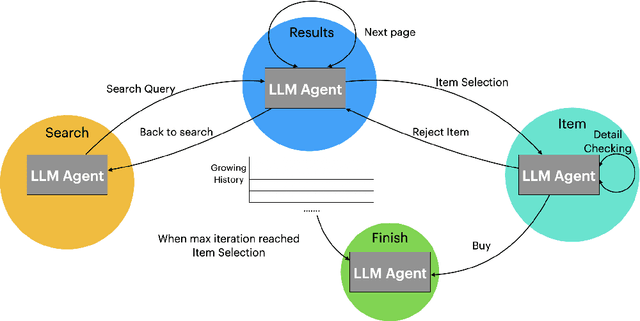
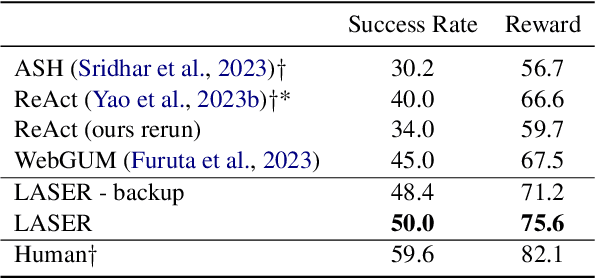
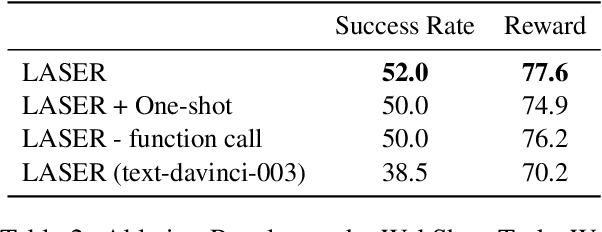
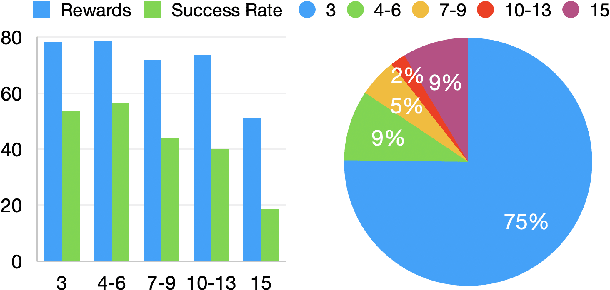
Large language models (LLMs) have been successfully adapted for interactive decision-making tasks like web navigation. While achieving decent performance, previous methods implicitly assume a forward-only execution mode for the model, where they only provide oracle trajectories as in-context examples to teach the model how to reason in the interactive environment. Consequently, the model could not handle more challenging scenarios not covered in the in-context examples, e.g., mistakes, leading to sub-optimal performance. To address this issue, we propose to model the interactive task as state space exploration, where the LLM agent transitions among a pre-defined set of states by performing actions to complete the task. This formulation enables flexible back-tracking, allowing the model to easily recover from errors. We evaluate our proposed LLM Agent with State-Space ExploRation (LASER) on the WebShop task. Experimental results show that our LASER agent significantly outperforms previous methods and closes the gap with human performance on the web navigation task.
SpatialCodec: Neural Spatial Speech Coding
Sep 14, 2023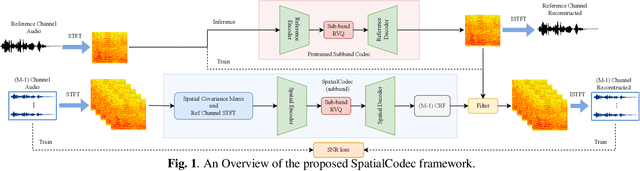
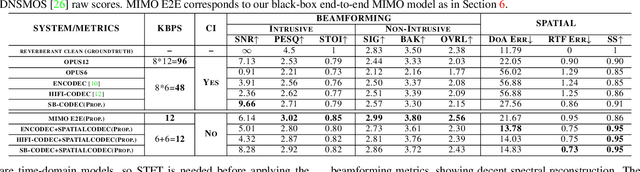
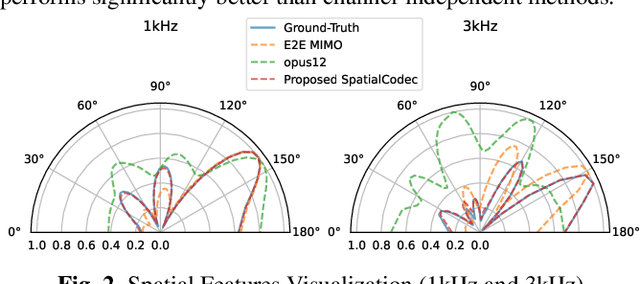
In this work, we address the challenge of encoding speech captured by a microphone array using deep learning techniques with the aim of preserving and accurately reconstructing crucial spatial cues embedded in multi-channel recordings. We propose a neural spatial audio coding framework that achieves a high compression ratio, leveraging single-channel neural sub-band codec and SpatialCodec. Our approach encompasses two phases: (i) a neural sub-band codec is designed to encode the reference channel with low bit rates, and (ii), a SpatialCodec captures relative spatial information for accurate multi-channel reconstruction at the decoder end. In addition, we also propose novel evaluation metrics to assess the spatial cue preservation: (i) spatial similarity, which calculates cosine similarity on a spatially intuitive beamspace, and (ii), beamformed audio quality. Our system shows superior spatial performance compared with high bitrate baselines and black-box neural architecture. Demos are available at https://xzwy.github.io/SpatialCodecDemo. Codes and models are available at https://github.com/XZWY/SpatialCodec.
Unsupervised Multi-document Summarization with Holistic Inference
Sep 08, 2023


Multi-document summarization aims to obtain core information from a collection of documents written on the same topic. This paper proposes a new holistic framework for unsupervised multi-document extractive summarization. Our method incorporates the holistic beam search inference method associated with the holistic measurements, named Subset Representative Index (SRI). SRI balances the importance and diversity of a subset of sentences from the source documents and can be calculated in unsupervised and adaptive manners. To demonstrate the effectiveness of our method, we conduct extensive experiments on both small and large-scale multi-document summarization datasets under both unsupervised and adaptive settings. The proposed method outperforms strong baselines by a significant margin, as indicated by the resulting ROUGE scores and diversity measures. Our findings also suggest that diversity is essential for improving multi-document summary performance.
Text-Only Domain Adaptation for End-to-End Speech Recognition through Down-Sampling Acoustic Representation
Sep 04, 2023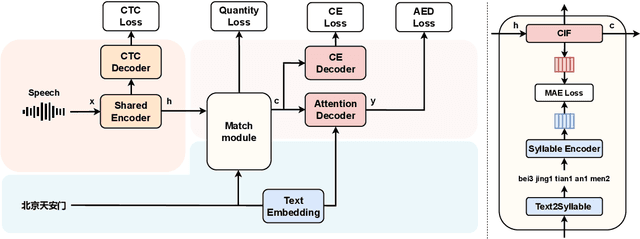


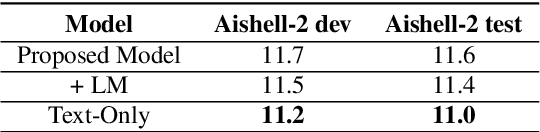
Mapping two modalities, speech and text, into a shared representation space, is a research topic of using text-only data to improve end-to-end automatic speech recognition (ASR) performance in new domains. However, the length of speech representation and text representation is inconsistent. Although the previous method up-samples the text representation to align with acoustic modality, it may not match the expected actual duration. In this paper, we proposed novel representations match strategy through down-sampling acoustic representation to align with text modality. By introducing a continuous integrate-and-fire (CIF) module generating acoustic representations consistent with token length, our ASR model can learn unified representations from both modalities better, allowing for domain adaptation using text-only data of the target domain. Experiment results of new domain data demonstrate the effectiveness of the proposed method.
Bayes Risk Transducer: Transducer with Controllable Alignment Prediction
Aug 19, 2023Automatic speech recognition (ASR) based on transducers is widely used. In training, a transducer maximizes the summed posteriors of all paths. The path with the highest posterior is commonly defined as the predicted alignment between the speech and the transcription. While the vanilla transducer does not have a prior preference for any of the valid paths, this work intends to enforce the preferred paths and achieve controllable alignment prediction. Specifically, this work proposes Bayes Risk Transducer (BRT), which uses a Bayes risk function to set lower risk values to the preferred paths so that the predicted alignment is more likely to satisfy specific desired properties. We further demonstrate that these predicted alignments with intentionally designed properties can provide practical advantages over the vanilla transducer. Experimentally, the proposed BRT saves inference cost by up to 46% for non-streaming ASR and reduces overall system latency by 41% for streaming ASR.
Skills-in-Context Prompting: Unlocking Compositionality in Large Language Models
Aug 14, 2023We consider the problem of eliciting compositional generalization capabilities in large language models (LLMs) with a novel type of prompting strategy. Compositional generalization empowers the LLMs to solve problems that are harder than the ones they have seen (i.e., easy-to-hard generalization), which is a critical reasoning capability of human-like intelligence. However, even the current state-of-the-art LLMs still struggle with this form of reasoning. To bridge this gap, we propose skills-in-context (SKiC) prompting, which instructs LLMs how to compose basic skills to resolve more complex problems. We find that it is crucial to demonstrate both the skills and the compositional examples within the same prompting context. With as few as two examplars, our SKiC prompting initiates strong synergies between skills and their composition capabilities. Notably, it empowers LLMs to solve unseen problems that require innovative skill compositions, achieving near-perfect generalization on a broad range of challenging compositionality tasks. Intriguingly, SKiC prompting unlocks the latent potential of LLMs, enabling them to leverage pre-existing internal skills acquired during earlier pre-training stages, even when these skills are not explicitly presented in the prompting context. This results in the capability of LLMs to solve unseen complex problems by activating and composing internal competencies. With such prominent features, SKiC prompting is able to achieve state-of-the-art performance on challenging mathematical reasoning benchmarks (e.g., MATH).
Thrust: Adaptively Propels Large Language Models with External Knowledge
Jul 19, 2023Although large-scale pre-trained language models (PTLMs) are shown to encode rich knowledge in their model parameters, the inherent knowledge in PTLMs can be opaque or static, making external knowledge necessary. However, the existing information retrieval techniques could be costly and may even introduce noisy and sometimes misleading knowledge. To address these challenges, we propose the instance-level adaptive propulsion of external knowledge (IAPEK), where we only conduct the retrieval when necessary. To achieve this goal, we propose measuring whether a PTLM contains enough knowledge to solve an instance with a novel metric, Thrust, which leverages the representation distribution of a small number of seen instances. Extensive experiments demonstrate that thrust is a good measurement of PTLM models' instance-level knowledgeability. Moreover, we can achieve significantly higher cost-efficiency with the Thrust score as the retrieval indicator than the naive usage of external knowledge on 88% of the evaluated tasks with 26% average performance improvement. Such findings shed light on the real-world practice of knowledge-enhanced LMs with a limited knowledge-seeking budget due to computation latency or costs.
MinT: Boosting Generalization in Mathematical Reasoning via Multi-View Fine-Tuning
Jul 16, 2023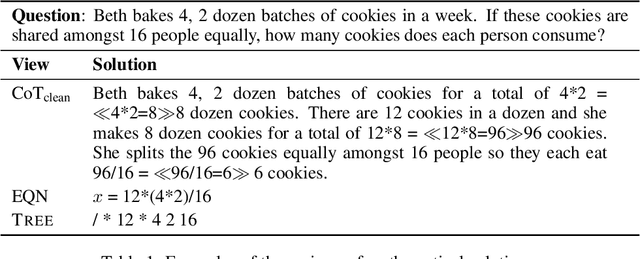
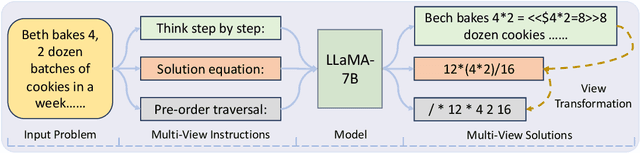

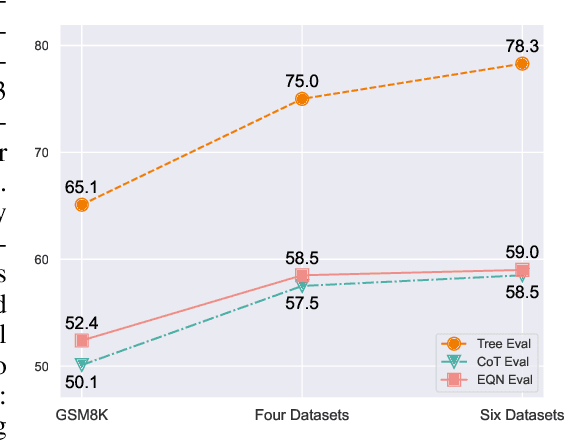
Reasoning in mathematical domains remains a significant challenge for relatively small language models (LMs). Many current methods focus on specializing LMs in mathematical reasoning and rely heavily on knowledge distillation from powerful but inefficient large LMs (LLMs). In this work, we explore a new direction that avoids over-reliance on LLM teachers, introducing a multi-view fine-tuning method that efficiently exploits existing mathematical problem datasets with diverse annotation styles. Our approach uniquely considers the various annotation formats as different "views" and leverages them in training the model. By postpending distinct instructions to input questions, models can learn to generate solutions in diverse formats in a flexible manner. Experimental results show that our strategy enables a LLaMA-7B model to outperform prior approaches that utilize knowledge distillation, as well as carefully established baselines. Additionally, the proposed method grants the models promising generalization ability across various views and datasets, and the capability to learn from inaccurate or incomplete noisy data. We hope our multi-view training paradigm could inspire future studies in other machine reasoning domains.