 Add to Chrome
 Add to Firefox
 Add to Edge
StreamHear: Domain-Adapted Pseudo-Labeling for Semi-Supervised Streaming Speech Recognition
Aug 13, 2026
Streaming automatic speech recognition (ASR) underperforms on domain-shifted target audio, where labeled in-domain data is costly to prepare while unlabeled audio is abundant. We present StreamHear, a semi-supervised pipeline that adapts a pretrained streaming student by fine-tuning an offline transducer teacher on the labeled training set, generating pseudo-labels on the unlabeled portion, and fine-tuning the student on the mixture. We further introduce a prior-regularized dynamic-programming realignment step that fixes chunk-level word placement using an ASR-hypothesis anchor. Across four datasets spanning financial calls, prepared read speech, and phone-quality dialogue, StreamHear consistently outperforms supervised student fine-tuning and narrows the gap to the offline teacher.

Ask, Don't Judge: Binary Questions for Interpretable LLM Evaluation and Self-Improvement
Jun 25, 2026Evaluating LLM outputs remains a major bottleneck in NLP: human evaluation is expensive and slow, lexical metrics correlate poorly with human judgments on open-ended generation, and holistic LLM judges often produce opaque scores that are hard to debug. We propose BINEVAL, a framework that decomposes evaluation criteria into atomic binary questions and aggregates the resulting verdicts into interpretable, multi-dimensional scores. Given a task prompt, a meta-prompt generates fine-grained evaluation questions, and an LLM answers them independently for each output, yielding transparent question-level feedback together with calibrated overall scores. This decomposition makes evaluation easier to inspect, easier to diagnose, and directly usable for prompt improvement. Across SummEval, Topical-Chat, and QAGS, BINEVAL matches or outperforms strong baselines including UniEval and G-Eval, with especially strong results on factual consistency benchmarks such as QAGS. Beyond competitive correlation with human judgments, BINEVAL better matches human score distributions and avoids the ceiling effects common in prior LLM judges, leading to better discrimination between borderline and clearly flawed outputs. We further show that the same question-level feedback supports iterative prompt optimization, improving evaluator prompts on summarization and generation prompts on IFBench under both self-update and cross-model update settings. Overall, BINEVAL provides a task-agnostic, training-free, and interpretable evaluation framework that combines strong empirical performance with practical diagnostic and optimization value.
SAFARI: Scaling Long Horizon Agentic Fault Attribution via Active Investigation
Jun 23, 2026As autonomous agents tackle increasingly complex multi-step, multi-agent tasks, their execution trajectories have scaled beyond the constraints of even the largest context windows. Current methods for effectively diagnosing agent failures load the full trajectory into an LLM's context window, which suffers from attention dilution and fails when agentic traces inevitably exceed context limits. To address this, we introduce SAFARI (Scaling long-horizon Agentic Fault AttRibution via active Investigation), a framework that replaces linear context loading with a tool-augmented diagnostic loop. By equipping LLMs with a specialized toolbox to read and search trajectory segments alongside a persistent Short-Term Memory (STM) for cross-turn reasoning, SAFARI effectively decouples diagnostic accuracy from architectural context limits. Our experiments demonstrate that SAFARI outperforms state-of-the-art results by 20% on the Who&When dataset within a 1M token budget, and by 19% on TRAIL GAIA subset on a 25K token budget. Most significantly, SAFARI maintains a 0.58 precision even when the target fault resides 5x beyond the model's native context window, a scenario where traditional evaluators fail entirely.
RECAP: Regression Evaluation for Continual Adaptation of Prompts
Jun 04, 2026Production agentic systems routinely face evolving constraints and must comply from the very next interaction. Scenarios like a tool-call notification changing a compliance threshold or a policy update adding disclosure requirements fit this criteria, having close to no room for errors in production. This proactive adaptation setting is common in deployment, but absent from current benchmarks, which assume either static constraint sets or reactive protocols with evaluation feedback. We introduce RECAP, a benchmark that measures continual-learning phenomena (forgetting, regression, forward transfer) at the constraint level under a strictly proactive adapt-then-test protocol: prompt optimization methods receive only the constraint specification and must generalize before seeing any test data. Evaluating six methods across four LLMs and three schedules with evolving constraints, we find that these methods show no significant improvement in performance, even after incurring a higher latency. These methods, designed for offline or reactive settings, are inadequate for the proactive paradigm. Our work emphasizes the growing need for designing proactive prompt adaptation methods, where the models must remain robust to evolving needs in deployment.
DIAL-SUMMER: A Structured Evaluation Framework of Hierarchical Errors in Dialogue Summaries
Feb 08, 2026Dialogues are a predominant mode of communication for humans, and it is immensely helpful to have automatically generated summaries of them (e.g., to revise key points discussed in a meeting, to review conversations between customer agents and product users). Prior works on dialogue summary evaluation largely ignore the complexities specific to this task: (i) shift in structure, from multiple speakers discussing information in a scattered fashion across several turns, to a summary's sentences, and (ii) shift in narration viewpoint, from speakers' first/second-person narration, standardized third-person narration in the summary. In this work, we introduce our framework DIALSUMMER to address the above. We propose DIAL-SUMMER's taxonomy of errors to comprehensively evaluate dialogue summaries at two hierarchical levels: DIALOGUE-LEVEL that focuses on the broader speakers/turns, and WITHIN-TURN-LEVEL that focuses on the information talked about inside a turn. We then present DIAL-SUMMER's dataset composed of dialogue summaries manually annotated with our taxonomy's fine-grained errors. We conduct empirical analyses of these annotated errors, and observe interesting trends (e.g., turns occurring in middle of the dialogue are the most frequently missed in the summary, extrinsic hallucinations largely occur at the end of the summary). We also conduct experiments on LLM-Judges' capability at detecting these errors, through which we demonstrate the challenging nature of our dataset, the robustness of our taxonomy, and the need for future work in this field to enhance LLMs' performance in the same. Code and inference dataset coming soon.
Lessons from the Field: An Adaptable Lifecycle Approach to Applied Dialogue Summarization
Jan 13, 2026Summarization of multi-party dialogues is a critical capability in industry, enhancing knowledge transfer and operational effectiveness across many domains. However, automatically generating high-quality summaries is challenging, as the ideal summary must satisfy a set of complex, multi-faceted requirements. While summarization has received immense attention in research, prior work has primarily utilized static datasets and benchmarks, a condition rare in practical scenarios where requirements inevitably evolve. In this work, we present an industry case study on developing an agentic system to summarize multi-party interactions. We share practical insights spanning the full development lifecycle to guide practitioners in building reliable, adaptable summarization systems, as well as to inform future research, covering: 1) robust methods for evaluation despite evolving requirements and task subjectivity, 2) component-wise optimization enabled by the task decomposition inherent in an agentic architecture, 3) the impact of upstream data bottlenecks, and 4) the realities of vendor lock-in due to the poor transferability of LLM prompts.
Leveraging Parameter Space Symmetries for Reasoning Skill Transfer in LLMs
Nov 13, 2025Task arithmetic is a powerful technique for transferring skills between Large Language Models (LLMs), but it often suffers from negative interference when models have diverged during training. We address this limitation by first aligning the models' parameter spaces, leveraging the inherent permutation, rotation, and scaling symmetries of Transformer architectures. We adapt parameter space alignment for modern Grouped-Query Attention (GQA) and SwiGLU layers, exploring both weight-based and activation-based approaches. Using this alignment-first strategy, we successfully transfer advanced reasoning skills to a non-reasoning model. Experiments on challenging reasoning benchmarks show that our method consistently outperforms standard task arithmetic. This work provides an effective approach for merging and transferring specialized skills across evolving LLM families, reducing redundant fine-tuning and enhancing model adaptability.
Skills Regularized Task Decomposition for Multi-task Offline Reinforcement Learning
Aug 28, 2024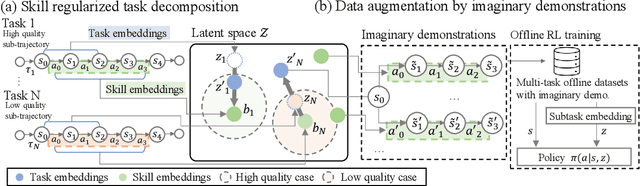
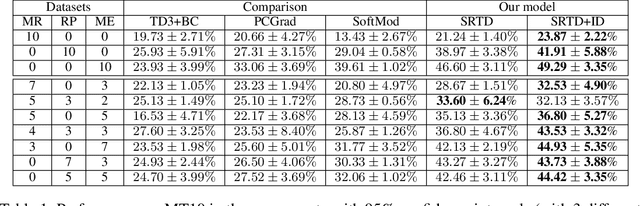
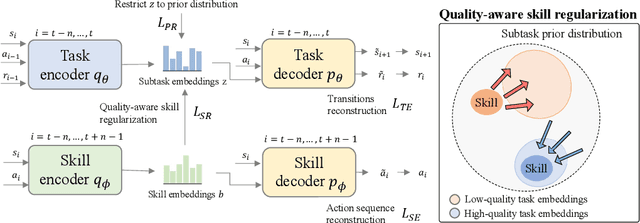
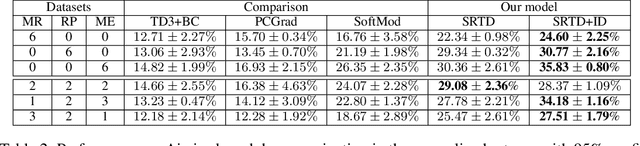
Reinforcement learning (RL) with diverse offline datasets can have the advantage of leveraging the relation of multiple tasks and the common skills learned across those tasks, hence allowing us to deal with real-world complex problems efficiently in a data-driven way. In offline RL where only offline data is used and online interaction with the environment is restricted, it is yet difficult to achieve the optimal policy for multiple tasks, especially when the data quality varies for the tasks. In this paper, we present a skill-based multi-task RL technique on heterogeneous datasets that are generated by behavior policies of different quality. To learn the shareable knowledge across those datasets effectively, we employ a task decomposition method for which common skills are jointly learned and used as guidance to reformulate a task in shared and achievable subtasks. In this joint learning, we use Wasserstein auto-encoder (WAE) to represent both skills and tasks on the same latent space and use the quality-weighted loss as a regularization term to induce tasks to be decomposed into subtasks that are more consistent with high-quality skills than others. To improve the performance of offline RL agents learned on the latent space, we also augment datasets with imaginary trajectories relevant to high-quality skills for each task. Through experiments, we show that our multi-task offline RL approach is robust to the mixed configurations of different-quality datasets and it outperforms other state-of-the-art algorithms for several robotic manipulation tasks and drone navigation tasks.
When Reasoning Meets Information Aggregation: A Case Study with Sports Narratives
Jun 17, 2024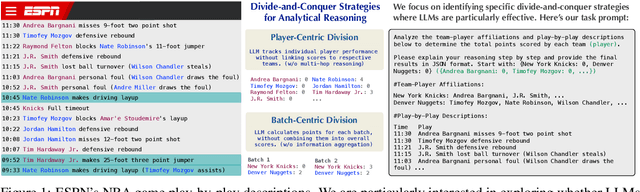


Reasoning is most powerful when an LLM accurately aggregates relevant information. We examine the critical role of information aggregation in reasoning by requiring the LLM to analyze sports narratives. To succeed at this task, an LLM must infer points from actions, identify related entities, attribute points accurately to players and teams, and compile key statistics to draw conclusions. We conduct comprehensive experiments with real NBA basketball data and present SportsGen, a new method to synthesize game narratives. By synthesizing data, we can rigorously evaluate LLMs' reasoning capabilities under complex scenarios with varying narrative lengths and density of information. Our findings show that most models, including GPT-4o, often fail to accurately aggregate basketball scores due to frequent scoring patterns. Open-source models like Llama-3 further suffer from significant score hallucinations. Finally, the effectiveness of reasoning is influenced by narrative complexity, information density, and domain-specific terms, highlighting the challenges in analytical reasoning tasks.
Polarity Calibration for Opinion Summarization
Apr 02, 2024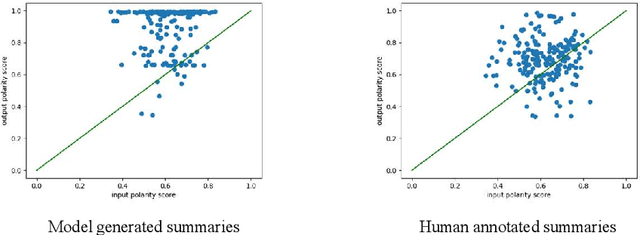
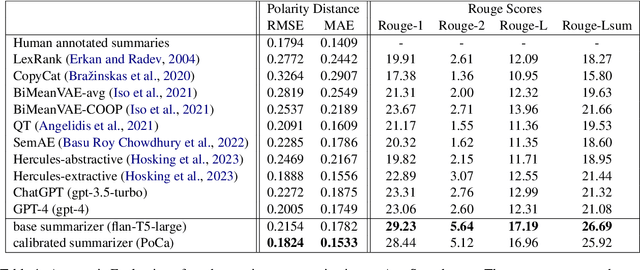
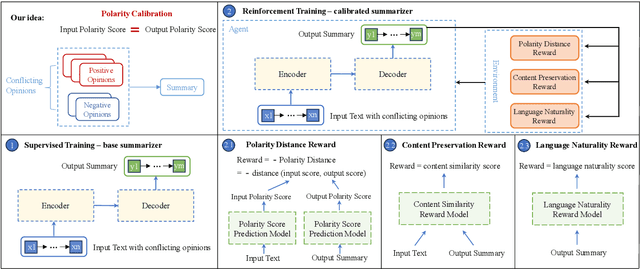
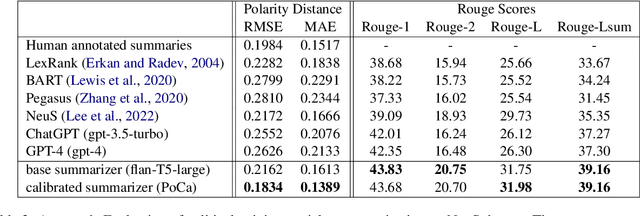
Opinion summarization is automatically generating summaries from a variety of subjective information, such as product reviews or political opinions. The challenge of opinions summarization lies in presenting divergent or even conflicting opinions. We conduct an analysis of previous summarization models, which reveals their inclination to amplify the polarity bias, emphasizing the majority opinions while ignoring the minority opinions. To address this issue and make the summarizer express both sides of opinions, we introduce the concept of polarity calibration, which aims to align the polarity of output summary with that of input text. Specifically, we develop a reinforcement training approach for polarity calibration. This approach feeds the polarity distance between output summary and input text as reward into the summarizer, and also balance polarity calibration with content preservation and language naturality. We evaluate our Polarity Calibration model (PoCa) on two types of opinions summarization tasks: summarizing product reviews and political opinions articles. Automatic and human evaluation demonstrate that our approach can mitigate the polarity mismatch between output summary and input text, as well as maintain the content semantic and language quality.