 Add to Chrome
 Add to Firefox
 Add to Edge
Enhancing Financial Time-Series Forecasting with Retrieval-Augmented Large Language Models
Feb 11, 2025
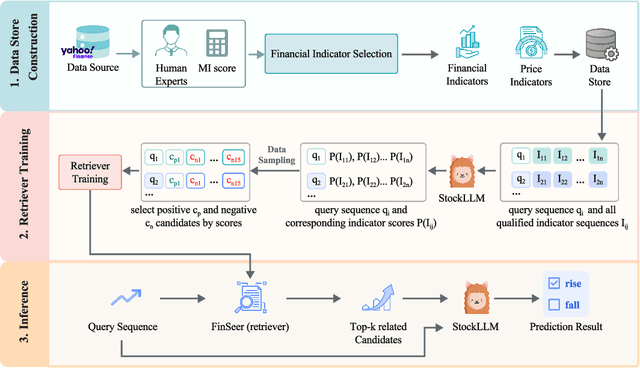
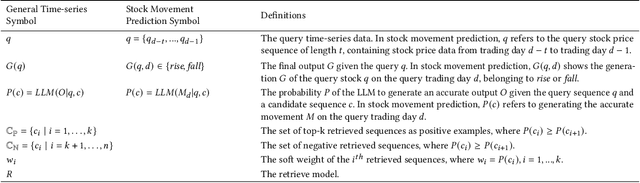
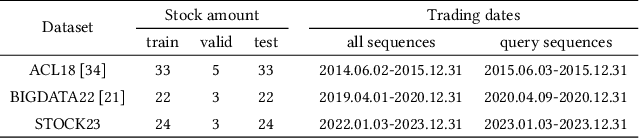
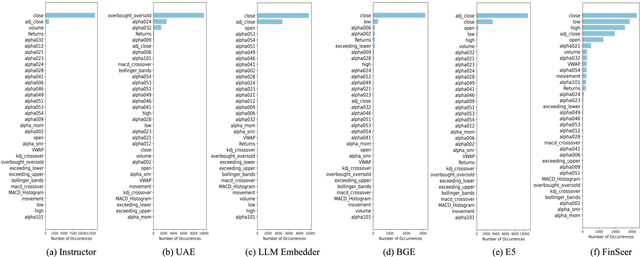
Stock movement prediction, a critical task in financial time-series forecasting, relies on identifying and retrieving key influencing factors from vast and complex datasets. However, traditional text-trained or numeric similarity-based retrieval methods often struggle to handle the intricacies of financial data. To address this, we propose the first retrieval-augmented generation (RAG) framework specifically designed for financial time-series forecasting. Our framework incorporates three key innovations: a fine-tuned 1B large language model (StockLLM) as its backbone, a novel candidate selection method enhanced by LLM feedback, and a training objective that maximizes the similarity between queries and historically significant sequences. These advancements enable our retriever, FinSeer, to uncover meaningful patterns while effectively minimizing noise in complex financial datasets. To support robust evaluation, we also construct new datasets that integrate financial indicators and historical stock prices. Experimental results demonstrate that our RAG framework outperforms both the baseline StockLLM and random retrieval methods, showcasing its effectiveness. FinSeer, as the retriever, achieves an 8% higher accuracy on the BIGDATA22 benchmark and retrieves more impactful sequences compared to existing retrieval methods. This work highlights the importance of tailored retrieval models in financial forecasting and provides a novel, scalable framework for future research in the field.

Jakiro: Boosting Speculative Decoding with Decoupled Multi-Head via MoE
Feb 10, 2025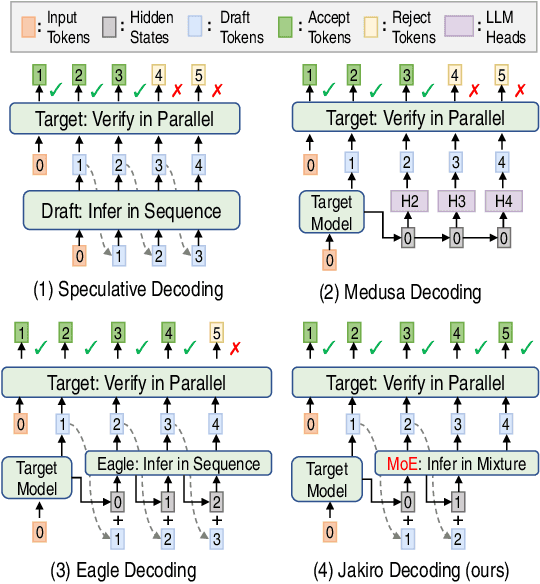
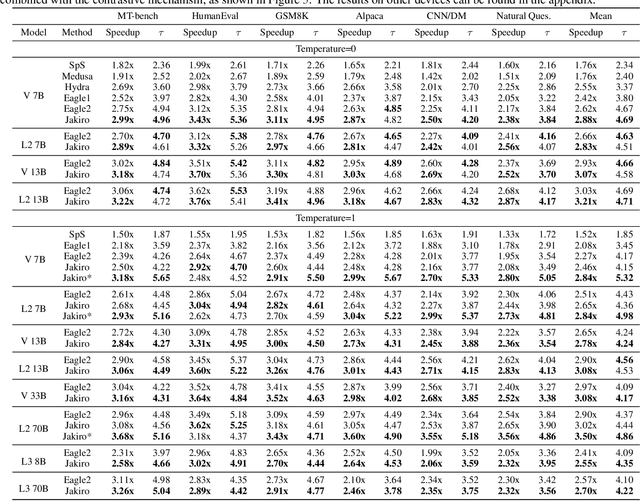
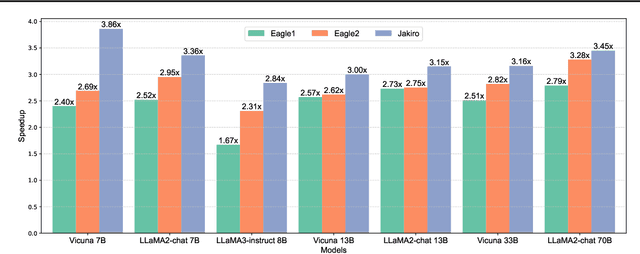
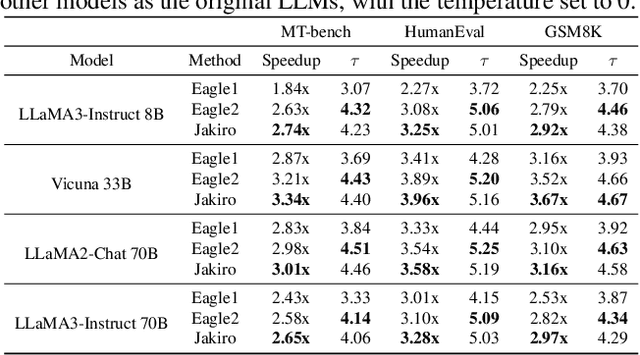
Speculative decoding (SD) accelerates large language model inference by using a smaller draft model to predict multiple tokens, which are then verified in parallel by the larger target model. However, the limited capacity of the draft model often necessitates tree-based sampling to improve prediction accuracy, where multiple candidates are generated at each step. We identify a key limitation in this approach: the candidates at the same step are derived from the same representation, limiting diversity and reducing overall effectiveness. To address this, we propose Jakiro, leveraging Mixture of Experts (MoE), where independent experts generate diverse predictions, effectively decoupling correlations among candidates. Furthermore, we introduce a hybrid inference strategy, combining autoregressive decoding for initial tokens with parallel decoding for subsequent stages, and enhance the latter with contrastive mechanism in features to improve accuracy. Our method significantly boosts prediction accuracy and achieves higher inference speedups. Extensive experiments across diverse models validate the effectiveness and robustness of our approach, establishing a new SOTA in speculative decoding. Our codes are available at https://github.com/haiduo/Jakiro.
Retrieval-augmented Large Language Models for Financial Time Series Forecasting
Feb 09, 2025Stock movement prediction, a fundamental task in financial time-series forecasting, requires identifying and retrieving critical influencing factors from vast amounts of time-series data. However, existing text-trained or numeric similarity-based retrieval methods fall short in handling complex financial analysis. To address this, we propose the first retrieval-augmented generation (RAG) framework for financial time-series forecasting, featuring three key innovations: a fine-tuned 1B parameter large language model (StockLLM) as the backbone, a novel candidate selection method leveraging LLM feedback, and a training objective that maximizes similarity between queries and historically significant sequences. This enables our retriever, FinSeer, to uncover meaningful patterns while minimizing noise in complex financial data. We also construct new datasets integrating financial indicators and historical stock prices to train FinSeer and ensure robust evaluation. Experimental results demonstrate that our RAG framework outperforms bare StockLLM and random retrieval, highlighting its effectiveness, while FinSeer surpasses existing retrieval methods, achieving an 8\% higher accuracy on BIGDATA22 and retrieving more impactful sequences. This work underscores the importance of tailored retrieval models in financial forecasting and provides a novel framework for future research.
ARIES: Stimulating Self-Refinement of Large Language Models by Iterative Preference Optimization
Feb 08, 2025A truly intelligent Large Language Model (LLM) should be capable of correcting errors in its responses through external interactions. However, even the most advanced models often face challenges in improving their outputs. In this paper, we explore how to cultivate LLMs with the self-refinement capability through iterative preference training, and how this ability can be leveraged to improve model performance during inference. To this end, we introduce a novel post-training and inference framework, called ARIES: Adaptive Refinement and Iterative Enhancement Structure. This method iteratively performs preference training and self-refinement-based data collection. During training, ARIES strengthen the model's direct question-answering capability while simultaneously unlocking its self-refinement potential. During inference, ARIES harnesses this self-refinement capability to generate a series of progressively refined responses, which are then filtered using either the Reward Model Scoring or a simple yet effective Rule-Based Selection mechanism, specifically tailored to our approach, to construct a dataset for the next round of preference training. Experimental results demonstrate the remarkable performance of ARIES. When applied to the Llama-3.1-8B model and under the self-refinement setting, ARIES surpasses powerful models such as GPT-4o, achieving 62.3% length-controlled (LC) and a 63.3% raw win rates on AlpacaEval 2, outperforming Iterative DPO by 27.8% and 35.5% respectively, as well as a 50.3% win rate on Arena-Hard, surpassing Iterative DPO by 26.6%. Furthermore, ARIES consistently enhances performance on mathematical reasoning tasks like GSM8K and MATH.
GARAD-SLAM: 3D GAussian splatting for Real-time Anti Dynamic SLAM
Feb 05, 2025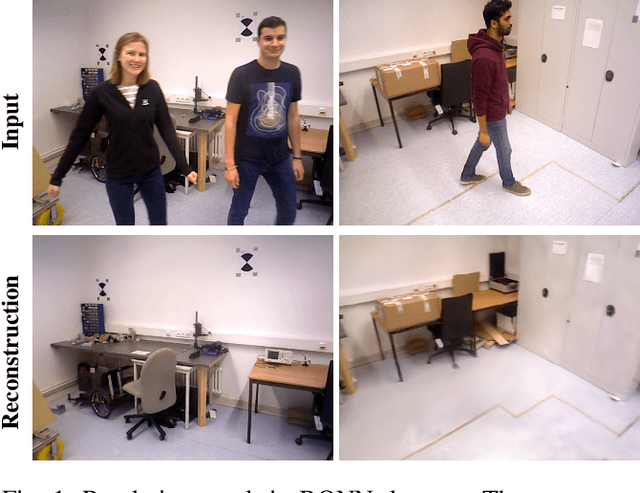
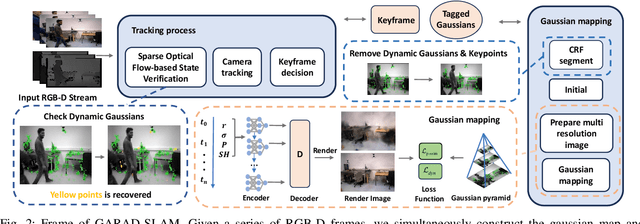


The 3D Gaussian Splatting (3DGS)-based SLAM system has garnered widespread attention due to its excellent performance in real-time high-fidelity rendering. However, in real-world environments with dynamic objects, existing 3DGS-based SLAM systems often face mapping errors and tracking drift issues. To address these problems, we propose GARAD-SLAM, a real-time 3DGS-based SLAM system tailored for dynamic scenes. In terms of tracking, unlike traditional methods, we directly perform dynamic segmentation on Gaussians and map them back to the front-end to obtain dynamic point labels through a Gaussian pyramid network, achieving precise dynamic removal and robust tracking. For mapping, we impose rendering penalties on dynamically labeled Gaussians, which are updated through the network, to avoid irreversible erroneous removal caused by simple pruning. Our results on real-world datasets demonstrate that our method is competitive in tracking compared to baseline methods, generating fewer artifacts and higher-quality reconstructions in rendering.
A Survey on Computational Pathology Foundation Models: Datasets, Adaptation Strategies, and Evaluation Tasks
Jan 27, 2025Computational pathology foundation models (CPathFMs) have emerged as a powerful approach for analyzing histopathological data, leveraging self-supervised learning to extract robust feature representations from unlabeled whole-slide images. These models, categorized into uni-modal and multi-modal frameworks, have demonstrated promise in automating complex pathology tasks such as segmentation, classification, and biomarker discovery. However, the development of CPathFMs presents significant challenges, such as limited data accessibility, high variability across datasets, the necessity for domain-specific adaptation, and the lack of standardized evaluation benchmarks. This survey provides a comprehensive review of CPathFMs in computational pathology, focusing on datasets, adaptation strategies, and evaluation tasks. We analyze key techniques, such as contrastive learning and multi-modal integration, and highlight existing gaps in current research. Finally, we explore future directions from four perspectives for advancing CPathFMs. This survey serves as a valuable resource for researchers, clinicians, and AI practitioners, guiding the advancement of CPathFMs toward robust and clinically applicable AI-driven pathology solutions.
MiniMax-01: Scaling Foundation Models with Lightning Attention
Jan 14, 2025We introduce MiniMax-01 series, including MiniMax-Text-01 and MiniMax-VL-01, which are comparable to top-tier models while offering superior capabilities in processing longer contexts. The core lies in lightning attention and its efficient scaling. To maximize computational capacity, we integrate it with Mixture of Experts (MoE), creating a model with 32 experts and 456 billion total parameters, of which 45.9 billion are activated for each token. We develop an optimized parallel strategy and highly efficient computation-communication overlap techniques for MoE and lightning attention. This approach enables us to conduct efficient training and inference on models with hundreds of billions of parameters across contexts spanning millions of tokens. The context window of MiniMax-Text-01 can reach up to 1 million tokens during training and extrapolate to 4 million tokens during inference at an affordable cost. Our vision-language model, MiniMax-VL-01 is built through continued training with 512 billion vision-language tokens. Experiments on both standard and in-house benchmarks show that our models match the performance of state-of-the-art models like GPT-4o and Claude-3.5-Sonnet while offering 20-32 times longer context window. We publicly release MiniMax-01 at https://github.com/MiniMax-AI.
Edit as You See: Image-guided Video Editing via Masked Motion Modeling
Jan 08, 2025Recent advancements in diffusion models have significantly facilitated text-guided video editing. However, there is a relative scarcity of research on image-guided video editing, a method that empowers users to edit videos by merely indicating a target object in the initial frame and providing an RGB image as reference, without relying on the text prompts. In this paper, we propose a novel Image-guided Video Editing Diffusion model, termed IVEDiff for the image-guided video editing. IVEDiff is built on top of image editing models, and is equipped with learnable motion modules to maintain the temporal consistency of edited video. Inspired by self-supervised learning concepts, we introduce a masked motion modeling fine-tuning strategy that empowers the motion module's capabilities for capturing inter-frame motion dynamics, while preserving the capabilities for intra-frame semantic correlations modeling of the base image editing model. Moreover, an optical-flow-guided motion reference network is proposed to ensure the accurate propagation of information between edited video frames, alleviating the misleading effects of invalid information. We also construct a benchmark to facilitate further research. The comprehensive experiments demonstrate that our method is able to generate temporally smooth edited videos while robustly dealing with various editing objects with high quality.
MSWA: Refining Local Attention with Multi-ScaleWindow Attention
Jan 02, 2025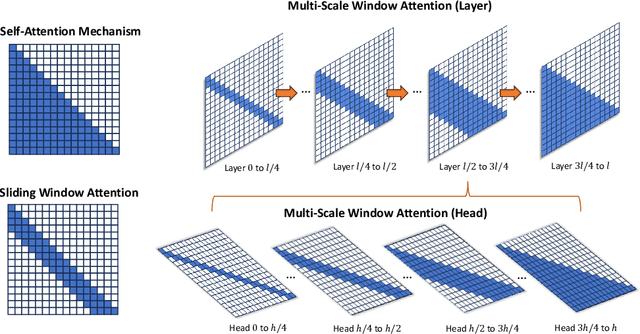
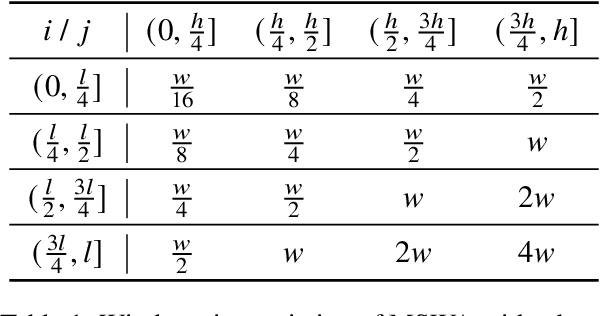
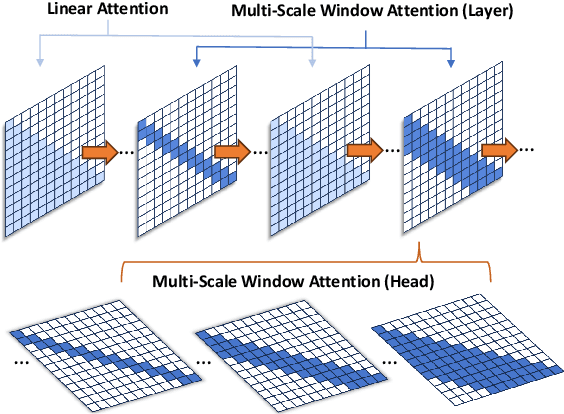
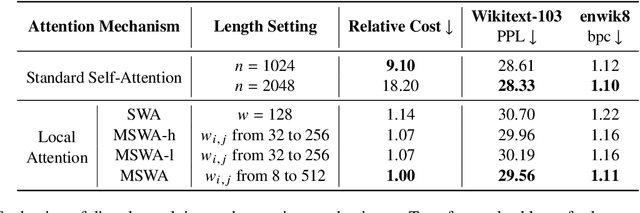
Transformer-based LLMs have achieved exceptional performance across a wide range of NLP tasks. However, the standard self-attention mechanism suffers from quadratic time complexity and linearly increased cache size. Sliding window attention (SWA) solves this problem by restricting the attention range to a fixed-size local context window. Nevertheless, SWA employs a uniform window size for each head in each layer, making it inefficient in capturing context of varying scales. To mitigate this limitation, we propose Multi-Scale Window Attention (MSWA) which applies diverse window sizes across heads and layers in the Transformer. It not only allows for different window sizes among heads within the same layer but also progressively increases window size allocation from shallow to deep layers, thus enabling the model to capture contextual information with different lengths and distances. Experimental results on language modeling and common-sense reasoning tasks substantiate that MSWA outperforms traditional local attention in both effectiveness and efficiency.
ReNeg: Learning Negative Embedding with Reward Guidance
Dec 27, 2024In text-to-image (T2I) generation applications, negative embeddings have proven to be a simple yet effective approach for enhancing generation quality. Typically, these negative embeddings are derived from user-defined negative prompts, which, while being functional, are not necessarily optimal. In this paper, we introduce ReNeg, an end-to-end method designed to learn improved Negative embeddings guided by a Reward model. We employ a reward feedback learning framework and integrate classifier-free guidance (CFG) into the training process, which was previously utilized only during inference, thus enabling the effective learning of negative embeddings. We also propose two strategies for learning both global and per-sample negative embeddings. Extensive experiments show that the learned negative embedding significantly outperforms null-text and handcrafted counterparts, achieving substantial improvements in human preference alignment. Additionally, the negative embedding learned within the same text embedding space exhibits strong generalization capabilities. For example, using the same CLIP text encoder, the negative embedding learned on SD1.5 can be seamlessly transferred to text-to-image or even text-to-video models such as ControlNet, ZeroScope, and VideoCrafter2, resulting in consistent performance improvements across the board.