 Add to Chrome
 Add to Firefox
 Add to Edge
Factorized AdaBoost.MH Achieves the Same Convergence Rate as AdaBoost.MH
Aug 02, 2026
AdaBoost.MH reduces multi-class classification to a collection of binary subproblems and enjoys the classical boosting-type convergence guarantee under a weak learning condition. A more structured variant, Factorized AdaBoost.MH, uses base classifiers of the form $\mathbf{h}(x)=α\mathbf{v} \bm{\varphi}(x)$, where a single binary classifier $\bm{\varphi}$ is shared across all classes and the label dependence is carried by a vote vector $\mathbf{v} \in\{\pm1\}^K$. This factorization is algorithmically attractive and achieves better performance in practice, but its convergence depends on whether one can always choose a vote vector with sufficiently large induced binary weight mass. Previous work resolved this question with a lower bound $\max\{1/n,1/\sqrt{2K}\}$, which still leaves a dimension-dependent slowdown relative to the original AdaBoost.MH analysis. In this paper, we sharpen this combinatorial step. For the minimax quantity $\mathfrak{W}_{n,K}$ governing the factorized edge, we prove $\max\{1/n,C_K\}\le\mathfrak{W}_{n,K}\le C_{\min\{n,K\}}$, where $C_q=1$ for $q=1$, $C_q=q/(3q-4)$ for even $q\ge2$, and $C_q=(q+1)/(3q-1)$ for odd $q\ge2$. Since $C_q\downarrow 1/3$, our bounds show that $\mathfrak{W}_{n,K}=Θ(1)$ uniformly over $n$ and $K$. Consequently, Factorized AdaBoost.MH achieves the same boosting-type convergence rate as AdaBoost.MH up to a universal constant factor, removing the previously suggested additional dependence on $n$ or $K$ in the number of boosting rounds.

A Closer Look at Knowledge Distillation in Spiking Neural Network Training
Nov 14, 2025Spiking Neural Networks (SNNs) become popular due to excellent energy efficiency, yet facing challenges for effective model training. Recent works improve this by introducing knowledge distillation (KD) techniques, with the pre-trained artificial neural networks (ANNs) used as teachers and the target SNNs as students. This is commonly accomplished through a straightforward element-wise alignment of intermediate features and prediction logits from ANNs and SNNs, often neglecting the intrinsic differences between their architectures. Specifically, ANN's outputs exhibit a continuous distribution, whereas SNN's outputs are characterized by sparsity and discreteness. To mitigate this issue, we introduce two innovative KD strategies. Firstly, we propose the Saliency-scaled Activation Map Distillation (SAMD), which aligns the spike activation map of the student SNN with the class-aware activation map of the teacher ANN. Rather than performing KD directly on the raw %and distinct features of ANN and SNN, our SAMD directs the student to learn from saliency activation maps that exhibit greater semantic and distribution consistency. Additionally, we propose a Noise-smoothed Logits Distillation (NLD), which utilizes Gaussian noise to smooth the sparse logits of student SNN, facilitating the alignment with continuous logits from teacher ANN. Extensive experiments on multiple datasets demonstrate the effectiveness of our methods. Code is available~\footnote{https://github.com/SinoLeu/CKDSNN.git}.
GARAD-SLAM: 3D GAussian splatting for Real-time Anti Dynamic SLAM
Feb 05, 2025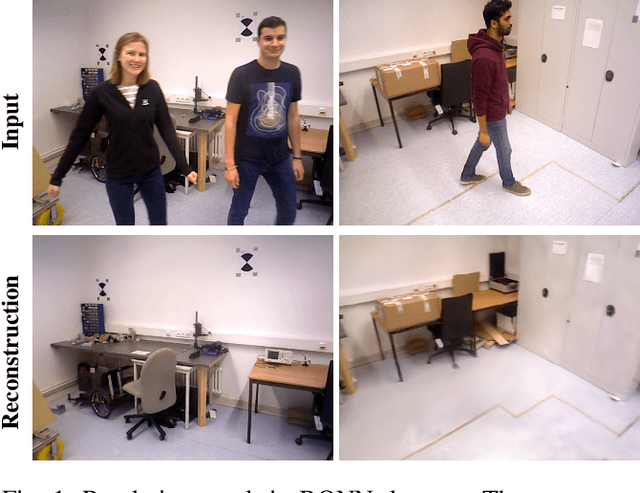
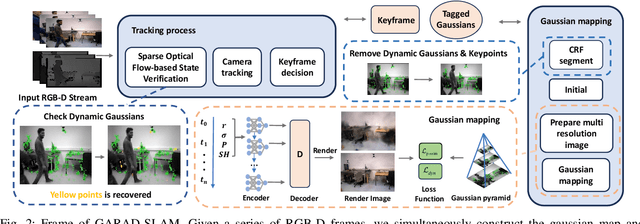


The 3D Gaussian Splatting (3DGS)-based SLAM system has garnered widespread attention due to its excellent performance in real-time high-fidelity rendering. However, in real-world environments with dynamic objects, existing 3DGS-based SLAM systems often face mapping errors and tracking drift issues. To address these problems, we propose GARAD-SLAM, a real-time 3DGS-based SLAM system tailored for dynamic scenes. In terms of tracking, unlike traditional methods, we directly perform dynamic segmentation on Gaussians and map them back to the front-end to obtain dynamic point labels through a Gaussian pyramid network, achieving precise dynamic removal and robust tracking. For mapping, we impose rendering penalties on dynamically labeled Gaussians, which are updated through the network, to avoid irreversible erroneous removal caused by simple pruning. Our results on real-world datasets demonstrate that our method is competitive in tracking compared to baseline methods, generating fewer artifacts and higher-quality reconstructions in rendering.
Prototypical Calibrating Ambiguous Samples for Micro-Action Recognition
Dec 19, 2024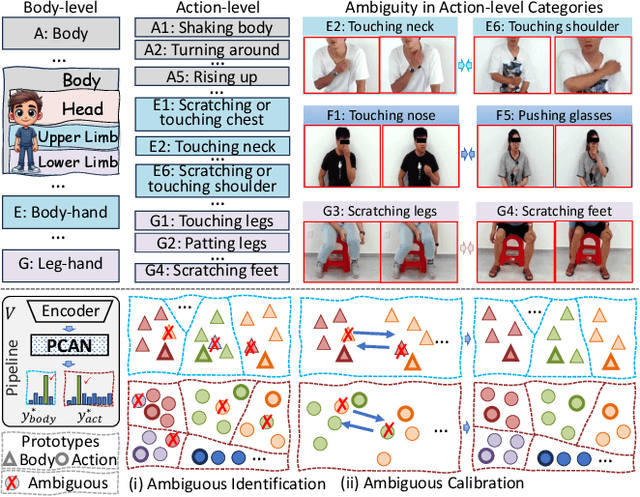


Micro-Action Recognition (MAR) has gained increasing attention due to its crucial role as a form of non-verbal communication in social interactions, with promising potential for applications in human communication and emotion analysis. However, current approaches often overlook the inherent ambiguity in micro-actions, which arises from the wide category range and subtle visual differences between categories. This oversight hampers the accuracy of micro-action recognition. In this paper, we propose a novel Prototypical Calibrating Ambiguous Network (\textbf{PCAN}) to unleash and mitigate the ambiguity of MAR. \textbf{Firstly}, we employ a hierarchical action-tree to identify the ambiguous sample, categorizing them into distinct sets of ambiguous samples of false negatives and false positives, considering both body- and action-level categories. \textbf{Secondly}, we implement an ambiguous contrastive refinement module to calibrate these ambiguous samples by regulating the distance between ambiguous samples and their corresponding prototypes. This calibration process aims to pull false negative ($\mathbb{FN}$) samples closer to their respective prototypes and push false positive ($\mathbb{FP}$) samples apart from their affiliated prototypes. In addition, we propose a new prototypical diversity amplification loss to strengthen the model's capacity by amplifying the differences between different prototypes. \textbf{Finally}, we propose a prototype-guided rectification to rectify prediction by incorporating the representability of prototypes. Extensive experiments conducted on the benchmark dataset demonstrate the superior performance of our method compared to existing approaches. The code is available at https://github.com/kunli-cs/PCAN.
Towards Pixel-Level Prediction for Gaze Following: Benchmark and Approach
Nov 30, 2024Following the gaze of other people and analyzing the target they are looking at can help us understand what they are thinking, and doing, and predict the actions that may follow. Existing methods for gaze following struggle to perform well in natural scenes with diverse objects, and focus on gaze points rather than objects, making it difficult to deliver clear semantics and accurate scope of the targets. To address this shortcoming, we propose a novel gaze target prediction solution named GazeSeg, that can fully utilize the spatial visual field of the person as guiding information and lead to a progressively coarse-to-fine gaze target segmentation and recognition process. Specifically, a prompt-based visual foundation model serves as the encoder, working in conjunction with three distinct decoding modules (e.g. FoV perception, heatmap generation, and segmentation) to form the framework for gaze target prediction. Then, with the head bounding box performed as an initial prompt, GazeSeg obtains the FoV map, heatmap, and segmentation map progressively, leading to a unified framework for multiple tasks (e.g. direction estimation, gaze target segmentation, and recognition). In particular, to facilitate this research, we construct and release a new dataset, comprising 72k images with pixel-level annotations and 270 categories of gaze targets, built upon the GazeFollow dataset. The quantitative evaluation shows that our approach achieves the Dice of 0.325 in gaze target segmentation and 71.7% top-5 recognition. Meanwhile, our approach also outperforms previous state-of-the-art methods, achieving 0.953 in AUC on the gaze-following task. The dataset and code will be released.