 Add to Chrome
 Add to Firefox
 Add to Edge
MindMemOS: A Portable and Self-Evolving Memory Operating Layer for AI Agents
Aug 12, 2026
Memory is a core component of AI agents, enabling them to accumulate experience, maintain personalization, and adapt over long-term interactions. However, existing memory systems often remain fixed after development, limiting their ability to adapt their memory models, organization strategies, and procedural knowledge through continued use. We present MindMemOS, a portable and self-evolving memory operating layer that organizes open-world information using a unified entity property timestructure. MindMemOS supports scenario-adaptive memory modeling, higher-order pattern discovery, autonomous memory refinement, and continuous skill evolution. Its MindMemEvolve algorithm employs validation-driven evolutionary search to optimize memory schemas for target scenarios, whiledreaming consolidates accumulated memories by merging redundant records and resolving conflicts. In addition, implicit corrective feedback serves as a human-in-the-loop signal for identifying and revising potentially inaccurate or misaligned memories. Its MindSkillEvolve algorithm further transforms agent execution trajectories into reusable and progressively refined skills. MindMemOS achieves 94.03% accuracy on LOCOMO and 70.63% on PersonaMem. MindSkillEvolve improves SpreadsheetBench success by 9.2 percentage points over the initial-skill baseline.

ARM: Detector-Agnostic Changepoint Attribution with Finite-Sample Error Control
Aug 03, 2026Detecting a change in a multivariate series answers only the first of two questions; the operational question is which coordinates changed. Existing answers are incomplete. Block-level procedures certify predefined groups of coordinates under an additive union bound, high-dimensional variable-selection methods return interpretable rankings without error guarantees, and the post-detection inference literature controls error along the time axis rather than across coordinates. We propose ARM (Attribution by Rank Maxima), a wrapper that accepts a changepoint located by an arbitrary detector and returns the set of coordinates certified to have changed, each carrying a location or scale type label. ARM scores each coordinate by a max-over-splits rank statistic. Because this statistic dominates the corresponding statistic at the estimated split, the resulting certificate is invariant to the manner, and to the accuracy, of the changepoint estimate. Three finite-sample guarantees follow from within-coordinate ranks alone: per-coordinate validity under any detector; exact family-wise error control through a Westfall--Young joint permutation that preserves cross-coordinate dependence, with a fully distribution-free Holm fallback; and false discovery rate control under arbitrary coordinate dependence in high dimensions through Benjamini--Yekutieli and e-BH. In simulations, naive per-coordinate testing at the estimated changepoint inflates its family-wise error beyond $0.66$ as the dimension grows, whereas ARM maintains the nominal level while retaining validity under heavy tails, power in high dimensions, and accurate type labels. On five financial series surrounding the 2008 collapse, ARM attributes a scale change to every asset class and excludes injected control coordinates.
Lost in the Tail: Addressing Geographic Imbalance in Urban Visual Place Recognition
Jun 30, 2026Urban-scale Visual Place Recognition (VPR) aims to identify the geographic location of a query image by matching it against a geo-tagged database. While recent methods achieve impressive performance, they overlook a serious long-tailed problem hidden in urban-scale datasets, which biases the model towards locations with abundant images and ignores less-visited areas, causing models to systematically favor frequently photographed locations while failing in sparsely covered areas. In this paper, we systematically characterize this imbalance challenge and propose Distribution-Aware Place Recognition (DAPR), a model-agnostic plug-in framework that rebalances gradient contributions across head and tail classes. Additionally, within classification-retrieval pipelines, DAPR applies a multi-scale distance search mechanism to compute per-class distributional compactness, providing complementary gains at the retrieval stage. On the large-scale SF-XL benchmark, our framework outperforms the previous classification-retrieval baseline by 18.3% on test set v1, and 6.7% on test set v2. As a plug-in module, it achieves consistent improvements across representative VPR methods on SF-XL, MSLS, and Pitts30k, demonstrating broad generalizability across different methods and benchmarks.
Mask Proposal Voting Based on Geodesic Framework for Robust Image Segmentation
Jun 12, 2026Despite great advances, finding accurate segmentation remains a challenging task, especially in scenarios with cluttered backgrounds, complex intensity variations and topology appearance. Minimal path models have exhibited their strong ability in addressing image segmentation tasks. However, the performance of minimal paths-based segmentation approaches is heavily influenced by model initialization, hence limiting their application scope in practice. In this work, we propose a novel mask proposal voting framework that overcomes the major drawback of classical approaches, allowing robust segmentation even in complicated scenarios. Firstly, we introduce an efficient method for constructing adaptive domain cuts as a constraint for initializing the region-based min-cut evolution, by which diverse and reliable mask proposal candidates can be generated, substantially increasing the possibility of accurately covering the objective region by these proposals. Secondly, we propose a new mask voting scheme to build a voting score map encoding the final segmentation information. In contrast to classical path voting methods, our model allows incorporating priors to assign different importance to each individual mask. As a consequence, the proposed segmentation model is capable of accurately delineating object boundaries under complex scenarios, and is insensitive to initialization. Experiments demonstrate that our method consistently outperforms state-of-the-art minimal path-based approaches in both accuracy and robustness.
Computing Smooth Geodesics under Two-Sided Curvature Bounds with Applications to Robotics and Image Analysis
Jun 11, 2026Curvature of planar curves serves as a key regularization term for computing second-order minimal paths, due to its tight relevance to desirable geometric properties such as smoothness, rigidity, and elasticity. In this paper, we tackle a more challenging problem in computational physics and geometry problem: tracking minimal paths whose curvature is constrained by arbitrary upper and lower bounds. For that purpose, we propose a new curvature-bounded geodesic model, developed under the Hamilton-Jacobi-Bellman (HJB) partial differential equation (PDE) framework. It provides strong geometric control over minimal paths by enforcing curvature range constraints, whose paths are smooth and of bounded curvature limitation. We also present a discretization scheme for the Hamiltonian and the HJB PDE incorporating curvature bounds, allowing efficient solver for estimating numerical solutions to the model. Finally, we illustrate the capability of the proposed curvature-bounded geodesic model in applications of robot path planning and curvilinear structures tracking from images. Numerical experiments demonstrate that the proposed curvature-bounded geodesic model serves as a powerful and robust tool for finding satisfactory paths.
Unification of Closed-Open Industrial Detection Scenarios: New Large-Scale Benchmarks,Challenges and Baselines
Jun 06, 2026Large-scale Visual-Language Models (LVLMs) have achieved remarkable success in natural visual tasks, yet their application to industrial defect detection remains challenging due to two fundamental limitations: (i) the scarcity of large-scale industrial datasets that cover diverse defect categories across multiple domains, and (ii) the reliance on manual prompts (points, boxes, masks) that introduce subjective noise and lack text-visual interaction for fine-grained understanding. To address these challenges, we introduce a Large-Scale Multi-Modal Industrial Open-Closed benchmark (MMIOC-1M) containing over one million samples across $14$ super-categories, $29$ industrial scenes, and $351$ defect subcategories. To our knowledge, MMIOC-1M is the first unified largest benchmark supporting both open-vocabulary and closed-set industrial detection, providing valuable pre-training data for LVLMs in industrial scenarios. Furthermore, we propose a Refined Text-Visual Prompt Network (RTVPNet) that incorporates three key innovations: (1) an expert-assisted domain projection mechanism that enables rapid adaptation of general vision models to industrial domains, (2) an energy-based sparse sampling strategy that automatically generates refined visual prompts without manual intervention, and (3) a bidirectional text-visual interaction module that enhances cross-modal semantic alignment and understanding. Extensive experiments demonstrate that RTVPNet achieves state-of-the-art performance on MMIOC-1M, LVIS, and COCO benchmarks while maintaining computational efficiency. The dataset and code are available at https://github.com/hellozzk/MMIO.
Geodesics with Unified Tangent-constrained Priors and Curvature Regularization
May 28, 2026Curvature-penalized geodesic models have proven their effectiveness in image segmentation by computing globally optimal curves. Unfortunately, these models remain susceptible to shortcuts when delineating objects with complex shapes and image intensity distributions, as they lack mechanisms to enforce shape-aware tangent constraints. To address this limitation, we propose a unified geodesic framework that integrates tangent-constrained priors with curvature penalization. The key idea is to formulate tangent admissibility directly within the orientation-lifted space, where path tangents are restricted to spatially varying angular sectors derived from intrinsic shape representatives (ISR) such as skeletons or interior landmarks. This formulation gives rise to a family of tangent-constrained Finslerian metrics, extending the classical curvature-penalized geodesic models while enforcing mandatory tangent constraints. The resulting Hamilton-Jacobi-Bellman (HJB) partial differential equations (PDEs) admit efficient numerical solutions via variants of the fast marching method, preserving the single-pass computational complexity. Experiments on synthetic, natural, and medical images demonstrate that the proposed geodesic framework indeed improves robustness against weak boundaries and topological shortcuts, yielding segmentation results with enhanced shape fidelity compared to existing geodesic models.
The MiniMax-M2 Series: Mini Activations Unleashing Max Real-World Intelligence
May 26, 2026We introduce the MiniMax-M2 series, a family of Mixture-of-Experts language models built around the principle that mini activations can unleash maximum real-world intelligence. The flagship M2 contains 229.9B total parameters with only 9.8B activated per token. Designed end-to-end for agentic deployment, the M2 series rests on three components: (i) agent-driven data pipelines producing large-scale, verifiable trajectories across agentic coding and agentic cowork, each grounded in an executable workspace and an artifact-aligned reward; (ii) Forge, a scalable agent-native RL system that adapts to long-horizon agent trajectories, paired with windowed-FIFO scheduling, prefix-tree merging, inference optimization, and a clean training-inference-agent decoupling that supports both white-box and black-box agents; (iii) the latest M2.7 checkpoint takes an early step toward self-evolution -- autonomously debugging training runs and modifying its own scaffold. Across M2 through M2.7, this combination translates a mini-activation footprint into frontier-tier performance on agentic coding, deep search, office-task, and reasoning benchmarks.
Interpretability Transfer from Language to Vision via Sparse Autoencoders
May 24, 2026Recent advances in language model interpretability using sparse autoencoders (SAEs) have yet to effectively translate to the visual domain, mainly due to the difficulty and ambiguity of labeling visual concepts. In this paper, we introduce Visual Interpretability via SAE Transfer Alignment (VISTA), a framework that transfers interpretability from language to vision in a LLaVA-style vision-language model by constraining a visual projector to map visual tokens into an LLM's pre-existing, labeled textual SAE space. This approach enables visual interpretability without training dedicated vision SAEs. By regularizing the projector using the LLM's SAE reconstruction loss, VISTA achieves a threefold increase in the matching rate, which measures how accurately the most activating textual concepts in the SAE space correspond to semantic elements in the image. Using this framework, we further analyze spatial localization properties of different vision encoders and show that DINOv2 features have stronger localization abilities than other encoders. Leveraging this precision, we validate VISTA's cross-modal alignment through fine-grained, localized concept interventions, where specific objects are removed or replaced in the model's perception while preserving the surrounding scene. This results in improvements of 35% in object removal and 47% in object replacement tasks over vision-only baselines, providing causal evidence that visual tokens inhabit the text SAE manifold. These contributions are validated across multiple LLM architectures.
Rethinking Few Shot CLIP Benchmarks: A Critical Analysis in the Inductive Setting
Jul 28, 2025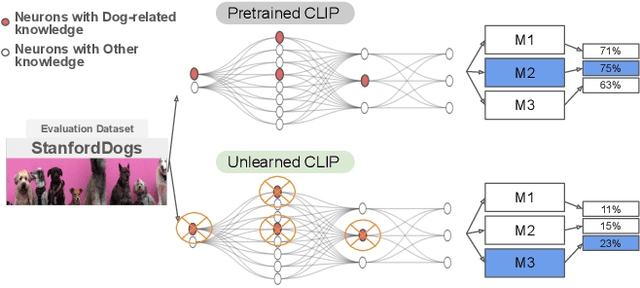

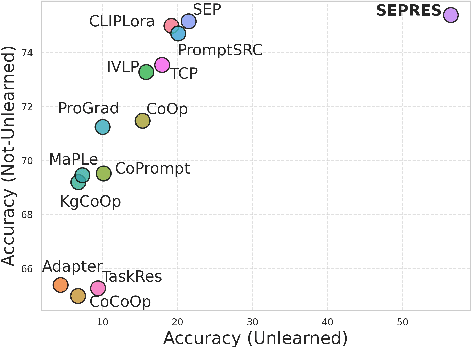

CLIP is a foundational model with transferable classification performance in the few-shot setting. Several methods have shown improved performance of CLIP using few-shot examples. However, so far, all these techniques have been benchmarked using standard few-shot datasets. We argue that this mode of evaluation does not provide a true indication of the inductive generalization ability using few-shot examples. As most datasets have been seen by the CLIP model, the resultant setting can be termed as partially transductive. To solve this, we propose a pipeline that uses an unlearning technique to obtain true inductive baselines. In this new inductive setting, the methods show a significant drop in performance (-55% on average among 13 baselines with multiple datasets). We validate the unlearning technique using oracle baselines. An improved few-shot classification technique is proposed that consistently obtains state-of-the-art performance over 13 other recent baseline methods on a comprehensive analysis with 5880 experiments - varying the datasets, differing number of few-shot examples, unlearning setting, and with different seeds. Thus, we identify the issue with the evaluation of CLIP-based few-shot classification, provide a solution using unlearning, propose new benchmarks, and provide an improved method.