 Add to Chrome
 Add to Firefox
 Add to Edge
EH-MAM: Easy-to-Hard Masked Acoustic Modeling for Self-Supervised Speech Representation Learning
Oct 17, 2024


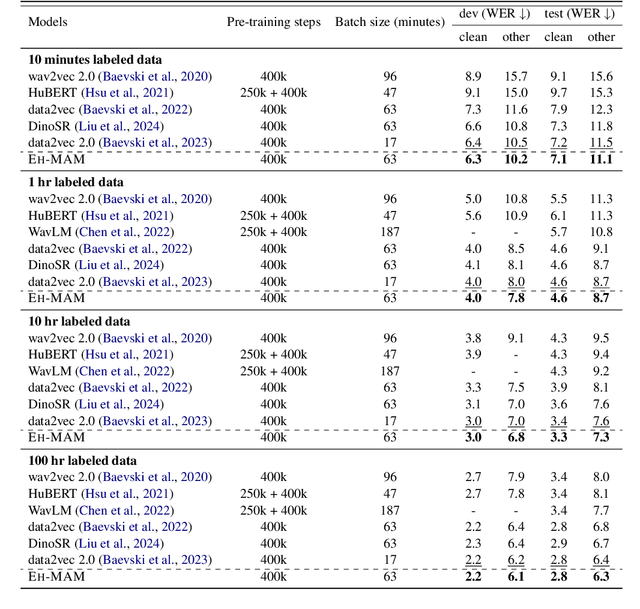
In this paper, we present EH-MAM (Easy-to-Hard adaptive Masked Acoustic Modeling), a novel self-supervised learning approach for speech representation learning. In contrast to the prior methods that use random masking schemes for Masked Acoustic Modeling (MAM), we introduce a novel selective and adaptive masking strategy. Specifically, during SSL training, we progressively introduce harder regions to the model for reconstruction. Our approach automatically selects hard regions and is built on the observation that the reconstruction loss of individual frames in MAM can provide natural signals to judge the difficulty of solving the MAM pre-text task for that frame. To identify these hard regions, we employ a teacher model that first predicts the frame-wise losses and then decides which frames to mask. By learning to create challenging problems, such as identifying harder frames and solving them simultaneously, the model is able to learn more effective representations and thereby acquire a more comprehensive understanding of the speech. Quantitatively, EH-MAM outperforms several state-of-the-art baselines across various low-resource speech recognition and SUPERB benchmarks by 5%-10%. Additionally, we conduct a thorough analysis to show that the regions masked by EH-MAM effectively capture useful context across speech frames.

Failing Forward: Improving Generative Error Correction for ASR with Synthetic Data and Retrieval Augmentation
Oct 17, 2024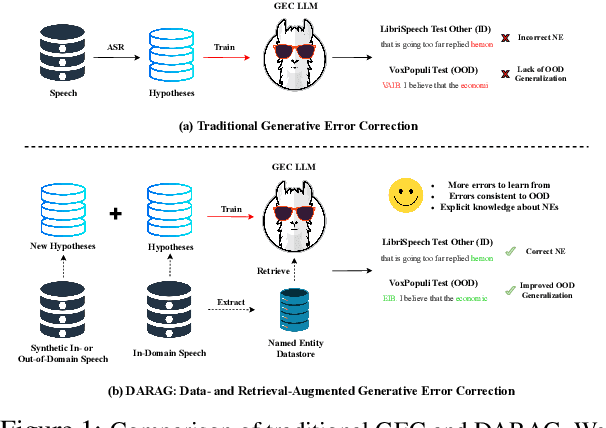
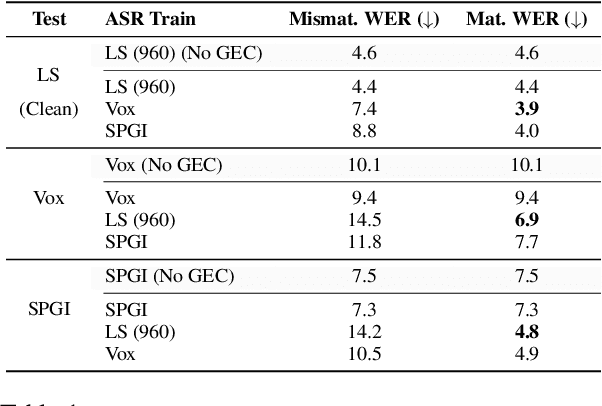


Generative Error Correction (GEC) has emerged as a powerful post-processing method to enhance the performance of Automatic Speech Recognition (ASR) systems. However, we show that GEC models struggle to generalize beyond the specific types of errors encountered during training, limiting their ability to correct new, unseen errors at test time, particularly in out-of-domain (OOD) scenarios. This phenomenon amplifies with named entities (NEs), where, in addition to insufficient contextual information or knowledge about the NEs, novel NEs keep emerging. To address these issues, we propose DARAG (Data- and Retrieval-Augmented Generative Error Correction), a novel approach designed to improve GEC for ASR in in-domain (ID) and OOD scenarios. We augment the GEC training dataset with synthetic data generated by prompting LLMs and text-to-speech models, thereby simulating additional errors from which the model can learn. For OOD scenarios, we simulate test-time errors from new domains similarly and in an unsupervised fashion. Additionally, to better handle named entities, we introduce retrieval-augmented correction by augmenting the input with entities retrieved from a database. Our approach is simple, scalable, and both domain- and language-agnostic. We experiment on multiple datasets and settings, showing that DARAG outperforms all our baselines, achieving 8\% -- 30\% relative WER improvements in ID and 10\% -- 33\% improvements in OOD settings.
ET-Former: Efficient Triplane Deformable Attention for 3D Semantic Scene Completion From Monocular Camera
Oct 14, 2024

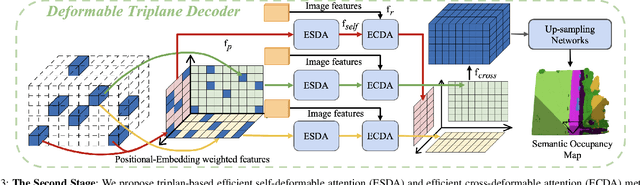

We introduce ET-Former, a novel end-to-end algorithm for semantic scene completion using a single monocular camera. Our approach generates a semantic occupancy map from single RGB observation while simultaneously providing uncertainty estimates for semantic predictions. By designing a triplane-based deformable attention mechanism, our approach improves geometric understanding of the scene than other SOTA approaches and reduces noise in semantic predictions. Additionally, through the use of a Conditional Variational AutoEncoder (CVAE), we estimate the uncertainties of these predictions. The generated semantic and uncertainty maps will aid in the formulation of navigation strategies that facilitate safe and permissible decision-making in the future. Evaluated on the Semantic-KITTI dataset, ET-Former achieves the highest IoU and mIoU, surpassing other methods by 15.16% in IoU and 24.24% in mIoU, while reducing GPU memory usage of existing methods by 25%-50.5%.
MeshGS: Adaptive Mesh-Aligned Gaussian Splatting for High-Quality Rendering
Oct 11, 2024Recently, 3D Gaussian splatting has gained attention for its capability to generate high-fidelity rendering results. At the same time, most applications such as games, animation, and AR/VR use mesh-based representations to represent and render 3D scenes. We propose a novel approach that integrates mesh representation with 3D Gaussian splats to perform high-quality rendering of reconstructed real-world scenes. In particular, we introduce a distance-based Gaussian splatting technique to align the Gaussian splats with the mesh surface and remove redundant Gaussian splats that do not contribute to the rendering. We consider the distance between each Gaussian splat and the mesh surface to distinguish between tightly-bound and loosely-bound Gaussian splats. The tightly-bound splats are flattened and aligned well with the mesh geometry. The loosely-bound Gaussian splats are used to account for the artifacts in reconstructed 3D meshes in terms of rendering. We present a training strategy of binding Gaussian splats to the mesh geometry, and take into account both types of splats. In this context, we introduce several regularization techniques aimed at precisely aligning tightly-bound Gaussian splats with the mesh surface during the training process. We validate the effectiveness of our method on large and unbounded scene from mip-NeRF 360 and Deep Blending datasets. Our method surpasses recent mesh-based neural rendering techniques by achieving a 2dB higher PSNR, and outperforms mesh-based Gaussian splatting methods by 1.3 dB PSNR, particularly on the outdoor mip-NeRF 360 dataset, demonstrating better rendering quality. We provide analyses for each type of Gaussian splat and achieve a reduction in the number of Gaussian splats by 30% compared to the original 3D Gaussian splatting.
Mode-GS: Monocular Depth Guided Anchored 3D Gaussian Splatting for Robust Ground-View Scene Rendering
Oct 06, 2024We present a novel-view rendering algorithm, Mode-GS, for ground-robot trajectory datasets. Our approach is based on using anchored Gaussian splats, which are designed to overcome the limitations of existing 3D Gaussian splatting algorithms. Prior neural rendering methods suffer from severe splat drift due to scene complexity and insufficient multi-view observation, and can fail to fix splats on the true geometry in ground-robot datasets. Our method integrates pixel-aligned anchors from monocular depths and generates Gaussian splats around these anchors using residual-form Gaussian decoders. To address the inherent scale ambiguity of monocular depth, we parameterize anchors with per-view depth-scales and employ scale-consistent depth loss for online scale calibration. Our method results in improved rendering performance, based on PSNR, SSIM, and LPIPS metrics, in ground scenes with free trajectory patterns, and achieves state-of-the-art rendering performance on the R3LIVE odometry dataset and the Tanks and Temples dataset.
AIME: AI System Optimization via Multiple LLM Evaluators
Oct 04, 2024Text-based AI system optimization typically involves a feedback loop scheme where a single LLM generates an evaluation in natural language of the current output to improve the next iteration's output. However, in this work, we empirically demonstrate that for a practical and complex task (code generation) with multiple criteria to evaluate, utilizing only one LLM evaluator tends to let errors in generated code go undetected, thus leading to incorrect evaluations and ultimately suboptimal test case performance. Motivated by this failure case, we assume there exists an optimal evaluation policy that samples an evaluation between response and ground truth. We then theoretically prove that a linear combination of multiple evaluators can approximate this optimal policy. From this insight, we propose AI system optimization via Multiple LLM Evaluators (AIME). AIME is an evaluation protocol that utilizes multiple LLMs that each independently generate an evaluation on separate criteria and then combine them via concatenation. We provide an extensive empirical study showing AIME outperforming baseline methods in code generation tasks, with up to $62\%$ higher error detection rate and up to $16\%$ higher success rate than a single LLM evaluation protocol on LeetCodeHard and HumanEval datasets. We also show that the selection of the number of evaluators and which criteria to utilize is non-trivial as it can impact pact success rate by up to $12\%$.
Synthio: Augmenting Small-Scale Audio Classification Datasets with Synthetic Data
Oct 02, 2024


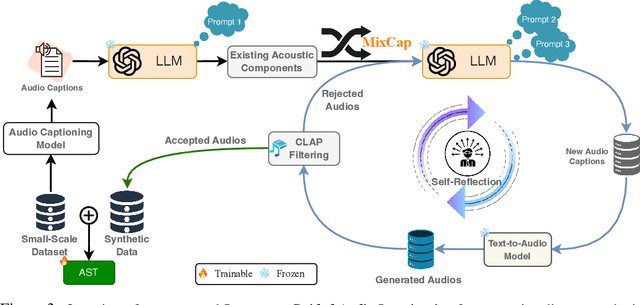
We present Synthio, a novel approach for augmenting small-scale audio classification datasets with synthetic data. Our goal is to improve audio classification accuracy with limited labeled data. Traditional data augmentation techniques, which apply artificial transformations (e.g., adding random noise or masking segments), struggle to create data that captures the true diversity present in real-world audios. To address this shortcoming, we propose to augment the dataset with synthetic audio generated from text-to-audio (T2A) diffusion models. However, synthesizing effective augmentations is challenging because not only should the generated data be acoustically consistent with the underlying small-scale dataset, but they should also have sufficient compositional diversity. To overcome the first challenge, we align the generations of the T2A model with the small-scale dataset using preference optimization. This ensures that the acoustic characteristics of the generated data remain consistent with the small-scale dataset. To address the second challenge, we propose a novel caption generation technique that leverages the reasoning capabilities of Large Language Models to (1) generate diverse and meaningful audio captions and (2) iteratively refine their quality. The generated captions are then used to prompt the aligned T2A model. We extensively evaluate Synthio on ten datasets and four simulated limited-data settings. Results indicate our method consistently outperforms all baselines by 0.1%-39% using a T2A model trained only on weakly-captioned AudioSet.
Robot Navigation Using Physically Grounded Vision-Language Models in Outdoor Environments
Sep 30, 2024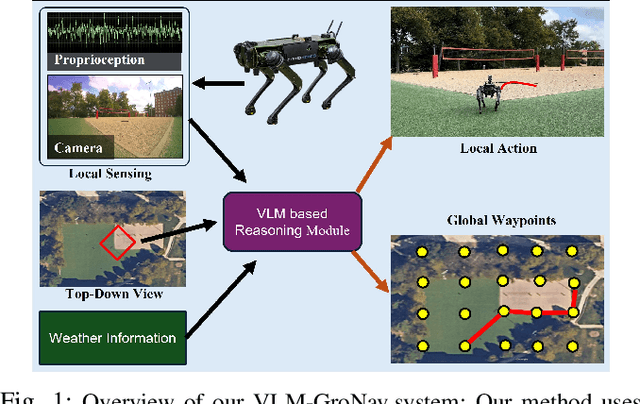
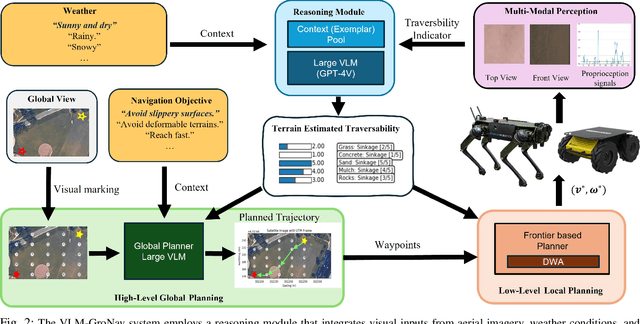
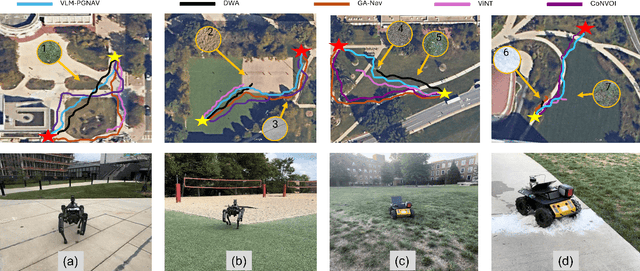
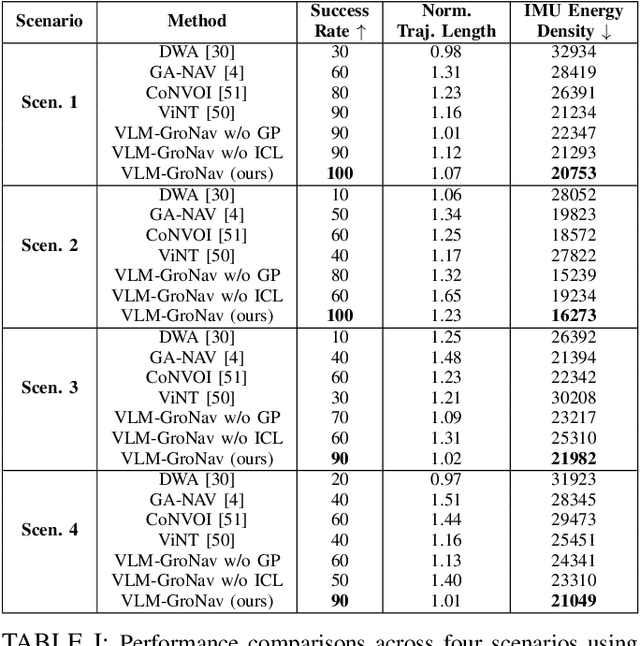
We present a novel autonomous robot navigation algorithm for outdoor environments that is capable of handling diverse terrain traversability conditions. Our approach, VLM-GroNav, uses vision-language models (VLMs) and integrates them with physical grounding that is used to assess intrinsic terrain properties such as deformability and slipperiness. We use proprioceptive-based sensing, which provides direct measurements of these physical properties, and enhances the overall semantic understanding of the terrains. Our formulation uses in-context learning to ground the VLM's semantic understanding with proprioceptive data to allow dynamic updates of traversability estimates based on the robot's real-time physical interactions with the environment. We use the updated traversability estimations to inform both the local and global planners for real-time trajectory replanning. We validate our method on a legged robot (Ghost Vision 60) and a wheeled robot (Clearpath Husky), in diverse real-world outdoor environments with different deformable and slippery terrains. In practice, we observe significant improvements over state-of-the-art methods by up to 50% increase in navigation success rate.
SOAR: Self-supervision Optimized UAV Action Recognition with Efficient Object-Aware Pretraining
Sep 26, 2024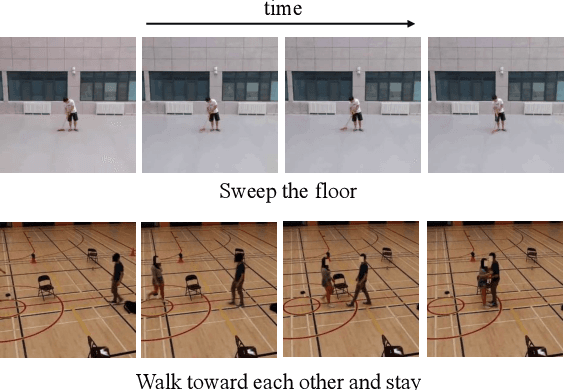
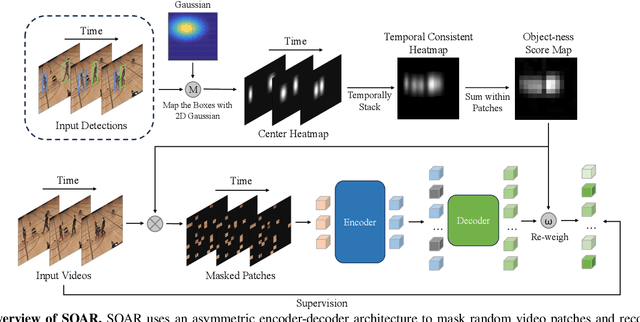
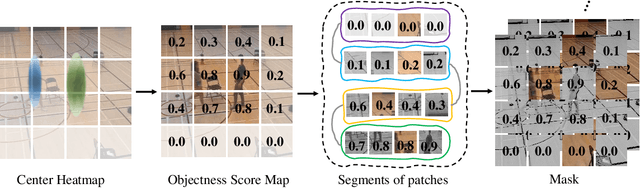
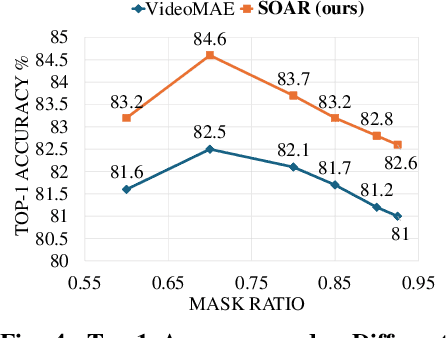
We introduce SOAR, a novel Self-supervised pretraining algorithm for aerial footage captured by Unmanned Aerial Vehicles (UAVs). We incorporate human object knowledge throughout the pretraining process to enhance UAV video pretraining efficiency and downstream action recognition performance. This is in contrast to prior works that primarily incorporate object information during the fine-tuning stage. Specifically, we first propose a novel object-aware masking strategy designed to retain the visibility of certain patches related to objects throughout the pretraining phase. Second, we introduce an object-aware loss function that utilizes object information to adjust the reconstruction loss, preventing bias towards less informative background patches. In practice, SOAR with a vanilla ViT backbone, outperforms best UAV action recognition models, recording a 9.7% and 21.4% boost in top-1 accuracy on the NEC-Drone and UAV-Human datasets, while delivering an inference speed of 18.7ms per video, making it 2x to 5x faster. Additionally, SOAR obtains comparable accuracy to prior self-supervised learning (SSL) methods while requiring 87.5% less pretraining time and 25% less memory usage
CROSS-GAiT: Cross-Attention-Based Multimodal Representation Fusion for Parametric Gait Adaptation in Complex Terrains
Sep 25, 2024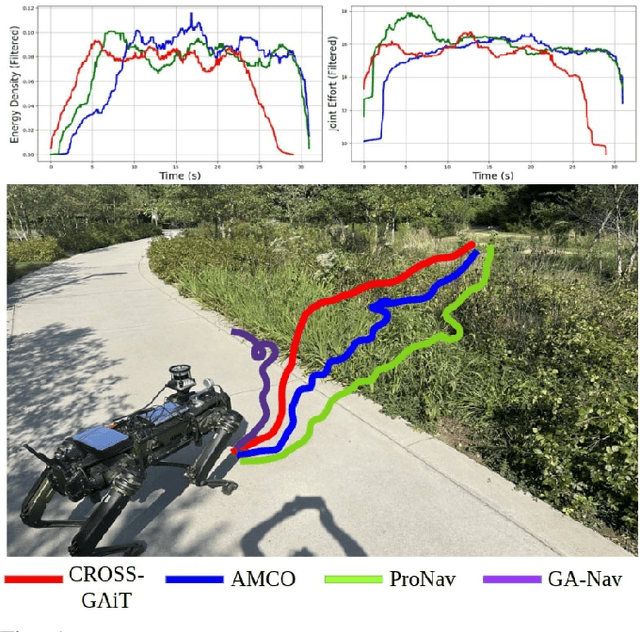
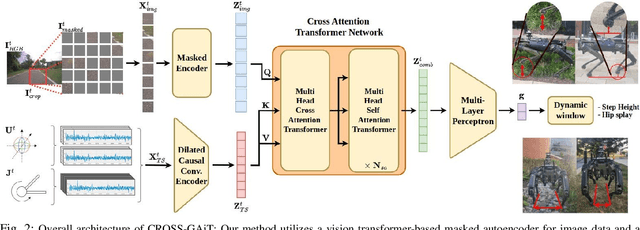
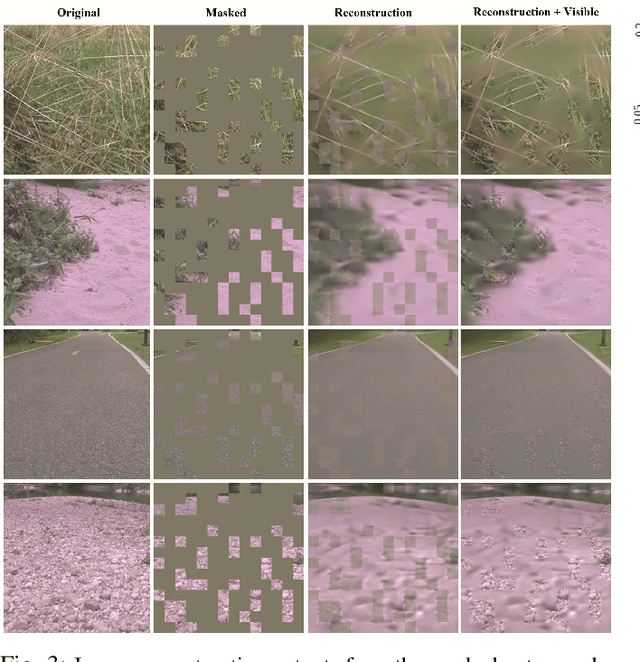
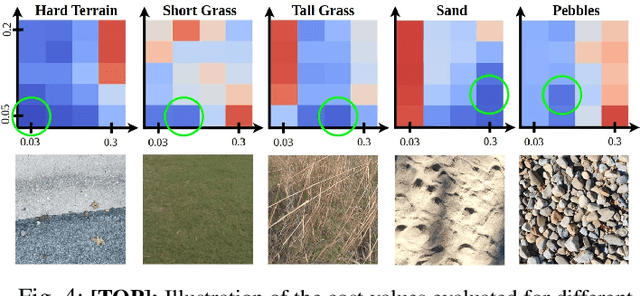
We present CROSS-GAiT, a novel algorithm for quadruped robots that uses Cross Attention to fuse terrain representations derived from visual and time-series inputs, including linear accelerations, angular velocities, and joint efforts. These fused representations are used to adjust the robot's step height and hip splay, enabling adaptive gaits that respond dynamically to varying terrain conditions. We generate these terrain representations by processing visual inputs through a masked Vision Transformer (ViT) encoder and time-series data through a dilated causal convolutional encoder. The cross-attention mechanism then selects and integrates the most relevant features from each modality, combining terrain characteristics with robot dynamics for better-informed gait adjustments. CROSS-GAiT uses the combined representation to dynamically adjust gait parameters in response to varying and unpredictable terrains. We train CROSS-GAiT on data from diverse terrains, including asphalt, concrete, brick pavements, grass, dense vegetation, pebbles, gravel, and sand. Our algorithm generalizes well and adapts to unseen environmental conditions, enhancing real-time navigation performance. CROSS-GAiT was implemented on a Ghost Robotics Vision 60 robot and extensively tested in complex terrains with high vegetation density, uneven/unstable surfaces, sand banks, deformable substrates, etc. We observe at least a 7.04% reduction in IMU energy density and a 27.3% reduction in total joint effort, which directly correlates with increased stability and reduced energy usage when compared to state-of-the-art methods. Furthermore, CROSS-GAiT demonstrates at least a 64.5% increase in success rate and a 4.91% reduction in time to reach the goal in four complex scenarios. Additionally, the learned representations perform 4.48% better than the state-of-the-art on a terrain classification task.