 Add to Chrome
 Add to Firefox
 Add to Edge
Privacy-Preserving Data Drift Detection and Recovery for Large-Scale LLM Applications via Proxy Representations
Aug 08, 2026
LLM applications deployed at scale face a fundamental challenge: privacy constraints prevent direct inspection of user interactions, making it difficult to obtain any representative evaluation dataset or to track the ongoing evolution of production traffic. We present ProxyDrift, a framework that (i) identifies and measures drift between production traffic and offline evaluation sets, and (ii) constructs and refreshes those evaluation sets accordingly; all without access to raw user data. Our approach operates entirely on non-PII proxy representations: structured, multi-dimensional descriptors derived from LLM-based classification of user interactions. We introduce (1) a chance-calibrated, redundancy-aware (RA) alignment score that aggregates per-dimension drift measurements via mutual information; (2) a conditional sampler that generates synthetic proxies respecting inter-dimensional dependencies; (3) a roundtrip consistency analysis that exposes generator/classifier disagreements and guides proxy taxonomy refinement; and (4) a feedback-linkage analysis that ties per-dimension and per-value proxy distributions to user satisfaction, surfacing actionable failure and success modes. Serving hundreds of millions of users, ProxyDrift enables continuous drift monitoring and targeted synthetic data generation without exposing sensitive user data. Experiments confirm strong roundtrip consistency, discriminator-level indistinguishability of synthetic queries from human queries, and tight end-to-end alignment (RA~0.9) with production.

Failing Forward: Improving Generative Error Correction for ASR with Synthetic Data and Retrieval Augmentation
Oct 17, 2024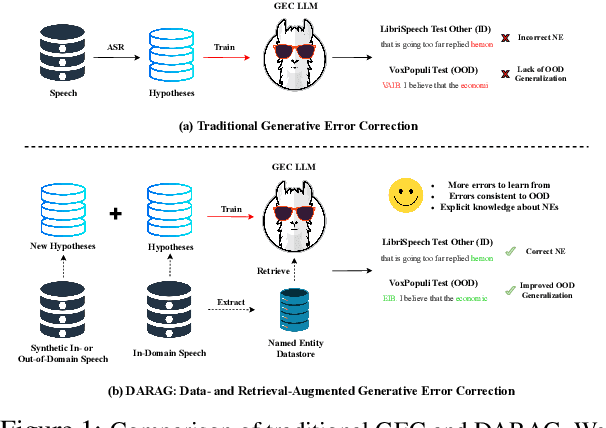
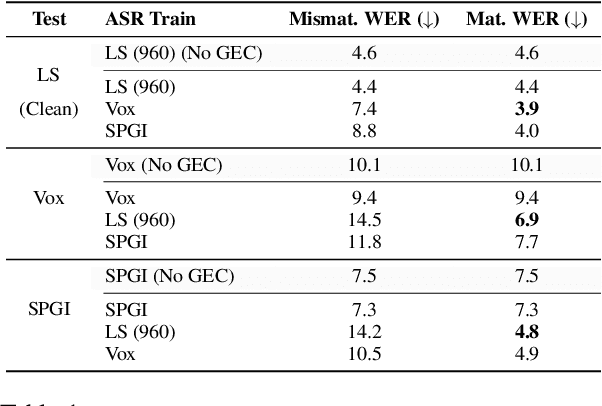


Generative Error Correction (GEC) has emerged as a powerful post-processing method to enhance the performance of Automatic Speech Recognition (ASR) systems. However, we show that GEC models struggle to generalize beyond the specific types of errors encountered during training, limiting their ability to correct new, unseen errors at test time, particularly in out-of-domain (OOD) scenarios. This phenomenon amplifies with named entities (NEs), where, in addition to insufficient contextual information or knowledge about the NEs, novel NEs keep emerging. To address these issues, we propose DARAG (Data- and Retrieval-Augmented Generative Error Correction), a novel approach designed to improve GEC for ASR in in-domain (ID) and OOD scenarios. We augment the GEC training dataset with synthetic data generated by prompting LLMs and text-to-speech models, thereby simulating additional errors from which the model can learn. For OOD scenarios, we simulate test-time errors from new domains similarly and in an unsupervised fashion. Additionally, to better handle named entities, we introduce retrieval-augmented correction by augmenting the input with entities retrieved from a database. Our approach is simple, scalable, and both domain- and language-agnostic. We experiment on multiple datasets and settings, showing that DARAG outperforms all our baselines, achieving 8\% -- 30\% relative WER improvements in ID and 10\% -- 33\% improvements in OOD settings.
External Language Model Integration for Factorized Neural Transducers
May 26, 2023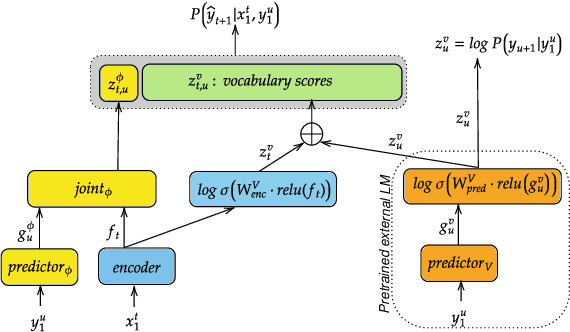
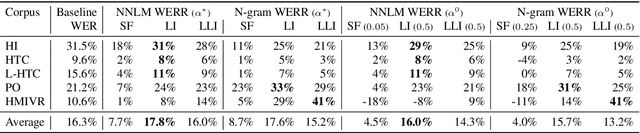
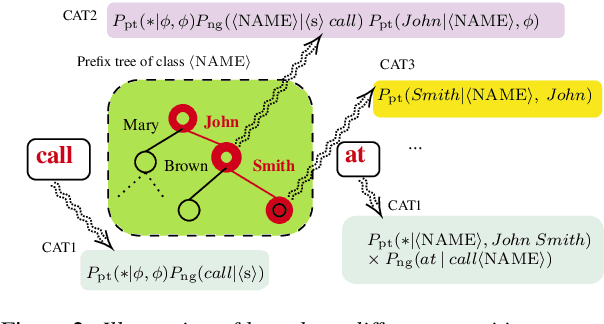
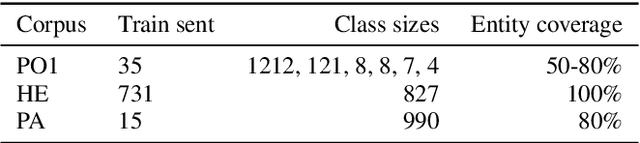
We propose an adaptation method for factorized neural transducers (FNT) with external language models. We demonstrate that both neural and n-gram external LMs add significantly more value when linearly interpolated with predictor output compared to shallow fusion, thus confirming that FNT forces the predictor to act like regular language models. Further, we propose a method to integrate class-based n-gram language models into FNT framework resulting in accuracy gains similar to a hybrid setup. We show average gains of 18% WERR with lexical adaptation across various scenarios and additive gains of up to 60% WERR in one entity-rich scenario through a combination of class-based n-gram and neural LMs.