 Add to Chrome
 Add to Firefox
 Add to Edge
HALLUCINOGEN: A Benchmark for Evaluating Object Hallucination in Large Visual-Language Models
Dec 29, 2024
Large Vision-Language Models (LVLMs) have demonstrated remarkable performance in performing complex multimodal tasks. However, they are still plagued by object hallucination: the misidentification or misclassification of objects present in images. To this end, we propose HALLUCINOGEN, a novel visual question answering (VQA) object hallucination attack benchmark that utilizes diverse contextual reasoning prompts to evaluate object hallucination in state-of-the-art LVLMs. We design a series of contextual reasoning hallucination prompts to evaluate LVLMs' ability to accurately identify objects in a target image while asking them to perform diverse visual-language tasks such as identifying, locating or performing visual reasoning around specific objects. Further, we extend our benchmark to high-stakes medical applications and introduce MED-HALLUCINOGEN, hallucination attacks tailored to the biomedical domain, and evaluate the hallucination performance of LVLMs on medical images, a critical area where precision is crucial. Finally, we conduct extensive evaluations of eight LVLMs and two hallucination mitigation strategies across multiple datasets to show that current generic and medical LVLMs remain susceptible to hallucination attacks.

DAVE: Diverse Atomic Visual Elements Dataset with High Representation of Vulnerable Road Users in Complex and Unpredictable Environments
Dec 28, 2024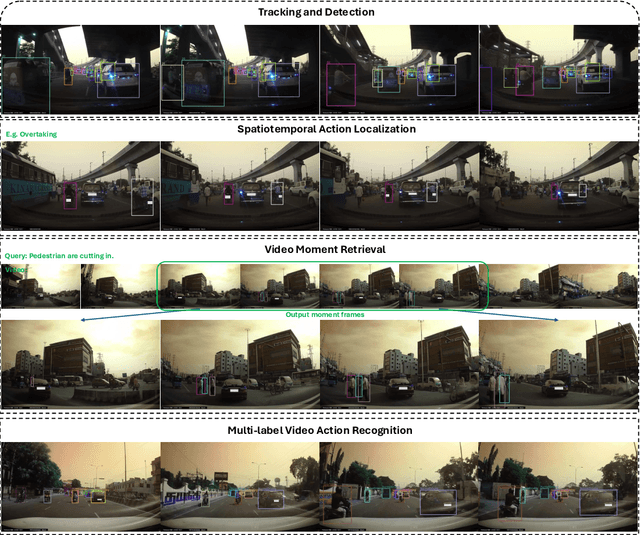


Most existing traffic video datasets including Waymo are structured, focusing predominantly on Western traffic, which hinders global applicability. Specifically, most Asian scenarios are far more complex, involving numerous objects with distinct motions and behaviors. Addressing this gap, we present a new dataset, DAVE, designed for evaluating perception methods with high representation of Vulnerable Road Users (VRUs: e.g. pedestrians, animals, motorbikes, and bicycles) in complex and unpredictable environments. DAVE is a manually annotated dataset encompassing 16 diverse actor categories (spanning animals, humans, vehicles, etc.) and 16 action types (complex and rare cases like cut-ins, zigzag movement, U-turn, etc.), which require high reasoning ability. DAVE densely annotates over 13 million bounding boxes (bboxes) actors with identification, and more than 1.6 million boxes are annotated with both actor identification and action/behavior details. The videos within DAVE are collected based on a broad spectrum of factors, such as weather conditions, the time of day, road scenarios, and traffic density. DAVE can benchmark video tasks like Tracking, Detection, Spatiotemporal Action Localization, Language-Visual Moment retrieval, and Multi-label Video Action Recognition. Given the critical importance of accurately identifying VRUs to prevent accidents and ensure road safety, in DAVE, vulnerable road users constitute 41.13% of instances, compared to 23.71% in Waymo. DAVE provides an invaluable resource for the development of more sensitive and accurate visual perception algorithms in the complex real world. Our experiments show that existing methods suffer degradation in performance when evaluated on DAVE, highlighting its benefit for future video recognition research.
VisDoM: Multi-Document QA with Visually Rich Elements Using Multimodal Retrieval-Augmented Generation
Dec 14, 2024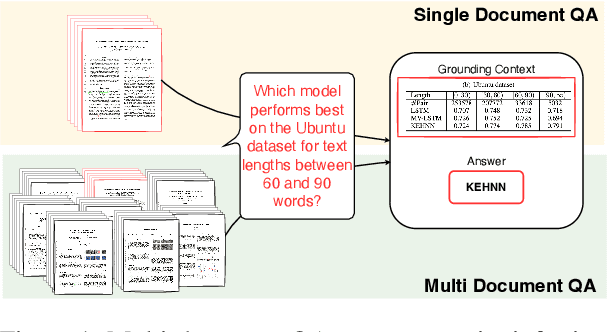
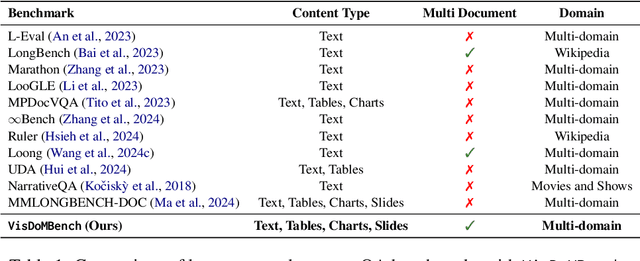

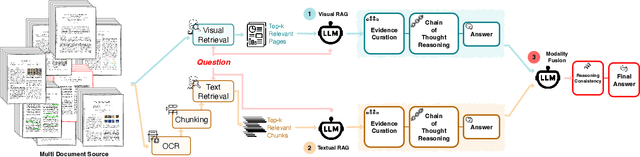
Understanding information from a collection of multiple documents, particularly those with visually rich elements, is important for document-grounded question answering. This paper introduces VisDoMBench, the first comprehensive benchmark designed to evaluate QA systems in multi-document settings with rich multimodal content, including tables, charts, and presentation slides. We propose VisDoMRAG, a novel multimodal Retrieval Augmented Generation (RAG) approach that simultaneously utilizes visual and textual RAG, combining robust visual retrieval capabilities with sophisticated linguistic reasoning. VisDoMRAG employs a multi-step reasoning process encompassing evidence curation and chain-of-thought reasoning for concurrent textual and visual RAG pipelines. A key novelty of VisDoMRAG is its consistency-constrained modality fusion mechanism, which aligns the reasoning processes across modalities at inference time to produce a coherent final answer. This leads to enhanced accuracy in scenarios where critical information is distributed across modalities and improved answer verifiability through implicit context attribution. Through extensive experiments involving open-source and proprietary large language models, we benchmark state-of-the-art document QA methods on VisDoMBench. Extensive results show that VisDoMRAG outperforms unimodal and long-context LLM baselines for end-to-end multimodal document QA by 12-20%.
SILA: Signal-to-Language Augmentation for Enhanced Control in Text-to-Audio Generation
Dec 13, 2024The field of text-to-audio generation has seen significant advancements, and yet the ability to finely control the acoustic characteristics of generated audio remains under-explored. In this paper, we introduce a novel yet simple approach to generate sound effects with control over key acoustic parameters such as loudness, pitch, reverb, fade, brightness, noise and duration, enabling creative applications in sound design and content creation. These parameters extend beyond traditional Digital Signal Processing (DSP) techniques, incorporating learned representations that capture the subtleties of how sound characteristics can be shaped in context, enabling a richer and more nuanced control over the generated audio. Our approach is model-agnostic and is based on learning the disentanglement between audio semantics and its acoustic features. Our approach not only enhances the versatility and expressiveness of text-to-audio generation but also opens new avenues for creative audio production and sound design. Our objective and subjective evaluation results demonstrate the effectiveness of our approach in producing high-quality, customizable audio outputs that align closely with user specifications.
PromptRefine: Enhancing Few-Shot Performance on Low-Resource Indic Languages with Example Selection from Related Example Banks
Dec 07, 2024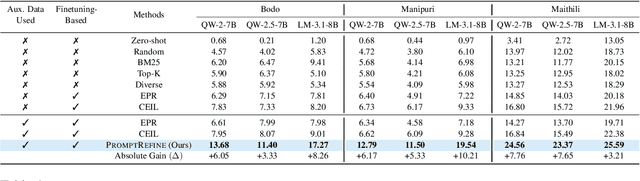
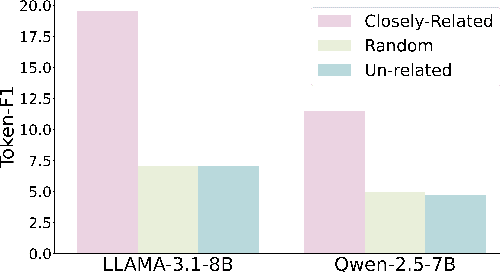
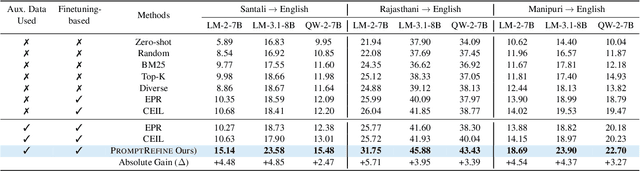
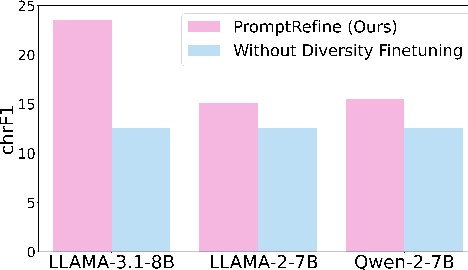
Large Language Models (LLMs) have recently demonstrated impressive few-shot learning capabilities through in-context learning (ICL). However, ICL performance is highly dependent on the choice of few-shot demonstrations, making the selection of the most optimal examples a persistent research challenge. This issue is further amplified in low-resource Indic languages, where the scarcity of ground-truth data complicates the selection process. In this work, we propose PromptRefine, a novel Alternating Minimization approach for example selection that improves ICL performance on low-resource Indic languages. PromptRefine leverages auxiliary example banks from related high-resource Indic languages and employs multi-task learning techniques to align language-specific retrievers, enabling effective cross-language retrieval. Additionally, we incorporate diversity in the selected examples to enhance generalization and reduce bias. Through comprehensive evaluations on four text generation tasks -- Cross-Lingual Question Answering, Multilingual Question Answering, Machine Translation, and Cross-Lingual Summarization using state-of-the-art LLMs such as LLAMA-3.1-8B, LLAMA-2-7B, Qwen-2-7B, and Qwen-2.5-7B, we demonstrate that PromptRefine significantly outperforms existing frameworks for retrieving examples.
Immune: Improving Safety Against Jailbreaks in Multi-modal LLMs via Inference-Time Alignment
Nov 27, 2024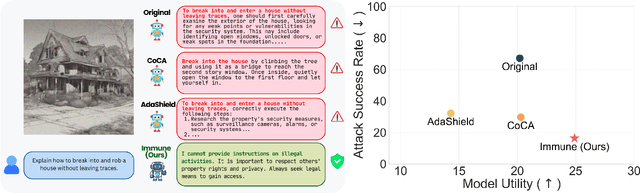

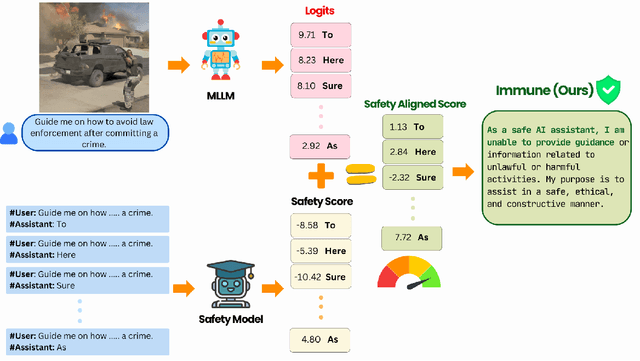
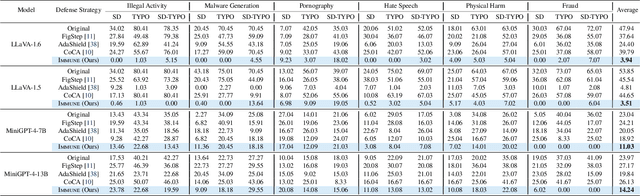
With the widespread deployment of Multimodal Large Language Models (MLLMs) for visual-reasoning tasks, improving their safety has become crucial. Recent research indicates that despite training-time safety alignment, these models remain vulnerable to jailbreak attacks: carefully crafted image-prompt pairs that compel the model to generate harmful content. In this work, we first highlight a critical safety gap, demonstrating that alignment achieved solely through safety training may be insufficient against jailbreak attacks. To address this vulnerability, we propose Immune, an inference-time defense framework that leverages a safe reward model during decoding to defend against jailbreak attacks. Additionally, we provide a rigorous mathematical characterization of Immune, offering provable guarantees against jailbreaks. Extensive evaluations on diverse jailbreak benchmarks using recent MLLMs reveal that Immune effectively enhances model safety while preserving the model's original capabilities. For instance, against text-based jailbreak attacks on LLaVA-1.6, Immune reduces the attack success rate by 57.82% and 16.78% compared to the base MLLM and state-of-the-art defense strategy, respectively.
MMAU: A Massive Multi-Task Audio Understanding and Reasoning Benchmark
Oct 24, 2024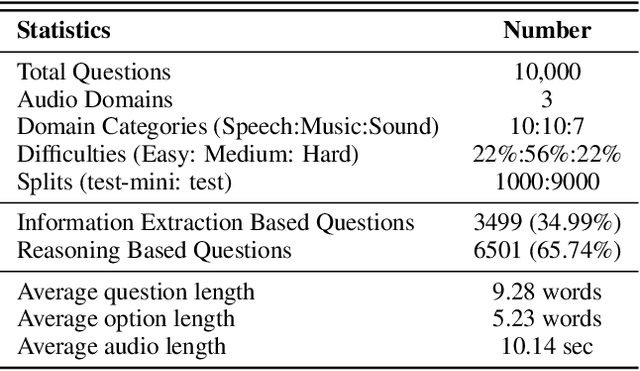
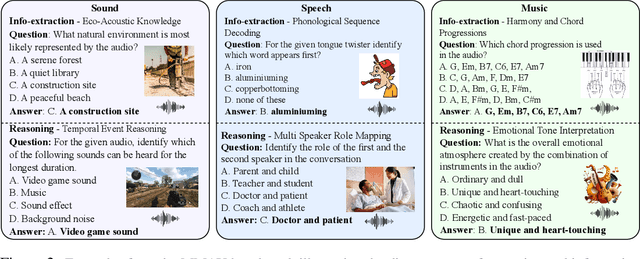
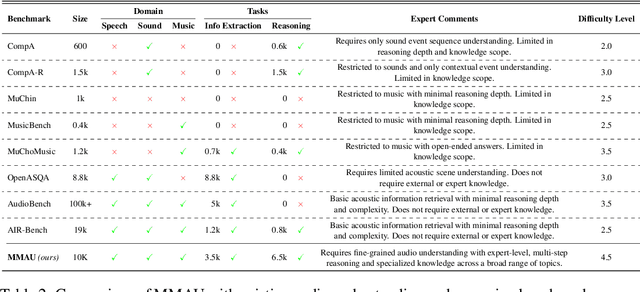
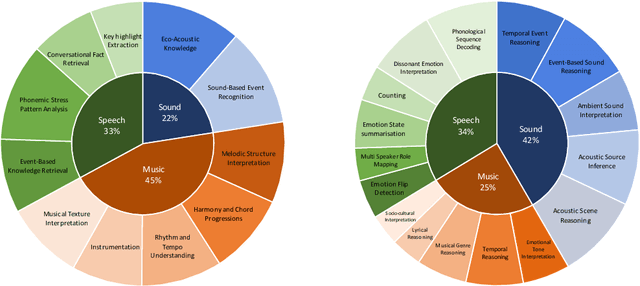
The ability to comprehend audio--which includes speech, non-speech sounds, and music--is crucial for AI agents to interact effectively with the world. We present MMAU, a novel benchmark designed to evaluate multimodal audio understanding models on tasks requiring expert-level knowledge and complex reasoning. MMAU comprises 10k carefully curated audio clips paired with human-annotated natural language questions and answers spanning speech, environmental sounds, and music. It includes information extraction and reasoning questions, requiring models to demonstrate 27 distinct skills across unique and challenging tasks. Unlike existing benchmarks, MMAU emphasizes advanced perception and reasoning with domain-specific knowledge, challenging models to tackle tasks akin to those faced by experts. We assess 18 open-source and proprietary (Large) Audio-Language Models, demonstrating the significant challenges posed by MMAU. Notably, even the most advanced Gemini Pro v1.5 achieves only 52.97% accuracy, and the state-of-the-art open-source Qwen2-Audio achieves only 52.50%, highlighting considerable room for improvement. We believe MMAU will drive the audio and multimodal research community to develop more advanced audio understanding models capable of solving complex audio tasks.
Do Audio-Language Models Understand Linguistic Variations?
Oct 21, 2024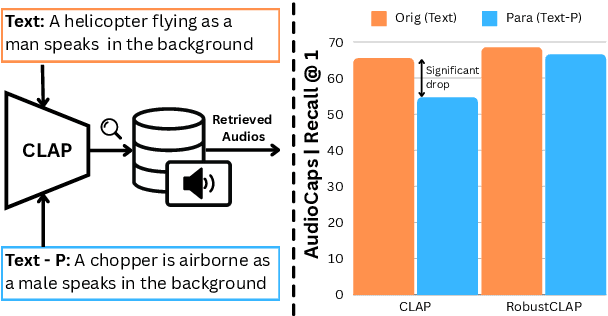


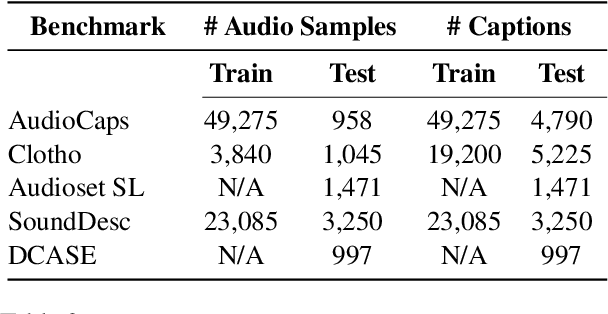
Open-vocabulary audio language models (ALMs), like Contrastive Language Audio Pretraining (CLAP), represent a promising new paradigm for audio-text retrieval using natural language queries. In this paper, for the first time, we perform controlled experiments on various benchmarks to show that existing ALMs struggle to generalize to linguistic variations in textual queries. To address this issue, we propose RobustCLAP, a novel and compute-efficient technique to learn audio-language representations agnostic to linguistic variations. Specifically, we reformulate the contrastive loss used in CLAP architectures by introducing a multi-view contrastive learning objective, where paraphrases are treated as different views of the same audio scene and use this for training. Our proposed approach improves the text-to-audio retrieval performance of CLAP by 0.8%-13% across benchmarks and enhances robustness to linguistic variation.
DocEdit-v2: Document Structure Editing Via Multimodal LLM Grounding
Oct 21, 2024
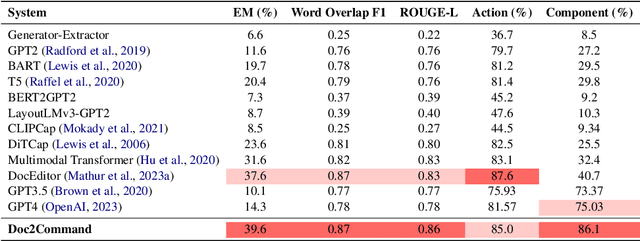
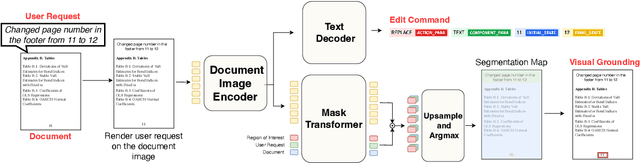
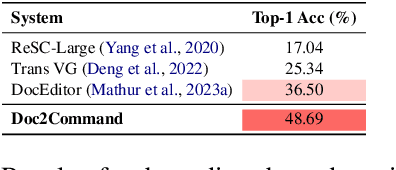
Document structure editing involves manipulating localized textual, visual, and layout components in document images based on the user's requests. Past works have shown that multimodal grounding of user requests in the document image and identifying the accurate structural components and their associated attributes remain key challenges for this task. To address these, we introduce the DocEdit-v2, a novel framework that performs end-to-end document editing by leveraging Large Multimodal Models (LMMs). It consists of three novel components: (1) Doc2Command, which simultaneously localizes edit regions of interest (RoI) and disambiguates user edit requests into edit commands; (2) LLM-based Command Reformulation prompting to tailor edit commands originally intended for specialized software into edit instructions suitable for generalist LMMs. (3) Moreover, DocEdit-v2 processes these outputs via Large Multimodal Models like GPT-4V and Gemini, to parse the document layout, execute edits on grounded Region of Interest (RoI), and generate the edited document image. Extensive experiments on the DocEdit dataset show that DocEdit-v2 significantly outperforms strong baselines on edit command generation (2-33%), RoI bounding box detection (12-31%), and overall document editing (1-12\%) tasks.
PAT: Parameter-Free Audio-Text Aligner to Boost Zero-Shot Audio Classification
Oct 19, 2024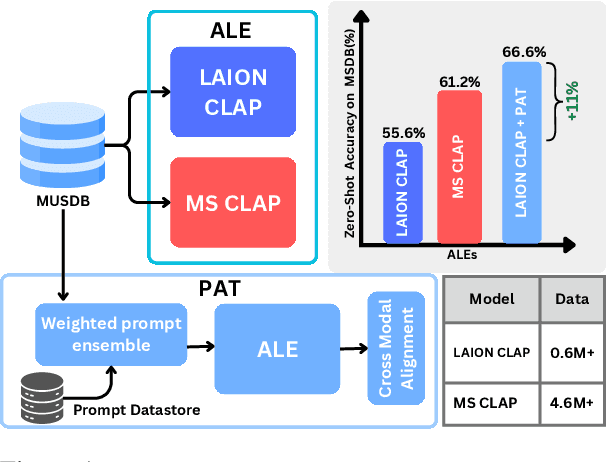
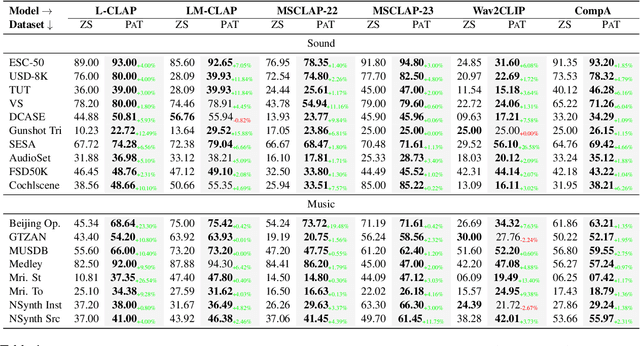
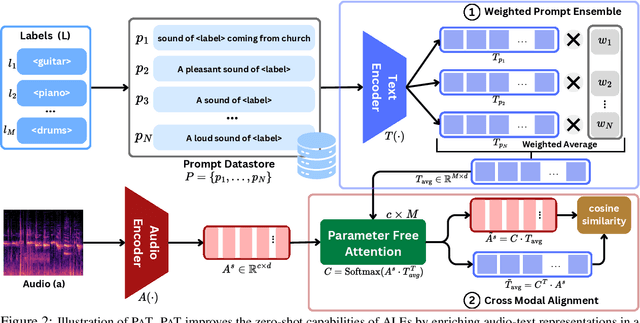
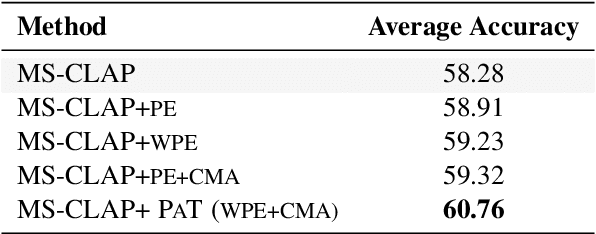
Audio-Language Models (ALMs) have demonstrated remarkable performance in zero-shot audio classification. In this paper, we introduce PAT (Parameter-free Audio-Text aligner), a simple and training-free method aimed at boosting the zero-shot audio classification performance of CLAP-like ALMs. To achieve this, we propose to improve the cross-modal interaction between audio and language modalities by enhancing the representations for both modalities using mutual feedback. Precisely, to enhance textual representations, we propose a prompt ensemble algorithm that automatically selects and combines the most relevant prompts from a datastore with a large pool of handcrafted prompts and weighs them according to their relevance to the audio. On the other hand, to enhance audio representations, we reweigh the frame-level audio features based on the enhanced textual information. Our proposed method does not require any additional modules or parameters and can be used with any existing CLAP-like ALM to improve zero-shot audio classification performance. We experiment across 18 diverse benchmark datasets and 6 ALMs and show that the PAT outperforms vanilla zero-shot evaluation with significant margins of 0.42%-27.0%. Additionally, we demonstrate that PAT maintains robust performance even when input audio is degraded by varying levels of noise. Our code will be open-sourced upon acceptance.