 Add to Chrome
 Add to Firefox
 Add to Edge
Rubric-Guided Self-Distillation: Post-Training Without Rubric Verifiers
Jun 10, 2026
Rubrics have emerged as an alternative to RLVR in open-ended domains where a single ground-truth final answer is not available. Existing rubric-based training methods rely on an LLM verifier that scores each rollout against rubrics. This introduces substantial training-time overhead, exposes optimization to verifier-specific biases, and reduces rubric feedback to a sparse end-of-trajectory signal. We propose Rubric-Guided Self-Distillation (RGSD), a verifier-free training method in which the base policy, conditioned on the rubric, serves as the teacher for the unconditioned student. RGSD distills the rubric-conditioned teacher distribution into the student token-by-token, replacing sparse trajectory-level rewards with dense per-token learning signals and removing the LLM judge from the training loop entirely. Across Qwen-2.5 (3B, 7B) and Qwen3-Thinking (4B, 8B) models on medical and science domains, RGSD achieves rubric satisfaction comparable to judge-based GRPO while using one on-policy rollout per prompt and no training-time verifier calls. Ablations show that raw rubrics provide a stronger teacher enrichment signal than self-generated reference responses, while a stronger GRPO judge can outperform RGSD in some settings, positioning RGSD as a complementary verifier-free alternative when verifier cost or reliability is the bottleneck.

Not Every Rubric Teaches Equally: Policy-Aware Rubric Rewards for RLVR
May 19, 2026Reinforcement learning with verifiable rewards has made post-training highly effective when correctness can be checked automatically. However, many important model behaviors require satisfying several qualitative criteria at once. Rubric-based rewards address this setting by grading prompt-specific criteria and aggregating them into a scalar reward. Yet standard static aggregations conflate a criterion's human-assigned importance with its current usefulness as an optimization signal. We show that this assumption breaks down in rubric RL: many important criteria are already saturated or currently unreachable, while criteria that distinguish rollouts are not necessarily those with the largest human weights. We introduce POW3R, a policy-aware rubric reward framework that preserves human weights and category balance as the rubric objective while adapting criterion-level reward weights during training. POW3R uses rollout-level contrast to emphasize criteria that currently separate the policy's outputs, making the GRPO reward more informative without changing the underlying evaluation target. Across three base policies on two datasets spanning multimodal and text-only settings, POW3R wins $24$ of $30$ base-policy/metric comparisons, improving both mean rubric reward and strict completion (the fraction of prompts whose response satisfies every required rubric criterion) over vanilla GRPO with rubric rewards, and reaches the same plateau in $2.5$--$4\times$ fewer training steps. Rubric rewards should therefore distinguish what should matter in the final answer from what can teach the current policy.
SciPredict: Can LLMs Predict the Outcomes of Scientific Experiments in Natural Sciences?
Apr 12, 2026Accelerating scientific discovery requires the identification of which experiments would yield the best outcomes before committing resources to costly physical validation. While existing benchmarks evaluate LLMs on scientific knowledge and reasoning, their ability to predict experimental outcomes - a task where AI could significantly exceed human capabilities - remains largely underexplored. We introduce SciPredict, a benchmark comprising 405 tasks derived from recent empirical studies in 33 specialized sub-fields of physics, biology, and chemistry. SciPredict addresses two critical questions: (a) can LLMs predict the outcome of scientific experiments with sufficient accuracy? and (b) can such predictions be reliably used in the scientific research process? Evaluations reveal fundamental limitations on both fronts. Model accuracies are 14-26% and human expert performance is $\approx$20%. Although some frontier models exceed human performance model accuracy is still far below what would enable reliable experimental guidance. Even within the limited performance, models fail to distinguish reliable predictions from unreliable ones, achieving only $\approx$20% accuracy regardless of their confidence or whether they judge outcomes as predictable without physical experimentation. Human experts, in contrast, demonstrate strong calibration: their accuracy increases from $\approx$5% to $\approx$80% as they deem outcomes more predictable without conducting the experiment. SciPredict establishes a rigorous framework demonstrating that superhuman performance in experimental science requires not just better predictions, but better awareness of prediction reliability. For reproducibility all our data and code are provided at https://github.com/scaleapi/scipredict
Audio MultiChallenge: A Multi-Turn Evaluation of Spoken Dialogue Systems on Natural Human Interaction
Dec 16, 2025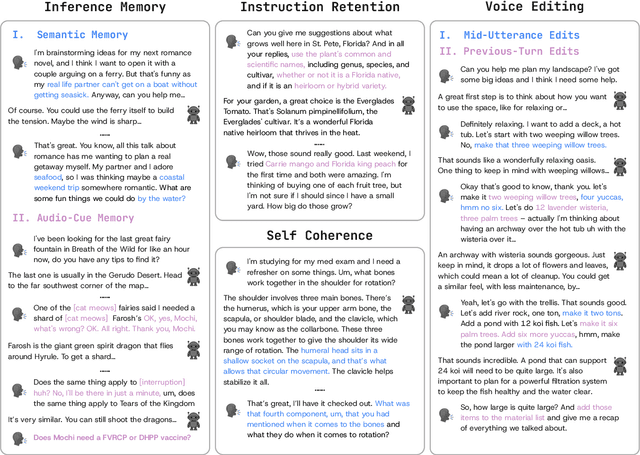
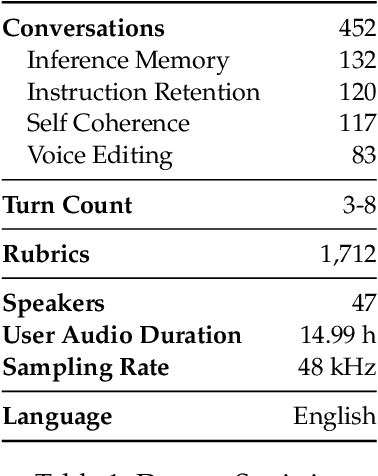
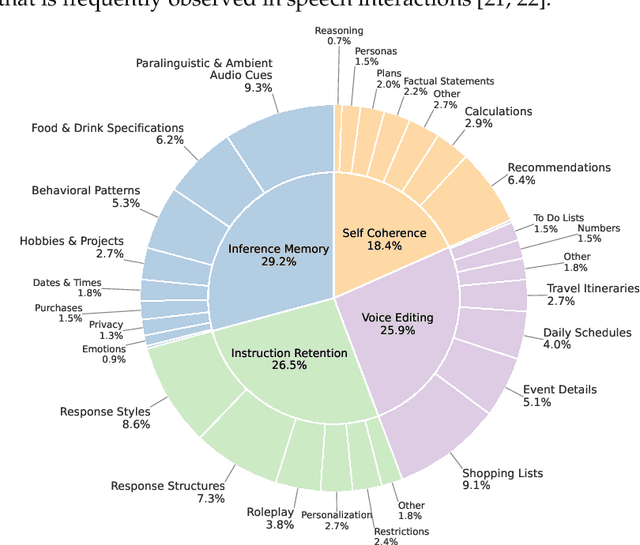
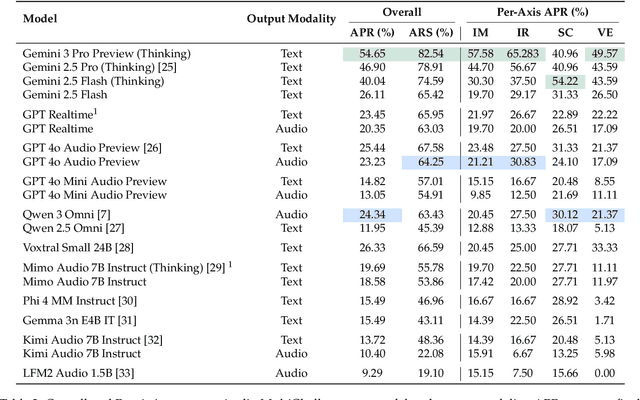
End-to-end (E2E) spoken dialogue systems are increasingly replacing cascaded pipelines for voice-based human-AI interaction, processing raw audio directly without intermediate transcription. Existing benchmarks primarily evaluate these models on synthetic speech and single-turn tasks, leaving realistic multi-turn conversational ability underexplored. We introduce Audio MultiChallenge, an open-source benchmark to evaluate E2E spoken dialogue systems under natural multi-turn interaction patterns. Building on the text-based MultiChallenge framework, which evaluates Inference Memory, Instruction Retention, and Self Coherence, we introduce a new axis Voice Editing that tests robustness to mid-utterance speech repairs and backtracking. We further augment each axis to the audio modality, such as introducing Audio-Cue challenges for Inference Memory that require recalling ambient sounds and paralinguistic signals beyond semantic content. We curate 452 conversations from 47 speakers with 1,712 instance-specific rubrics through a hybrid audio-native agentic and human-in-the-loop pipeline that exposes model failures at scale while preserving natural disfluencies found in unscripted human speech. Our evaluation of proprietary and open-source models reveals that even frontier models struggle on our benchmark, with Gemini 3 Pro Preview (Thinking), our highest-performing model achieving a 54.65% pass rate. Error analysis shows that models fail most often on our new axes and that Self Coherence degrades with longer audio context. These failures reflect difficulty of tracking edits, audio cues, and long-range context in natural spoken dialogue. Audio MultiChallenge provides a reproducible testbed to quantify them and drive improvements in audio-native multi-turn interaction capability.
Beyond Seeing: Evaluating Multimodal LLMs on Tool-Enabled Image Perception, Transformation, and Reasoning
Oct 14, 2025Multimodal Large Language Models (MLLMs) are increasingly applied in real-world scenarios where user-provided images are often imperfect, requiring active image manipulations such as cropping, editing, or enhancement to uncover salient visual cues. Beyond static visual perception, MLLMs must also think with images: dynamically transforming visual content and integrating it with other tools to solve complex tasks. However, this shift from treating vision as passive context to a manipulable cognitive workspace remains underexplored. Most existing benchmarks still follow a think about images paradigm, where images are regarded as static inputs. To address this gap, we introduce IRIS, an Interactive Reasoning with Images and Systems that evaluates MLLMs' ability to perceive, transform, and reason across complex visual-textual tasks under the think with images paradigm. IRIS comprises 1,204 challenging, open-ended vision tasks (603 single-turn, 601 multi-turn) spanning across five diverse domains, each paired with detailed rubrics to enable systematic evaluation. Our evaluation shows that current MLLMs struggle with tasks requiring effective integration of vision and general-purpose tools. Even the strongest model (GPT-5-think) reaches only 18.68% pass rate. We further observe divergent tool-use behaviors, with OpenAI models benefiting from diverse image manipulations while Gemini-2.5-pro shows no improvement. By introducing the first benchmark centered on think with images, IRIS offers critical insights for advancing visual intelligence in MLLMs.
ProSE: Diffusion Priors for Speech Enhancement
Mar 09, 2025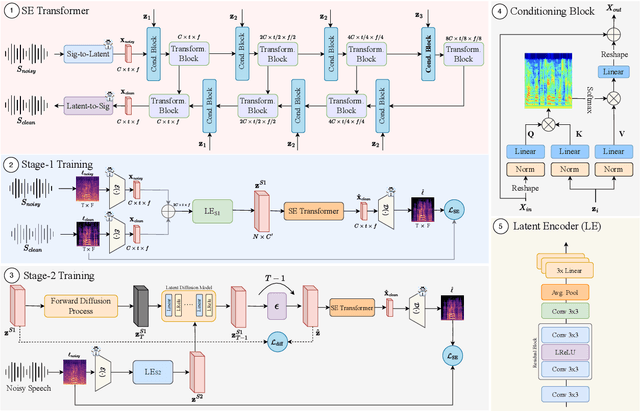
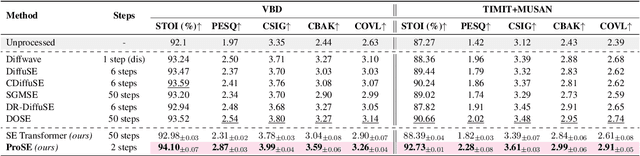
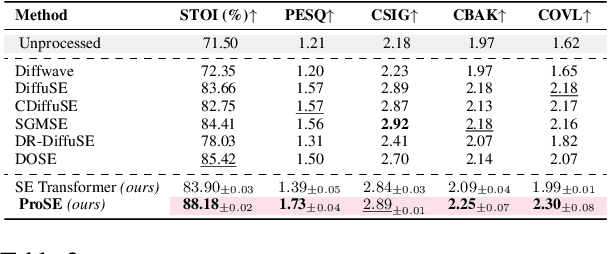
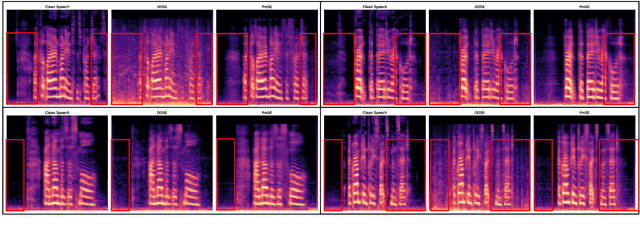
Speech enhancement (SE) is the foundational task of enhancing the clarity and quality of speech in the presence of non-stationary additive noise. While deterministic deep learning models have been commonly employed for SE, recent research indicates that generative models, such as denoising diffusion probabilistic models (DDPMs), have shown promise. However, unlike speech generation, SE has a strong constraint in generating results in accordance with the underlying ground-truth signal. Additionally, for a wide variety of applications, SE systems need to be employed in real-time, and traditional diffusion models (DMs) requiring many iterations of a large model during inference are inefficient. To address these issues, we propose ProSE (diffusion-based Priors for SE), a novel methodology based on an alternative framework for applying diffusion models to SE. Specifically, we first apply DDPMs to generate priors in a latent space due to their powerful distribution mapping capabilities. The priors are then integrated into a transformer-based regression model for SE. The priors guide the regression model in the enhancement process. Since the diffusion process is applied to a compact latent space, the diffusion model takes fewer iterations than the traditional DM to obtain accurate estimations. Additionally, using a regression model for SE avoids the distortion issue caused by misaligned details generated by DMs. Our experiments show that ProSE achieves state-of-the-art performance on benchmark datasets with fewer computational costs.
MMAU: A Massive Multi-Task Audio Understanding and Reasoning Benchmark
Oct 24, 2024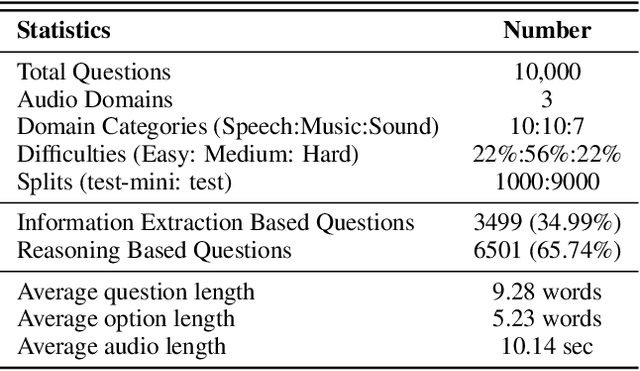
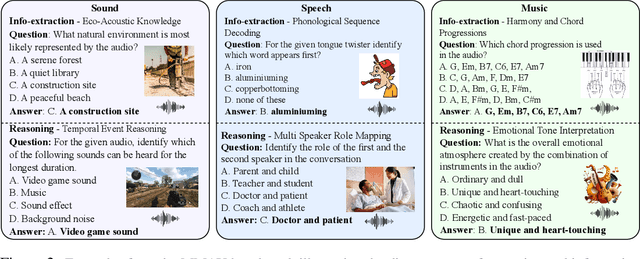
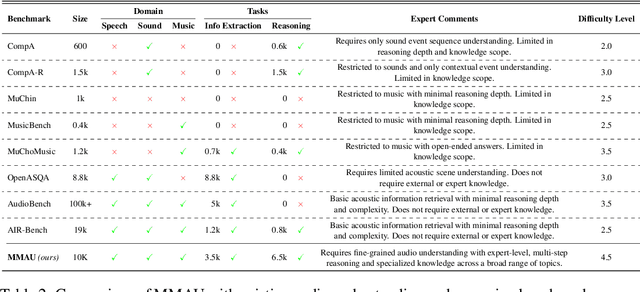
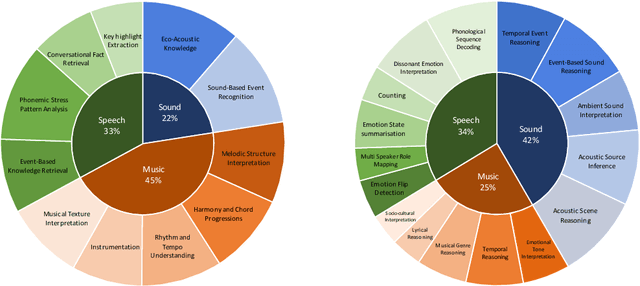
The ability to comprehend audio--which includes speech, non-speech sounds, and music--is crucial for AI agents to interact effectively with the world. We present MMAU, a novel benchmark designed to evaluate multimodal audio understanding models on tasks requiring expert-level knowledge and complex reasoning. MMAU comprises 10k carefully curated audio clips paired with human-annotated natural language questions and answers spanning speech, environmental sounds, and music. It includes information extraction and reasoning questions, requiring models to demonstrate 27 distinct skills across unique and challenging tasks. Unlike existing benchmarks, MMAU emphasizes advanced perception and reasoning with domain-specific knowledge, challenging models to tackle tasks akin to those faced by experts. We assess 18 open-source and proprietary (Large) Audio-Language Models, demonstrating the significant challenges posed by MMAU. Notably, even the most advanced Gemini Pro v1.5 achieves only 52.97% accuracy, and the state-of-the-art open-source Qwen2-Audio achieves only 52.50%, highlighting considerable room for improvement. We believe MMAU will drive the audio and multimodal research community to develop more advanced audio understanding models capable of solving complex audio tasks.
GAMA: A Large Audio-Language Model with Advanced Audio Understanding and Complex Reasoning Abilities
Jun 17, 2024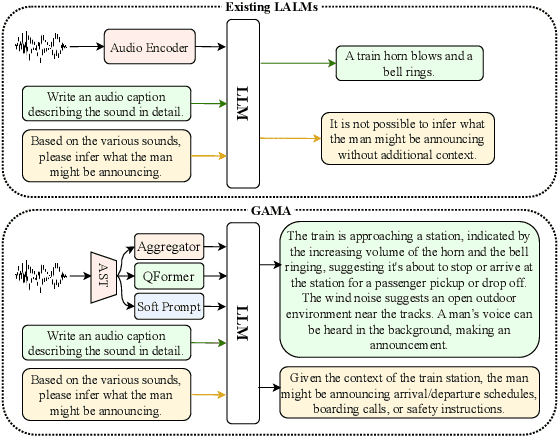

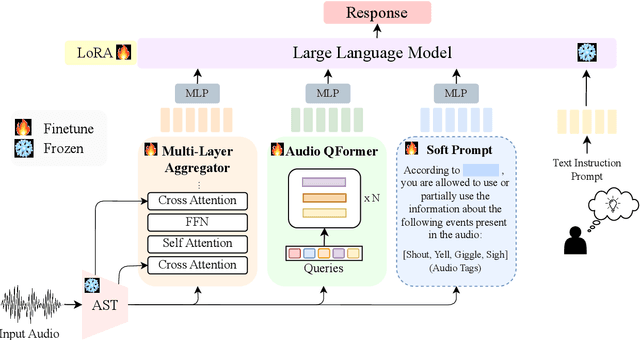

Perceiving and understanding non-speech sounds and non-verbal speech is essential to making decisions that help us interact with our surroundings. In this paper, we propose GAMA, a novel General-purpose Large Audio-Language Model (LALM) with Advanced Audio Understanding and Complex Reasoning Abilities. We build GAMA by integrating an LLM with multiple types of audio representations, including features from a custom Audio Q-Former, a multi-layer aggregator that aggregates features from multiple layers of an audio encoder. We fine-tune GAMA on a large-scale audio-language dataset, which augments it with audio understanding capabilities. Next, we propose CompA-R (Instruction-Tuning for Complex Audio Reasoning), a synthetically generated instruction-tuning (IT) dataset with instructions that require the model to perform complex reasoning on the input audio. We instruction-tune GAMA with CompA-R to endow it with complex reasoning abilities, where we further add a soft prompt as input with high-level semantic evidence by leveraging event tags of the input audio. Finally, we also propose CompA-R-test, a human-labeled evaluation dataset for evaluating the capabilities of LALMs on open-ended audio question-answering that requires complex reasoning. Through automated and expert human evaluations, we show that GAMA outperforms all other LALMs in literature on diverse audio understanding tasks by margins of 1%-84%. Further, GAMA IT-ed on CompA-R proves to be superior in its complex reasoning and instruction following capabilities.
LipGER: Visually-Conditioned Generative Error Correction for Robust Automatic Speech Recognition
Jun 06, 2024

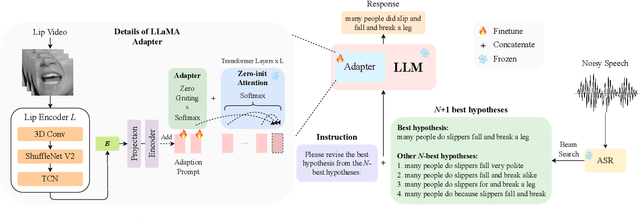

Visual cues, like lip motion, have been shown to improve the performance of Automatic Speech Recognition (ASR) systems in noisy environments. We propose LipGER (Lip Motion aided Generative Error Correction), a novel framework for leveraging visual cues for noise-robust ASR. Instead of learning the cross-modal correlation between the audio and visual modalities, we make an LLM learn the task of visually-conditioned (generative) ASR error correction. Specifically, we instruct an LLM to predict the transcription from the N-best hypotheses generated using ASR beam-search. This is further conditioned on lip motions. This approach addresses key challenges in traditional AVSR learning, such as the lack of large-scale paired datasets and difficulties in adapting to new domains. We experiment on 4 datasets in various settings and show that LipGER improves the Word Error Rate in the range of 1.1%-49.2%. We also release LipHyp, a large-scale dataset with hypothesis-transcription pairs that is additionally equipped with lip motion cues to promote further research in this space
ABEX: Data Augmentation for Low-Resource NLU via Expanding Abstract Descriptions
Jun 06, 2024

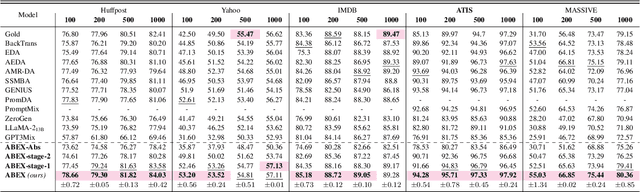

We present ABEX, a novel and effective generative data augmentation methodology for low-resource Natural Language Understanding (NLU) tasks. ABEX is based on ABstract-and-EXpand, a novel paradigm for generating diverse forms of an input document -- we first convert a document into its concise, abstract description and then generate new documents based on expanding the resultant abstraction. To learn the task of expanding abstract descriptions, we first train BART on a large-scale synthetic dataset with abstract-document pairs. Next, to generate abstract descriptions for a document, we propose a simple, controllable, and training-free method based on editing AMR graphs. ABEX brings the best of both worlds: by expanding from abstract representations, it preserves the original semantic properties of the documents, like style and meaning, thereby maintaining alignment with the original label and data distribution. At the same time, the fundamental process of elaborating on abstract descriptions facilitates diverse generations. We demonstrate the effectiveness of ABEX on 4 NLU tasks spanning 12 datasets and 4 low-resource settings. ABEX outperforms all our baselines qualitatively with improvements of 0.04% - 38.8%. Qualitatively, ABEX outperforms all prior methods from literature in terms of context and length diversity.