 Add to Chrome
 Add to Firefox
 Add to Edge
Video2LoRA: Parametric Video Internalization for Vision-Language Models
Jun 03, 2026
Processing video in vision-language models is expensive: each frame occupies hundreds of tokens, and inference cost scales with every frame and every repeated query. We introduce Video2LoRA, a method for parametric video internalization. A perceiver hypernetwork reads the intermediate representations produced layer-by-layer as a frozen VLM encodes a video, and generates a Low-Rank Adaptation (LoRA) adapter in a single forward pass. Unlike standard LoRA fine-tuning, which requires iterative gradient updates, Video2LoRA predicts these weights directly from the video. Trained for SmolVLM2 500M and 2.2B on video summarization and captioning, Video2LoRA enables the same frozen VLM to answer queries from the adapter alone, with zero visual tokens in its context at query time. Video2LoRA is statistically non-inferior and equivalent to direct video-in-context inference across all five captioning benchmarks at both model scales, and across seven of eight video question answering benchmark-scale pairings. Although trained only on 12 frames at 384px, it remains stable up to 1,024 frames and 1024px, where direct video-in-context inference often degenerates. Across this sweep, it reduces answer-time visual-token load by up to 1,500x and query TTFT by 6-80x, while preserving video-faithful outputs. We also find that independently generated adapters for non-overlapping video segments can compose in rank space, suggesting a path toward chunked long-video internalization.

DRAGON: A Benchmark for Evidence-Grounded Visual Reasoning over Diagrams
Apr 28, 2026Diagram question answering (DQA) requires models to interpret structured visual representations such as charts, maps, infographics, circuit schematics, and scientific diagrams. Recent vision-language models (VLMs) often achieve high answer accuracy on these tasks, yet correct answers do not guarantee that models ground their reasoning in the diagram regions that support the prediction. Models may instead rely on textual correlations or dataset artifacts without identifying the visual evidence required to verify the answer. This limitation prevents reliable evaluation of diagram reasoning and reduces interpretability. We introduce DRAGON, a benchmark for evaluating evidence-grounded visual reasoning in diagrams. Given a diagram, a question, and the correct answer, a model must predict bounding boxes that correspond to the visual elements required to justify the answer. These evidence regions may include answer-bearing components, textual labels, legends, axes, connectors, and other supporting structures involved in the reasoning process. The DRAGON dataset contains 11,664 annotated question instances collected from six diagram QA datasets: ChartQA, Circuit-VQA, InfographicsVQA, MapIQ, MapWise, and AI2D. We release a 2,445-instance benchmark test set with human-verified reasoning evidence annotations and a standardized evaluation framework. We evaluate eight recent VLMs and analyze their ability to localize reasoning evidence across diverse diagram domains. DRAGON enables systematic evaluation of diagram reasoning and supports future research on models that ground their predictions in visual evidence.
Learning Illumination Control in Diffusion Models
Apr 27, 2026Controlling illumination in images is essential for photography and visual content creation. While closed-source models have demonstrated impressive illumination control, open-source alternatives either require heavy control inputs like depth maps or do not release their data and code. We present a fully open-source and reproducible pipeline for learning illumination control in diffusion models. Our approach builds a data engine that transforms well-lit images into supervised training triplets consisting of a poorly-illuminated input image, a natural language lighting instruction, and a well-illuminated output image. We finetune a diffusion model on this data and demonstrate significant improvements over baseline SD 1.5, SDXL, and FLUX.1-dev models in perceptual similarity, structural similarity, and identity preservation. Our work provides a reproducible solution built entirely with open-source tools and publicly available data. We release all our code, data, and model weights publicly.
Structured Uncertainty guided Clarification for LLM Agents
Nov 11, 2025LLM agents extend large language models with tool-calling capabilities, but ambiguous user instructions often lead to incorrect invocations and task failures. We introduce a principled formulation of structured uncertainty over tool-call parameters, modeling joint tool-argument clarification as a POMDP with Expected Value of Perfect Information (EVPI) objective for optimal question selection and aspect-based cost modeling to prevent redundancy. Our SAGE-Agent leverages this structured uncertainty to achieve superior efficiency: increasing coverage on ambiguous tasks by 7-39\% while reducing clarification questions by 1.5-2.7$\times$ compared to strong prompting and uncertainty-based baselines. We present ClarifyBench, the first multi-turn tool-augmented disambiguation benchmark with realistic LLM-based user simulation across diverse domains including document editing, vehicle control, and travel booking. Additionally, we demonstrate that structured uncertainty provides effective training signals for reinforcement learning, boosting When2Call accuracy from 36.5\% to 65.2\% (3B model) and 36.7\% to 62.9\% (7B model) through uncertainty-weighted GRPO training. These results establish structured uncertainty as a principled, efficient approach for tool-augmented agents, improving both task success and interaction efficiency in real-world scenarios.
ChartLens: Fine-grained Visual Attribution in Charts
May 25, 2025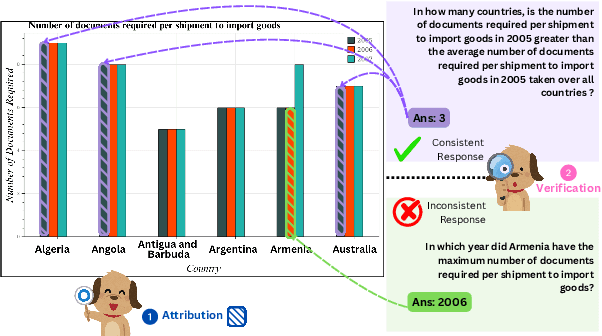
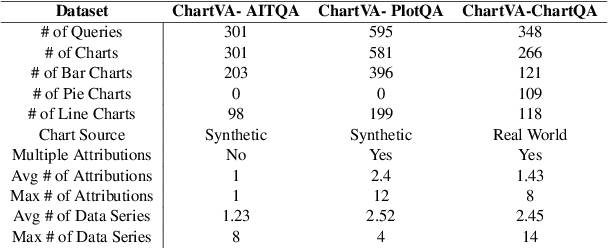
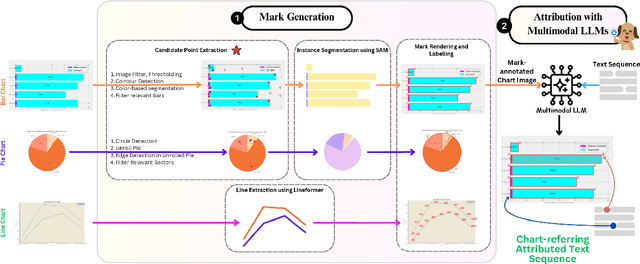
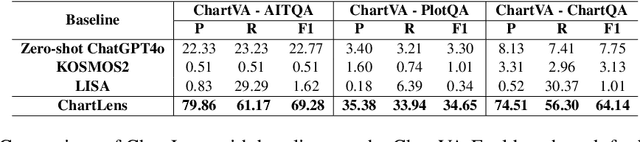
The growing capabilities of multimodal large language models (MLLMs) have advanced tasks like chart understanding. However, these models often suffer from hallucinations, where generated text sequences conflict with the provided visual data. To address this, we introduce Post-Hoc Visual Attribution for Charts, which identifies fine-grained chart elements that validate a given chart-associated response. We propose ChartLens, a novel chart attribution algorithm that uses segmentation-based techniques to identify chart objects and employs set-of-marks prompting with MLLMs for fine-grained visual attribution. Additionally, we present ChartVA-Eval, a benchmark with synthetic and real-world charts from diverse domains like finance, policy, and economics, featuring fine-grained attribution annotations. Our evaluations show that ChartLens improves fine-grained attributions by 26-66%.
Mitigating Memorization in LLMs using Activation Steering
Mar 08, 2025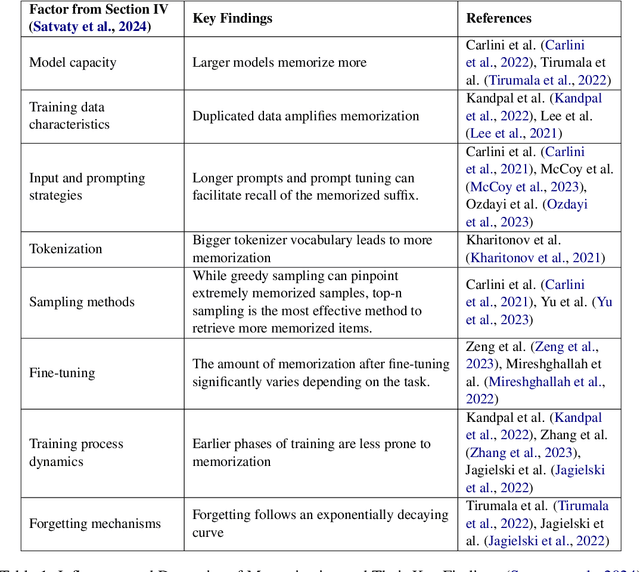
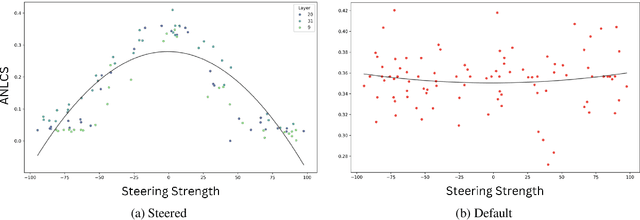
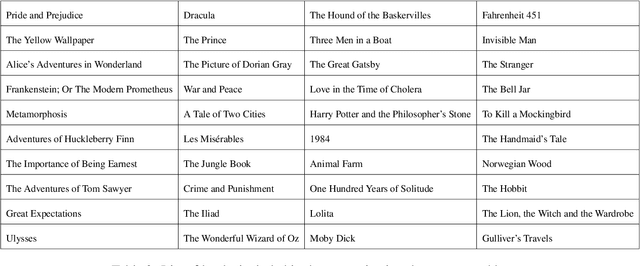
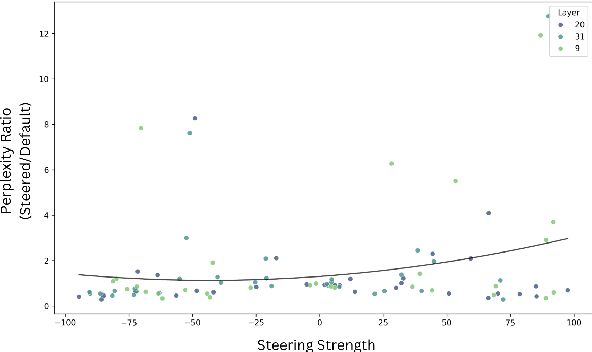
The memorization of training data by Large Language Models (LLMs) poses significant risks, including privacy leaks and the regurgitation of copyrighted content. Activation steering, a technique that directly intervenes in model activations, has emerged as a promising approach for manipulating LLMs. In this work, we explore the effectiveness of activation steering in reducing memorization while preserving generalization capabilities. We conduct empirical evaluations using a controlled memorization benchmark of literary material and demonstrate that our method successfully suppresses memorized content with minimal degradation in model performance in Gemma. Additionally, we analyze the trade-offs between suppression effectiveness and linguistic fluency, highlighting the advantages and limitations of activation-based interventions. Our findings contribute to ongoing efforts in developing safer and more privacy-preserving LLMs by providing a practical and efficient mechanism to mitigate unintended memorization.
VisDoM: Multi-Document QA with Visually Rich Elements Using Multimodal Retrieval-Augmented Generation
Dec 14, 2024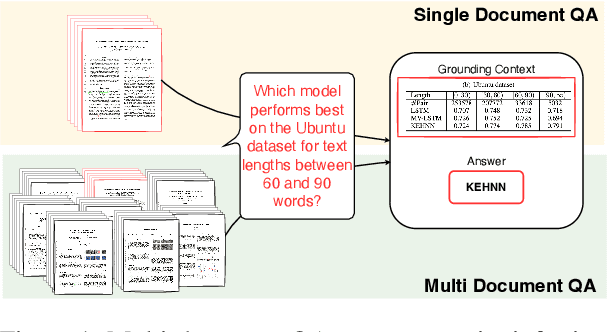
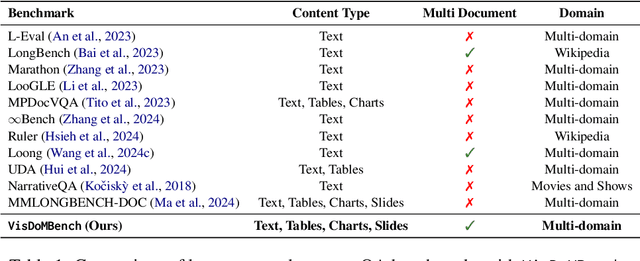

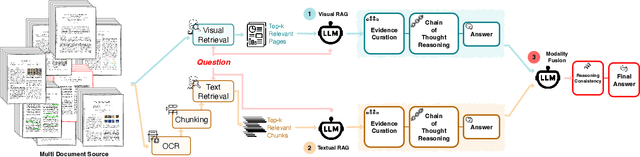
Understanding information from a collection of multiple documents, particularly those with visually rich elements, is important for document-grounded question answering. This paper introduces VisDoMBench, the first comprehensive benchmark designed to evaluate QA systems in multi-document settings with rich multimodal content, including tables, charts, and presentation slides. We propose VisDoMRAG, a novel multimodal Retrieval Augmented Generation (RAG) approach that simultaneously utilizes visual and textual RAG, combining robust visual retrieval capabilities with sophisticated linguistic reasoning. VisDoMRAG employs a multi-step reasoning process encompassing evidence curation and chain-of-thought reasoning for concurrent textual and visual RAG pipelines. A key novelty of VisDoMRAG is its consistency-constrained modality fusion mechanism, which aligns the reasoning processes across modalities at inference time to produce a coherent final answer. This leads to enhanced accuracy in scenarios where critical information is distributed across modalities and improved answer verifiability through implicit context attribution. Through extensive experiments involving open-source and proprietary large language models, we benchmark state-of-the-art document QA methods on VisDoMBench. Extensive results show that VisDoMRAG outperforms unimodal and long-context LLM baselines for end-to-end multimodal document QA by 12-20%.
x-RAGE: eXtended Reality -- Action & Gesture Events Dataset
Oct 25, 2024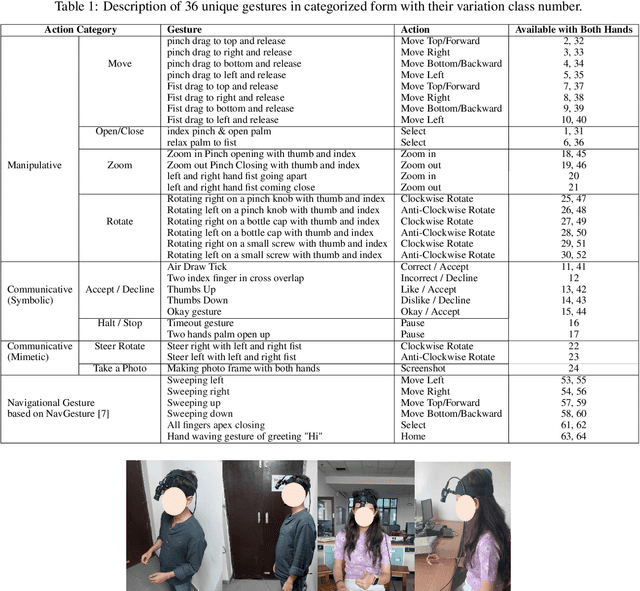
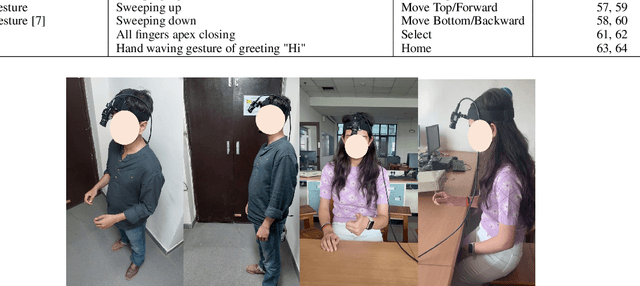
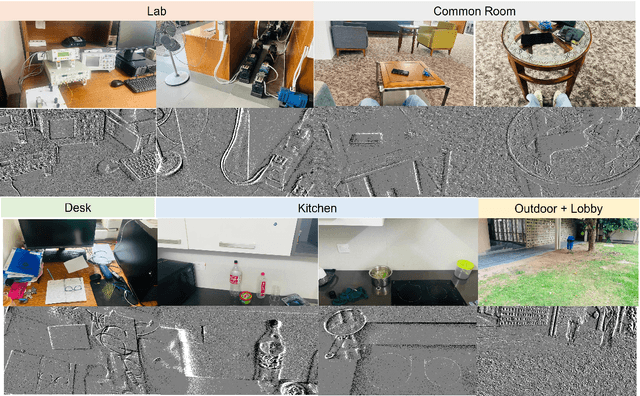
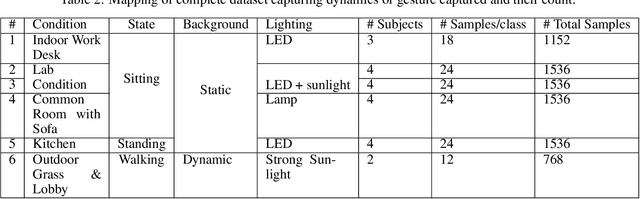
With the emergence of the Metaverse and focus on wearable devices in the recent years gesture based human-computer interaction has gained significance. To enable gesture recognition for VR/AR headsets and glasses several datasets focusing on egocentric i.e. first-person view have emerged in recent years. However, standard frame-based vision suffers from limitations in data bandwidth requirements as well as ability to capture fast motions. To overcome these limitation bio-inspired approaches such as event-based cameras present an attractive alternative. In this work, we present the first event-camera based egocentric gesture dataset for enabling neuromorphic, low-power solutions for XR-centric gesture recognition. The dataset has been made available publicly at the following URL: https://gitlab.com/NVM_IITD_Research/xrage.
DocEdit-v2: Document Structure Editing Via Multimodal LLM Grounding
Oct 21, 2024
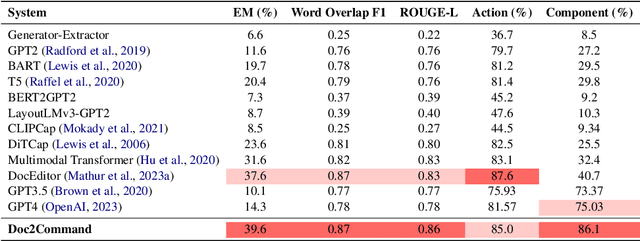
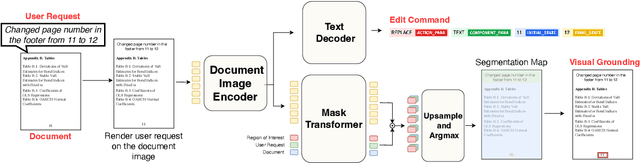
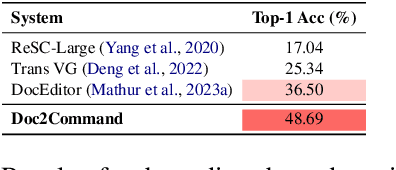
Document structure editing involves manipulating localized textual, visual, and layout components in document images based on the user's requests. Past works have shown that multimodal grounding of user requests in the document image and identifying the accurate structural components and their associated attributes remain key challenges for this task. To address these, we introduce the DocEdit-v2, a novel framework that performs end-to-end document editing by leveraging Large Multimodal Models (LMMs). It consists of three novel components: (1) Doc2Command, which simultaneously localizes edit regions of interest (RoI) and disambiguates user edit requests into edit commands; (2) LLM-based Command Reformulation prompting to tailor edit commands originally intended for specialized software into edit instructions suitable for generalist LMMs. (3) Moreover, DocEdit-v2 processes these outputs via Large Multimodal Models like GPT-4V and Gemini, to parse the document layout, execute edits on grounded Region of Interest (RoI), and generate the edited document image. Extensive experiments on the DocEdit dataset show that DocEdit-v2 significantly outperforms strong baselines on edit command generation (2-33%), RoI bounding box detection (12-31%), and overall document editing (1-12\%) tasks.
Non-Invasive Qualitative Vibration Analysis using Event Camera
Oct 18, 2024

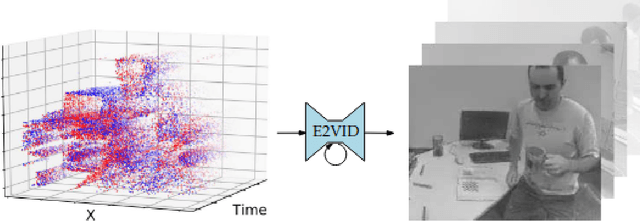
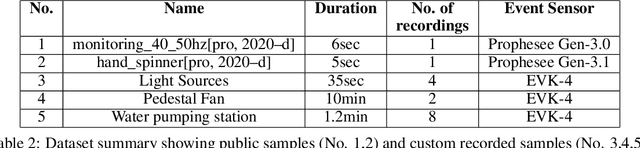
This technical report investigates the application of event-based vision sensors in non-invasive qualitative vibration analysis, with a particular focus on frequency measurement and motion magnification. Event cameras, with their high temporal resolution and dynamic range, offer promising capabilities for real-time structural assessment and subtle motion analysis. Our study employs cutting-edge event-based vision techniques to explore real-world scenarios in frequency measurement in vibrational analysis and intensity reconstruction for motion magnification. In the former, event-based sensors demonstrated significant potential for real-time structural assessment. However, our work in motion magnification revealed considerable challenges, particularly in scenarios involving stationary cameras and isolated motion.