 Add to Chrome
 Add to Firefox
 Add to Edge
DrivingGaussian: Composite Gaussian Splatting for Surrounding Dynamic Autonomous Driving Scenes
Dec 13, 2023

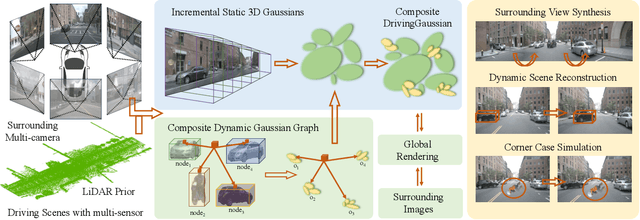

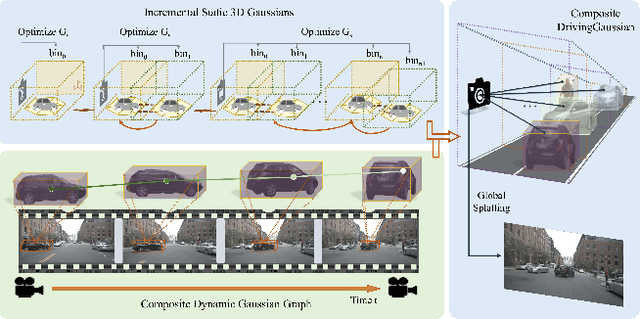
We present DrivingGaussian, an efficient and effective framework for surrounding dynamic autonomous driving scenes. For complex scenes with moving objects, we first sequentially and progressively model the static background of the entire scene with incremental static 3D Gaussians. We then leverage a composite dynamic Gaussian graph to handle multiple moving objects, individually reconstructing each object and restoring their accurate positions and occlusion relationships within the scene. We further use a LiDAR prior for Gaussian Splatting to reconstruct scenes with greater details and maintain panoramic consistency. DrivingGaussian outperforms existing methods in driving scene reconstruction and enables photorealistic surround-view synthesis with high-fidelity and multi-camera consistency. The source code and trained models will be released.

HOI-Diff: Text-Driven Synthesis of 3D Human-Object Interactions using Diffusion Models
Dec 11, 2023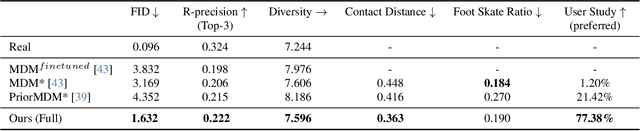
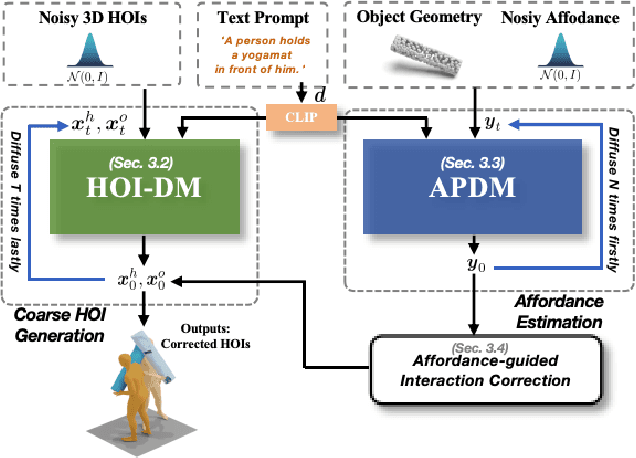
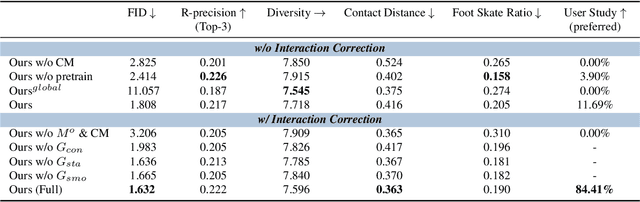
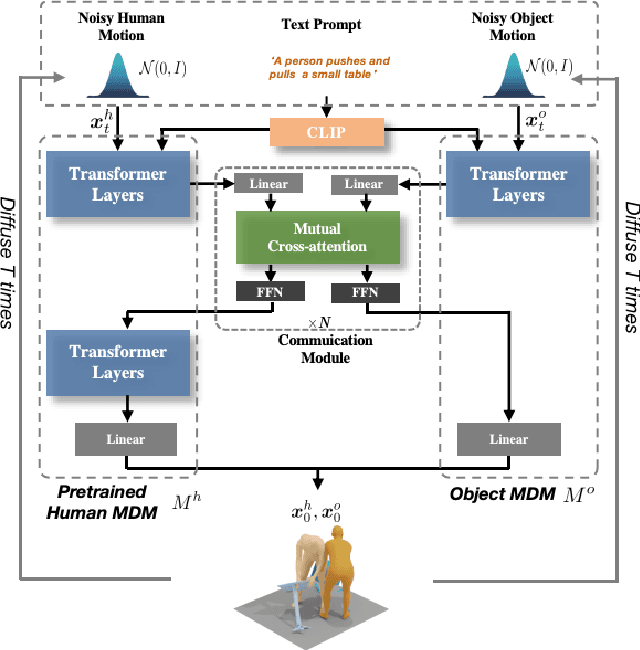
We address the problem of generating realistic 3D human-object interactions (HOIs) driven by textual prompts. Instead of a single model, our key insight is to take a modular design and decompose the complex task into simpler sub-tasks. We first develop a dual-branch diffusion model (HOI-DM) to generate both human and object motions conditioning on the input text, and encourage coherent motions by a cross-attention communication module between the human and object motion generation branches. We also develop an affordance prediction diffusion model (APDM) to predict the contacting area between the human and object during the interactions driven by the textual prompt. The APDM is independent of the results by the HOI-DM and thus can correct potential errors by the latter. Moreover, it stochastically generates the contacting points to diversify the generated motions. Finally, we incorporate the estimated contacting points into the classifier-guidance to achieve accurate and close contact between humans and objects. To train and evaluate our approach, we annotate BEHAVE dataset with text descriptions. Experimental results demonstrate that our approach is able to produce realistic HOIs with various interactions and different types of objects.
WonderJourney: Going from Anywhere to Everywhere
Dec 06, 2023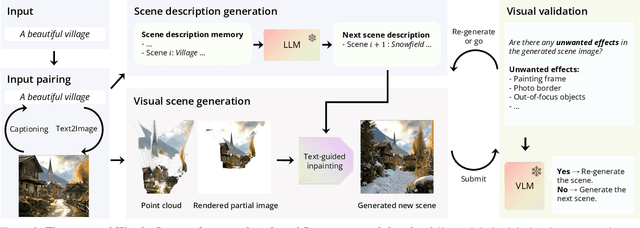
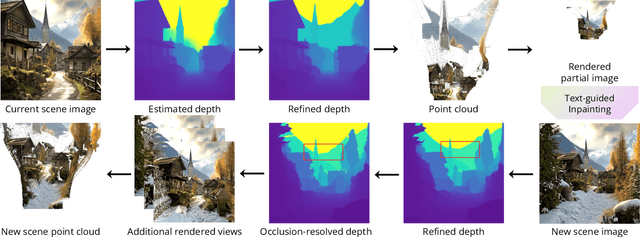


We introduce WonderJourney, a modularized framework for perpetual 3D scene generation. Unlike prior work on view generation that focuses on a single type of scenes, we start at any user-provided location (by a text description or an image) and generate a journey through a long sequence of diverse yet coherently connected 3D scenes. We leverage an LLM to generate textual descriptions of the scenes in this journey, a text-driven point cloud generation pipeline to make a compelling and coherent sequence of 3D scenes, and a large VLM to verify the generated scenes. We show compelling, diverse visual results across various scene types and styles, forming imaginary "wonderjourneys". Project website: https://kovenyu.com/WonderJourney/
Fine-grained Controllable Video Generation via Object Appearance and Context
Dec 05, 2023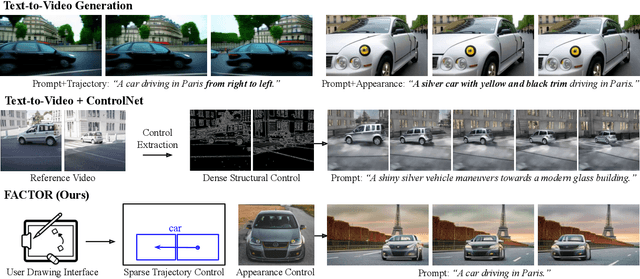
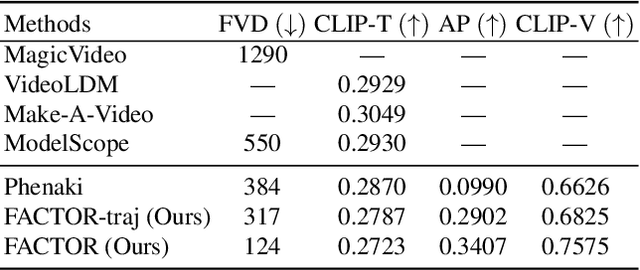
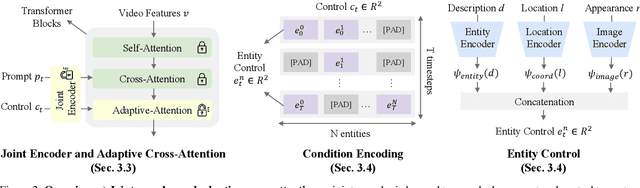
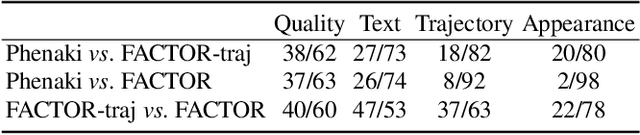
Text-to-video generation has shown promising results. However, by taking only natural languages as input, users often face difficulties in providing detailed information to precisely control the model's output. In this work, we propose fine-grained controllable video generation (FACTOR) to achieve detailed control. Specifically, FACTOR aims to control objects' appearances and context, including their location and category, in conjunction with the text prompt. To achieve detailed control, we propose a unified framework to jointly inject control signals into the existing text-to-video model. Our model consists of a joint encoder and adaptive cross-attention layers. By optimizing the encoder and the inserted layer, we adapt the model to generate videos that are aligned with both text prompts and fine-grained control. Compared to existing methods relying on dense control signals such as edge maps, we provide a more intuitive and user-friendly interface to allow object-level fine-grained control. Our method achieves controllability of object appearances without finetuning, which reduces the per-subject optimization efforts for the users. Extensive experiments on standard benchmark datasets and user-provided inputs validate that our model obtains a 70% improvement in controllability metrics over competitive baselines.
One-Shot Open Affordance Learning with Foundation Models
Nov 29, 2023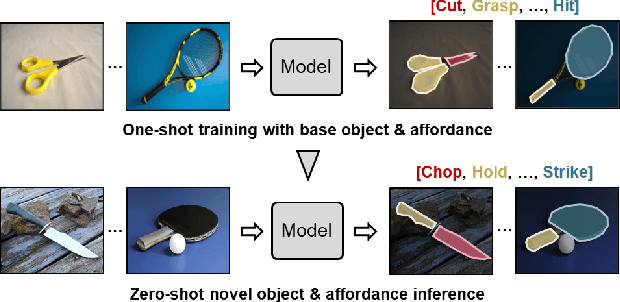
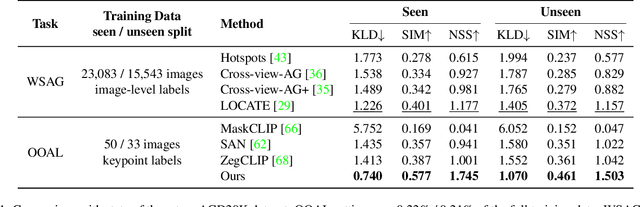
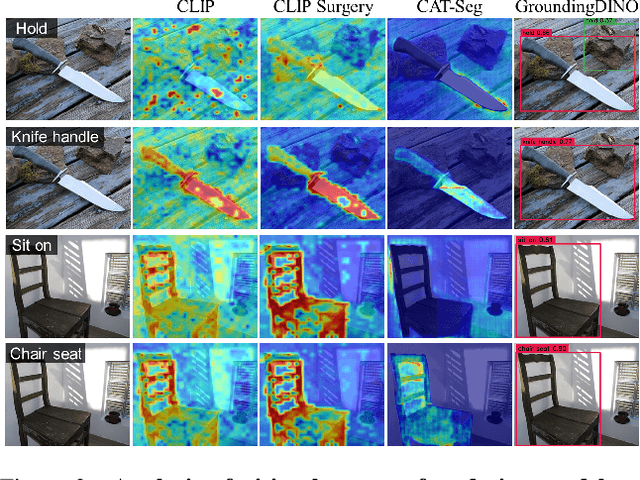
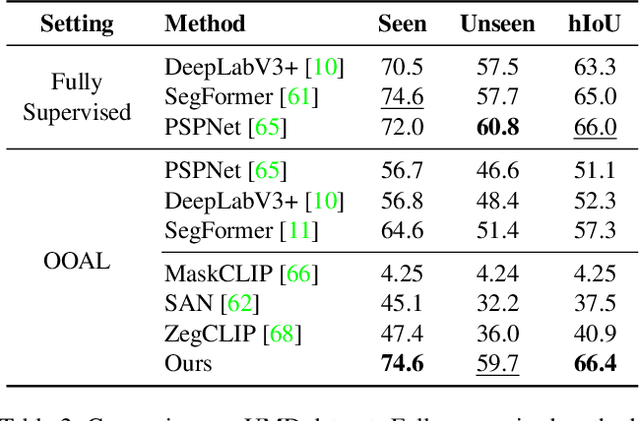
We introduce One-shot Open Affordance Learning (OOAL), where a model is trained with just one example per base object category, but is expected to identify novel objects and affordances. While vision-language models excel at recognizing novel objects and scenes, they often struggle to understand finer levels of granularity such as affordances. To handle this issue, we conduct a comprehensive analysis of existing foundation models, to explore their inherent understanding of affordances and assess the potential for data-limited affordance learning. We then propose a vision-language framework with simple and effective designs that boost the alignment between visual features and affordance text embeddings. Experiments on two affordance segmentation benchmarks show that the proposed method outperforms state-of-the-art models with less than 1% of the full training data, and exhibits reasonable generalization capability on unseen objects and affordances.
Telling Left from Right: Identifying Geometry-Aware Semantic Correspondence
Nov 28, 2023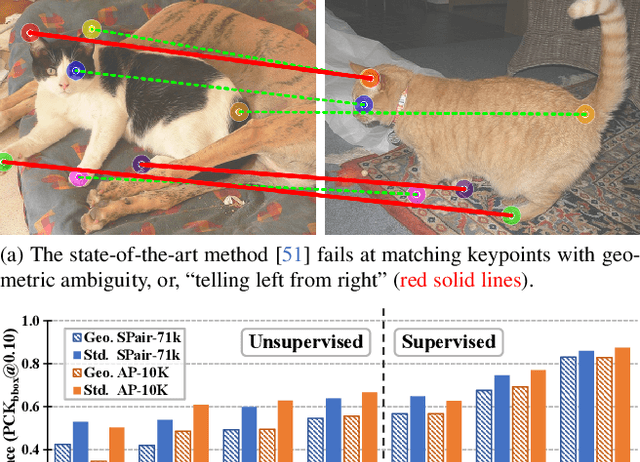


While pre-trained large-scale vision models have shown significant promise for semantic correspondence, their features often struggle to grasp the geometry and orientation of instances. This paper identifies the importance of being geometry-aware for semantic correspondence and reveals a limitation of the features of current foundation models under simple post-processing. We show that incorporating this information can markedly enhance semantic correspondence performance with simple but effective solutions in both zero-shot and supervised settings. We also construct a new challenging benchmark for semantic correspondence built from an existing animal pose estimation dataset, for both pre-training validating models. Our method achieves a PCK@0.10 score of 64.2 (zero-shot) and 85.6 (supervised) on the challenging SPair-71k dataset, outperforming the state-of-the-art by 4.3p and 11.0p absolute gains, respectively. Our code and datasets will be publicly available.
ZeroNVS: Zero-Shot 360-Degree View Synthesis from a Single Real Image
Oct 27, 2023
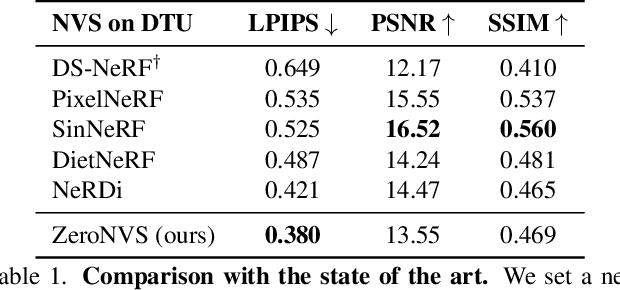
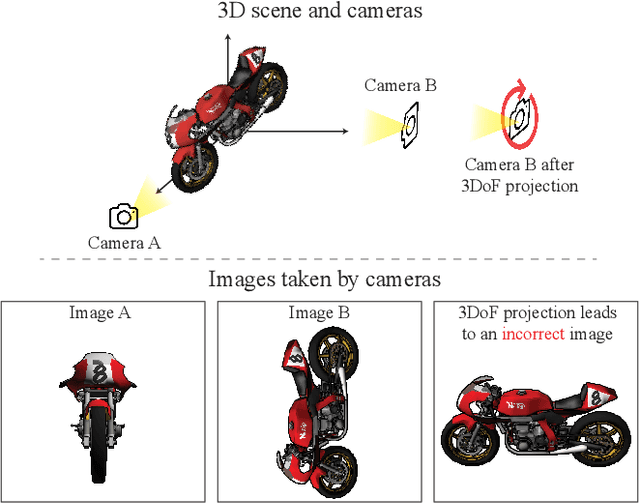
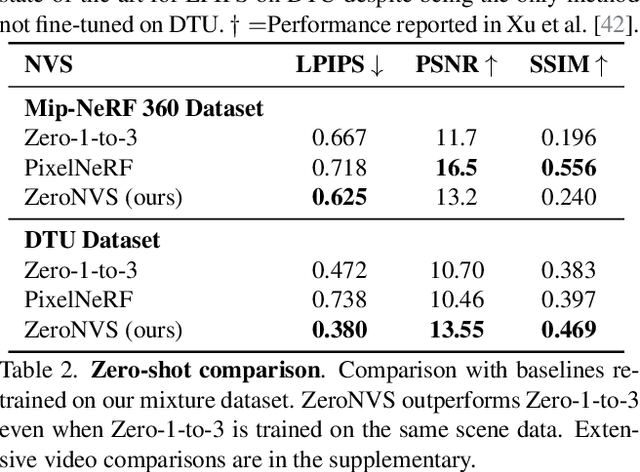
We introduce a 3D-aware diffusion model, ZeroNVS, for single-image novel view synthesis for in-the-wild scenes. While existing methods are designed for single objects with masked backgrounds, we propose new techniques to address challenges introduced by in-the-wild multi-object scenes with complex backgrounds. Specifically, we train a generative prior on a mixture of data sources that capture object-centric, indoor, and outdoor scenes. To address issues from data mixture such as depth-scale ambiguity, we propose a novel camera conditioning parameterization and normalization scheme. Further, we observe that Score Distillation Sampling (SDS) tends to truncate the distribution of complex backgrounds during distillation of 360-degree scenes, and propose "SDS anchoring" to improve the diversity of synthesized novel views. Our model sets a new state-of-the-art result in LPIPS on the DTU dataset in the zero-shot setting, even outperforming methods specifically trained on DTU. We further adapt the challenging Mip-NeRF 360 dataset as a new benchmark for single-image novel view synthesis, and demonstrate strong performance in this setting. Our code and data are at http://kylesargent.github.io/zeronvs/
OmniControl: Control Any Joint at Any Time for Human Motion Generation
Oct 12, 2023

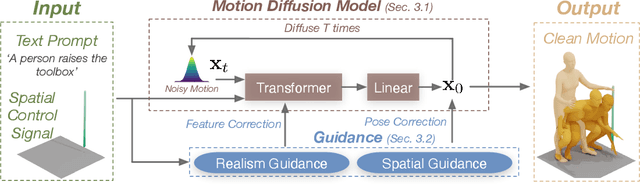

We present a novel approach named OmniControl for incorporating flexible spatial control signals into a text-conditioned human motion generation model based on the diffusion process. Unlike previous methods that can only control the pelvis trajectory, OmniControl can incorporate flexible spatial control signals over different joints at different times with only one model. Specifically, we propose analytic spatial guidance that ensures the generated motion can tightly conform to the input control signals. At the same time, realism guidance is introduced to refine all the joints to generate more coherent motion. Both the spatial and realism guidance are essential and they are highly complementary for balancing control accuracy and motion realism. By combining them, OmniControl generates motions that are realistic, coherent, and consistent with the spatial constraints. Experiments on HumanML3D and KIT-ML datasets show that OmniControl not only achieves significant improvement over state-of-the-art methods on pelvis control but also shows promising results when incorporating the constraints over other joints.
Structure-Preserving Instance Segmentation via Skeleton-Aware Distance Transform
Oct 08, 2023Objects with complex structures pose significant challenges to existing instance segmentation methods that rely on boundary or affinity maps, which are vulnerable to small errors around contacting pixels that cause noticeable connectivity change. While the distance transform (DT) makes instance interiors and boundaries more distinguishable, it tends to overlook the intra-object connectivity for instances with varying width and result in over-segmentation. To address these challenges, we propose a skeleton-aware distance transform (SDT) that combines the merits of object skeleton in preserving connectivity and DT in modeling geometric arrangement to represent instances with arbitrary structures. Comprehensive experiments on histopathology image segmentation demonstrate that SDT achieves state-of-the-art performance.
SAMPLING: Scene-adaptive Hierarchical Multiplane Images Representation for Novel View Synthesis from a Single Image
Sep 13, 2023Recent novel view synthesis methods obtain promising results for relatively small scenes, e.g., indoor environments and scenes with a few objects, but tend to fail for unbounded outdoor scenes with a single image as input. In this paper, we introduce SAMPLING, a Scene-adaptive Hierarchical Multiplane Images Representation for Novel View Synthesis from a Single Image based on improved multiplane images (MPI). Observing that depth distribution varies significantly for unbounded outdoor scenes, we employ an adaptive-bins strategy for MPI to arrange planes in accordance with each scene image. To represent intricate geometry and multi-scale details, we further introduce a hierarchical refinement branch, which results in high-quality synthesized novel views. Our method demonstrates considerable performance gains in synthesizing large-scale unbounded outdoor scenes using a single image on the KITTI dataset and generalizes well to the unseen Tanks and Temples dataset.The code and models will soon be made available.