 Add to Chrome
 Add to Firefox
 Add to Edge
RUEL: Retrieval-Augmented User Representation with Edge Browser Logs for Sequential Recommendation
Sep 19, 2023
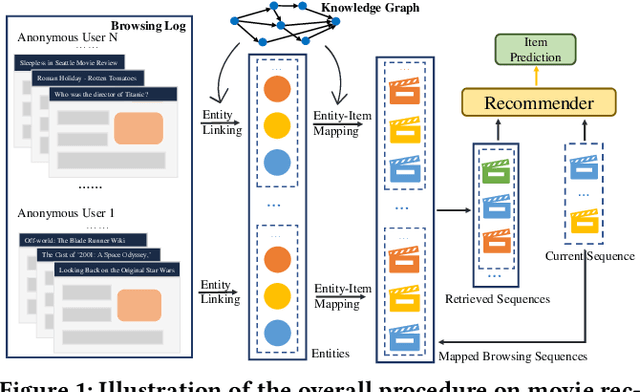
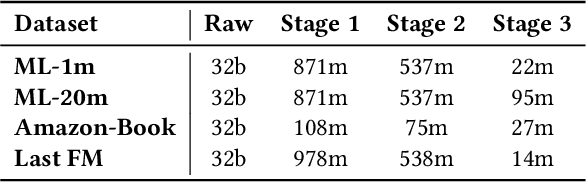
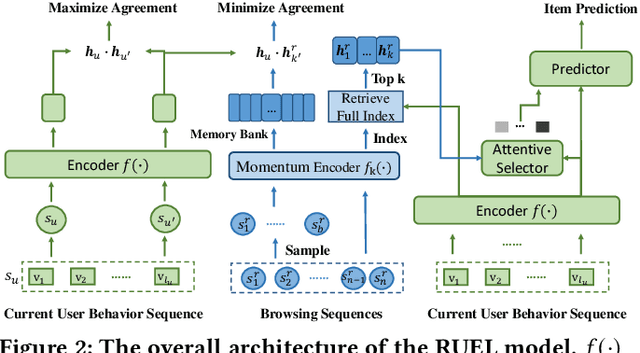
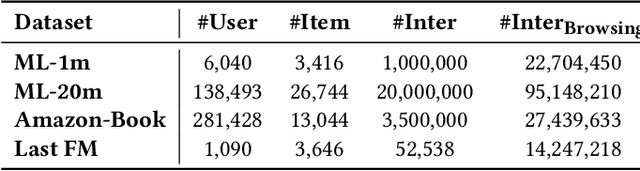
Online recommender systems (RS) aim to match user needs with the vast amount of resources available on various platforms. A key challenge is to model user preferences accurately under the condition of data sparsity. To address this challenge, some methods have leveraged external user behavior data from multiple platforms to enrich user representation. However, all of these methods require a consistent user ID across platforms and ignore the information from similar users. In this study, we propose RUEL, a novel retrieval-based sequential recommender that can effectively incorporate external anonymous user behavior data from Edge browser logs to enhance recommendation. We first collect and preprocess a large volume of Edge browser logs over a one-year period and link them to target entities that correspond to candidate items in recommendation datasets. We then design a contrastive learning framework with a momentum encoder and a memory bank to retrieve the most relevant and diverse browsing sequences from the full browsing log based on the semantic similarity between user representations. After retrieval, we apply an item-level attentive selector to filter out noisy items and generate refined sequence embeddings for the final predictor. RUEL is the first method that connects user browsing data with typical recommendation datasets and can be generalized to various recommendation scenarios and datasets. We conduct extensive experiments on four real datasets for sequential recommendation tasks and demonstrate that RUEL significantly outperforms state-of-the-art baselines. We also conduct ablation studies and qualitative analysis to validate the effectiveness of each component of RUEL and provide additional insights into our method.

Investigating the Learning Behaviour of In-context Learning: A Comparison with Supervised Learning
Aug 01, 2023Large language models (LLMs) have shown remarkable capacity for in-context learning (ICL), where learning a new task from just a few training examples is done without being explicitly pre-trained. However, despite the success of LLMs, there has been little understanding of how ICL learns the knowledge from the given prompts. In this paper, to make progress toward understanding the learning behaviour of ICL, we train the same LLMs with the same demonstration examples via ICL and supervised learning (SL), respectively, and investigate their performance under label perturbations (i.e., noisy labels and label imbalance) on a range of classification tasks. First, via extensive experiments, we find that gold labels have significant impacts on the downstream in-context performance, especially for large language models; however, imbalanced labels matter little to ICL across all model sizes. Second, when comparing with SL, we show empirically that ICL is less sensitive to label perturbations than SL, and ICL gradually attains comparable performance to SL as the model size increases.
WizardCoder: Empowering Code Large Language Models with Evol-Instruct
Jun 14, 2023Code Large Language Models (Code LLMs), such as StarCoder, have demonstrated exceptional performance in code-related tasks. However, most existing models are solely pre-trained on extensive raw code data without instruction fine-tuning. In this paper, we introduce WizardCoder, which empowers Code LLMs with complex instruction fine-tuning, by adapting the Evol-Instruct method to the domain of code. Through comprehensive experiments on four prominent code generation benchmarks, namely HumanEval, HumanEval+, MBPP, and DS-1000, we unveil the exceptional capabilities of our model. It surpasses all other open-source Code LLMs by a substantial margin. Moreover, our model even outperforms the largest closed LLMs, Anthropic's Claude and Google's Bard, on HumanEval and HumanEval+. Our code, model weights, and data are public at https://github.com/nlpxucan/WizardLM
Knowledge Refinement via Interaction Between Search Engines and Large Language Models
May 21, 2023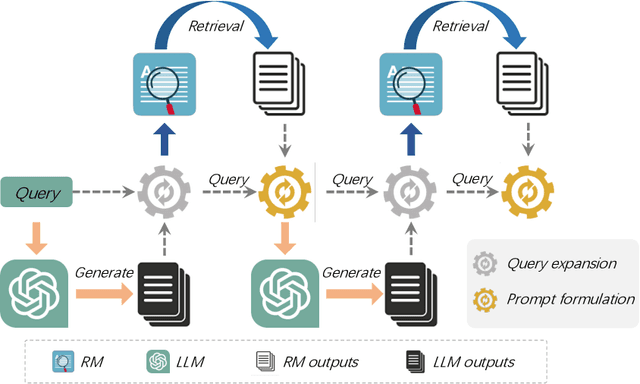


Information retrieval (IR) plays a crucial role in locating relevant resources from vast amounts of data, and its applications have evolved from traditional knowledge bases to modern search engines (SEs). The emergence of large language models (LLMs) has further revolutionized the IR field by enabling users to interact with search systems in natural language. In this paper, we explore the advantages and disadvantages of LLMs and SEs, highlighting their respective strengths in understanding user-issued queries and retrieving up-to-date information. To leverage the benefits of both paradigms while circumventing their limitations, we propose InteR, a novel framework that facilitates knowledge refinement through interaction between SEs and LLMs. InteR allows SEs to expand knowledge in queries using LLM-generated knowledge collections and enables LLMs to enhance prompt formulation using SE-retrieved documents. This iterative refinement process augments the inputs of SEs and LLMs, leading to more accurate retrieval. Experiments on large-scale retrieval benchmarks involving web search and low-resource retrieval tasks demonstrate that InteR achieves overall superior zero-shot retrieval performance compared to state-of-the-art methods, even those using relevance judgment. Source code is available at https://github.com/Cyril-JZ/InteR
Augmented Large Language Models with Parametric Knowledge Guiding
May 18, 2023Large Language Models (LLMs) have significantly advanced natural language processing (NLP) with their impressive language understanding and generation capabilities. However, their performance may be suboptimal for domain-specific tasks that require specialized knowledge due to limited exposure to the related data. Additionally, the lack of transparency of most state-of-the-art (SOTA) LLMs, which can only be accessed via APIs, impedes further fine-tuning with domain custom data. Moreover, providing private data to the LLMs' owner leads to data privacy problems. To address these challenges, we propose the novel Parametric Knowledge Guiding (PKG) framework, which equips LLMs with a knowledge-guiding module to access relevant knowledge without altering the LLMs' parameters. Our PKG is based on open-source "white-box" language models, allowing offline memory of any knowledge that LLMs require. We demonstrate that our PKG framework can enhance the performance of "black-box" LLMs on a range of domain knowledge-intensive tasks that require factual (+7.9%), tabular (+11.9%), medical (+3.0%), and multimodal (+8.1%) knowledge.
Alleviating Over-smoothing for Unsupervised Sentence Representation
May 09, 2023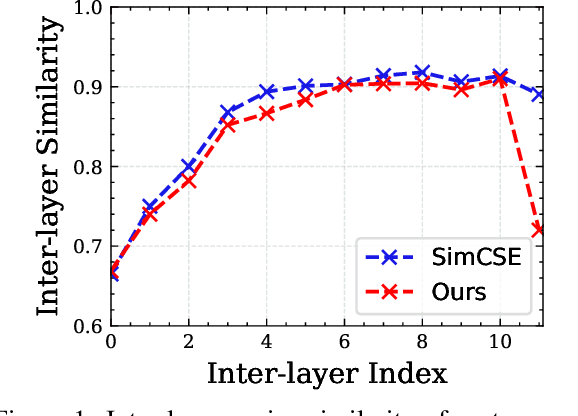
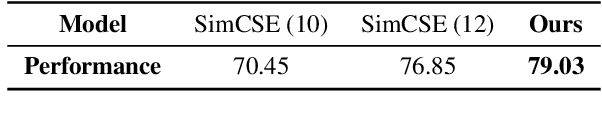
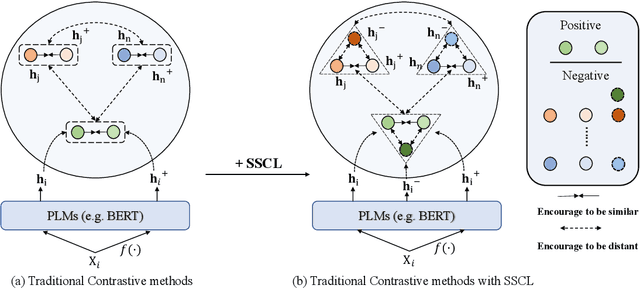
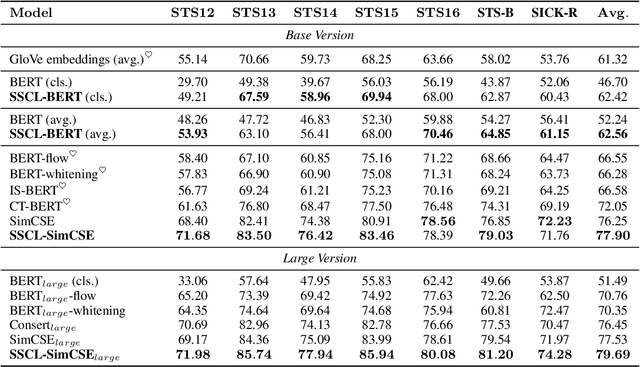
Currently, learning better unsupervised sentence representations is the pursuit of many natural language processing communities. Lots of approaches based on pre-trained language models (PLMs) and contrastive learning have achieved promising results on this task. Experimentally, we observe that the over-smoothing problem reduces the capacity of these powerful PLMs, leading to sub-optimal sentence representations. In this paper, we present a Simple method named Self-Contrastive Learning (SSCL) to alleviate this issue, which samples negatives from PLMs intermediate layers, improving the quality of the sentence representation. Our proposed method is quite simple and can be easily extended to various state-of-the-art models for performance boosting, which can be seen as a plug-and-play contrastive framework for learning unsupervised sentence representation. Extensive results prove that SSCL brings the superior performance improvements of different strong baselines (e.g., BERT and SimCSE) on Semantic Textual Similarity and Transfer datasets. Our codes are available at https://github.com/nuochenpku/SSCL.
* 13 pages
Code Execution with Pre-trained Language Models
May 08, 2023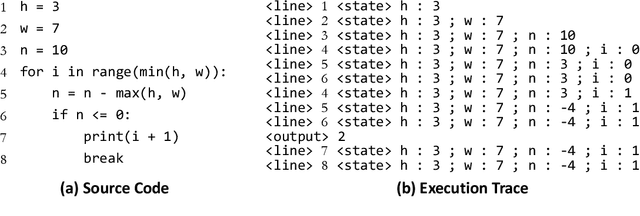
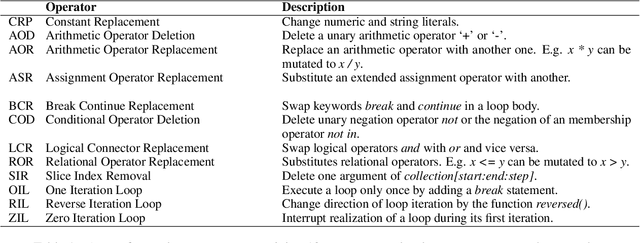
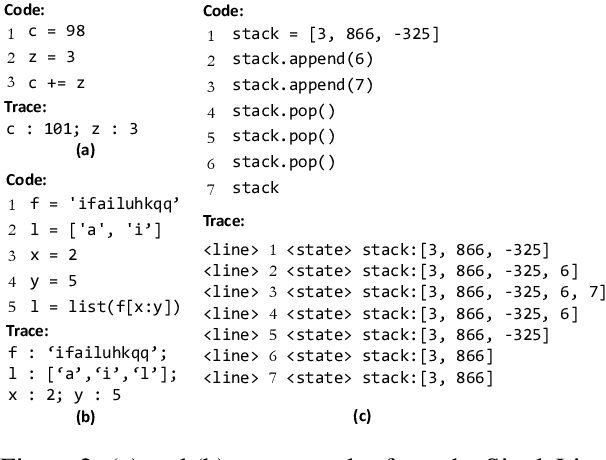
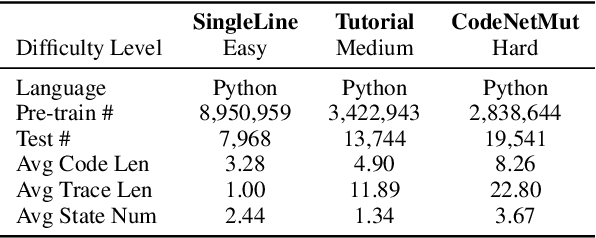
Code execution is a fundamental aspect of programming language semantics that reflects the exact behavior of the code. However, most pre-trained models for code intelligence ignore the execution trace and only rely on source code and syntactic structures. In this paper, we investigate how well pre-trained models can understand and perform code execution. We develop a mutation-based data augmentation technique to create a large-scale and realistic Python dataset and task for code execution, which challenges existing models such as Codex. We then present CodeExecutor, a Transformer model that leverages code execution pre-training and curriculum learning to enhance its semantic comprehension. We evaluate CodeExecutor on code execution and show its promising performance and limitations. We also demonstrate its potential benefits for code intelligence tasks such as zero-shot code-to-code search and text-to-code generation. Our analysis provides insights into the learning and generalization abilities of pre-trained models for code execution.
Large Language Models are Strong Zero-Shot Retriever
Apr 27, 2023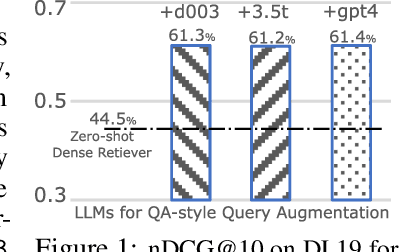


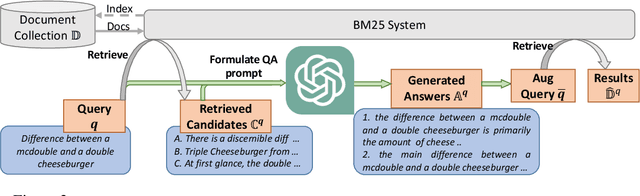
In this work, we propose a simple method that applies a large language model (LLM) to large-scale retrieval in zero-shot scenarios. Our method, Language language model as Retriever (LameR) is built upon no other neural models but an LLM, while breaking up brute-force combinations of retrievers with LLMs and lifting the performance of zero-shot retrieval to be very competitive on benchmark datasets. Essentially, we propose to augment a query with its potential answers by prompting LLMs with a composition of the query and the query's in-domain candidates. The candidates, regardless of correct or wrong, are obtained by a vanilla retrieval procedure on the target collection. Such candidates, as a part of prompts, are likely to help LLM generate more precise answers by pattern imitation or candidate summarization. Even if all the candidates are wrong, the prompts at least make LLM aware of in-collection patterns and genres. Moreover, due to the low performance of a self-supervised retriever, the LLM-based query augmentation becomes less effective as the retriever bottlenecks the whole pipeline. So, we propose to leverage a non-parametric lexicon-based method (e.g., BM25) as the retrieval module to capture query-document overlap in a literal fashion. As such, LameR makes the retrieval procedure transparent to the LLM, so it circumvents the performance bottleneck.
WizardLM: Empowering Large Language Models to Follow Complex Instructions
Apr 24, 2023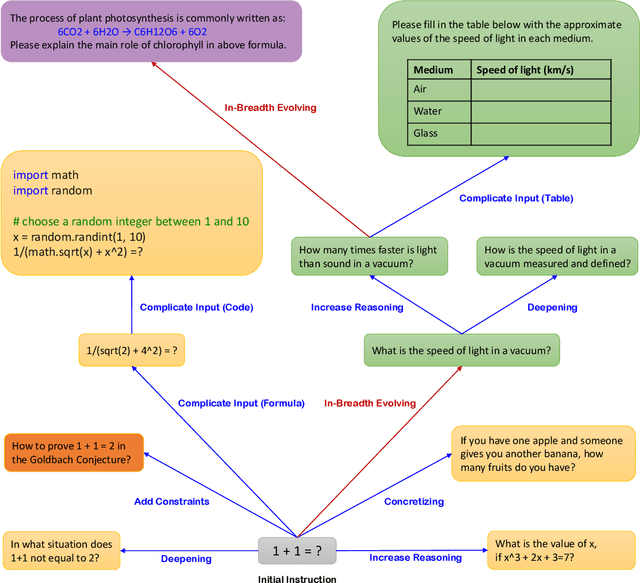
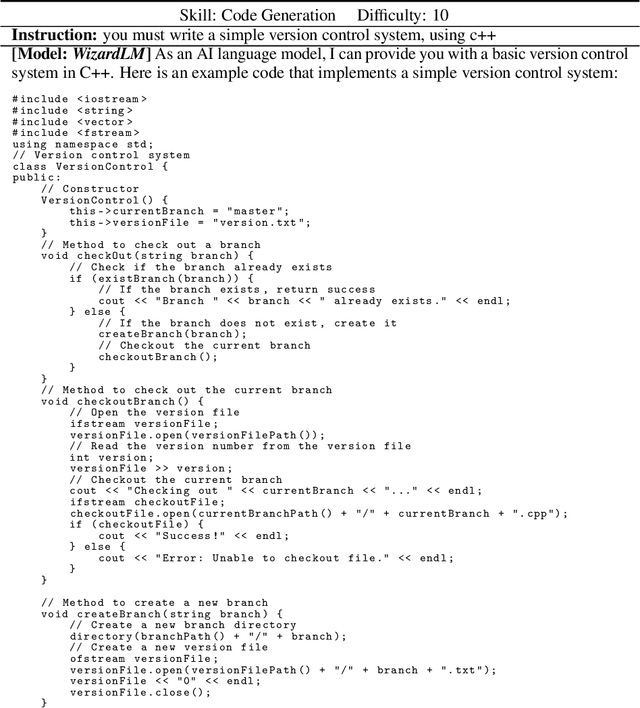
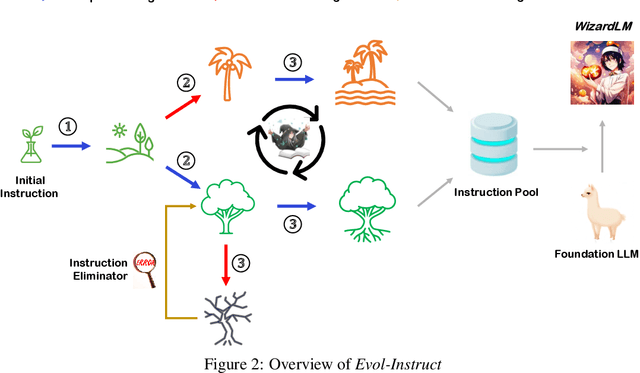
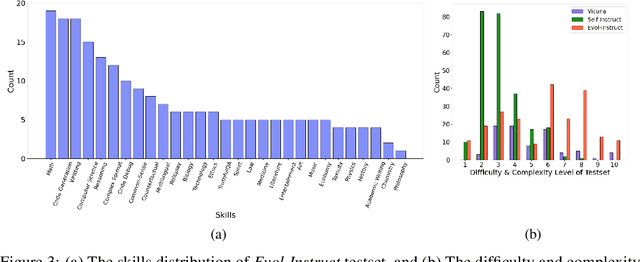
Training large language models (LLM) with open-domain instruction following data brings colossal success. However, manually creating such instruction data is very time-consuming and labor-intensive. Moreover, humans may struggle to produce high-complexity instructions. In this paper, we show an avenue for creating large amounts of instruction data with varying levels of complexity using LLM instead of humans. Starting with an initial set of instructions, we use our proposed Evol-Instruct to rewrite them step by step into more complex instructions. Then, we mix all generated instruction data to fine-tune LLaMA. We call the resulting model WizardLM. Human evaluations on a complexity-balanced test bed show that instructions from Evol-Instruct are superior to human-created ones. By analyzing the human evaluation results of the high complexity part, we demonstrate that outputs from our WizardLM model are preferred to outputs from OpenAI ChatGPT. Even though WizardLM still lags behind ChatGPT in some aspects, our findings suggest that fine-tuning with AI-evolved instructions is a promising direction for enhancing large language models. Our codes and generated data are public at https://github.com/nlpxucan/WizardLM
Typos-aware Bottlenecked Pre-Training for Robust Dense Retrieval
Apr 17, 2023Current dense retrievers (DRs) are limited in their ability to effectively process misspelled queries, which constitute a significant portion of query traffic in commercial search engines. The main issue is that the pre-trained language model-based encoders used by DRs are typically trained and fine-tuned using clean, well-curated text data. Misspelled queries are typically not found in the data used for training these models, and thus misspelled queries observed at inference time are out-of-distribution compared to the data used for training and fine-tuning. Previous efforts to address this issue have focused on \textit{fine-tuning} strategies, but their effectiveness on misspelled queries remains lower than that of pipelines that employ separate state-of-the-art spell-checking components. To address this challenge, we propose ToRoDer (TypOs-aware bottlenecked pre-training for RObust DEnse Retrieval), a novel \textit{pre-training} strategy for DRs that increases their robustness to misspelled queries while preserving their effectiveness in downstream retrieval tasks. ToRoDer utilizes an encoder-decoder architecture where the encoder takes misspelled text with masked tokens as input and outputs bottlenecked information to the decoder. The decoder then takes as input the bottlenecked embeddings, along with token embeddings of the original text with the misspelled tokens masked out. The pre-training task is to recover the masked tokens for both the encoder and decoder. Our extensive experimental results and detailed ablation studies show that DRs pre-trained with ToRoDer exhibit significantly higher effectiveness on misspelled queries, sensibly closing the gap with pipelines that use a separate, complex spell-checker component, while retaining their effectiveness on correctly spelled queries.