 Add to Chrome
 Add to Firefox
 Add to Edge
Fire as a Service: Augmenting Robot Simulators with Thermally and Visually Accurate Fire Dynamics
Mar 19, 2026
Most existing robot simulators prioritize rigid-body dynamics and photorealistic rendering, but largely neglect the thermally and optically complex phenomena that characterize real-world fire environments. For robots envisioned as future firefighters, this limitation hinders both reliable capability evaluation and the generation of representative training data prior to deployment in hazardous scenarios. To address these challenges, we introduce Fire as a Service (FaaS), a novel, asynchronous co-simulation framework that augments existing robot simulators with high-fidelity and computationally efficient fire simulations. Our pipeline enables robots to experience accurate, multi-species thermodynamic heat transfer and visually consistent volumetric smoke without disrupting high-frequency rigid-body control loops. We demonstrate that our framework can be integrated with diverse robot simulators to generate physically accurate fire behavior, benchmark thermal hazards encountered by robotic platforms, and collect realistic multimodal perceptual data. Crucially, its real-time performance supports human-in-the-loop teleoperation, enabling the successful training of reactive, multimodal policies via Behavioral Cloning. By adding fire dynamics to robot simulations, FaaS provides a scalable pathway toward safer, more reliable deployment of robots in fire scenarios.

Understanding Fire Through Thermal Radiation Fields for Mobile Robots
Feb 22, 2026Safely moving through environments affected by fire is a critical capability for autonomous mobile robots deployed in disaster response. In this work, we present a novel approach for mobile robots to understand fire through building real-time thermal radiation fields. We register depth and thermal images to obtain a 3D point cloud annotated with temperature values. From these data, we identify fires and use the Stefan-Boltzmann law to approximate the thermal radiation in empty spaces. This enables the construction of a continuous thermal radiation field over the environment. We show that this representation can be used for robot navigation, where we embed thermal constraints into the cost map to compute collision-free and thermally safe paths. We validate our approach on a Boston Dynamics Spot robot in controlled experimental settings. Our experiments demonstrate the robot's ability to avoid hazardous regions while still reaching navigation goals. Our approach paves the way toward mobile robots that can be autonomously deployed in fire-affected environments, with potential applications in search-and-rescue, firefighting, and hazardous material response.
Verti-Arena: A Controllable and Standardized Indoor Testbed for Multi-Terrain Off-Road Autonomy
Aug 11, 2025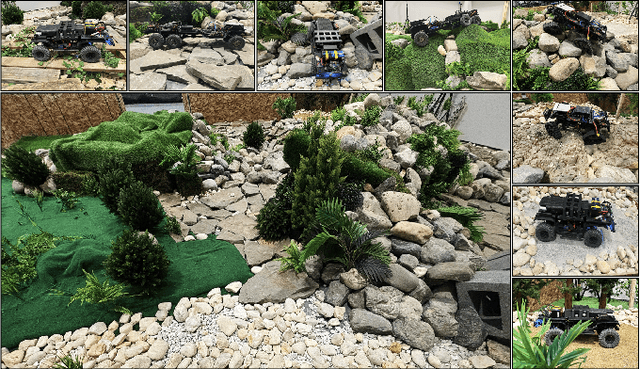
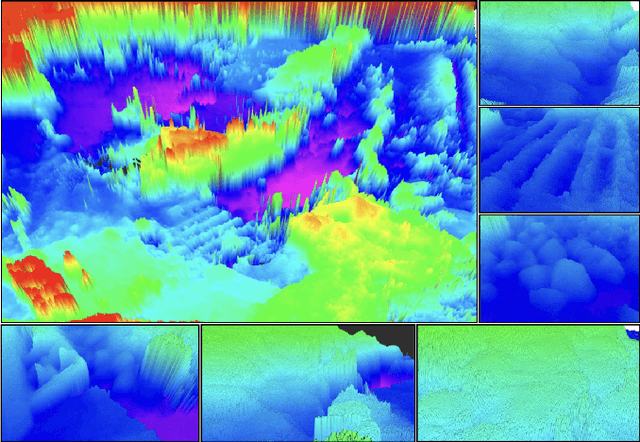
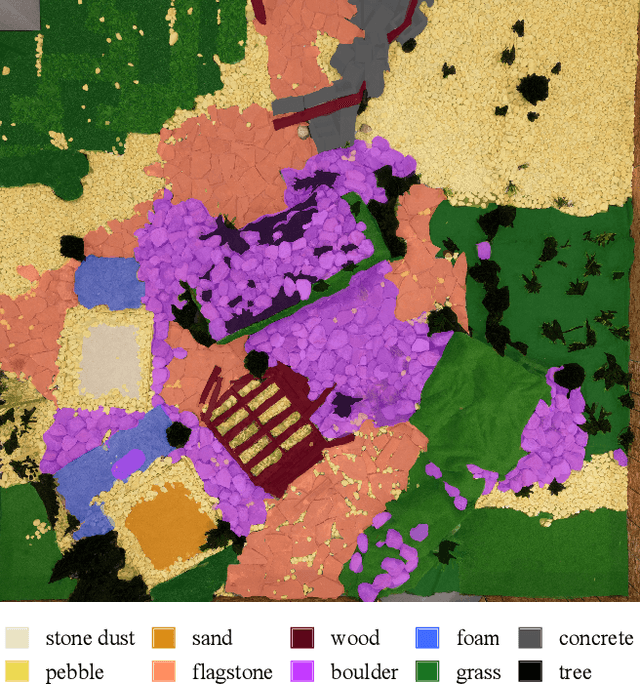
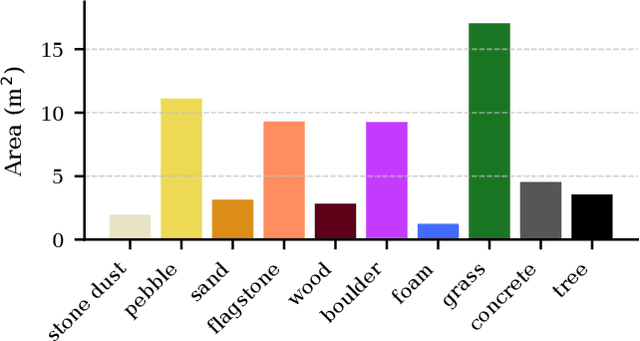
Off-road navigation is an important capability for mobile robots deployed in environments that are inaccessible or dangerous to humans, such as disaster response or planetary exploration. Progress is limited due to the lack of a controllable and standardized real-world testbed for systematic data collection and validation. To fill this gap, we introduce Verti-Arena, a reconfigurable indoor facility designed specifically for off-road autonomy. By providing a repeatable benchmark environment, Verti-Arena supports reproducible experiments across a variety of vertically challenging terrains and provides precise ground truth measurements through onboard sensors and a motion capture system. Verti-Arena also supports consistent data collection and comparative evaluation of algorithms in off-road autonomy research. We also develop a web-based interface that enables research groups worldwide to remotely conduct standardized off-road autonomy experiments on Verti-Arena.