 Add to Chrome
 Add to Firefox
 Add to Edge
ACME: A Multi-Cultural, Multi-Embodiment Social-Navigation Dataset
Jul 24, 2026
Understanding how robots and humans move in shared spaces is essential for designing effective social robot navigation policies and predicting human behavior. However, existing datasets often lack the diversity needed to capture differences in culture, geography, and human-robot interaction-factors that strongly shape appropriate social behavior. To address this gap, we introduce ACME: A Cross-cultural, Multi-Embodiment dataset for social navigation. A large-scale data collection effort across 8 sites in 5 countries, using 7 robot embodiments, ACME is a large and diverse multi-modal dataset aimed at advancing social navigation research, providing 29.35 hours of onboard robot data and 43.5 hours of overhead pedestrian tracking data. Unlike prior datasets, it focuses on capturing goal-driven social navigation behavior in complex social scenarios with explicit robot-crowd interaction through robot speech. To facilitate learning navigation policies and predicting pedestrian trajectories, ACME provides 3D and 2D scene features, odometry, interaction information, and human-annotated pedestrian trajectory labels. We make ACME easy to use by providing both human-readable data for each sensor modality as well as raw binary data. Our qualitative and quantitative analyses show that our dataset captures more challenging scenarios and a broader distribution of pedestrian behavior than previous datasets.

Change-Robust Online Spatial-Semantic Topological Mapping
May 04, 2026Autonomous robots require change-robust spatial-semantic reasoning: using spatial and semantic knowledge to decide where to go, how to get there, and where the robot is despite environmental change. Existing approaches typically attach semantics to SLAM-built metric maps, but these pipelines are brittle under appearance shifts and scene dynamics, where data association and relocalization degrade. We propose a Change-Robust Online Spatial-Semantic (CROSS) representation that replaces a globally consistent metric substrate with an online, pose-aware topological graph of RGB-D keyframes. The system explicitly reasons over perceptual ambiguity using sequential hypothesis testing in continuous SE(3). Our estimator maintains a bounded Gaussian-mixture belief over poses, enabling principled handling of loop closures and kidnapped-robot events. Experiments under severe appearance change, including real-robot object-goal navigation with lighting shifts and furniture rearrangement, demonstrate improved robustness over SLAM-based and topological baselines while remaining safe under perceptual aliasing.
Variable Time-Step MPC for Agile Multi-Rotor UAV Interception of Dynamic Targets
Mar 18, 2025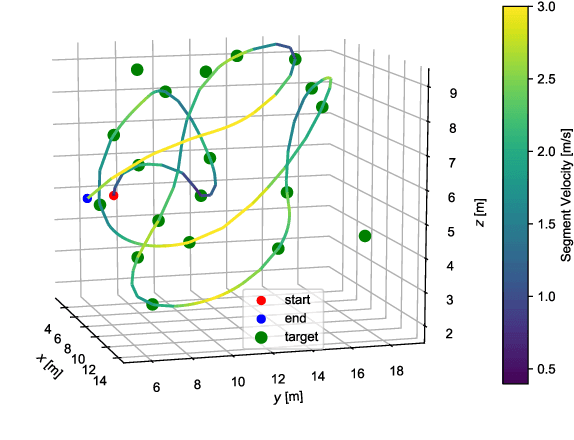

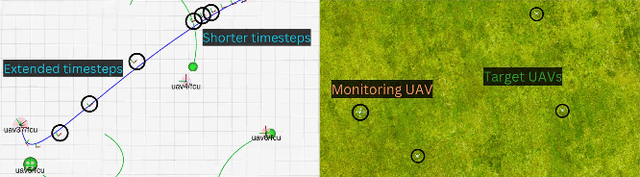
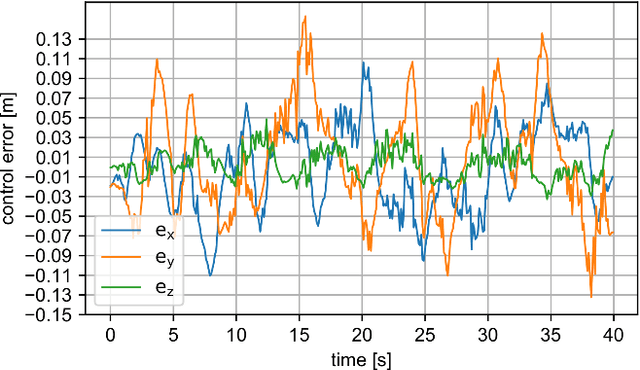
Agile trajectory planning can improve the efficiency of multi-rotor Uncrewed Aerial Vehicles (UAVs) in scenarios with combined task-oriented and kinematic trajectory planning, such as monitoring spatio-temporal phenomena or intercepting dynamic targets. Agile planning using existing non-linear model predictive control methods is limited by the number of planning steps as it becomes increasingly computationally demanding. That reduces the prediction horizon length, leading to a decrease in solution quality. Besides, the fixed time-step length limits the utilization of the available UAV dynamics in the target neighborhood. In this paper, we propose to address these limitations by introducing variable time steps and coupling them with the prediction horizon length. A simplified point-mass motion primitive is used to leverage the differential flatness of quadrotor dynamics and the generation of feasible trajectories in the flat output space. Based on the presented evaluation results and experimentally validated deployment, the proposed method increases the solution quality by enabling planning for long flight segments but allowing tightly sampled maneuvering.