 Add to Chrome
 Add to Firefox
 Add to Edge
VertiAKD: Adaptive Off-Road Kinodynamics on Vertically Challenging Terrain
Aug 02, 2026
Off-road mobility requires autonomous mobile robots to generalize across heterogeneous vehicle fleets and continuously changing terrain conditions. Existing cross-vehicle adaptation approaches generally assume flat terrain, while terrain-aware kinodynamic models often require platform-specific data collection and retraining. To this end, we propose VertiAKD, a unified framework for transferring and adapting off-road kinodynamic knowledge across diverse vehicles on geometrically and semantically complex terrain simultaneously. VertiAKD learns a shared mobility representation that jointly encodes vehicle configurations, trajectory transitions, and local elevation and semantic terrain features. Given limited data from a novel vehicle operating on unseen terrain, VertiAKD identifies the most relevant mobility descriptors and transfers their knowledge to initialize a terrain-aware kinodynamic model via function encoders, which is then periodically refined online from streaming observations without gradient-based retraining. We evaluate VertiAKD in the Verti-Bench simulator, built on the Chrono multi-physics engine, and on five physical configurations of the Verti-4-Wheeler platform. With only one minute of new trajectory data and associated terrain features, VertiAKD reduces long-horizon prediction error by up to 34.52% over direct mobility descriptor transfer across diverse unseen vehicle configurations and 94.43% over competing baselines. We further demonstrate robust closed-loop trajectory tracking in both simulation and physical experiments, highlighting the effectiveness of terrain-aware cross-vehicle knowledge transfer for accurate modeling and reliable off-road navigation.

Zero-Shot Adaptation to Robot Structural Damage via Natural Language-Informed Kinodynamics Modeling
Feb 12, 2026High-performance autonomous mobile robots endure significant mechanical stress during in-the-wild operations, e.g., driving at high speeds or over rugged terrain. Although these platforms are engineered to withstand such conditions, mechanical degradation is inevitable. Structural damage manifests as consistent and notable changes in kinodynamic behavior compared to a healthy vehicle. Given the heterogeneous nature of structural failures, quantifying various damages to inform kinodynamics is challenging. We posit that natural language can describe and thus capture this variety of damages. Therefore, we propose Zero-shot Language Informed Kinodynamics (ZLIK), which employs self-supervised learning to ground semantic information of damage descriptions in kinodynamic behaviors to learn a forward kinodynamics model in a data-driven manner. Using the high-fidelity soft-body physics simulator BeamNG.tech, we collect data from a variety of structurally compromised vehicles. Our learned model achieves zero-shot adaptation to different damages with up to 81% reduction in kinodynamics error and generalizes across the sim-to-real and full-to-1/10$^{\text{th}}$ scale gaps.
Verti-Arena: A Controllable and Standardized Indoor Testbed for Multi-Terrain Off-Road Autonomy
Aug 11, 2025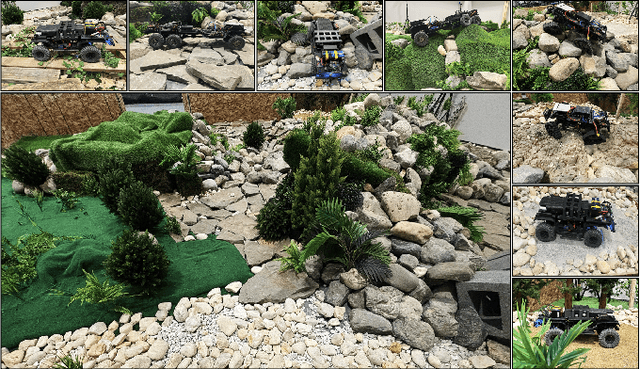
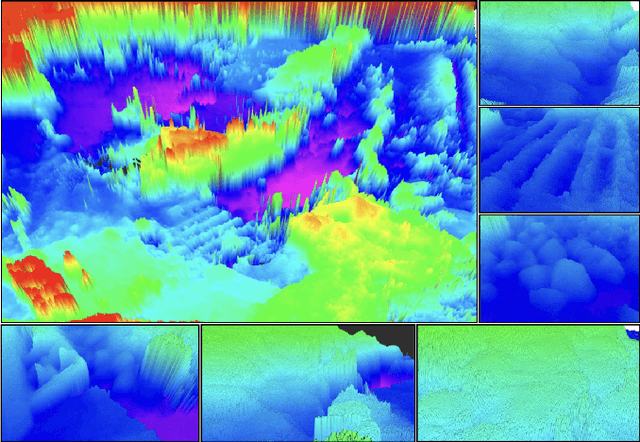
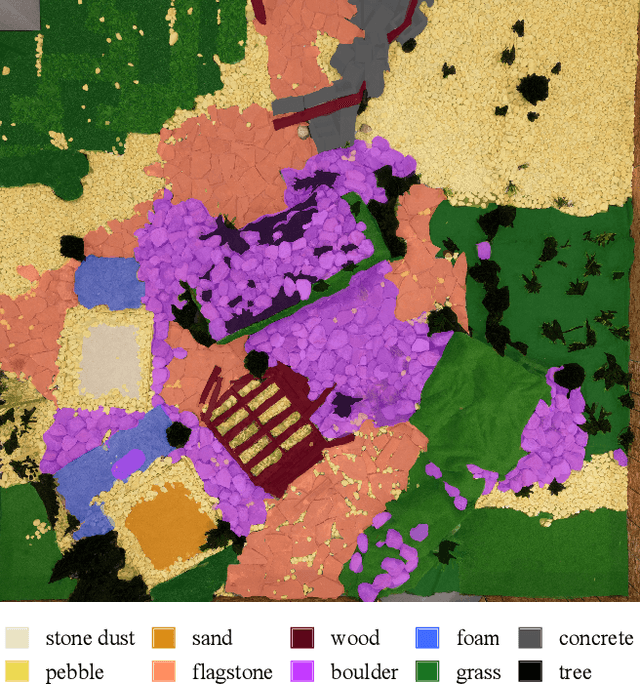
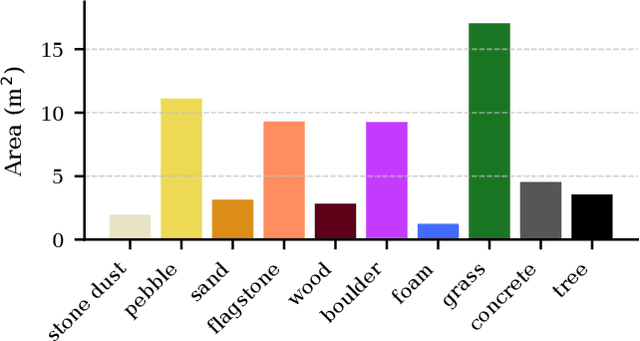
Off-road navigation is an important capability for mobile robots deployed in environments that are inaccessible or dangerous to humans, such as disaster response or planetary exploration. Progress is limited due to the lack of a controllable and standardized real-world testbed for systematic data collection and validation. To fill this gap, we introduce Verti-Arena, a reconfigurable indoor facility designed specifically for off-road autonomy. By providing a repeatable benchmark environment, Verti-Arena supports reproducible experiments across a variety of vertically challenging terrains and provides precise ground truth measurements through onboard sensors and a motion capture system. Verti-Arena also supports consistent data collection and comparative evaluation of algorithms in off-road autonomy research. We also develop a web-based interface that enables research groups worldwide to remotely conduct standardized off-road autonomy experiments on Verti-Arena.