 Add to Chrome
 Add to Firefox
 Add to Edge
Agentic Bayesian Optimization through Surrogate-Augmented Autoresearch
Jul 31, 2026
Bayesian optimization (BO) has become the standard tool for sample-efficient optimization and owes its efficiency to uncertainty-aware search driven by generic statistical priors. Richer domain priors can improve BO in principle, but encoding them through tailored kernels or problem structure is difficult and rarely done in practice. LLMs can help sidestep this difficulty by making informal priors from natural language, code, and documentation directly available to the optimizer. However, existing LLM-based BO methods either insert the LLM into a fixed role (surrogate, acquisition proxy, or configuration interface) or hand it broad control, sacrificing the systematic exploration that makes BO reliable. We introduce agentic Bayesian optimization: a paradigm in which an LLM agent is the central decision maker in the BO loop while a Bayesian backend provides the uncertainty-aware optimization substrate. The agent configures the problem, queries the backend, selects and commits evaluations, and can revise the optimization strategy during the run by tightening bounds, switching acquisition functions, proposing targeted evaluations, or even reframing the problem following new instructions or observed evidence. We instantiate this idea in Sara, a surrogate-augmented autoresearch agent, and lenz, a modular BoTorch-based backend that the agent can inspect and modify through a structured interface. Across synthetic and real-world benchmarks, Sara preserves the reliability of state-of-the-art BO without prior knowledge, outperforms LLM-based baselines, and uses natural-language priors to improve beyond standard BO. We further demonstrate the practical value of agentic BO in dynamic settings, where Sara reconfigures the full optimization problem on the fly as requirements change, a capability not previously available in standard BO.

ACME: A Multi-Cultural, Multi-Embodiment Social-Navigation Dataset
Jul 24, 2026Understanding how robots and humans move in shared spaces is essential for designing effective social robot navigation policies and predicting human behavior. However, existing datasets often lack the diversity needed to capture differences in culture, geography, and human-robot interaction-factors that strongly shape appropriate social behavior. To address this gap, we introduce ACME: A Cross-cultural, Multi-Embodiment dataset for social navigation. A large-scale data collection effort across 8 sites in 5 countries, using 7 robot embodiments, ACME is a large and diverse multi-modal dataset aimed at advancing social navigation research, providing 29.35 hours of onboard robot data and 43.5 hours of overhead pedestrian tracking data. Unlike prior datasets, it focuses on capturing goal-driven social navigation behavior in complex social scenarios with explicit robot-crowd interaction through robot speech. To facilitate learning navigation policies and predicting pedestrian trajectories, ACME provides 3D and 2D scene features, odometry, interaction information, and human-annotated pedestrian trajectory labels. We make ACME easy to use by providing both human-readable data for each sensor modality as well as raw binary data. Our qualitative and quantitative analyses show that our dataset captures more challenging scenarios and a broader distribution of pedestrian behavior than previous datasets.
HumAIN: Human-Aware Implicit Social Robot Navigation
Jul 08, 2026Effective social robot navigation requires sensitivity to human behavior, often revealed through subtle skeletal cues like gait and orientation. We present Human-Aware Implicit Social Robot Navigation (HumAIN), a novel framework that fuses implicit social cues directly into the planning loop via knowledge distillation. We first employ a transformer-based teacher model that fuses rich multi-modal inputs, including historic images, skeletal keypoints, robot state, and a robot's target goal, to learn robust, human-aware representations for the robot's future trajectory planning. To enable real-time deployment, we then distill this knowledge into a lightweight student model. By optimizing for both trajectory reconstruction and latent feature alignment with the teacher, the student learns to infer complex social dynamics from minimal inputs. Bridging the prediction-planning gap with an efficient distilled architecture, our method enables robots to reason about human behavior in a manner that is adaptive, robust, and socially compliant. We validate HumAIN through extensive experiments, where it improves trajectory prediction metrics by an average of 29.8% across all metrics compared to state-of-the-art baselines. These results highlight the benefit of using implicit, whole-body cues to achieve human-like navigation awareness on resource-constrained platforms.
Multi-scale Coarse-to-fine Modeling for Test-time Human Motion Control
May 14, 2026We present MSCoT, a multi-scale, coarse-to-fine model for test-time human motion synthesis and control. Unlike recent approaches that rely on multiple iterative denoising/token-prediction steps, or modules tailored for specific control signals, MSCoT discretizes motion into a multi-scale hierarchical representation and predicts the entire token sequence at each temporal scale in a coarse-to-fine fashion. Building on this coarse-to-fine paradigm, we propose an efficient multi-scale token guidance strategy that overcomes the challenge of discrete sampling and steers the token distribution towards the control goals, allowing for fast and flexible control. To address the limitations of a discrete codebook, a lightweight token refiner further adds continuous residuals to the discrete token embeddings and allows differentiable test-time refinement optimization to ensure precise alignment with the control objectives. MSCoT is able to produce quality motions, consistent with the control constraints, while offering substantially faster sampling than diffusion-based approaches. Experiments on popular benchmarks demonstrate state-of-the-art controllable text-to-motion generation performance of MSCoT over existing baselines, with better motion quality (48% FID improvement), higher control accuracy (-61% avg error), and $10 \times$ faster inference speed on HumanML3D.
AffordMatcher: Affordance Learning in 3D Scenes from Visual Signifiers
Mar 30, 2026Affordance learning is a complex challenge in many applications, where existing approaches primarily focus on the geometric structures, visual knowledge, and affordance labels of objects to determine interactable regions. However, extending this learning capability to a scene is significantly more complicated, as incorporating object- and scene-level semantics is not straightforward. In this work, we introduce AffordBridge, a large-scale dataset with 291,637 functional interaction annotations across 685 high-resolution indoor scenes in the form of point clouds. Our affordance annotations are complemented by RGB images that are linked to the same instances within the scenes. Building upon our dataset, we propose AffordMatcher, an affordance learning method that establishes coherent semantic correspondences between image-based and point cloud-based instances for keypoint matching, enabling a more precise identification of affordance regions based on cues, so-called visual signifiers. Experimental results on our dataset demonstrate the effectiveness of our approach compared to other methods.
Design Once, Deploy at Scale: Template-Driven ML Development for Large Model Ecosystems
Mar 26, 2026Modern computational advertising platforms typically rely on recommendation systems to predict user responses, such as click-through rates, conversion rates, and other optimization events. To support a wide variety of product surfaces and advertiser goals, these platforms frequently maintain an extensive ecosystem of machine learning (ML) models. However, operating at this scale creates significant development and efficiency challenges. Substantial engineering effort is required to regularly refresh ML models and propagate new techniques, which results in long latencies when deploying ML innovations across the ecosystem. We present a large-scale empirical study comparing model performance, efficiency, and ML technique propagation between a standardized model-building approach and independent per-model optimization in recommendation systems. To facilitate this standardization, we propose the Standard Model Template (SMT) -- a framework that generates high-performance models adaptable to diverse data distributions and optimization events. By utilizing standardized, composable ML model components, SMT reduces technique propagation complexity from $O(n \cdot 2^k)$ to $O(n + k)$ where $n$ is the number of models and $k$ the number of techniques. Evaluating an extensive suite of models over four global development cycles within Meta's production ads ranking ecosystem, our results demonstrate: (1) a 0.63% average improvement in cross-entropy at neutral serving capacity, (2) a 92% reduction in per-model iteration engineering time, and (3) a $6.3\times$ increase in technique-model pair adoption throughput. These findings challenge the conventional wisdom that diverse optimization goals inherently require diversified ML model design.
Legs Over Arms: On the Predictive Value of Lower-Body Pose for Human Trajectory Prediction from Egocentric Robot Perception
Feb 09, 2026Predicting human trajectory is crucial for social robot navigation in crowded environments. While most existing approaches treat human as point mass, we present a study on multi-agent trajectory prediction that leverages different human skeletal features for improved forecast accuracy. In particular, we systematically evaluate the predictive utility of 2D and 3D skeletal keypoints and derived biomechanical cues as additional inputs. Through a comprehensive study on the JRDB dataset and another new dataset for social navigation with 360-degree panoramic videos, we find that focusing on lower-body 3D keypoints yields a 13% reduction in Average Displacement Error and augmenting 3D keypoint inputs with corresponding biomechanical cues provides a further 1-4% improvement. Notably, the performance gain persists when using 2D keypoint inputs extracted from equirectangular panoramic images, indicating that monocular surround vision can capture informative cues for motion forecasting. Our finding that robots can forecast human movement efficiently by watching their legs provides actionable insights for designing sensing capabilities for social robot navigation.
Scalable Group Choreography via Variational Phase Manifold Learning
Jul 26, 2024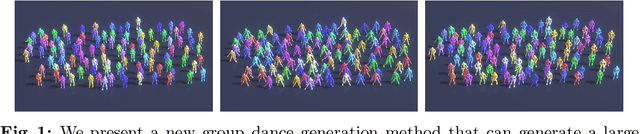
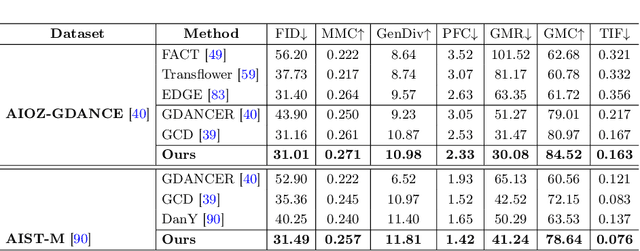
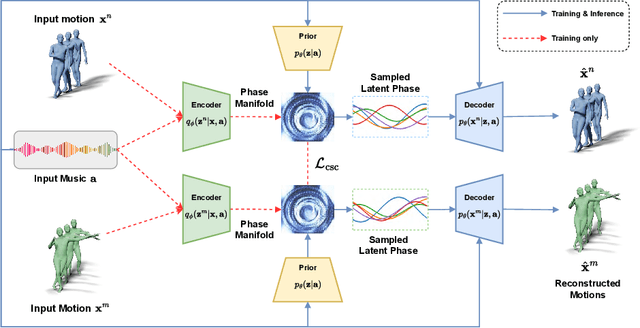
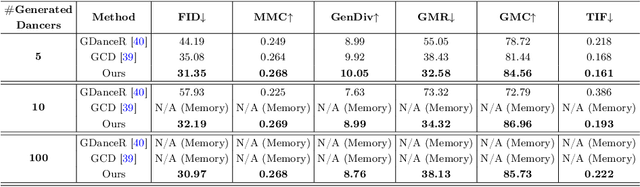
Generating group dance motion from the music is a challenging task with several industrial applications. Although several methods have been proposed to tackle this problem, most of them prioritize optimizing the fidelity in dancing movement, constrained by predetermined dancer counts in datasets. This limitation impedes adaptability to real-world applications. Our study addresses the scalability problem in group choreography while preserving naturalness and synchronization. In particular, we propose a phase-based variational generative model for group dance generation on learning a generative manifold. Our method achieves high-fidelity group dance motion and enables the generation with an unlimited number of dancers while consuming only a minimal and constant amount of memory. The intensive experiments on two public datasets show that our proposed method outperforms recent state-of-the-art approaches by a large margin and is scalable to a great number of dancers beyond the training data.
Interpretability analysis on a pathology foundation model reveals biologically relevant embeddings across modalities
Jul 15, 2024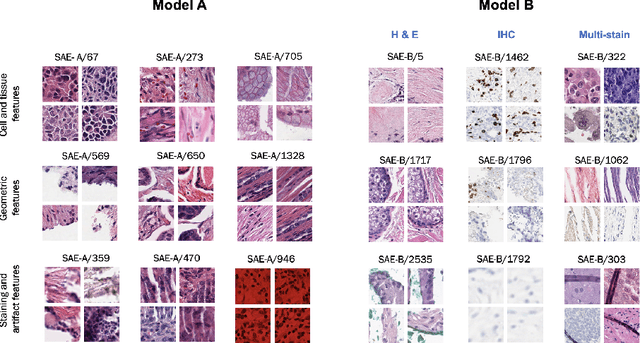
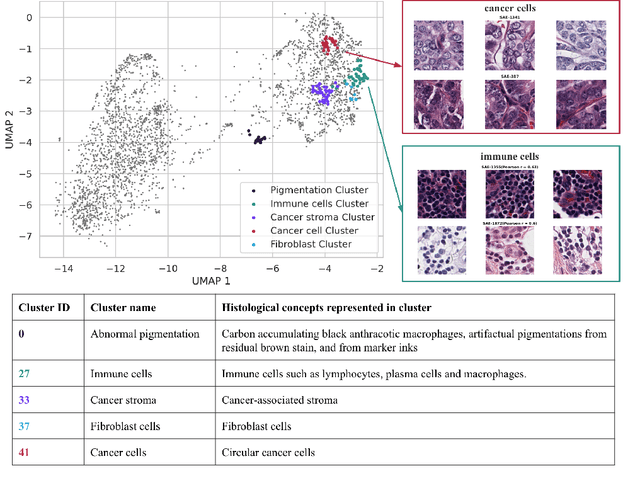
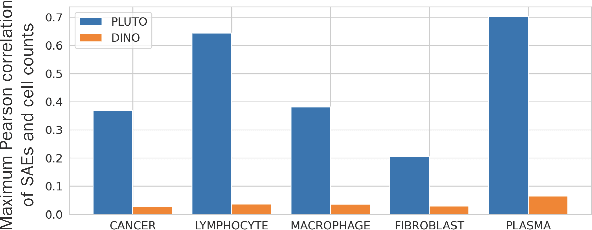
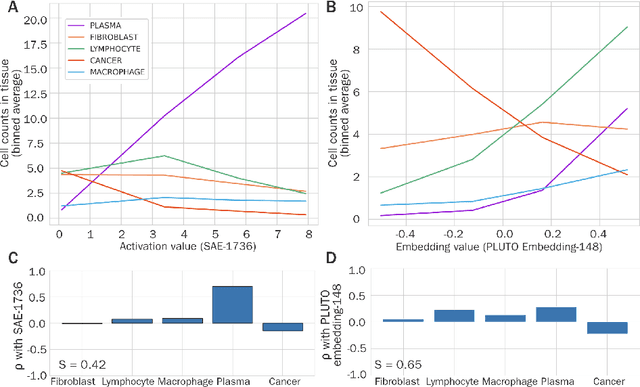
Mechanistic interpretability has been explored in detail for large language models (LLMs). For the first time, we provide a preliminary investigation with similar interpretability methods for medical imaging. Specifically, we analyze the features from a ViT-Small encoder obtained from a pathology Foundation Model via application to two datasets: one dataset of pathology images, and one dataset of pathology images paired with spatial transcriptomics. We discover an interpretable representation of cell and tissue morphology, along with gene expression within the model embedding space. Our work paves the way for further exploration around interpretable feature dimensions and their utility for medical and clinical applications.
Controllable Group Choreography using Contrastive Diffusion
Nov 03, 2023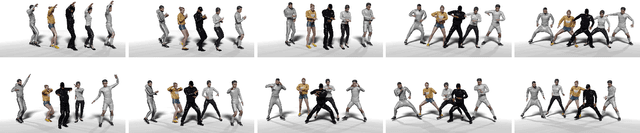
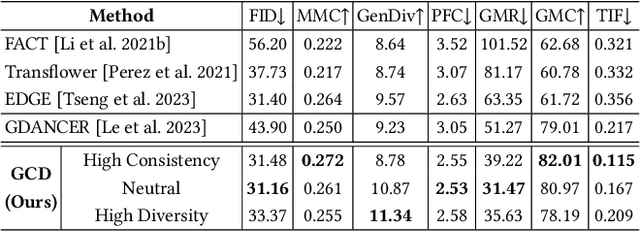
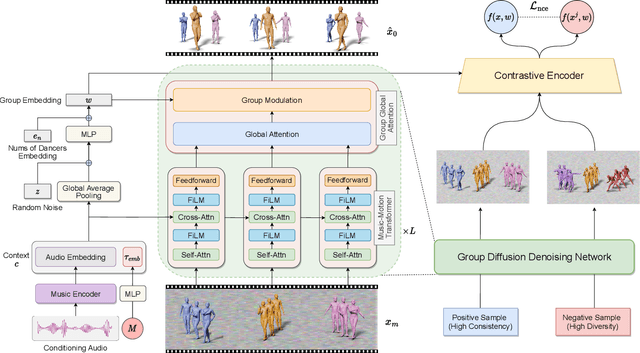
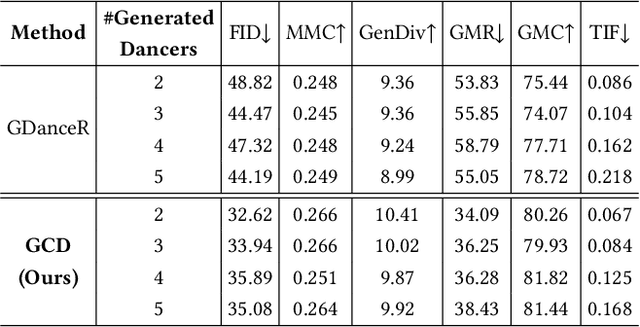
Music-driven group choreography poses a considerable challenge but holds significant potential for a wide range of industrial applications. The ability to generate synchronized and visually appealing group dance motions that are aligned with music opens up opportunities in many fields such as entertainment, advertising, and virtual performances. However, most of the recent works are not able to generate high-fidelity long-term motions, or fail to enable controllable experience. In this work, we aim to address the demand for high-quality and customizable group dance generation by effectively governing the consistency and diversity of group choreographies. In particular, we utilize a diffusion-based generative approach to enable the synthesis of flexible number of dancers and long-term group dances, while ensuring coherence to the input music. Ultimately, we introduce a Group Contrastive Diffusion (GCD) strategy to enhance the connection between dancers and their group, presenting the ability to control the consistency or diversity level of the synthesized group animation via the classifier-guidance sampling technique. Through intensive experiments and evaluation, we demonstrate the effectiveness of our approach in producing visually captivating and consistent group dance motions. The experimental results show the capability of our method to achieve the desired levels of consistency and diversity, while maintaining the overall quality of the generated group choreography. The source code can be found at https://aioz-ai.github.io/GCD