 Add to Chrome
 Add to Firefox
 Add to Edge
PHANTOM: PHysical ANamorphic Threats Obstructing Connected Vehicle Mobility
Dec 15, 2025
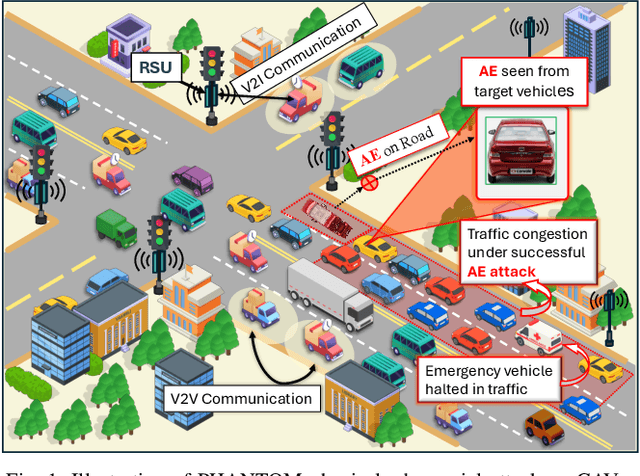
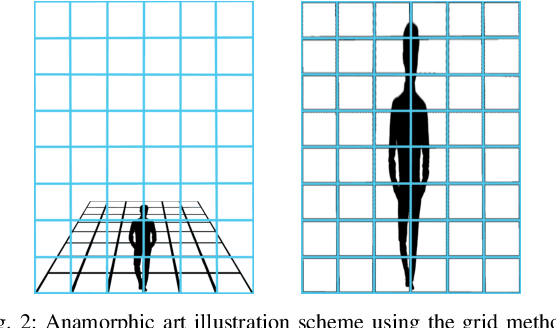
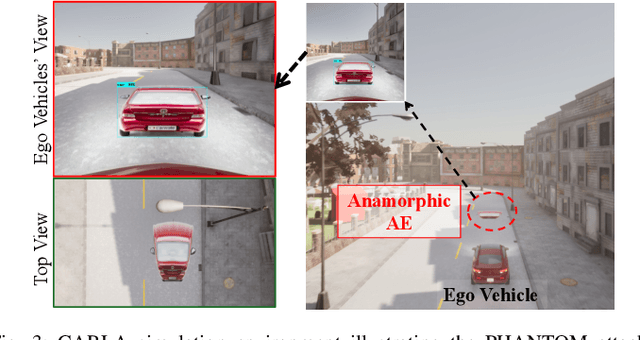
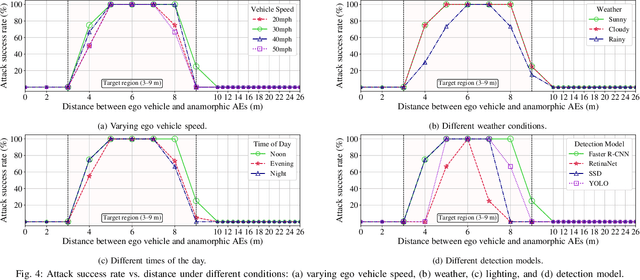
Connected autonomous vehicles (CAVs) rely on vision-based deep neural networks (DNNs) and low-latency (Vehicle-to-Everything) V2X communication to navigate safely and efficiently. Despite their advances, these systems remain vulnerable to physical adversarial attacks. In this paper, we introduce PHANTOM (PHysical ANamorphic Threats Obstructing connected vehicle Mobility), a novel framework for crafting and deploying perspective-dependent adversarial examples using \textit{anamorphic art}. PHANTOM exploits geometric distortions that appear natural to humans but are misclassified with high confidence by state-of-the-art object detectors. Unlike conventional attacks, PHANTOM operates in black-box settings without model access and demonstrates strong transferability across four diverse detector architectures (YOLOv5, SSD, Faster R-CNN, and RetinaNet). Comprehensive evaluation in CARLA across varying speeds, weather conditions, and lighting scenarios shows that PHANTOM achieves over 90\% attack success rate under optimal conditions and maintains 60-80\% effectiveness even in degraded environments. The attack activates within 6-10 meters of the target, providing insufficient time for safe maneuvering. Beyond individual vehicle deception, PHANTOM triggers network-wide disruption in CAV systems: SUMO-OMNeT++ co-simulation demonstrates that false emergency messages propagate through V2X links, increasing Peak Age of Information by 68-89\% and degrading safety-critical communication. These findings expose critical vulnerabilities in both perception and communication layers of CAV ecosystems.

FLARE: A Wireless Side-Channel Fingerprinting Attack on Federated Learning
Dec 11, 2025Federated Learning (FL) enables collaborative model training across distributed devices while safeguarding data and user privacy. However, FL remains susceptible to privacy threats that can compromise data via direct means. That said, indirectly compromising the confidentiality of the FL model architecture (e.g., a convolutional neural network (CNN) or a recurrent neural network (RNN)) on a client device by an outsider remains unexplored. If leaked, this information can enable next-level attacks tailored to the architecture. This paper proposes a novel side-channel fingerprinting attack, leveraging flow-level and packet-level statistics of encrypted wireless traffic from an FL client to infer its deep learning model architecture. We name it FLARE, a fingerprinting framework based on FL Architecture REconnaissance. Evaluation across various CNN and RNN variants-including pre-trained and custom models trained over IEEE 802.11 Wi-Fi-shows that FLARE achieves over 98% F1-score in closed-world and up to 91% in open-world scenarios. These results reveal that CNN and RNN models leak distinguishable traffic patterns, enabling architecture fingerprinting even under realistic FL settings with hardware, software, and data heterogeneity. To our knowledge, this is the first work to fingerprint FL model architectures by sniffing encrypted wireless traffic, exposing a critical side-channel vulnerability in current FL systems.
GND: Global Navigation Dataset with Multi-Modal Perception and Multi-Category Traversability in Outdoor Campus Environments
Sep 21, 2024


Navigating large-scale outdoor environments requires complex reasoning in terms of geometric structures, environmental semantics, and terrain characteristics, which are typically captured by onboard sensors such as LiDAR and cameras. While current mobile robots can navigate such environments using pre-defined, high-precision maps based on hand-crafted rules catered for the specific environment, they lack commonsense reasoning capabilities that most humans possess when navigating unknown outdoor spaces. To address this gap, we introduce the Global Navigation Dataset (GND), a large-scale dataset that integrates multi-modal sensory data, including 3D LiDAR point clouds and RGB and 360-degree images, as well as multi-category traversability maps (pedestrian walkways, vehicle roadways, stairs, off-road terrain, and obstacles) from ten university campuses. These environments encompass a variety of parks, urban settings, elevation changes, and campus layouts of different scales. The dataset covers approximately 2.7km2 and includes at least 350 buildings in total. We also present a set of novel applications of GND to showcase its utility to enable global robot navigation, such as map-based global navigation, mapless navigation, and global place recognition.