 Add to Chrome
 Add to Firefox
 Add to Edge
MUSON: A Reasoning-oriented Multimodal Dataset for Socially Compliant Navigation in Urban Environments
Dec 28, 2025
Socially compliant navigation requires structured reasoning over dynamic pedestrians and physical constraints to ensure safe and interpretable decisions. However, existing social navigation datasets often lack explicit reasoning supervision and exhibit highly long-tailed action distributions, limiting models' ability to learn safety-critical behaviors. To address these issues, we introduce MUSON, a multimodal dataset for short-horizon social navigation collected across diverse indoor and outdoor campus scenes. MUSON adopts a structured five-step Chain-of-Thought annotation consisting of perception, prediction, reasoning, action, and explanation, with explicit modeling of static physical constraints and a rationally balanced discrete action space. Compared to SNEI, MUSON provides consistent reasoning, action, and explanation. Benchmarking multiple state-of-the-art Small Vision Language Models on MUSON shows that Qwen2.5-VL-3B achieves the highest decision accuracy of 0.8625, demonstrating that MUSON serves as an effective and reusable benchmark for socially compliant navigation. The dataset is publicly available at https://huggingface.co/datasets/MARSLab/MUSON

MAction-SocialNav: Multi-Action Socially Compliant Navigation via Reasoning-enhanced Prompt Tuning
Dec 25, 2025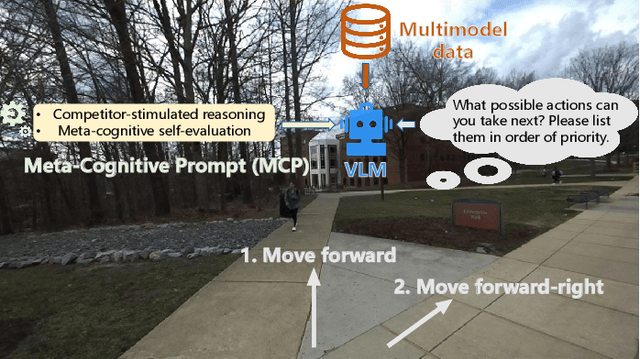
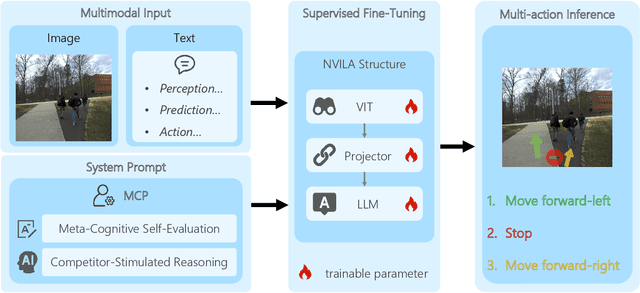
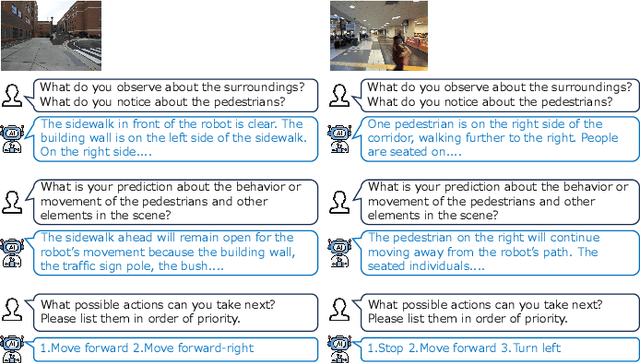
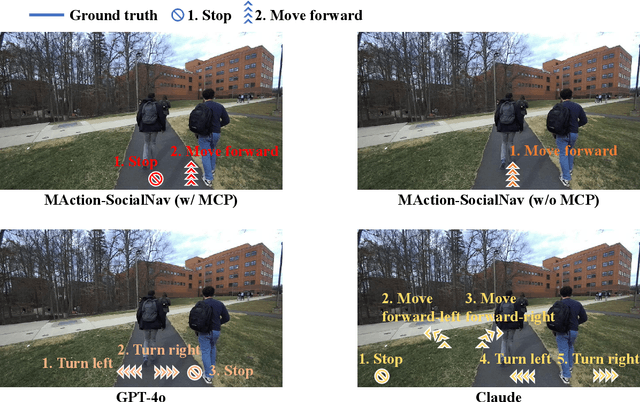
Socially compliant navigation requires robots to move safely and appropriately in human-centered environments by respecting social norms. However, social norms are often ambiguous, and in a single scenario, multiple actions may be equally acceptable. Most existing methods simplify this problem by assuming a single correct action, which limits their ability to handle real-world social uncertainty. In this work, we propose MAction-SocialNav, an efficient vision language model for socially compliant navigation that explicitly addresses action ambiguity, enabling generating multiple plausible actions within one scenario. To enhance the model's reasoning capability, we introduce a novel meta-cognitive prompt (MCP) method. Furthermore, to evaluate the proposed method, we curate a multi-action socially compliant navigation dataset that accounts for diverse conditions, including crowd density, indoor and outdoor environments, and dual human annotations. The dataset contains 789 samples, each with three-turn conversation, split into 710 training samples and 79 test samples through random selection. We also design five evaluation metrics to assess high-level decision precision, safety, and diversity. Extensive experiments demonstrate that the proposed MAction-SocialNav achieves strong social reasoning performance while maintaining high efficiency, highlighting its potential for real-world human robot navigation. Compared with zero-shot GPT-4o and Claude, our model achieves substantially higher decision quality (APG: 0.595 vs. 0.000/0.025) and safety alignment (ER: 0.264 vs. 0.642/0.668), while maintaining real-time efficiency (1.524 FPS, over 3x faster).