 Add to Chrome
 Add to Firefox
 Add to Edge
SoRoMoX: Fast, Differentiable, and Parallelizable Soft Robot Models
Aug 06, 2026
Reduced-order models based on Cosserat-rod theory are now well established, and modeling theory is no longer the primary bottleneck in soft-robot control. Their implementations, however, do not support the differentiable, GPU-parallel, and control-oriented workflows that underpin advanced rigid-robotics applications. Here, we fill this gap with SoRoMoX (Soft Robot Models in JAX), a fully numerical, JIT-compilable Python/JAX framework. SoRoMoX implements articulated, Piecewise Constant Strain, and Variable Strain models through a unified, control-ready interface that provides inertia matrices, gravitational and elastic forces, Jacobians, and their derivatives. To our knowledge, it is the first rod/strain-based soft-robot modeling framework that runs directly on GPUs and is end-to-end differentiable with respect to states, inputs, and parameters. Sequential CPU rollouts are up to 18.1x faster than state-of-the-art alternatives, while GPU-parallel rollouts increase throughput by up to 234.6x. This performance enables workflows that were previously impractical or impossible: static-equilibrium system identification with 66% lower marker RMSE; residual-force learning with a further 64% reduction; computed-torque tracking with RMSE reduced by a factor of approximately 500 relative to model-free PD; control-gain optimization with up to 62% lower loss than untuned gains; safety-constrained control using high-order control barrier functions to keep the peak contact force within a prescribed 5 N bound, compared with 33.5 N without the safety constraint; and reinforcement-learning policy training up to 7x faster than a CPU PyElastica discrete-rod baseline through massively parallel rollouts.

Video Generation Models are General-Purpose Vision Learners
Jul 10, 2026Driven by next-token prediction, NLP shifted from task-specific models into powerful generalist foundation models. What, then, is the equivalent catalyst needed to achieve a general-purpose model in computer vision? In this paper, we contend that large-scale text-to-video generation serves as a strong pre-training paradigm for computer vision, providing the necessary spatiotemporal priors, vision-language alignment, and scalability required for general visual intelligence. We introduce GenCeption, which leverages a pre-trained video generative diffusion backbone to define a feed-forward perception model, capable of performing various vision tasks steered by text instructions. Empirical results demonstrate that GenCeption achieves state-of-the-art performance across a diverse suite of tasks, including depth, surface normal, and camera pose estimation, expression-referring segmentation, and 3D keypoint prediction, often matching or surpassing specialized models (e.g. DepthAnything3, SAM3, D4RT, VGGT-Omega, Sapiens, David, Genmo, and Lotus-2). Furthermore, the video generative pretrained backbone outperforms alternative pretraining paradigms (e.g., V-JEPA, and Video MAE) under comparable settings. Importantly, GenCeption exhibits preliminary data and model scaling properties along with exceptional data efficiency, where it achieves comparable performance with leading models like D4RT and VGGT-Omega with 7 to 500 less training data. Finally, GenCeption also exhibits intriguing emergent behaviors: a model trained exclusively on synthetic human videos generalizes to real-world footage and out-of-distribution object categories (e.g., animals and robots). These findings suggest that video generation is not merely a synthesis tool, but a foundational path toward generalist vision intelligence for the physical world. Project page: https://genception.github.io
Dynamics, stability, and energy efficiency of an energy-recycling rimless wheel with spring-clutch legs
Jun 23, 2026This paper proposes an energy-recycling rimless wheel with spring-clutch legs. The proposed mechanism uses a lockable clutch to store part of the impact-induced elastic energy after foot contact and reinject it in the next gait cycle. First, we develop a hybrid dynamic model of the energy-recycling rimless wheel. Second, numerical simulations are used to examine the dynamics, local stability of periodic gaits, and the Cost of Transport (CoT) of the proposed mechanism. The simulation results show that the proposed mechanism reduces the CoT by up to 16.13% compared with a benchmark viscoelastic-legged rimless wheel with telescopic spring-damper legs. Compared with the rigid rimless wheel, the viscoelastic-legged and energy-recycling models reduce the CoT by more than 50%. The energy-recycling model also maintains locally stable periodic gaits over the tested slope and stiffness ranges. Finally, prototype experiments on an inclined plane are conducted to examine the feasibility of the proposed mechanism. The experimental results show that the proposed rimless wheel achieves passive walking on a shallow 1° slope, corresponding to a CoT of approximately 0.02. These results suggest that the proposed spring-clutch mechanism can improve the simulated walking efficiency of the energy-recycling rimless wheel, while the prototype experiments support the feasibility of passive walking with the mechanism.
Propeller-Assisted Robust 3D Hopping Robot with Hierarchical Force Allocation
Jun 06, 2026Monopedal hopping robots are conceptually simple but highly dynamic and inherently unstable. Achieving robust 3D hopping is still difficult because ground reaction forces are available only during the short stance phase, while the robot is underactuated in flight. A key unresolved issue is how to improve flight-phase control authority. Propeller assistance provides a promising solution, but it requires careful coordination of leg-generated contact forces and propeller thrusts across stance and flight. This paper presents Pro-OMEGA2, a propeller-assisted 3D monopedal hopping robot with an active 3-RSR parallel leg and a trunk-mounted tri-rotor for auxiliary attitude regulation. To address the force coordination challenge, we propose a Hierarchical Force Allocation (HFA) framework based on a single rigid body (SRB) model. The leg generates the main stance contact wrench, while the tri-rotor provides auxiliary attitude regulation, compensating the residual attitude moment in stance and maintaining attitude during flight. Real-robot experiments in indoor and outdoor scenarios demonstrate sustained 3D hopping, including terrain transitions and impulsive push recovery, validating robustness under unmodeled contact and external disturbances.
Efficiently Reconstructing Dynamic Scenes One D4RT at a Time
Dec 10, 2025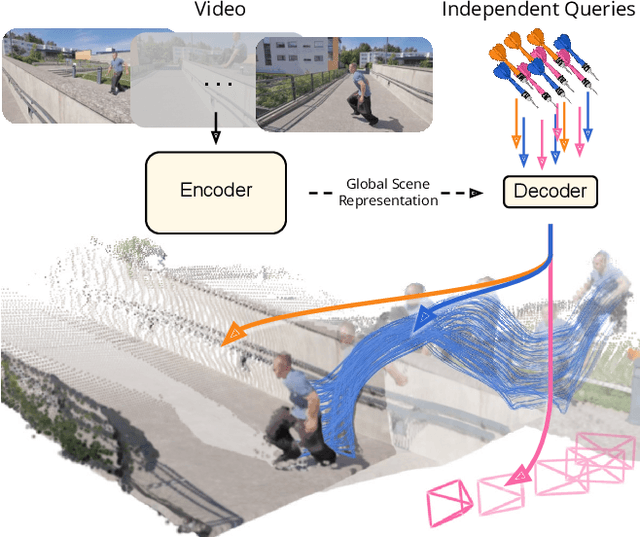
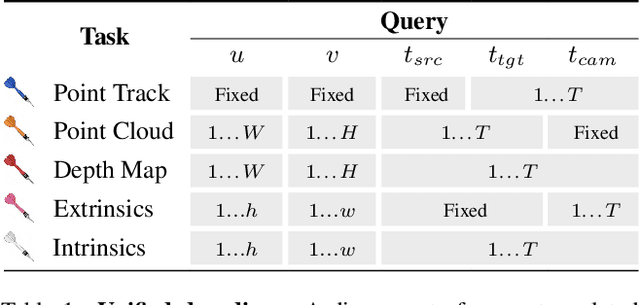
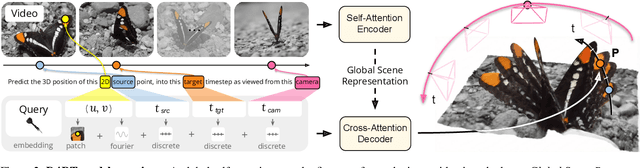
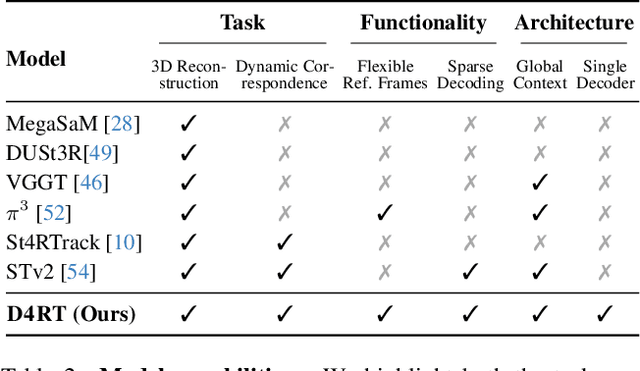
Understanding and reconstructing the complex geometry and motion of dynamic scenes from video remains a formidable challenge in computer vision. This paper introduces D4RT, a simple yet powerful feedforward model designed to efficiently solve this task. D4RT utilizes a unified transformer architecture to jointly infer depth, spatio-temporal correspondence, and full camera parameters from a single video. Its core innovation is a novel querying mechanism that sidesteps the heavy computation of dense, per-frame decoding and the complexity of managing multiple, task-specific decoders. Our decoding interface allows the model to independently and flexibly probe the 3D position of any point in space and time. The result is a lightweight and highly scalable method that enables remarkably efficient training and inference. We demonstrate that our approach sets a new state of the art, outperforming previous methods across a wide spectrum of 4D reconstruction tasks. We refer to the project webpage for animated results: https://d4rt-paper.github.io/.
Interaction-Centric Knowledge Infusion and Transfer for Open-Vocabulary Scene Graph Generation
Nov 08, 2025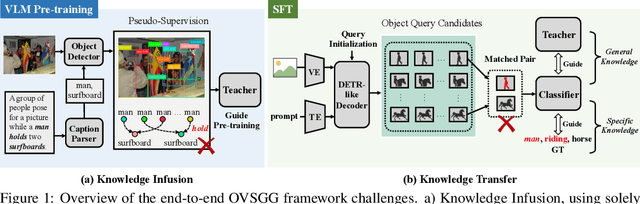
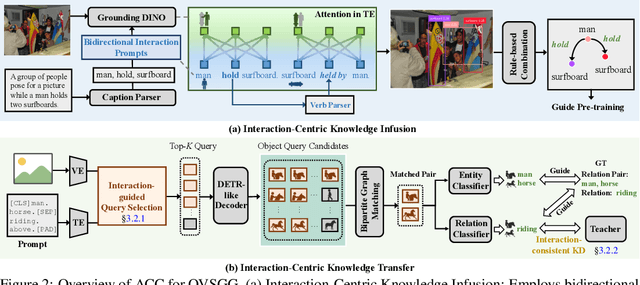
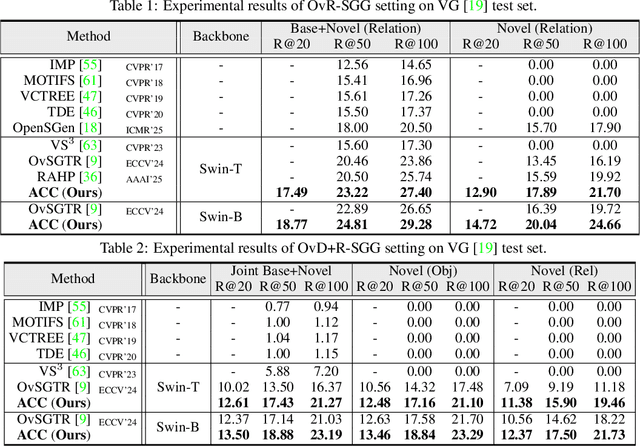
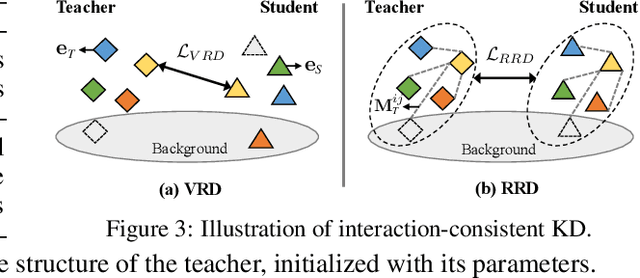
Open-vocabulary scene graph generation (OVSGG) extends traditional SGG by recognizing novel objects and relationships beyond predefined categories, leveraging the knowledge from pre-trained large-scale models. Existing OVSGG methods always adopt a two-stage pipeline: 1) \textit{Infusing knowledge} into large-scale models via pre-training on large datasets; 2) \textit{Transferring knowledge} from pre-trained models with fully annotated scene graphs during supervised fine-tuning. However, due to a lack of explicit interaction modeling, these methods struggle to distinguish between interacting and non-interacting instances of the same object category. This limitation induces critical issues in both stages of OVSGG: it generates noisy pseudo-supervision from mismatched objects during knowledge infusion, and causes ambiguous query matching during knowledge transfer. To this end, in this paper, we propose an inter\textbf{AC}tion-\textbf{C}entric end-to-end OVSGG framework (\textbf{ACC}) in an interaction-driven paradigm to minimize these mismatches. For \textit{interaction-centric knowledge infusion}, ACC employs a bidirectional interaction prompt for robust pseudo-supervision generation to enhance the model's interaction knowledge. For \textit{interaction-centric knowledge transfer}, ACC first adopts interaction-guided query selection that prioritizes pairing interacting objects to reduce interference from non-interacting ones. Then, it integrates interaction-consistent knowledge distillation to bolster robustness by pushing relational foreground away from the background while retaining general knowledge. Extensive experimental results on three benchmarks show that ACC achieves state-of-the-art performance, demonstrating the potential of interaction-centric paradigms for real-world applications.
NeuroBreak: Unveil Internal Jailbreak Mechanisms in Large Language Models
Sep 04, 2025In deployment and application, large language models (LLMs) typically undergo safety alignment to prevent illegal and unethical outputs. However, the continuous advancement of jailbreak attack techniques, designed to bypass safety mechanisms with adversarial prompts, has placed increasing pressure on the security defenses of LLMs. Strengthening resistance to jailbreak attacks requires an in-depth understanding of the security mechanisms and vulnerabilities of LLMs. However, the vast number of parameters and complex structure of LLMs make analyzing security weaknesses from an internal perspective a challenging task. This paper presents NeuroBreak, a top-down jailbreak analysis system designed to analyze neuron-level safety mechanisms and mitigate vulnerabilities. We carefully design system requirements through collaboration with three experts in the field of AI security. The system provides a comprehensive analysis of various jailbreak attack methods. By incorporating layer-wise representation probing analysis, NeuroBreak offers a novel perspective on the model's decision-making process throughout its generation steps. Furthermore, the system supports the analysis of critical neurons from both semantic and functional perspectives, facilitating a deeper exploration of security mechanisms. We conduct quantitative evaluations and case studies to verify the effectiveness of our system, offering mechanistic insights for developing next-generation defense strategies against evolving jailbreak attacks.
Learning from Streaming Video with Orthogonal Gradients
Apr 02, 2025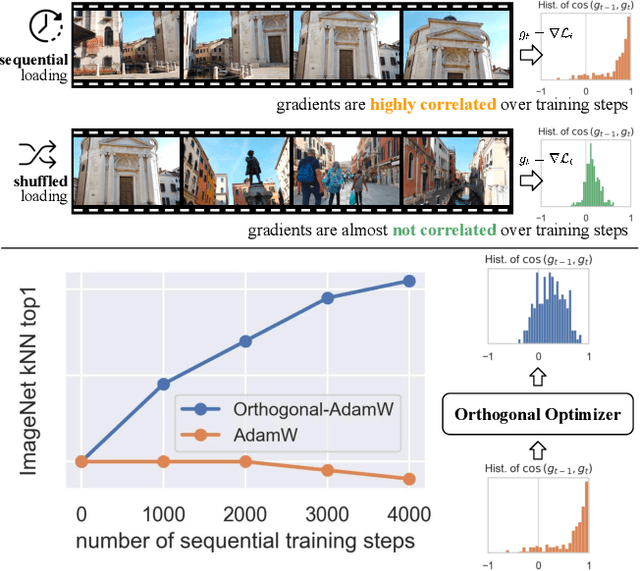
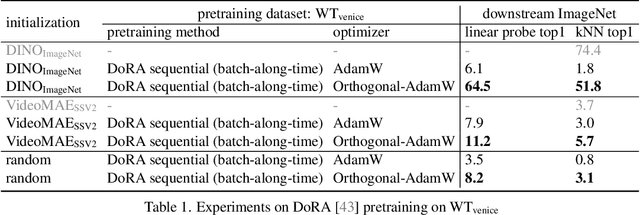
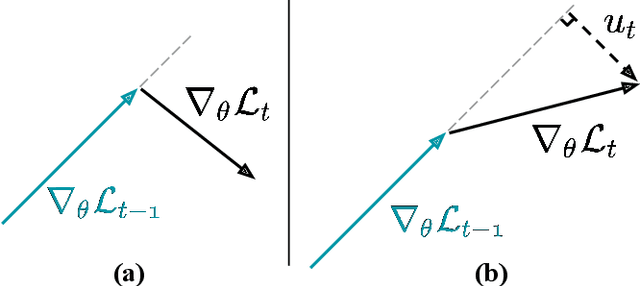
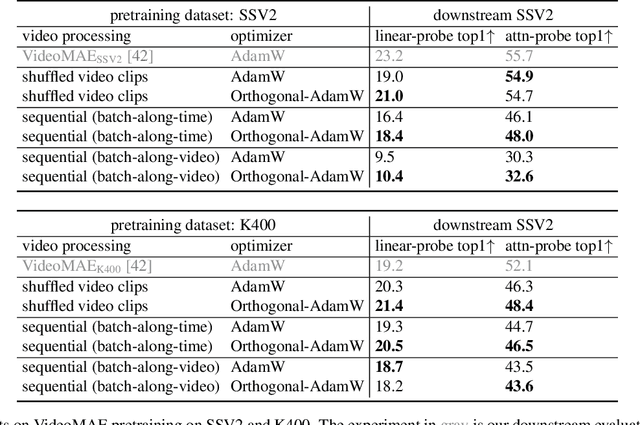
We address the challenge of representation learning from a continuous stream of video as input, in a self-supervised manner. This differs from the standard approaches to video learning where videos are chopped and shuffled during training in order to create a non-redundant batch that satisfies the independently and identically distributed (IID) sample assumption expected by conventional training paradigms. When videos are only available as a continuous stream of input, the IID assumption is evidently broken, leading to poor performance. We demonstrate the drop in performance when moving from shuffled to sequential learning on three tasks: the one-video representation learning method DoRA, standard VideoMAE on multi-video datasets, and the task of future video prediction. To address this drop, we propose a geometric modification to standard optimizers, to decorrelate batches by utilising orthogonal gradients during training. The proposed modification can be applied to any optimizer -- we demonstrate it with Stochastic Gradient Descent (SGD) and AdamW. Our proposed orthogonal optimizer allows models trained from streaming videos to alleviate the drop in representation learning performance, as evaluated on downstream tasks. On three scenarios (DoRA, VideoMAE, future prediction), we show our orthogonal optimizer outperforms the strong AdamW in all three scenarios.
Cyclic Contrastive Knowledge Transfer for Open-Vocabulary Object Detection
Mar 14, 2025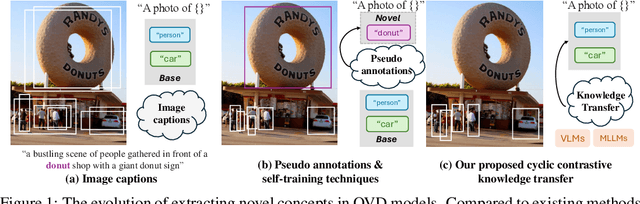
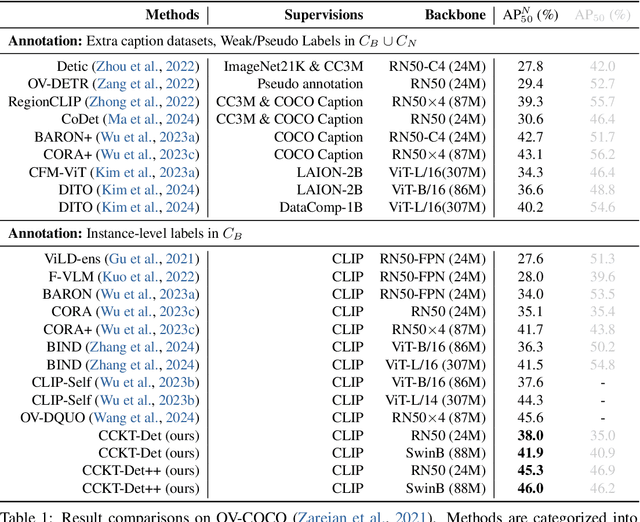
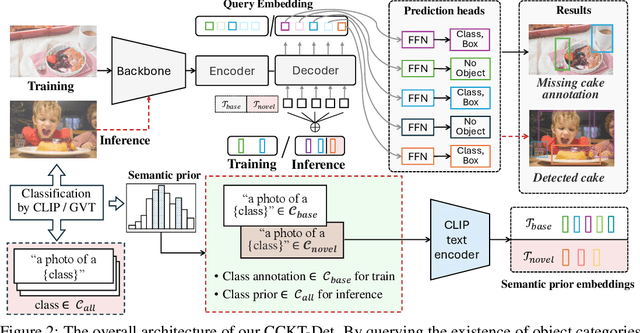
In pursuit of detecting unstinted objects that extend beyond predefined categories, prior arts of open-vocabulary object detection (OVD) typically resort to pretrained vision-language models (VLMs) for base-to-novel category generalization. However, to mitigate the misalignment between upstream image-text pretraining and downstream region-level perception, additional supervisions are indispensable, eg, image-text pairs or pseudo annotations generated via self-training strategies. In this work, we propose CCKT-Det trained without any extra supervision. The proposed framework constructs a cyclic and dynamic knowledge transfer from language queries and visual region features extracted from VLMs, which forces the detector to closely align with the visual-semantic space of VLMs. Specifically, 1) we prefilter and inject semantic priors to guide the learning of queries, and 2) introduce a regional contrastive loss to improve the awareness of queries on novel objects. CCKT-Det can consistently improve performance as the scale of VLMs increases, all while requiring the detector at a moderate level of computation overhead. Comprehensive experimental results demonstrate that our method achieves performance gain of +2.9% and +10.2% AP50 over previous state-of-the-arts on the challenging COCO benchmark, both without and with a stronger teacher model. The code is provided at https://github.com/ZCHUHan/CCKT-Det.
* 10 pages, 5 figures, Published as a conference paper at ICLR 2025
From Image to Video: An Empirical Study of Diffusion Representations
Feb 10, 2025Diffusion models have revolutionized generative modeling, enabling unprecedented realism in image and video synthesis. This success has sparked interest in leveraging their representations for visual understanding tasks. While recent works have explored this potential for image generation, the visual understanding capabilities of video diffusion models remain largely uncharted. To address this gap, we systematically compare the same model architecture trained for video versus image generation, analyzing the performance of their latent representations on various downstream tasks including image classification, action recognition, depth estimation, and tracking. Results show that video diffusion models consistently outperform their image counterparts, though we find a striking range in the extent of this superiority. We further analyze features extracted from different layers and with varying noise levels, as well as the effect of model size and training budget on representation and generation quality. This work marks the first direct comparison of video and image diffusion objectives for visual understanding, offering insights into the role of temporal information in representation learning.