 Add to Chrome
 Add to Firefox
 Add to Edge
SoRoMoX: Fast, Differentiable, and Parallelizable Soft Robot Models
Aug 06, 2026
Reduced-order models based on Cosserat-rod theory are now well established, and modeling theory is no longer the primary bottleneck in soft-robot control. Their implementations, however, do not support the differentiable, GPU-parallel, and control-oriented workflows that underpin advanced rigid-robotics applications. Here, we fill this gap with SoRoMoX (Soft Robot Models in JAX), a fully numerical, JIT-compilable Python/JAX framework. SoRoMoX implements articulated, Piecewise Constant Strain, and Variable Strain models through a unified, control-ready interface that provides inertia matrices, gravitational and elastic forces, Jacobians, and their derivatives. To our knowledge, it is the first rod/strain-based soft-robot modeling framework that runs directly on GPUs and is end-to-end differentiable with respect to states, inputs, and parameters. Sequential CPU rollouts are up to 18.1x faster than state-of-the-art alternatives, while GPU-parallel rollouts increase throughput by up to 234.6x. This performance enables workflows that were previously impractical or impossible: static-equilibrium system identification with 66% lower marker RMSE; residual-force learning with a further 64% reduction; computed-torque tracking with RMSE reduced by a factor of approximately 500 relative to model-free PD; control-gain optimization with up to 62% lower loss than untuned gains; safety-constrained control using high-order control barrier functions to keep the peak contact force within a prescribed 5 N bound, compared with 33.5 N without the safety constraint; and reinforcement-learning policy training up to 7x faster than a CPU PyElastica discrete-rod baseline through massively parallel rollouts.

Boundary Control Behaviors of Multiple Low-cost AUVs Using Acoustic Communication
Nov 28, 2024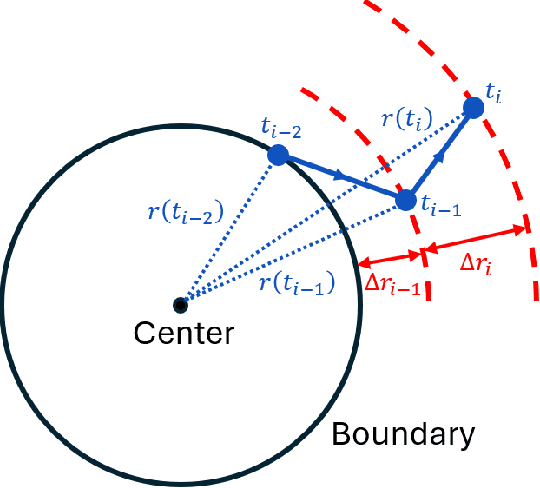
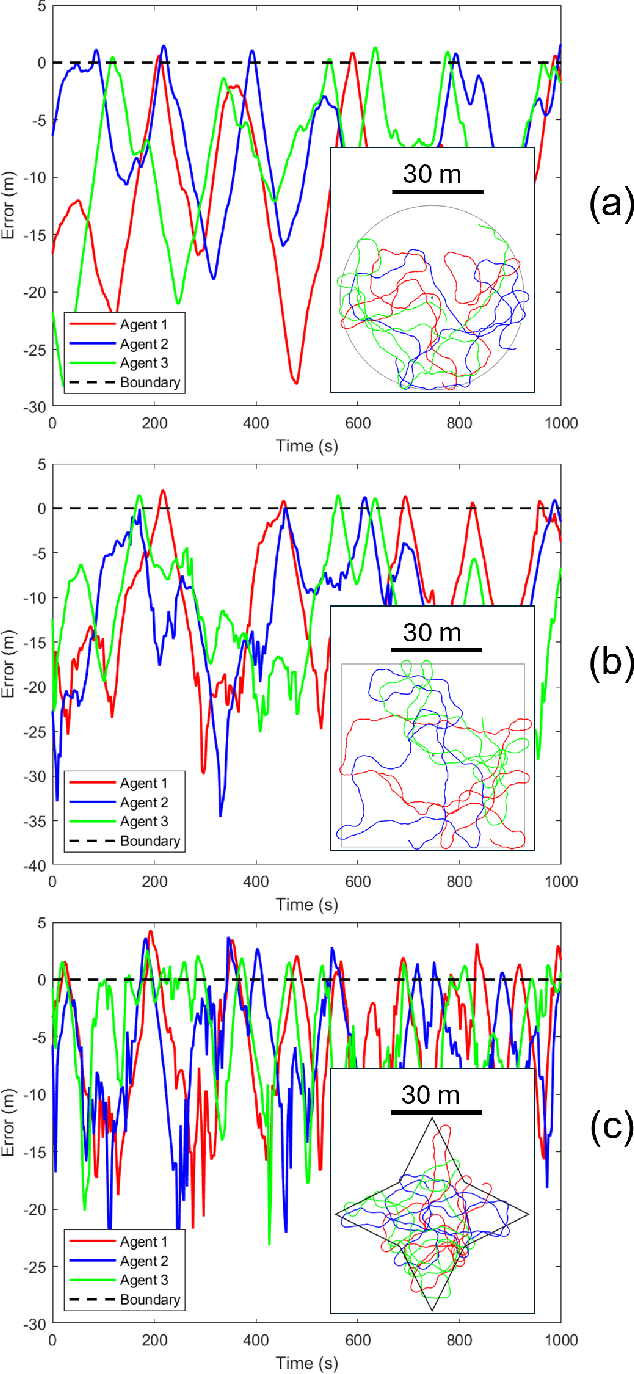

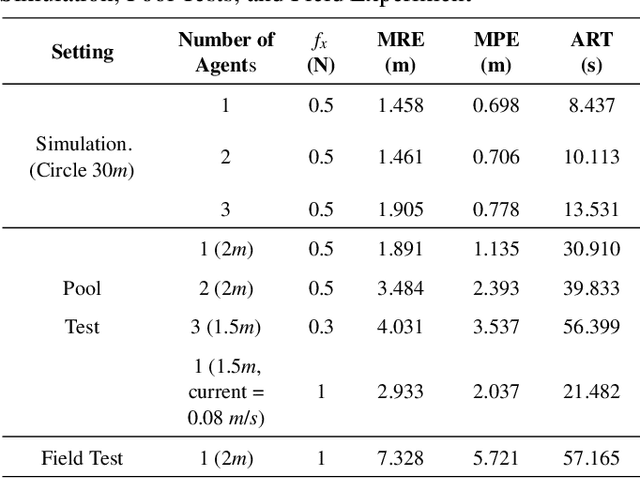
This study presents acoustic-based methods for the control of multiple autonomous underwater vehicles (AUV). This study proposes two different models for implementing boundary and path control on low-cost AUVs using acoustic communication and a single central acoustic beacon. Two methods are presented: the Range Variation-Based (RVB) model completely relies on range data obtained by acoustic modems, whereas the Heading Estimation-Based (HEB) model uses ranges and range rates to estimate the position of the central boundary beacon and perform assigned behaviors. The models are tested on two boundary control behaviors: Fencing and Milling. Fencing behavior ensures AUVs return within predefined boundaries, while Milling enables the AUVs to move cyclically on a predefined path around the beacon. Models are validated by successfully performing the boundary control behaviors in simulations, pool tests, including artificial underwater currents, and field tests conducted in the ocean. All tests were performed with fully autonomous platforms, and no external input or sensor was provided to the AUVs during validation. Quantitative and qualitative analyses are presented in the study, focusing on the effect and application of a multi-robot system.