 Add to Chrome
 Add to Firefox
 Add to Edge
EviLink: Multi-Path Schema Linking with Uncertainty-Guided Evidence Acquisition for Large-Scale Text-to-SQL
May 28, 2026
Schema linking is a difficult and important step in large-scale Text-to-SQL, where systems must identify a compact yet sufficient schema context from large and ambiguous databases. Existing methods often treat schema linking as deterministic selection around a single SQL path, but complex questions may admit multiple valid realizations with different schema needs. We reframe schema linking as uncertainty-aware schema-need inference over multiple plausible SQL paths, where the system distinguishes required schema items from path-dependent uncertain ones and acquires evidence only where needed. We instantiate this reframing with EviLink, which combines multi-hypothesis schema grounding with uncertainty-guided evidence acquisition. Experiments on BIRD-Dev and Spider2-Snow show that this perspective improves the balance among schema completeness, schema relevance, and token cost. On Spider2-Snow, EviLink achieves 90.15% field-level strict recall rate, uses 123.30K average tokens, and improves downstream SQL generation under a fixed generator.

Dynamic TMoE: A Drift-Aware Dynamic Mixture of Experts Framework for Non-Stationary Time Series Forecasting
May 20, 2026Non-stationary time series forecasting is challenged by evolving distribution shifts that static models struggle to capture. While Mixture-of-Experts (MoE) architectures offer a promising paradigm for decoupling complex drift patterns, existing approaches are limited by fixed expert pools and memoryless routing, hampering their ability to adapt to abrupt regime shifts. To address this, we propose Dynamic TMoE, a framework that unifies architectural evolution with temporal continuity during learning phase. By detecting distribution shifts via Maximum Mean Discrepancy (MMD), we dynamically instantiate heterogeneous experts and prune redundant ones to optimize capacity. Additionally, a temporal memory router leverages recurrent states and an anomaly repository to ensure stable, context-aware expert selection without requiring test-time updates. Experiments on nine benchmarks demonstrate state-of-the-art performance, reducing MSE by 10.4% and MAE by 7.8%. Code is available at https://github.com/andone-07/Dynamic-TMoE.
AtomEval: Atomic Evaluation of Adversarial Claims in Fact Verification
Apr 09, 2026Adversarial claim rewriting is widely used to test fact-checking systems, but standard metrics fail to capture truth-conditional consistency and often label semantically corrupted rewrites as successful. We introduce AtomEval, a validity-aware evaluation framework that decomposes claims into subject-relation-object-modifier (SROM) atoms and scores adversarial rewrites with Atomic Validity Scoring (AVS), enabling detection of factual corruption beyond surface similarity. Experiments on the FEVER dataset across representative attack strategies and LLM generators show that AtomEval provides more reliable evaluation signals in our experiments. Using AtomEval, we further analyze LLM-based adversarial generators and observe that stronger models do not necessarily produce more effective adversarial claims under validity-aware evaluation, highlighting previously overlooked limitations in current adversarial evaluation practices.
KEditVis: A Visual Analytics System for Knowledge Editing of Large Language Models
Mar 31, 2026Large Language Models (LLMs) demonstrate exceptional capabilities in factual question answering, yet they sometimes provide incorrect responses. To address this issue, knowledge editing techniques have emerged as effective methods for correcting factual information in LLMs. However, typical knowledge editing workflows struggle with identifying the optimal set of model layers for editing and rely on summary indicators that provide insufficient guidance. This lack of transparency hinders effective comparison and identification of optimal editing strategies. In this paper, we present KEditVis, a novel visual analytics system designed to assist users in gaining a deeper understanding of knowledge editing through interactive visualizations, improving editing outcomes, and discovering valuable insights for the future development of knowledge editing algorithms. With KEditVis, users can select appropriate layers as the editing target, explore the reasons behind ineffective edits, and perform more targeted and effective edits. Our evaluation, including usage scenarios, expert interviews, and a user study, validates the effectiveness and usability of the system.
Do LLM-Driven Agents Exhibit Engagement Mechanisms? Controlled Tests of Information Load, Descriptive Norms, and Popularity Cues
Mar 21, 2026Large language models make agent-based simulation more behaviorally expressive, but they also sharpen a basic methodological tension: fluent, human-like output is not, by itself, evidence for theory. We evaluate what an LLM-driven simulation can credibly support using information engagement on social media as a test case. In a Weibo-like environment, we manipulate information load and descriptive norms, while allowing popularity cues (cumulative likes and Sina Weibo-style cumulative reshares) to evolve endogenously. We then ask whether simulated behavior changes in theoretically interpretable ways under these controlled variations, rather than merely producing plausible-looking traces. Engagement responds systematically to information load and descriptive norms, and sensitivity to popularity cues varies across contexts, indicating conditionality rather than rigid prompt compliance. We discuss methodological implications for simulation-based communication research, including multi-condition stress tests, explicit no-norm baselines because default prompts are not blank controls, and design choices that preserve endogenous feedback loops when studying bandwagon dynamics.
RiskAtlas: Exposing Domain-Specific Risks in LLMs through Knowledge-Graph-Guided Harmful Prompt Generation
Jan 08, 2026Large language models (LLMs) are increasingly applied in specialized domains such as finance and healthcare, where they introduce unique safety risks. Domain-specific datasets of harmful prompts remain scarce and still largely rely on manual construction; public datasets mainly focus on explicit harmful prompts, which modern LLM defenses can often detect and refuse. In contrast, implicit harmful prompts-expressed through indirect domain knowledge-are harder to detect and better reflect real-world threats. We identify two challenges: transforming domain knowledge into actionable constraints and increasing the implicitness of generated harmful prompts. To address them, we propose an end-to-end framework that first performs knowledge-graph-guided harmful prompt generation to systematically produce domain-relevant prompts, and then applies dual-path obfuscation rewriting to convert explicit harmful prompts into implicit variants via direct and context-enhanced rewriting. This framework yields high-quality datasets combining strong domain relevance with implicitness, enabling more realistic red-teaming and advancing LLM safety research. We release our code and datasets at GitHub.
CycleChart: A Unified Consistency-Based Learning Framework for Bidirectional Chart Understanding and Generation
Dec 22, 2025Current chart-specific tasks, such as chart question answering, chart parsing, and chart generation, are typically studied in isolation, preventing models from learning the shared semantics that link chart generation and interpretation. We introduce CycleChart, a consistency-based learning framework for bidirectional chart understanding and generation. CycleChart adopts a schema-centric formulation as a common interface across tasks. We construct a consistent multi-task dataset, where each chart sample includes aligned annotations for schema prediction, data parsing, and question answering. To learn cross-directional chart semantics, CycleChart introduces a generate-parse consistency objective: the model generates a chart schema from a table and a textual query, then learns to recover the schema and data from the generated chart, enforcing semantic alignment across directions. CycleChart achieves strong results on chart generation, chart parsing, and chart question answering, demonstrating improved cross-task generalization and marking a step toward more general chart understanding models.
Linking Heterogeneous Data with Coordinated Agent Flows for Social Media Analysis
Oct 30, 2025Social media platforms generate massive volumes of heterogeneous data, capturing user behaviors, textual content, temporal dynamics, and network structures. Analyzing such data is crucial for understanding phenomena such as opinion dynamics, community formation, and information diffusion. However, discovering insights from this complex landscape is exploratory, conceptually challenging, and requires expertise in social media mining and visualization. Existing automated approaches, though increasingly leveraging large language models (LLMs), remain largely confined to structured tabular data and cannot adequately address the heterogeneity of social media analysis. We present SIA (Social Insight Agents), an LLM agent system that links heterogeneous multi-modal data -- including raw inputs (e.g., text, network, and behavioral data), intermediate outputs, mined analytical results, and visualization artifacts -- through coordinated agent flows. Guided by a bottom-up taxonomy that connects insight types with suitable mining and visualization techniques, SIA enables agents to plan and execute coherent analysis strategies. To ensure multi-modal integration, it incorporates a data coordinator that unifies tabular, textual, and network data into a consistent flow. Its interactive interface provides a transparent workflow where users can trace, validate, and refine the agent's reasoning, supporting both adaptability and trustworthiness. Through expert-centered case studies and quantitative evaluation, we show that SIA effectively discovers diverse and meaningful insights from social media while supporting human-agent collaboration in complex analytical tasks.
NeuroBreak: Unveil Internal Jailbreak Mechanisms in Large Language Models
Sep 04, 2025In deployment and application, large language models (LLMs) typically undergo safety alignment to prevent illegal and unethical outputs. However, the continuous advancement of jailbreak attack techniques, designed to bypass safety mechanisms with adversarial prompts, has placed increasing pressure on the security defenses of LLMs. Strengthening resistance to jailbreak attacks requires an in-depth understanding of the security mechanisms and vulnerabilities of LLMs. However, the vast number of parameters and complex structure of LLMs make analyzing security weaknesses from an internal perspective a challenging task. This paper presents NeuroBreak, a top-down jailbreak analysis system designed to analyze neuron-level safety mechanisms and mitigate vulnerabilities. We carefully design system requirements through collaboration with three experts in the field of AI security. The system provides a comprehensive analysis of various jailbreak attack methods. By incorporating layer-wise representation probing analysis, NeuroBreak offers a novel perspective on the model's decision-making process throughout its generation steps. Furthermore, the system supports the analysis of critical neurons from both semantic and functional perspectives, facilitating a deeper exploration of security mechanisms. We conduct quantitative evaluations and case studies to verify the effectiveness of our system, offering mechanistic insights for developing next-generation defense strategies against evolving jailbreak attacks.
ProTAL: A Drag-and-Link Video Programming Framework for Temporal Action Localization
May 23, 2025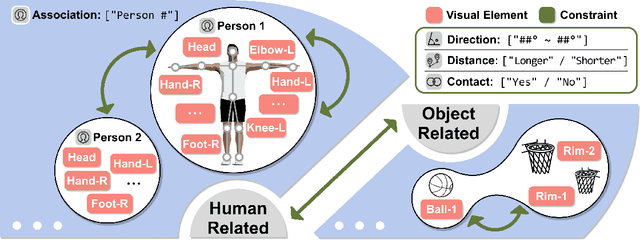
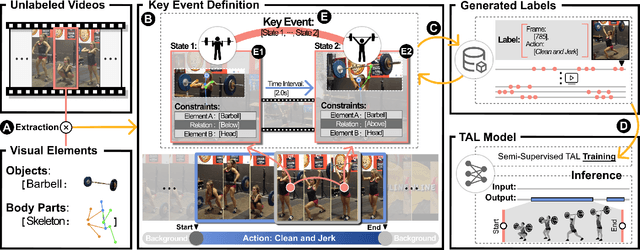
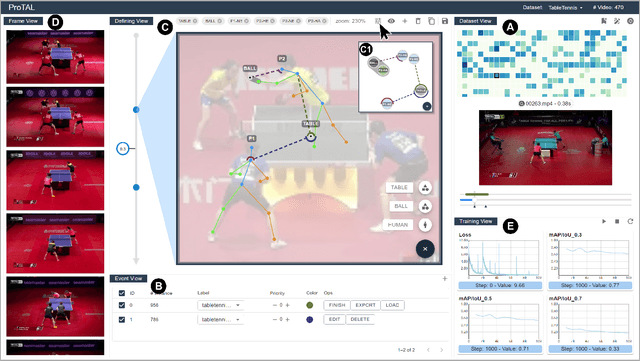
Temporal Action Localization (TAL) aims to detect the start and end timestamps of actions in a video. However, the training of TAL models requires a substantial amount of manually annotated data. Data programming is an efficient method to create training labels with a series of human-defined labeling functions. However, its application in TAL faces difficulties of defining complex actions in the context of temporal video frames. In this paper, we propose ProTAL, a drag-and-link video programming framework for TAL. ProTAL enables users to define \textbf{key events} by dragging nodes representing body parts and objects and linking them to constrain the relations (direction, distance, etc.). These definitions are used to generate action labels for large-scale unlabelled videos. A semi-supervised method is then employed to train TAL models with such labels. We demonstrate the effectiveness of ProTAL through a usage scenario and a user study, providing insights into designing video programming framework.