 Add to Chrome
 Add to Firefox
 Add to Edge
Concurrent Image Understanding and Generation: Self-Correcting Coupled Markov Jump Processes
Jul 14, 2026
Human cognition does not separate understanding and generation. A teacher at a whiteboard speaks and draws $\textit{together}$, each modality reshapes the other. In this paper, we bring this coupled loop to artificial systems. Masked Diffusion Models (MDMs) are ideally suited to this task, yet existing samplers either decode text and image interleavedly or independently update them in parallel branches that share only previous-step history, but not the other modality's latest decisions $\textit{within}$ the same step; combined with MDMs' inability to remask, cross-modal contradictions are neither detected nor repaired. We introduce $\textbf{Self-Correcting Coupled Markov Jump Processes (SC-CMJP)}$, a framework in which one modality's transition rates are functionals of the other modality's confidence score, as weighted by cross-modal attention. Furthermore, a remasking jump retracts commitments the moment cross-modal evidence turns against them. In conjunction with SC-CMJP, we introduce $\texttt{CO}_\texttt{2}\texttt{Jump}$ (Self-$\underline{\text{CO}}$rrecting $\underline{\text{CO}}$upled $\underline{\text{Jump}}$), a novel training-free single-pass sampler for joint multimodal geneneration. For training and evaluation purposes, we have created and will release three large-scale joint multimodal generation corpora: $\text{JEdit-1M}$, $\text{JMaze-200K}$, $\text{JNono-200K}$, with matching in- and out-of-distribution benchmarks. $\texttt{CO}_\texttt{2}\texttt{Jump}$ achieves best joint performance for image understanding and editing as well as visual reasoning (maze and nonogram solving). The performance of the sampler scales monotonically with the number of denoising steps, evidence that the benefits of cross-modal coupling $\textit{compound}$ across the trajectory. Project page: https://coupled-jump.github.io

From Image to Video: An Empirical Study of Diffusion Representations
Feb 10, 2025Diffusion models have revolutionized generative modeling, enabling unprecedented realism in image and video synthesis. This success has sparked interest in leveraging their representations for visual understanding tasks. While recent works have explored this potential for image generation, the visual understanding capabilities of video diffusion models remain largely uncharted. To address this gap, we systematically compare the same model architecture trained for video versus image generation, analyzing the performance of their latent representations on various downstream tasks including image classification, action recognition, depth estimation, and tracking. Results show that video diffusion models consistently outperform their image counterparts, though we find a striking range in the extent of this superiority. We further analyze features extracted from different layers and with varying noise levels, as well as the effect of model size and training budget on representation and generation quality. This work marks the first direct comparison of video and image diffusion objectives for visual understanding, offering insights into the role of temporal information in representation learning.
Scaling 4D Representations
Dec 19, 2024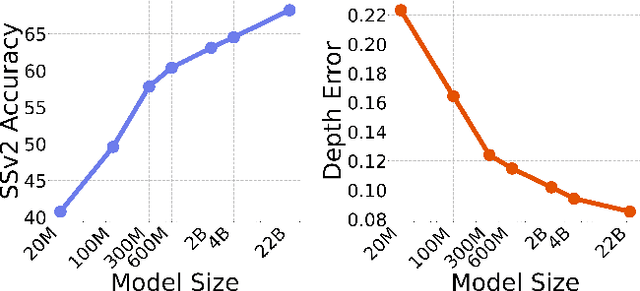
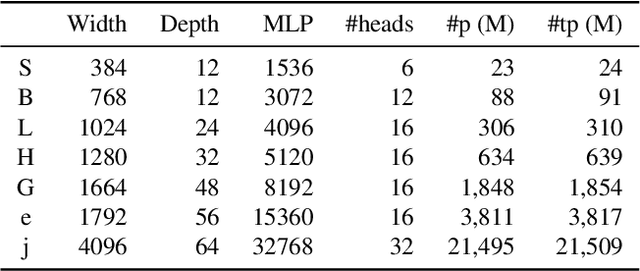
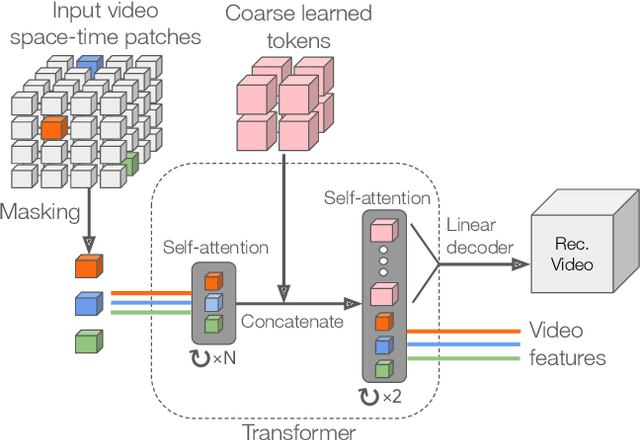
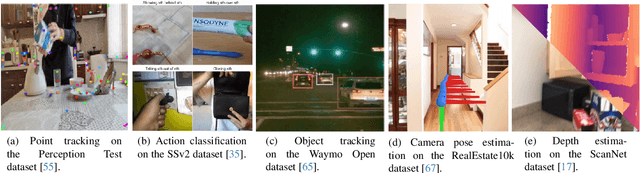
Scaling has not yet been convincingly demonstrated for pure self-supervised learning from video. However, prior work has focused evaluations on semantic-related tasks $\unicode{x2013}$ action classification, ImageNet classification, etc. In this paper we focus on evaluating self-supervised learning on non-semantic vision tasks that are more spatial (3D) and temporal (+1D = 4D), such as camera pose estimation, point and object tracking, and depth estimation. We show that by learning from very large video datasets, masked auto-encoding (MAE) with transformer video models actually scales, consistently improving performance on these 4D tasks, as model size increases from 20M all the way to the largest by far reported self-supervised video model $\unicode{x2013}$ 22B parameters. Rigorous apples-to-apples comparison with many recent image and video models demonstrates the benefits of scaling 4D representations.