 Add to Chrome
 Add to Firefox
 Add to Edge
NFIG: Autoregressive Image Generation with Next-Frequency Prediction
Mar 10, 2025
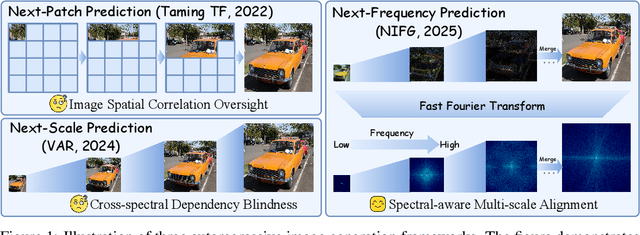
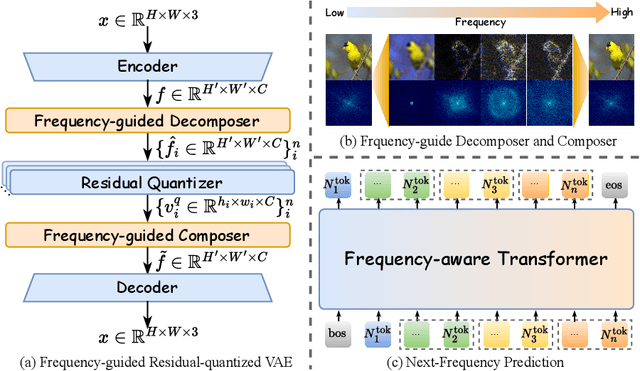
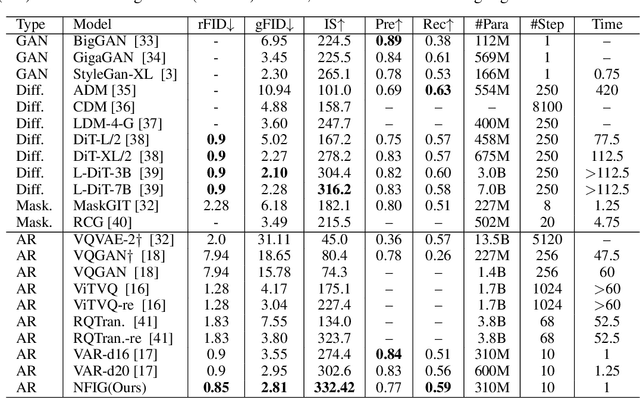
Autoregressive models have achieved promising results in natural language processing. However, for image generation tasks, they encounter substantial challenges in effectively capturing long-range dependencies, managing computational costs, and most crucially, defining meaningful autoregressive sequences that reflect natural image hierarchies. To address these issues, we present \textbf{N}ext-\textbf{F}requency \textbf{I}mage \textbf{G}eneration (\textbf{NFIG}), a novel framework that decomposes the image generation process into multiple frequency-guided stages. Our approach first generates low-frequency components to establish global structure with fewer tokens, then progressively adds higher-frequency details, following the natural spectral hierarchy of images. This principled autoregressive sequence not only improves the quality of generated images by better capturing true causal relationships between image components, but also significantly reduces computational overhead during inference. Extensive experiments demonstrate that NFIG achieves state-of-the-art performance with fewer steps, offering a more efficient solution for image generation, with 1.25$\times$ speedup compared to VAR-d20 while achieving better performance (FID: 2.81) on the ImageNet-256 benchmark. We hope that our insight of incorporating frequency-domain knowledge to guide autoregressive sequence design will shed light on future research. We will make our code publicly available upon acceptance of the paper.

AgiBot World Colosseo: A Large-scale Manipulation Platform for Scalable and Intelligent Embodied Systems
Mar 09, 2025We explore how scalable robot data can address real-world challenges for generalized robotic manipulation. Introducing AgiBot World, a large-scale platform comprising over 1 million trajectories across 217 tasks in five deployment scenarios, we achieve an order-of-magnitude increase in data scale compared to existing datasets. Accelerated by a standardized collection pipeline with human-in-the-loop verification, AgiBot World guarantees high-quality and diverse data distribution. It is extensible from grippers to dexterous hands and visuo-tactile sensors for fine-grained skill acquisition. Building on top of data, we introduce Genie Operator-1 (GO-1), a novel generalist policy that leverages latent action representations to maximize data utilization, demonstrating predictable performance scaling with increased data volume. Policies pre-trained on our dataset achieve an average performance improvement of 30% over those trained on Open X-Embodiment, both in in-domain and out-of-distribution scenarios. GO-1 exhibits exceptional capability in real-world dexterous and long-horizon tasks, achieving over 60% success rate on complex tasks and outperforming prior RDT approach by 32%. By open-sourcing the dataset, tools, and models, we aim to democratize access to large-scale, high-quality robot data, advancing the pursuit of scalable and general-purpose intelligence.
Towards Universal Learning-based Model for Cardiac Image Reconstruction: Summary of the CMRxRecon2024 Challenge
Mar 05, 2025Cardiovascular magnetic resonance (CMR) offers diverse imaging contrasts for assessment of cardiac function and tissue characterization. However, acquiring each single CMR modality is often time-consuming, and comprehensive clinical protocols require multiple modalities with various sampling patterns, further extending the overall acquisition time and increasing susceptibility to motion artifacts. Existing deep learning-based reconstruction methods are often designed for specific acquisition parameters, which limits their ability to generalize across a variety of scan scenarios. As part of the CMRxRecon Series, the CMRxRecon2024 challenge provides diverse datasets encompassing multi-modality multi-view imaging with various sampling patterns, and a platform for the international community to develop and benchmark reconstruction solutions in two well-crafted tasks. Task 1 is a modality-universal setting, evaluating the out-of-distribution generalization of the reconstructed model, while Task 2 follows sampling-universal setting assessing the one-for-all adaptability of the universal model. Main contributions include providing the first and largest publicly available multi-modality, multi-view cardiac k-space dataset; developing a benchmarking platform that simulates clinical acceleration protocols, with a shared code library and tutorial for various k-t undersampling patterns and data processing; giving technical insights of enhanced data consistency based on physic-informed networks and adaptive prompt-learning embedding to be versatile to different clinical settings; additional finding on evaluation metrics to address the limitations of conventional ground-truth references in universal reconstruction tasks.
AppAgentX: Evolving GUI Agents as Proficient Smartphone Users
Mar 04, 2025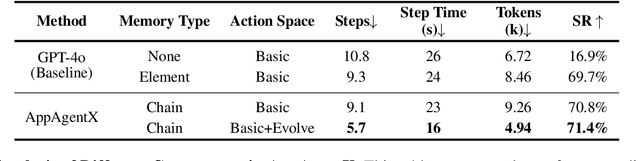
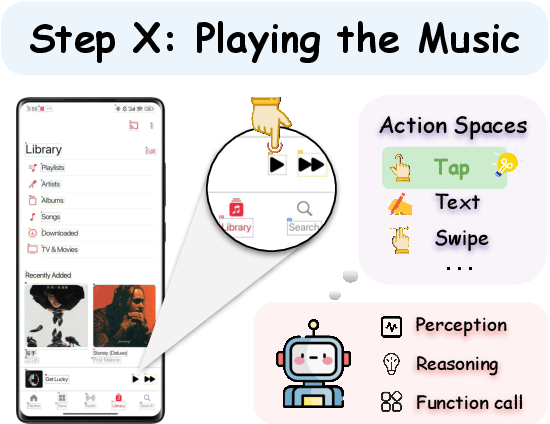
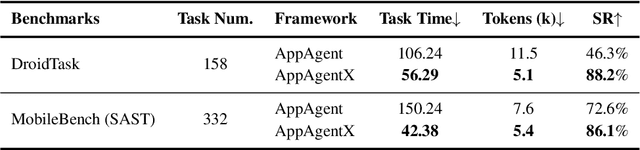
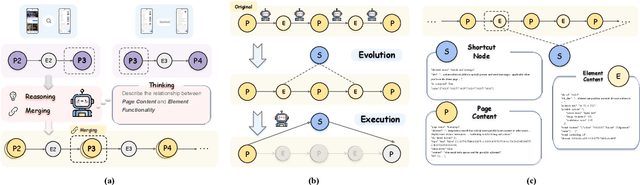
Recent advancements in Large Language Models (LLMs) have led to the development of intelligent LLM-based agents capable of interacting with graphical user interfaces (GUIs). These agents demonstrate strong reasoning and adaptability, enabling them to perform complex tasks that traditionally required predefined rules. However, the reliance on step-by-step reasoning in LLM-based agents often results in inefficiencies, particularly for routine tasks. In contrast, traditional rule-based systems excel in efficiency but lack the intelligence and flexibility to adapt to novel scenarios. To address this challenge, we propose a novel evolutionary framework for GUI agents that enhances operational efficiency while retaining intelligence and flexibility. Our approach incorporates a memory mechanism that records the agent's task execution history. By analyzing this history, the agent identifies repetitive action sequences and evolves high-level actions that act as shortcuts, replacing these low-level operations and improving efficiency. This allows the agent to focus on tasks requiring more complex reasoning, while simplifying routine actions. Experimental results on multiple benchmark tasks demonstrate that our approach significantly outperforms existing methods in both efficiency and accuracy. The code will be open-sourced to support further research.
External Large Foundation Model: How to Efficiently Serve Trillions of Parameters for Online Ads Recommendation
Feb 26, 2025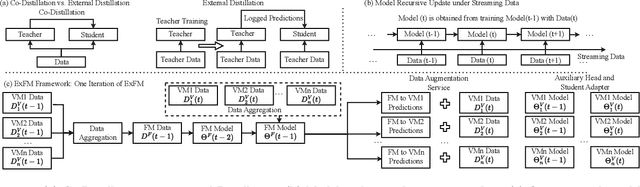
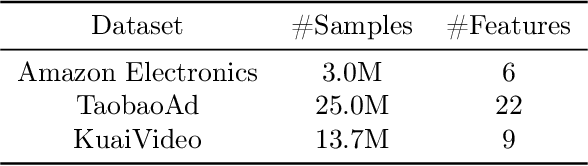
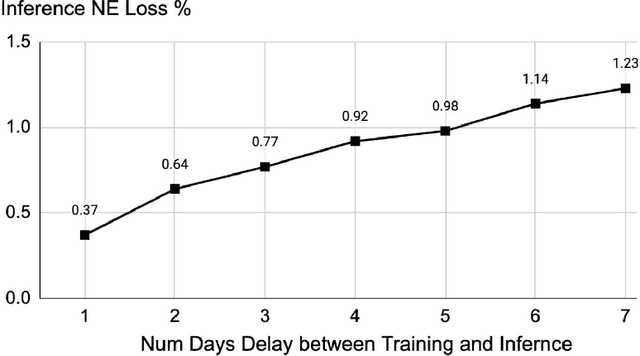
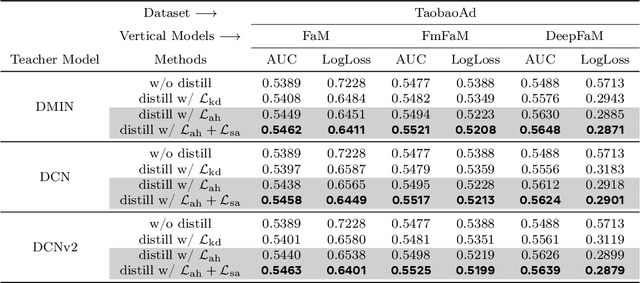
Ads recommendation is a prominent service of online advertising systems and has been actively studied. Recent studies indicate that scaling-up and advanced design of the recommendation model can bring significant performance improvement. However, with a larger model scale, such prior studies have a significantly increasing gap from industry as they often neglect two fundamental challenges in industrial-scale applications. First, training and inference budgets are restricted for the model to be served, exceeding which may incur latency and impair user experience. Second, large-volume data arrive in a streaming mode with data distributions dynamically shifting, as new users/ads join and existing users/ads leave the system. We propose the External Large Foundation Model (ExFM) framework to address the overlooked challenges. Specifically, we develop external distillation and a data augmentation system (DAS) to control the computational cost of training/inference while maintaining high performance. We design the teacher in a way like a foundation model (FM) that can serve multiple students as vertical models (VMs) to amortize its building cost. We propose Auxiliary Head and Student Adapter to mitigate the data distribution gap between FM and VMs caused by the streaming data issue. Comprehensive experiments on internal industrial-scale applications and public datasets demonstrate significant performance gain by ExFM.
Distill Any Depth: Distillation Creates a Stronger Monocular Depth Estimator
Feb 26, 2025Monocular depth estimation (MDE) aims to predict scene depth from a single RGB image and plays a crucial role in 3D scene understanding. Recent advances in zero-shot MDE leverage normalized depth representations and distillation-based learning to improve generalization across diverse scenes. However, current depth normalization methods for distillation, relying on global normalization, can amplify noisy pseudo-labels, reducing distillation effectiveness. In this paper, we systematically analyze the impact of different depth normalization strategies on pseudo-label distillation. Based on our findings, we propose Cross-Context Distillation, which integrates global and local depth cues to enhance pseudo-label quality. Additionally, we introduce a multi-teacher distillation framework that leverages complementary strengths of different depth estimation models, leading to more robust and accurate depth predictions. Extensive experiments on benchmark datasets demonstrate that our approach significantly outperforms state-of-the-art methods, both quantitatively and qualitatively.
Monocular Depth Estimation and Segmentation for Transparent Object with Iterative Semantic and Geometric Fusion
Feb 20, 2025Transparent object perception is indispensable for numerous robotic tasks. However, accurately segmenting and estimating the depth of transparent objects remain challenging due to complex optical properties. Existing methods primarily delve into only one task using extra inputs or specialized sensors, neglecting the valuable interactions among tasks and the subsequent refinement process, leading to suboptimal and blurry predictions. To address these issues, we propose a monocular framework, which is the first to excel in both segmentation and depth estimation of transparent objects, with only a single-image input. Specifically, we devise a novel semantic and geometric fusion module, effectively integrating the multi-scale information between tasks. In addition, drawing inspiration from human perception of objects, we further incorporate an iterative strategy, which progressively refines initial features for clearer results. Experiments on two challenging synthetic and real-world datasets demonstrate that our model surpasses state-of-the-art monocular, stereo, and multi-view methods by a large margin of about 38.8%-46.2% with only a single RGB input. Codes and models are publicly available at https://github.com/L-J-Yuan/MODEST.
Neural Force Field: Learning Generalized Physical Representation from a Few Examples
Feb 13, 2025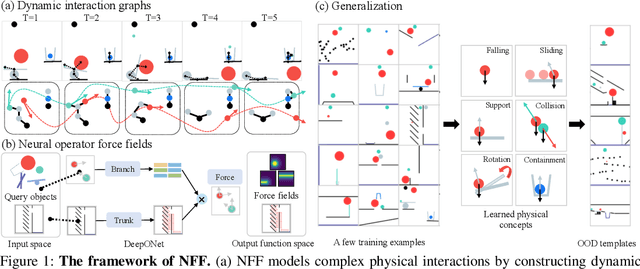
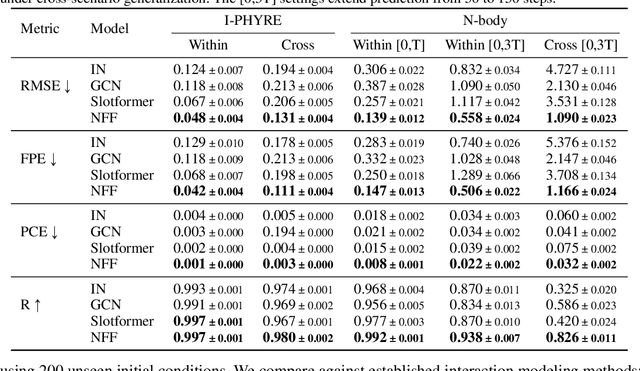
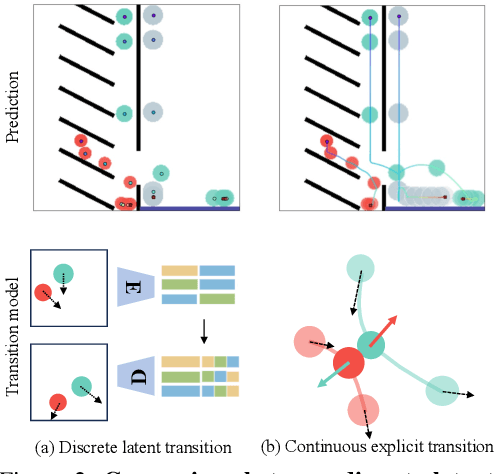

Physical reasoning is a remarkable human ability that enables rapid learning and generalization from limited experience. Current AI models, despite extensive training, still struggle to achieve similar generalization, especially in Out-of-distribution (OOD) settings. This limitation stems from their inability to abstract core physical principles from observations. A key challenge is developing representations that can efficiently learn and generalize physical dynamics from minimal data. Here we present Neural Force Field (NFF) a modeling framework built on Neural Ordinary Differential Equation (NODE) that learns interpretable force field representations which can be efficiently integrated through an Ordinary Differential Equation ( ODE) solver to predict object trajectories. Unlike existing approaches that rely on high-dimensional latent spaces, NFF captures fundamental physical concepts such as gravity, support, and collision in an interpretable manner. Experiments on two challenging physical reasoning tasks demonstrate that NFF, trained with only a few examples, achieves strong generalization to unseen scenarios. This physics-grounded representation enables efficient forward-backward planning and rapid adaptation through interactive refinement. Our work suggests that incorporating physics-inspired representations into learning systems can help bridge the gap between artificial and human physical reasoning capabilities.
UniForm: A Unified Diffusion Transformer for Audio-Video Generation
Feb 08, 2025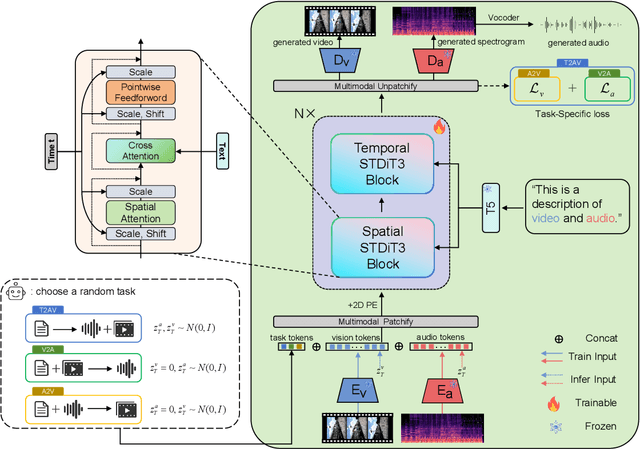
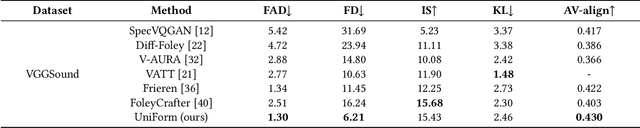
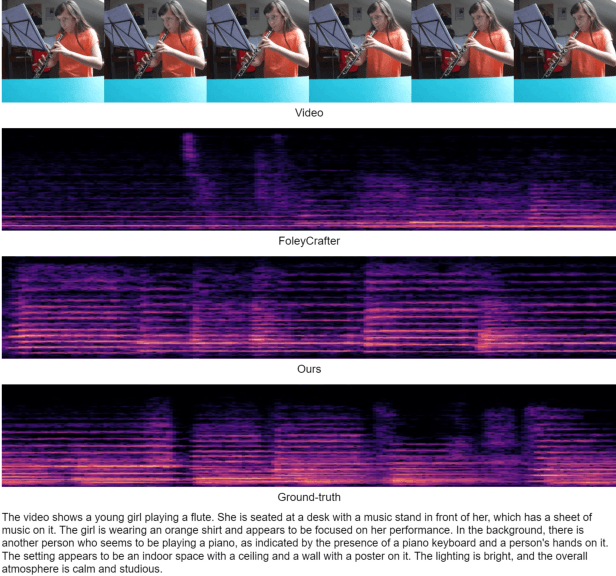
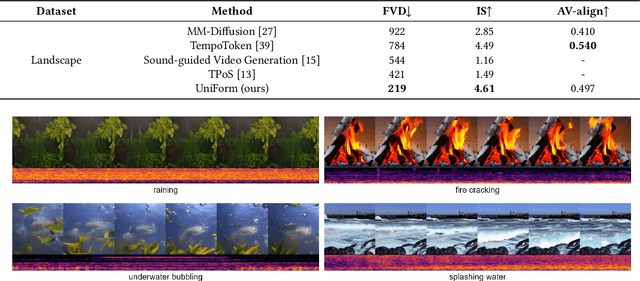
As a natural multimodal content, audible video delivers an immersive sensory experience. Consequently, audio-video generation systems have substantial potential. However, existing diffusion-based studies mainly employ relatively independent modules for generating each modality, which lack exploration of shared-weight generative modules. This approach may under-use the intrinsic correlations between audio and visual modalities, potentially resulting in sub-optimal generation quality. To address this, we propose UniForm, a unified diffusion transformer designed to enhance cross-modal consistency. By concatenating auditory and visual information, UniForm learns to generate audio and video simultaneously within a unified latent space, facilitating the creation of high-quality and well-aligned audio-visual pairs. Extensive experiments demonstrate the superior performance of our method in joint audio-video generation, audio-guided video generation, and video-guided audio generation tasks. Our demos are available at https://uniform-t2av.github.io/.
PoI: Pixel of Interest for Novel View Synthesis Assisted Scene Coordinate Regression
Feb 07, 2025The task of estimating camera poses can be enhanced through novel view synthesis techniques such as NeRF and Gaussian Splatting to increase the diversity and extension of training data. However, these techniques often produce rendered images with issues like blurring and ghosting, which compromise their reliability. These issues become particularly pronounced for Scene Coordinate Regression (SCR) methods, which estimate 3D coordinates at the pixel level. To mitigate the problems associated with unreliable rendered images, we introduce a novel filtering approach, which selectively extracts well-rendered pixels while discarding the inferior ones. This filter simultaneously measures the SCR model's real-time reprojection loss and gradient during training. Building on this filtering technique, we also develop a new strategy to improve scene coordinate regression using sparse inputs, drawing on successful applications of sparse input techniques in novel view synthesis. Our experimental results validate the effectiveness of our method, demonstrating state-of-the-art performance on indoor and outdoor datasets.