 Add to Chrome
 Add to Firefox
 Add to Edge
Benchmarking NACTI Species Recognition in Long-Tailed Regimes
Jul 20, 2026
As with most ``in the wild'' collections of the natural world, the North America Camera Trap Images (NACTI) dataset exhibits long-tailed class imbalance, with the largest class covering over 50% of its 3.7M images. Building on the PyTorch Wildlife model, we systematically evaluate Long-Tail Recognition (LTR) methodologies to benchmark species recognition performance, including specialised loss functions and LTR-sensitive regularisation. Our optimised configuration achieves state-of-the-art 99.40% Top-1 accuracy on the NACTI test split, significantly outperforming standard baselines and previously reported top performances. To assess robustness under domain shifts (e.g., night-time captures, occlusion, motion-blur), we extend our evaluation across three independent reduced-bias test sets (including ENA-Detection, Caltech Camera Traps and Missouri Camera Traps). Across these out-of-distribution (OOD) evaluations, our LTR-enhanced model consistently demonstrates substantially stronger generalisation capabilities compared to standard cross-entropy approaches. However, qualitative and quantitative analyses underline that current LTR optimisations cannot fully overcome representational bottlenecks, resulting in catastrophic predictive breakdown for rare `Tail' classes under severe domain shift. For maximum reproducibility, all dataset splits, key code, and network weights are published with this paper at https://github.com/ZehuaLiuY/Species-Classification.

Automating Visual Recognition of Leprosy in Wild Chimpanzees
Jul 19, 2026Leprosy (Mycobacterium leprae) has been confirmed in wild western chimpanzees (Pan troglodytes verus) in West Africa, presenting as clear and progressive visual symptoms. Manual review of camera-trap footage at landscape scale is infeasible, motivating the need for automated screening. We present the first deep learning pipeline for wildlife leprosy detection and contribute the PanLep300 dataset of 125,670 annotated bounding-box crops across 953 tracks from 303 camera-trap videos with ecologically-motivated splits that withhold whole individuals and camera installations. We benchmark spatial (2D), temporally aggregated (2.5D), and video-based (3D) classification approaches to investigate which approach is best suited to automated leprosy detection in wild apes. We find that simple aggregation of crop-level predictions consistently matches or outperforms both learned temporal models and end-to-end video architectures -- consistent with leprosy's static cutaneous presentation. We further find that performance is suppressed when tracklets contain frames of partially visible individuals -- as commonly occurs at the start and end of a track -- and demonstrate that this can be addressed through targeted construction and aggregation strategies.
The PanAf-SBR Dataset: Social Behaviour Recognition for Wild Great Apes
Jul 19, 2026Behavioural shifts in wild great ape populations, particularly the breakdown of social structures, can serve as an early indicator of population decline. Automating the detection of behaviours indicative of these shifts is therefore a critical task for conservation. Several valuable datasets have recently been introduced for the automated recognition of great ape behaviour, yet few include fine-grained social behaviour annotations, and those that do are captured either in captive settings or via aerial platforms such as UAVs. We address this gap by introducing PanAf-SBR, the first wild great ape camera trap dataset annotated with social behaviours. PanAf-SBR extends PanAf500 with 100 additional videos covering 36,063 frames. These come with 81,096 annotations including bounding boxes, segmentation masks, intra-video identities, and seven social behaviour classes defined under the action giver and receiver convention of ChimpACT. We use this data together with the AlphaChimp architecture to establish the first benchmarks for fine-grained social behaviour recognition in wild great apes from camera trap footage. We further conduct bidirectional transfer learning experiments between PanAf-SBR and the captive ChimpACT dataset, finding that cross-dataset pre-training is highly beneficial for specific classes rather than of uniform benefit. Finally, we examine the role of background context by inverting the segmentation masks to suppress non-ape pixels.
CoralLite: μCT Reconstruction of Coral Colonies from Individual Corallites
May 14, 2026The life history of an individual coral is archived within the accreting skeleton of the colony. While reef-forming coral colonies (e.g. massive \emph{Porites} sp.) may live for hundreds of years and deposit calcareous structures many metres in height and width, their living tissue is a thin outer surface layer comprised of asexually-dividing polyps that only survive a few years. To understand the rate and timing of polyp division and the consequences for colony skeletal growth, scientists need to track the skeletal corallite deposited around each polyp. Here we propose CoralLite, an annotated μCT scan dataset of entire calcareous skeletons and an associated, first corallite deep learning reconstruction baseline. CoralLite combines fully quantified volumetric segmentations with cross-slice linking for visualisations of 3D models for each corallite up to colony scale. For segmentation, we propose and evaluate in detail a hybrid V-Trans-UNet architecture applicable to segmenting tiled μCT virtual slabs of \emph{Porites} sp. colonies. The model is pre-trained on weakly annotated data and topology-aware fine-tuned using fully annotated slice sections with 8k+ manual corallite region annotations. On unseen slices of the same colony, the resulting model reaches 0.94 topological accuracy at mean Dice scores of 0.77 on the same colony and projection axis, and 0.63 mean Dice scores on a different, biologically unrelated specimen. Whilst our experiments are limited in scale and context, our results show for the first time that visual machine learning can effectively support full 3D individual corallite modelling from μCT scans of coral skeletons alone. For reproducibility and as a baseline for future research we publish our full dataset of 697 μCT slices, 37 partial or full slice annotations, and all network weights and source code with this paper.
Centering Ecological Goals in Automated Identification of Individual Animals
Apr 22, 2026Recognizing individual animals over time is central to many ecological and conservation questions, including estimating abundance, survival, movement, and social structure. Recent advances in automated identification from images and even acoustic data suggest that this process could be greatly accelerated, yet their promise has not translated well into ecological practice. We argue that the main barrier is not the performance of the automated methods themselves, but a mismatch between how those methods are typically developed and evaluated, and how ecological data is actually collected, processed, reviewed, and used. Future progress, therefore, will depend less on algorithmic gains alone than on recognizing that the usefulness of automated identification is grounded in ecological context: it depends on what question is being asked, what data are available, and what kinds of mistakes matter. Only by centering these questions can we move toward automated identification of individuals that is not only accurate but also ecologically useful, transparent, and trustworthy.
Automated Re-Identification of Holstein-Friesian Cattle in Dense Crowds
Feb 17, 2026Holstein-Friesian detection and re-identification (Re-ID) methods capture individuals well when targets are spatially separate. However, existing approaches, including YOLO-based species detection, break down when cows group closely together. This is particularly prevalent for species which have outline-breaking coat patterns. To boost both effectiveness and transferability in this setting, we propose a new detect-segment-identify pipeline that leverages the Open-Vocabulary Weight-free Localisation and the Segment Anything models as pre-processing stages alongside Re-ID networks. To evaluate our approach, we publish a collection of nine days CCTV data filmed on a working dairy farm. Our methodology overcomes detection breakdown in dense animal groupings, resulting in a 98.93% accuracy. This significantly outperforms current oriented bounding box-driven, as well as SAM species detection baselines with accuracy improvements of 47.52% and 27.13%, respectively. We show that unsupervised contrastive learning can build on this to yield 94.82% Re-ID accuracy on our test data. Our work demonstrates that Re-ID in crowded scenarios is both practical as well as reliable in working farm settings with no manual intervention. Code and dataset are provided for reproducibility.
Deep in the Jungle: Towards Automating Chimpanzee Population Estimation
Jan 30, 2026The estimation of abundance and density in unmarked populations of great apes relies on statistical frameworks that require animal-to-camera distance measurements. In practice, acquiring these distances depends on labour-intensive manual interpretation of animal observations across large camera trap video corpora. This study introduces and evaluates an only sparsely explored alternative: the integration of computer vision-based monocular depth estimation (MDE) pipelines directly into ecological camera trap workflows for great ape conservation. Using a real-world dataset of 220 camera trap videos documenting a wild chimpanzee population, we combine two MDE models, Dense Prediction Transformers and Depth Anything, with multiple distance sampling strategies. These components are used to generate detection distance estimates, from which population density and abundance are inferred. Comparative analysis against manually derived ground-truth distances shows that calibrated DPT consistently outperforms Depth Anything. This advantage is observed in both distance estimation accuracy and downstream density and abundance inference. Nevertheless, both models exhibit systematic biases. We show that, given complex forest environments, they tend to overestimate detection distances and consequently underestimate density and abundance relative to conventional manual approaches. We further find that failures in animal detection across distance ranges are a primary factor limiting estimation accuracy. Overall, this work provides a case study that shows MDE-driven camera trap distance sampling is a viable and practical alternative to manual distance estimation. The proposed approach yields population estimates within 22% of those obtained using traditional methods.
Visual-textual Dermatoglyphic Animal Biometrics: A First Case Study on Panthera tigris
Dec 16, 2025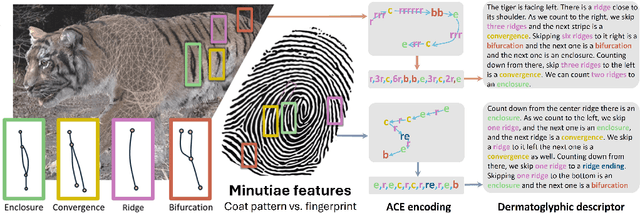
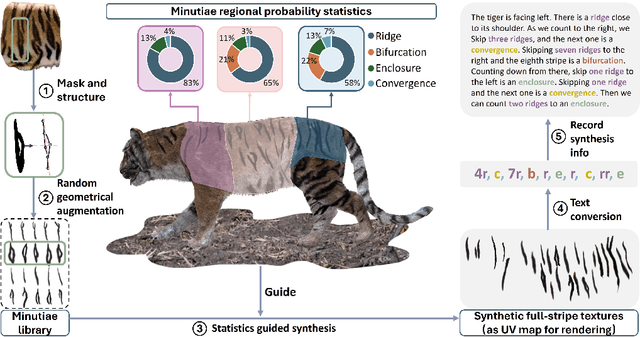
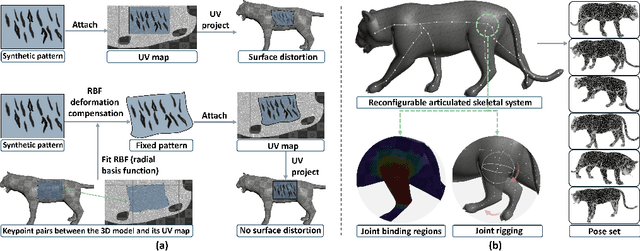
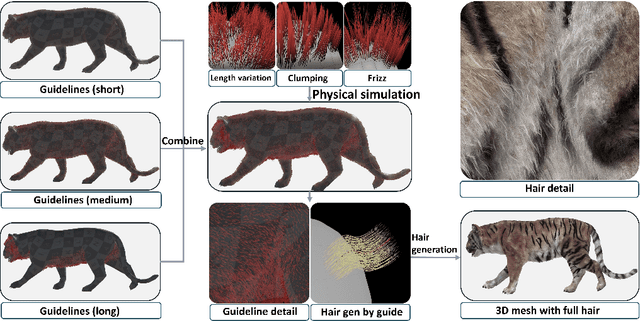
Biologists have long combined visuals with textual field notes to re-identify (Re-ID) animals. Contemporary AI tools automate this for species with distinctive morphological features but remain largely image-based. Here, we extend Re-ID methodologies by incorporating precise dermatoglyphic textual descriptors-an approach used in forensics but new to ecology. We demonstrate that these specialist semantics abstract and encode animal coat topology using human-interpretable language tags. Drawing on 84,264 manually labelled minutiae across 3,355 images of 185 tigers (Panthera tigris), we evaluate this visual-textual methodology, revealing novel capabilities for cross-modal identity retrieval. To optimise performance, we developed a text-image co-synthesis pipeline to generate 'virtual individuals', each comprising dozens of life-like visuals paired with dermatoglyphic text. Benchmarking against real-world scenarios shows this augmentation significantly boosts AI accuracy in cross-modal retrieval while alleviating data scarcity. We conclude that dermatoglyphic language-guided biometrics can overcome vision-only limitations, enabling textual-to-visual identity recovery underpinned by human-verifiable matchings. This represents a significant advance towards explainability in Re-ID and a language-driven unification of descriptive modalities in ecological monitoring.
The SA-FARI Dataset: Segment Anything in Footage of Animals for Recognition and Identification
Nov 19, 2025Automated video analysis is critical for wildlife conservation. A foundational task in this domain is multi-animal tracking (MAT), which underpins applications such as individual re-identification and behavior recognition. However, existing datasets are limited in scale, constrained to a few species, or lack sufficient temporal and geographical diversity - leaving no suitable benchmark for training general-purpose MAT models applicable across wild animal populations. To address this, we introduce SA-FARI, the largest open-source MAT dataset for wild animals. It comprises 11,609 camera trap videos collected over approximately 10 years (2014-2024) from 741 locations across 4 continents, spanning 99 species categories. Each video is exhaustively annotated culminating in ~46 hours of densely annotated footage containing 16,224 masklet identities and 942,702 individual bounding boxes, segmentation masks, and species labels. Alongside the task-specific annotations, we publish anonymized camera trap locations for each video. Finally, we present comprehensive benchmarks on SA-FARI using state-of-the-art vision-language models for detection and tracking, including SAM 3, evaluated with both species-specific and generic animal prompts. We also compare against vision-only methods developed specifically for wildlife analysis. SA-FARI is the first large-scale dataset to combine high species diversity, multi-region coverage, and high-quality spatio-temporal annotations, offering a new foundation for advancing generalizable multianimal tracking in the wild. The dataset is available at $\href{https://www.conservationxlabs.com/sa-fari}{\text{conservationxlabs.com/SA-FARI}}$.
Long-tailed Species Recognition in the NACTI Wildlife Dataset
Oct 24, 2025


As most ''in the wild'' data collections of the natural world, the North America Camera Trap Images (NACTI) dataset shows severe long-tailed class imbalance, noting that the largest 'Head' class alone covers >50% of the 3.7M images in the corpus. Building on the PyTorch Wildlife model, we present a systematic study of Long-Tail Recognition methodologies for species recognition on the NACTI dataset covering experiments on various LTR loss functions plus LTR-sensitive regularisation. Our best configuration achieves 99.40% Top-1 accuracy on our NACTI test data split, substantially improving over a 95.51% baseline using standard cross-entropy with Adam. This also improves on previously reported top performance in MLWIC2 at 96.8% albeit using partly unpublished (potentially different) partitioning, optimiser, and evaluation protocols. To evaluate domain shifts (e.g. night-time captures, occlusion, motion-blur) towards other datasets we construct a Reduced-Bias Test set from the ENA-Detection dataset where our experimentally optimised long-tail enhanced model achieves leading 52.55% accuracy (up from 51.20% with WCE loss), demonstrating stronger generalisation capabilities under distribution shift. We document the consistent improvements of LTR-enhancing scheduler choices in this NACTI wildlife domain, particularly when in tandem with state-of-the-art LTR losses. We finally discuss qualitative and quantitative shortcomings that LTR methods cannot sufficiently address, including catastrophic breakdown for 'Tail' classes under severe domain shift. For maximum reproducibility we publish all dataset splits, key code, and full network weights.