 Add to Chrome
 Add to Firefox
 Add to Edge
RankUp: Towards High-rank Representations for Large Scale Advertising Recommender Systems
Apr 21, 2026
The scaling laws for recommender systems have been increasingly validated, where MetaFormer-based architectures consistently benefit from increased model depth, hidden dimensionality, and user behavior sequence length. However, whether representation capacity scales proportionally with parameter growth remains largely unexplored. Prior studies on RankMixer reveal that the effective rank of token representations exhibits a damped oscillatory trajectory across layers, failing to increase consistently with depth and even degrading in deeper layers. Motivated by this observation, we propose \textbf{RankUp}, an architecture designed to mitigate representation collapse and enhance expressive capacity through randomized permutation splitting over sparse features, a multi-embedding paradigm, global token integration, crossed pretrained embedding tokens and task-specific token decoupling. RankUp has been fully deployed in large-scale production across Weixin Video Accounts, Official Accounts and Moments, yielding GMV improvements of 3.41\%, 4.81\% and 2.21\%, respectively.

Integrating Weather Foundation Model and Satellite to Enable Fine-Grained Solar Irradiance Forecasting
Mar 17, 2026Accurate day-ahead solar irradiance forecasting is essential for integrating solar energy into the power grid. However, it remains challenging due to the pronounced diurnal cycle and inherently complex cloud dynamics. Current methods either lack fine-scale resolution (e.g., numerical weather prediction, weather foundation models) or degrade at longer lead times (e.g., satellite extrapolation). We propose Baguan-solar, a two-stage multimodal framework that fuses forecasts from Baguan, a global weather foundation model, with high-resolution geostationary satellite imagery to produce 24- hour irradiance forecasts at kilometer scale. Its decoupled two-stage design first forecasts day-night continuous intermediates (e.g., cloud cover) and then infers irradiance, while its modality fusion jointly preserves fine-scale cloud structures from satellite and large-scale constraints from Baguan forecasts. Evaluated over East Asia using CLDAS as ground truth, Baguan-solar outperforms strong baselines (including ECMWF IFS, vanilla Baguan, and SolarSeer), reducing RMSE by 16.08% and better resolving cloud-induced transients. An operational deployment of Baguan-solar has supported solar power forecasting in an eastern province in China, since July 2025. Our code is accessible at https://github.com/DAMO-DI-ML/Baguansolar. git.
In-Situ Calibration of Antenna Arrays for Positioning With 5G Networks
Mar 08, 2023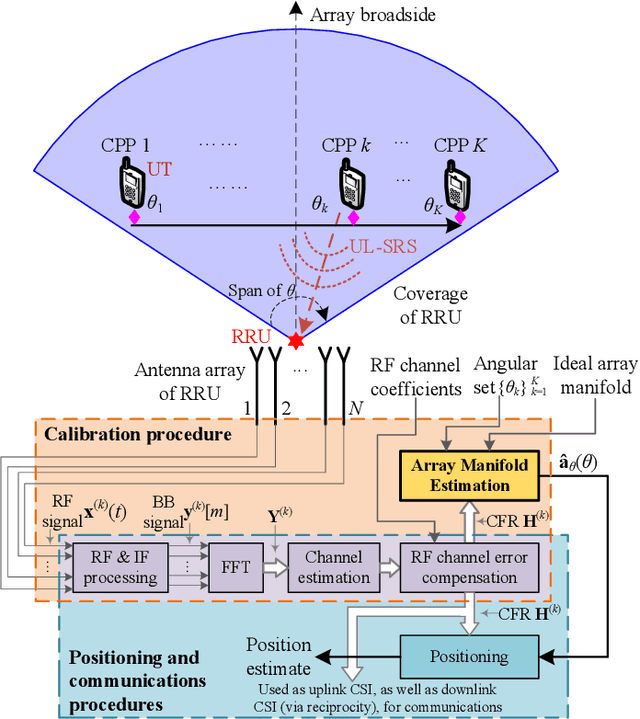
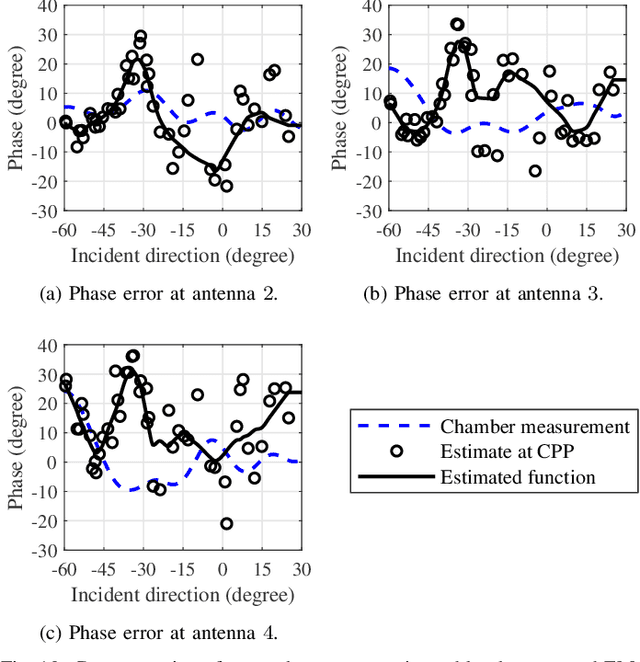
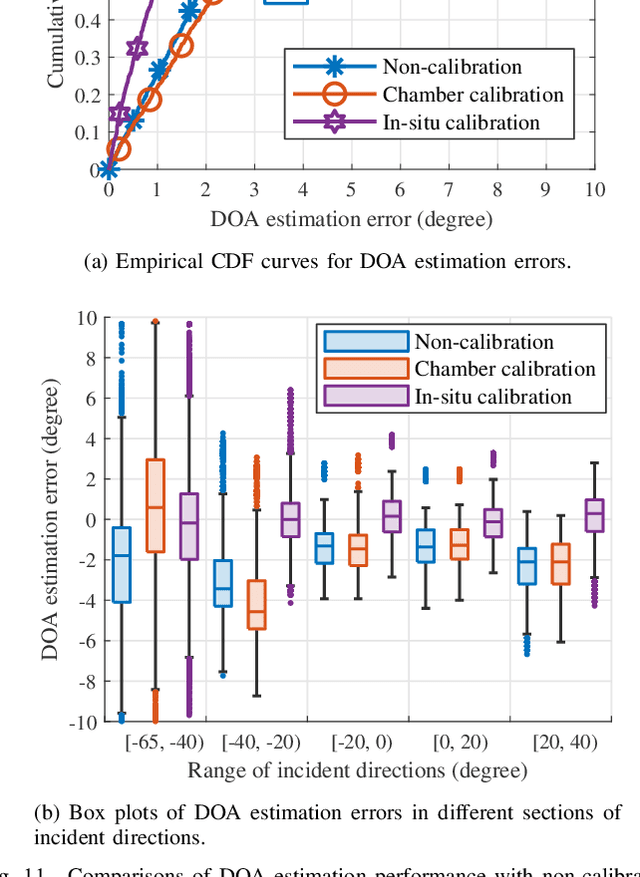
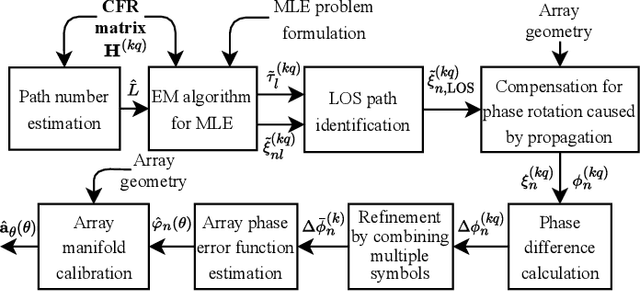
Owing to the ubiquity of cellular communication signals, positioning with the fifth generation (5G) signal has emerged as a promising solution in global navigation satellite system-denied areas. Unfortunately, although the widely employed antenna arrays in 5G remote radio units (RRUs) facilitate the measurement of the direction of arrival (DOA), DOA-based positioning performance is severely degraded by array errors. This paper proposes an in-situ calibration framework with a user terminal transmitting 5G reference signals at several known positions in the actual operating environment and the accessible RRUs estimating their array errors from these reference signals. Further, since sub-6GHz small-cell RRUs deployed for indoor coverage generally have small-aperture antenna arrays, while 5G signals have plentiful bandwidth resources, this work segregates the multipath components via super-resolution delay estimation based on the maximum likelihood criteria. This differs significantly from existing in-situ calibration works which resolve multipaths in the spatial domain. The superiority of the proposed method is first verified by numerical simulations. We then demonstrate via field test with commercial 5G equipment that, a reduction of 46.7% for 1-${\sigma}$ DOA estimation error can be achieved by in-situ calibration using the proposed method.
Link-level simulator for 5G localization
Dec 26, 2022Channel-state-information-based localization in 5G networks has been a promising way to obtain highly accurate positions compared to previous communication networks. However, there is no unified and effective platform to support the research on 5G localization algorithms. This paper releases a link-level simulator for 5G localization, which can depict realistic physical behaviors of the 5G positioning signal transmission. Specifically, we first develop a simulation architecture considering more elaborate parameter configuration and physical-layer processing. The architecture supports the link modeling at sub-6GHz and millimeter-wave (mmWave) frequency bands. Subsequently, the critical physical-layer components that determine the localization performance are designed and integrated. In particular, a lightweight new-radio channel model and hardware impairment functions that significantly limit the parameter estimation accuracy are developed. Finally, we present three application cases to evaluate the simulator, i.e. two-dimensional mobile terminal localization, mmWave beam sweeping, and beamforming-based angle estimation. The numerical results in the application cases present the performance diversity of localization algorithms in various impairment conditions.