 Add to Chrome
 Add to Firefox
 Add to Edge
NOVA: A Verification-Aware Agent Harness for Architecture Evolution in Industrial Recommender Systems
Jun 25, 2026
Industrial advertising recommender models are continuously improved through architecture evolution. Upgrades such as RankMixer, TokenMixer-Large, and MixFormer show that better structures remain a key source of quality and business gains. Yet developing such upgrades in production is expert-intensive and difficult to scale. Existing automation is insufficient: AutoML mainly tunes hyper-parameters, while effective gains often require cross-module changes under strict constraints; generic LLM coding agents optimize for runnable code, but runnable code does not imply a valid recommender architecture. Candidates may pass local tests while causing silent failures that degrade performance. We present NOVA, a level-aware agent harness for verification-aware architecture evolution. NOVA uses an architecture gradient, an SGD-inspired, non-differentiable update signal that aggregates prior modifications, verification diagnostics, metric feedback, and trajectory memory to guide the next modification. A verification cascade checks structure semantics, local executability, offline effectiveness, and online impact; invalid candidates are blocked early, with failure patterns recorded as forbidden directions. L1--L4 task-level control matches automation to task complexity and risk, routing high-risk tasks to Copilot for human oversight. Deployed in an industrial advertising system, NOVA achieves the highest effective pass rate on L2 ScaleUp and L3 Literature-to-Production tasks (54.5% and 60.0%), reduces silent failures compared with coding-agent baselines, and shortens one literature-to-production cycle by over 13x in human-attended time. In online A/B testing, the selected L3 candidate improves GMV on three pCVR objectives by +1.25%, +1.70%, and +2.02%, while reducing pCVR bias by 58.8%, 66.7%, and 37.3%.

Large Foundation Model for Ads Recommendation
Aug 20, 2025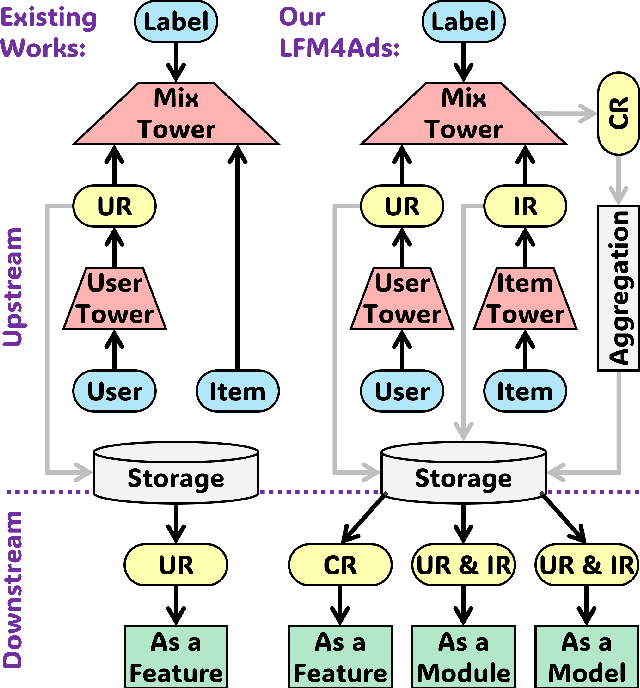
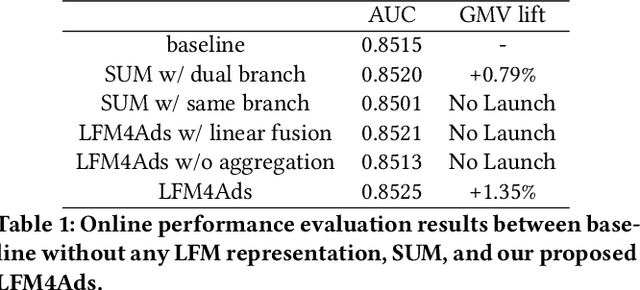
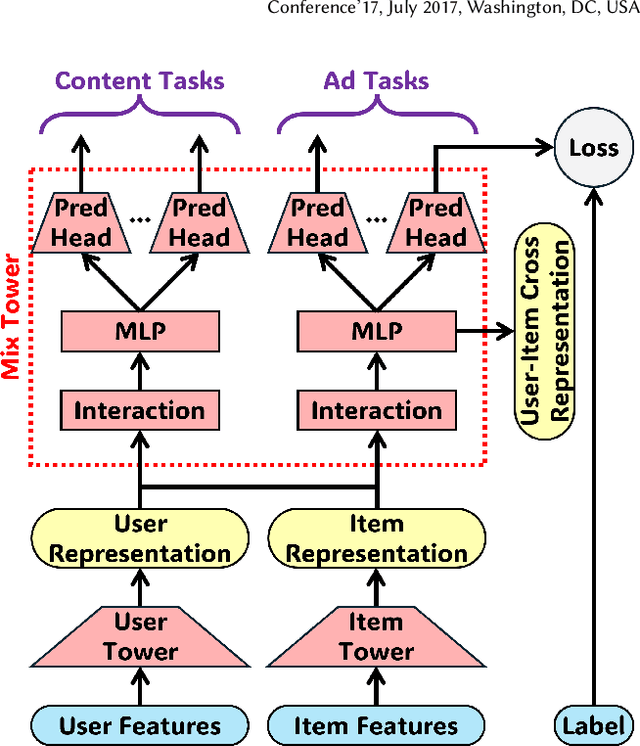
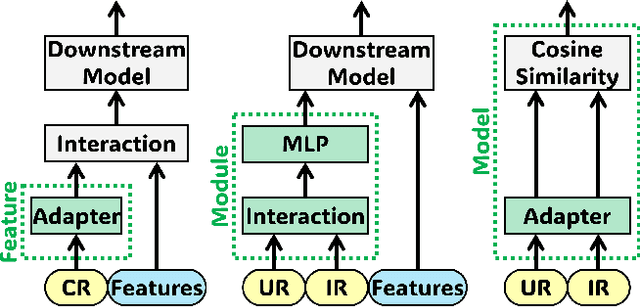
Online advertising relies on accurate recommendation models, with recent advances using pre-trained large-scale foundation models (LFMs) to capture users' general interests across multiple scenarios and tasks. However, existing methods have critical limitations: they extract and transfer only user representations (URs), ignoring valuable item representations (IRs) and user-item cross representations (CRs); and they simply use a UR as a feature in downstream applications, which fails to bridge upstream-downstream gaps and overlooks more transfer granularities. In this paper, we propose LFM4Ads, an All-Representation Multi-Granularity transfer framework for ads recommendation. It first comprehensively transfers URs, IRs, and CRs, i.e., all available representations in the pre-trained foundation model. To effectively utilize the CRs, it identifies the optimal extraction layer and aggregates them into transferable coarse-grained forms. Furthermore, we enhance the transferability via multi-granularity mechanisms: non-linear adapters for feature-level transfer, an Isomorphic Interaction Module for module-level transfer, and Standalone Retrieval for model-level transfer. LFM4Ads has been successfully deployed in Tencent's industrial-scale advertising platform, processing tens of billions of daily samples while maintaining terabyte-scale model parameters with billions of sparse embedding keys across approximately two thousand features. Since its production deployment in Q4 2024, LFM4Ads has achieved 10+ successful production launches across various advertising scenarios, including primary ones like Weixin Moments and Channels. These launches achieve an overall GMV lift of 2.45% across the entire platform, translating to estimated annual revenue increases in the hundreds of millions of dollars.
Federated Learning in Smart Cities: A Comprehensive Survey
Feb 02, 2021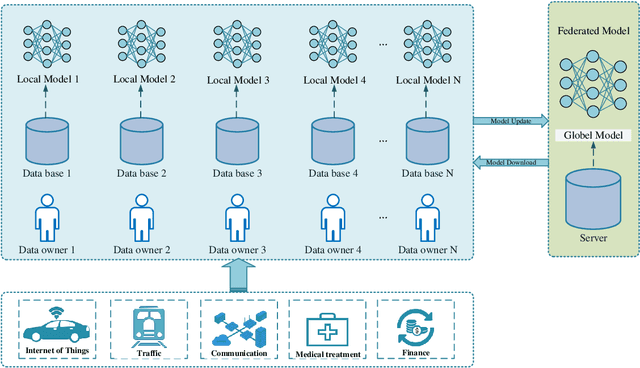
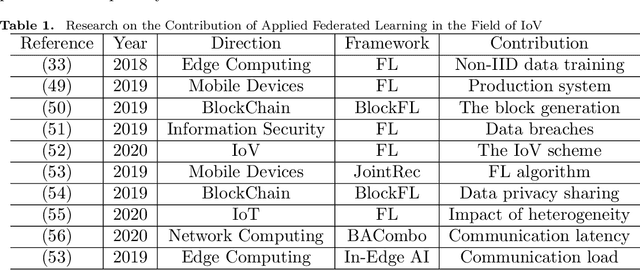
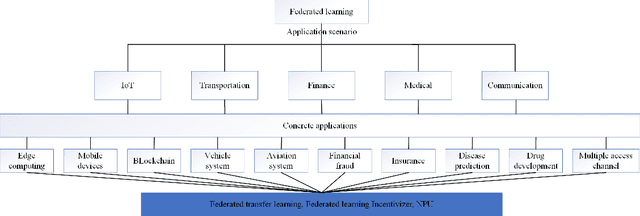
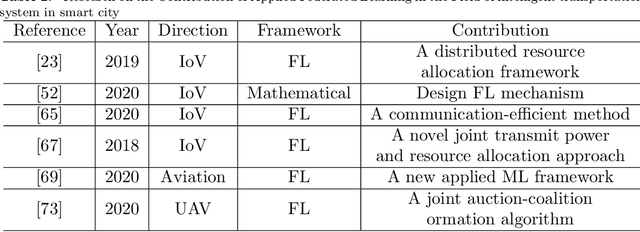
Federated learning plays an important role in the process of smart cities. With the development of big data and artificial intelligence, there is a problem of data privacy protection in this process. Federated learning is capable of solving this problem. This paper starts with the current developments of federated learning and its applications in various fields. We conduct a comprehensive investigation. This paper summarize the latest research on the application of federated learning in various fields of smart cities. In-depth understanding of the current development of federated learning from the Internet of Things, transportation, communications, finance, medical and other fields. Before that, we introduce the background, definition and key technologies of federated learning. Further more, we review the key technologies and the latest results. Finally, we discuss the future applications and research directions of federated learning in smart cities.
Design and Implementation of A Novel Precision Irrigation Robot Based on An Intelligent Path Planning Algorithm
Mar 02, 2020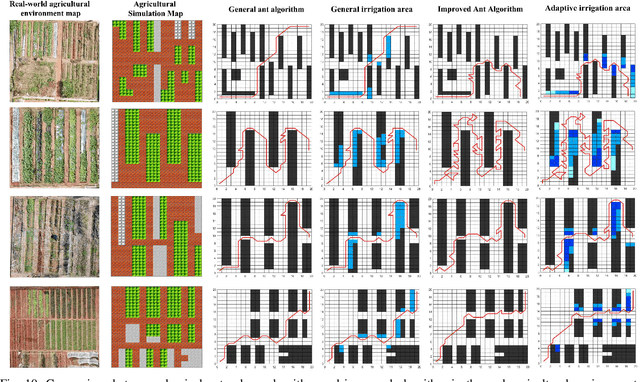
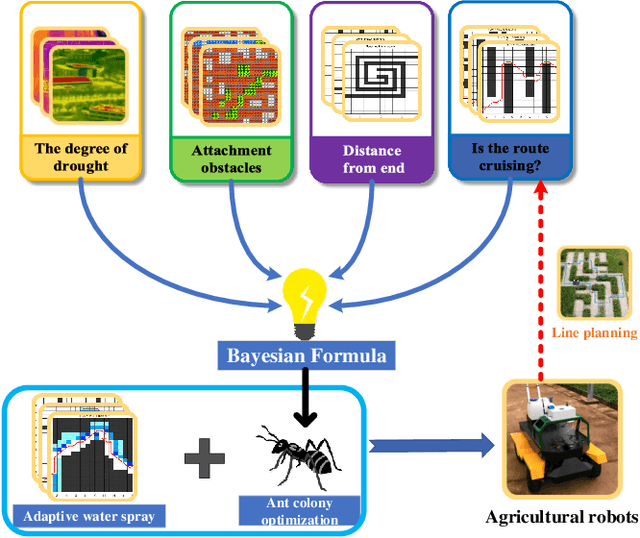
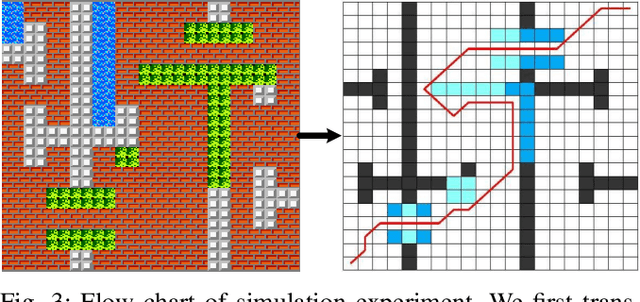
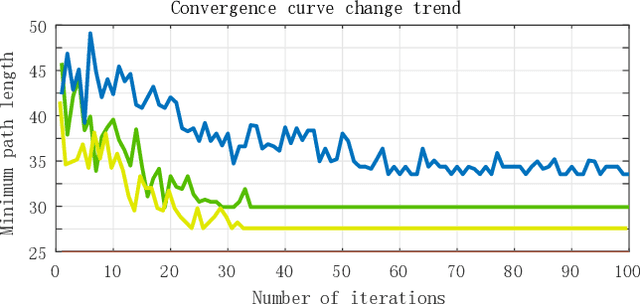
The agricultural irrigation system is closely related to agricultural production. There are some problems in nowadays agricultural irrigation system, such as poor mobility, imprecision and high price. To address these issues, an intelligent irrigation robot is designed and implemented in this work. The robot achieves precise irrigation by the irrigation path planning algorithm which is improved by Bayesian theory. In the proposed algorithm, we utilize as much information as possible to achieve full coverage irrigation in the complex agricultural environment. Besides, we propose the maximum risk to avoid the problem of lack of inspection in certain areas. Finally, We carried out simulation experiments and field experiments to verify the robot and the algorithm. The experimental results indicate that the robot is capable of fulfilling the requirements of various agricultural irrigation tasks.