 Add to Chrome
 Add to Firefox
 Add to Edge
Implicit Cross-Lingual Rewarding for Efficient Multilingual Preference Alignment
Mar 06, 2025
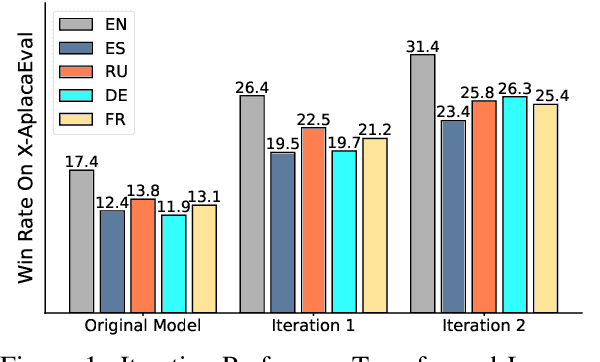
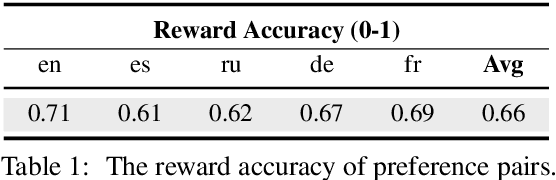
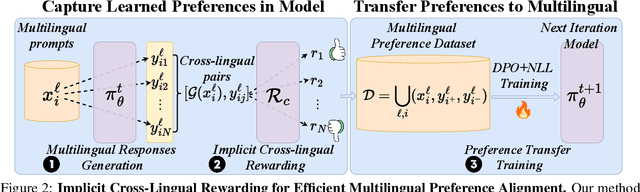
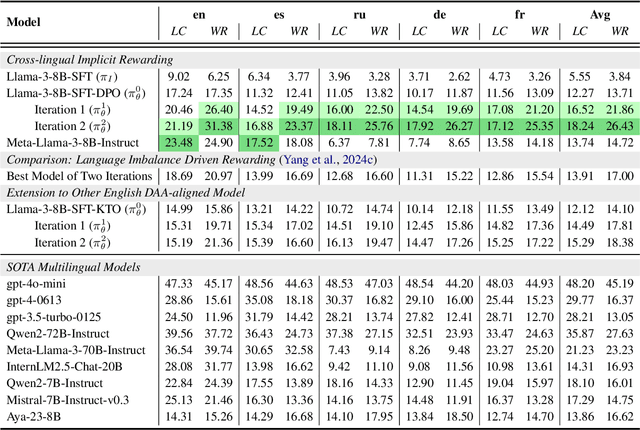
Direct Preference Optimization (DPO) has become a prominent method for aligning Large Language Models (LLMs) with human preferences. While DPO has enabled significant progress in aligning English LLMs, multilingual preference alignment is hampered by data scarcity. To address this, we propose a novel approach that $\textit{captures}$ learned preferences from well-aligned English models by implicit rewards and $\textit{transfers}$ them to other languages through iterative training. Specifically, we derive an implicit reward model from the logits of an English DPO-aligned model and its corresponding reference model. This reward model is then leveraged to annotate preference relations in cross-lingual instruction-following pairs, using English instructions to evaluate multilingual responses. The annotated data is subsequently used for multilingual DPO fine-tuning, facilitating preference knowledge transfer from English to other languages. Fine-tuning Llama3 for two iterations resulted in a 12.72% average improvement in Win Rate and a 5.97% increase in Length Control Win Rate across all training languages on the X-AlpacaEval leaderboard. Our findings demonstrate that leveraging existing English-aligned models can enable efficient and effective multilingual preference alignment, significantly reducing the need for extensive multilingual preference data. The code is available at https://github.com/ZNLP/Implicit-Cross-Lingual-Rewarding

AirRoom: Objects Matter in Room Reidentification
Mar 03, 2025Room reidentification (ReID) is a challenging yet essential task with numerous applications in fields such as augmented reality (AR) and homecare robotics. Existing visual place recognition (VPR) methods, which typically rely on global descriptors or aggregate local features, often struggle in cluttered indoor environments densely populated with man-made objects. These methods tend to overlook the crucial role of object-oriented information. To address this, we propose AirRoom, an object-aware pipeline that integrates multi-level object-oriented information-from global context to object patches, object segmentation, and keypoints-utilizing a coarse-to-fine retrieval approach. Extensive experiments on four newly constructed datasets-MPReID, HMReID, GibsonReID, and ReplicaReID-demonstrate that AirRoom outperforms state-of-the-art (SOTA) models across nearly all evaluation metrics, with improvements ranging from 6% to 80%. Moreover, AirRoom exhibits significant flexibility, allowing various modules within the pipeline to be substituted with different alternatives without compromising overall performance. It also shows robust and consistent performance under diverse viewpoint variations.
Training Large Recommendation Models via Graph-Language Token Alignment
Feb 26, 2025


Recommender systems (RS) have become essential tools for helping users efficiently navigate the overwhelming amount of information on e-commerce and social platforms. However, traditional RS relying on Collaborative Filtering (CF) struggles to integrate the rich semantic information from textual data. Meanwhile, large language models (LLMs) have shown promising results in natural language processing, but directly using LLMs for recommendation introduces challenges, such as ambiguity in generating item predictions and inefficiencies in scalability. In this paper, we propose a novel framework to train Large Recommendation models via Graph-Language Token Alignment. By aligning item and user nodes from the interaction graph with pretrained LLM tokens, GLTA effectively leverages the reasoning abilities of LLMs. Furthermore, we introduce Graph-Language Logits Matching (GLLM) to optimize token alignment for end-to-end item prediction, eliminating ambiguity in the free-form text as recommendation results. Extensive experiments on three benchmark datasets demonstrate the effectiveness of GLTA, with ablation studies validating each component.
Geometry-Aware 3D Salient Object Detection Network
Feb 23, 2025


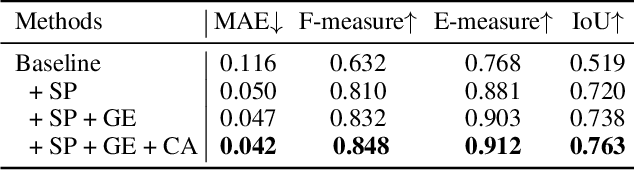
Point cloud salient object detection has attracted the attention of researchers in recent years. Since existing works do not fully utilize the geometry context of 3D objects, blurry boundaries are generated when segmenting objects with complex backgrounds. In this paper, we propose a geometry-aware 3D salient object detection network that explicitly clusters points into superpoints to enhance the geometric boundaries of objects, thereby segmenting complete objects with clear boundaries. Specifically, we first propose a simple yet effective superpoint partition module to cluster points into superpoints. In order to improve the quality of superpoints, we present a point cloud class-agnostic loss to learn discriminative point features for clustering superpoints from the object. After obtaining superpoints, we then propose a geometry enhancement module that utilizes superpoint-point attention to aggregate geometric information into point features for predicting the salient map of the object with clear boundaries. Extensive experiments show that our method achieves new state-of-the-art performance on the PCSOD dataset.
Physical Depth-aware Early Accident Anticipation: A Multi-dimensional Visual Feature Fusion Framework
Feb 19, 2025Early accident anticipation from dashcam videos is a highly desirable yet challenging task for improving the safety of intelligent vehicles. Existing advanced accident anticipation approaches commonly model the interaction among traffic agents (e.g., vehicles, pedestrians, etc.) in the coarse 2D image space, which may not adequately capture their true positions and interactions. To address this limitation, we propose a physical depth-aware learning framework that incorporates the monocular depth features generated by a large model named Depth-Anything to introduce more fine-grained spatial 3D information. Furthermore, the proposed framework also integrates visual interaction features and visual dynamic features from traffic scenes to provide a more comprehensive perception towards the scenes. Based on these multi-dimensional visual features, the framework captures early indicators of accidents through the analysis of interaction relationships between objects in sequential frames. Additionally, the proposed framework introduces a reconstruction adjacency matrix for key traffic participants that are occluded, mitigating the impact of occluded objects on graph learning and maintaining the spatio-temporal continuity. Experimental results on public datasets show that the proposed framework attains state-of-the-art performance, highlighting the effectiveness of incorporating visual depth features and the superiority of the proposed framework.
Benchmarking LLMs for Political Science: A United Nations Perspective
Feb 19, 2025Large Language Models (LLMs) have achieved significant advances in natural language processing, yet their potential for high-stake political decision-making remains largely unexplored. This paper addresses the gap by focusing on the application of LLMs to the United Nations (UN) decision-making process, where the stakes are particularly high and political decisions can have far-reaching consequences. We introduce a novel dataset comprising publicly available UN Security Council (UNSC) records from 1994 to 2024, including draft resolutions, voting records, and diplomatic speeches. Using this dataset, we propose the United Nations Benchmark (UNBench), the first comprehensive benchmark designed to evaluate LLMs across four interconnected political science tasks: co-penholder judgment, representative voting simulation, draft adoption prediction, and representative statement generation. These tasks span the three stages of the UN decision-making process--drafting, voting, and discussing--and aim to assess LLMs' ability to understand and simulate political dynamics. Our experimental analysis demonstrates the potential and challenges of applying LLMs in this domain, providing insights into their strengths and limitations in political science. This work contributes to the growing intersection of AI and political science, opening new avenues for research and practical applications in global governance. The UNBench Repository can be accessed at: https://github.com/yueqingliang1/UNBench.
ChineseSimpleVQA -- "See the World, Discover Knowledge": A Chinese Factuality Evaluation for Large Vision Language Models
Feb 19, 2025The evaluation of factual accuracy in large vision language models (LVLMs) has lagged behind their rapid development, making it challenging to fully reflect these models' knowledge capacity and reliability. In this paper, we introduce the first factuality-based visual question-answering benchmark in Chinese, named ChineseSimpleVQA, aimed at assessing the visual factuality of LVLMs across 8 major topics and 56 subtopics. The key features of this benchmark include a focus on the Chinese language, diverse knowledge types, a multi-hop question construction, high-quality data, static consistency, and easy-to-evaluate through short answers. Moreover, we contribute a rigorous data construction pipeline and decouple the visual factuality into two parts: seeing the world (i.e., object recognition) and discovering knowledge. This decoupling allows us to analyze the capability boundaries and execution mechanisms of LVLMs. Subsequently, we evaluate 34 advanced open-source and closed-source models, revealing critical performance gaps within this field.
Latent Swap Joint Diffusion for Long-Form Audio Generation
Feb 07, 2025


Previous work on long-form audio generation using global-view diffusion or iterative generation demands significant training or inference costs. While recent advancements in multi-view joint diffusion for panoramic generation provide an efficient option, they struggle with spectrum generation with severe overlap distortions and high cross-view consistency costs. We initially explore this phenomenon through the connectivity inheritance of latent maps and uncover that averaging operations excessively smooth the high-frequency components of the latent map. To address these issues, we propose Swap Forward (SaFa), a frame-level latent swap framework that synchronizes multiple diffusions to produce a globally coherent long audio with more spectrum details in a forward-only manner. At its core, the bidirectional Self-Loop Latent Swap is applied between adjacent views, leveraging stepwise diffusion trajectory to adaptively enhance high-frequency components without disrupting low-frequency components. Furthermore, to ensure cross-view consistency, the unidirectional Reference-Guided Latent Swap is applied between the reference and the non-overlap regions of each subview during the early stages, providing centralized trajectory guidance. Quantitative and qualitative experiments demonstrate that SaFa significantly outperforms existing joint diffusion methods and even training-based long audio generation models. Moreover, we find that it also adapts well to panoramic generation, achieving comparable state-of-the-art performance with greater efficiency and model generalizability. Project page is available at https://swapforward.github.io/.
Nearly Tight Bounds for Exploration in Streaming Multi-armed Bandits with Known Optimality Gap
Feb 03, 2025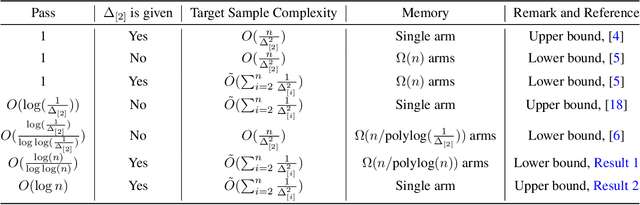
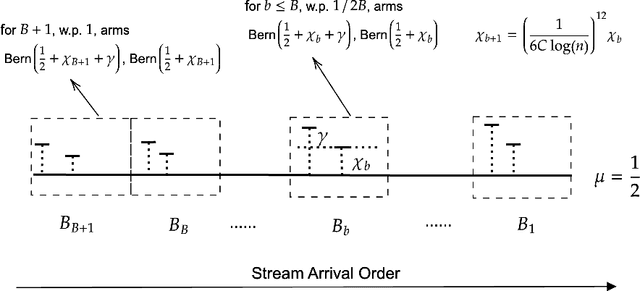
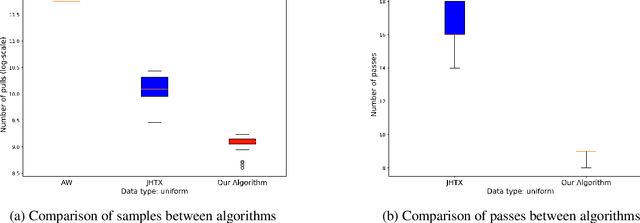
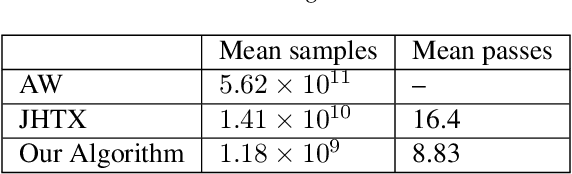
We investigate the sample-memory-pass trade-offs for pure exploration in multi-pass streaming multi-armed bandits (MABs) with the *a priori* knowledge of the optimality gap $\Delta_{[2]}$. Here, and throughout, the optimality gap $\Delta_{[i]}$ is defined as the mean reward gap between the best and the $i$-th best arms. A recent line of results by Jin, Huang, Tang, and Xiao [ICML'21] and Assadi and Wang [COLT'24] have shown that if there is no known $\Delta_{[2]}$, a pass complexity of $\Theta(\log(1/\Delta_{[2]}))$ (up to $\log\log(1/\Delta_{[2]})$ terms) is necessary and sufficient to obtain the *worst-case optimal* sample complexity of $O(n/\Delta^{2}_{[2]})$ with a single-arm memory. However, our understanding of multi-pass algorithms with known $\Delta_{[2]}$ is still limited. Here, the key open problem is how many passes are required to achieve the complexity, i.e., $O( \sum_{i=2}^{n}1/\Delta^2_{[i]})$ arm pulls, with a sublinear memory size. In this work, we show that the ``right answer'' for the question is $\Theta(\log{n})$ passes (up to $\log\log{n}$ terms). We first present a lower bound, showing that any algorithm that finds the best arm with slightly sublinear memory -- a memory of $o({n}/{\text{polylog}({n})})$ arms -- and $O(\sum_{i=2}^{n}{1}/{\Delta^{2}_{[i]}}\cdot \log{(n)})$ arm pulls has to make $\Omega(\frac{\log{n}}{\log\log{n}})$ passes over the stream. We then show a nearly-matching algorithm that assuming the knowledge of $\Delta_{[2]}$, finds the best arm with $O( \sum_{i=2}^{n}1/\Delta^2_{[i]} \cdot \log{n})$ arm pulls and a *single arm* memory.
VL-Nav: Real-time Vision-Language Navigation with Spatial Reasoning
Feb 02, 2025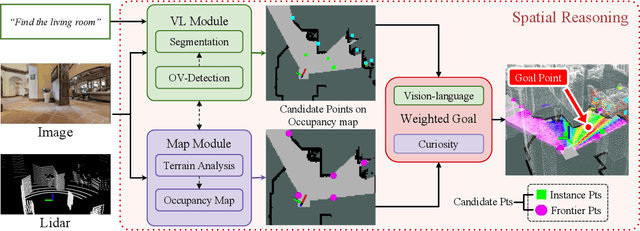
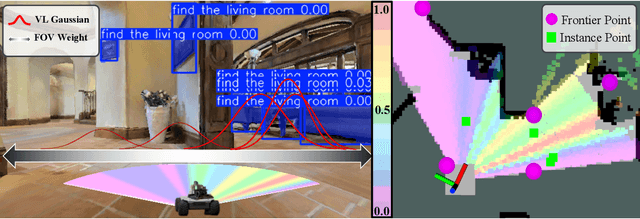
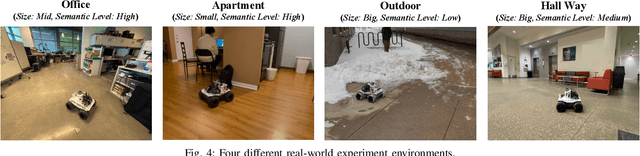
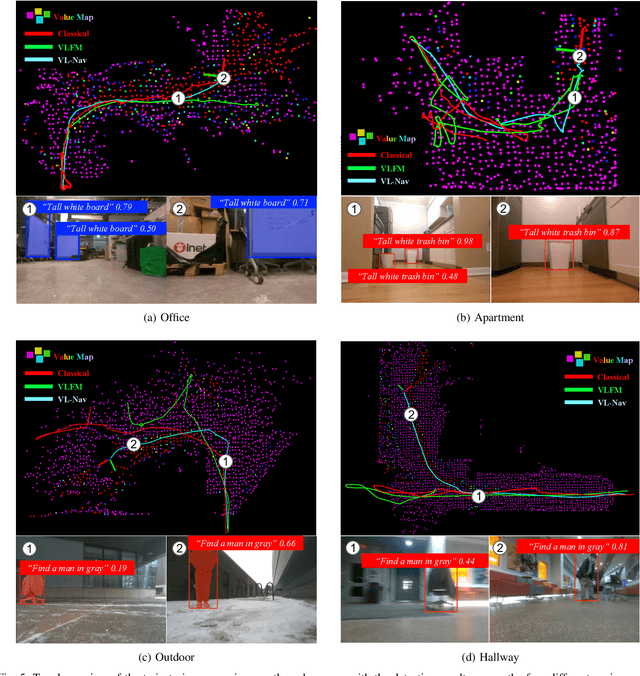
Vision-language navigation in unknown environments is crucial for mobile robots. In scenarios such as household assistance and rescue, mobile robots need to understand a human command, such as "find a person wearing black". We present a novel vision-language navigation (VL-Nav) system that integrates efficient spatial reasoning on low-power robots. Unlike prior methods that rely on a single image-level feature similarity to guide a robot, we introduce the heuristic-vision-language (HVL) spatial reasoning for goal point selection. It combines pixel-wise vision-language features and heuristic exploration to enable efficient navigation to human-instructed instances in various environments robustly. We deploy VL-Nav on a four-wheel mobile robot and conduct comprehensive navigation tasks in various environments of different scales and semantic complexities, indoors and outdoors. Remarkably, VL-Nav operates at a real-time frequency of 30 Hz with a Jetson Orin NX, highlighting its ability to conduct efficient vision-language navigation. Experimental results show that VL-Nav achieves an overall success rate of 86.3%, outperforming previous methods by 44.15%.