 Add to Chrome
 Add to Firefox
 Add to Edge
Ling and Ring 2.6 Technical Report: Efficient and Instant Agentic Intelligence at Trillion-Parameter Scale
Jun 13, 2026
Efficient and scalable agentic intelligence requires models that can deliver both low-latency responses and strong reasoning capabilities while remaining practical to train, serve, and deploy. In this report, we present Ling-2.6 and Ring-2.6, a family of models designed to address this challenge at scale. Ling-2.6 is optimized for instant response generation and high capability per output token, whereas Ring-2.6 is tailored for deeper reasoning and more advanced agentic workflows. Instead of training from scratch, we upgrade the Ling-2.0 base model through architectural migration pre-training and large-scale post-training. This upgrade is guided by a unified co-design of model architecture, optimization objectives, serving systems, and agent training environments, enabling improvements in both model capability and deployment efficiency. At the architectural level, we introduce a hybrid linear attention design that integrates Lightning Attention with MLA, improving the efficiency of long-context training and decoding. To further enhance token efficiency, we optimize capability per output token through Evolutionary Chain-of-Thought, Linguistic Unit Policy Optimization, bidirectional preference alignment, and shortest-correct-response distillation. For agentic capabilities, we propose KPop, a reinforcement learning framework designed to support stable training of Ring-2.6-1T on large-scale environment-grounded data. KPop improves training efficiency through asynchronous scheduling across coding, search, tool use, and workflow execution, enabling scalable learning from complex agent-environment interactions. Together, Ling-2.6 and Ring-2.6 provide a practical pathway toward efficient, scalable, and open agentic systems. We open-source all checkpoints in the 2.6 family to support further research and development in practical agentic intelligence.

SuperValid: Capability-Aligned OOD Validation for Generalizable Downstream Scaling
May 27, 2026Scaling laws guide large language model training by relating compute to cross-entropy loss, and recent work further extends them to predict downstream benchmark performance. However, prior approaches face generalization limitations from two aspects: focusing on benchmark-level performance introduces scenario-specific artifacts, while relying on IID validation loss fails to track capability improvements when training distributions vary. In this work, we argue that downstream scaling should be studied at the capability level, which captures shared skill factors across related tasks while abstracting away benchmark-specific noise. We propose SuperValid, a framework that synthesizes OOD (out-of-distribution), capability-aligned validation data by distilling core concepts from benchmarks within a capability domain and expanding them into diverse, knowledge-rich texts. Extensive experiments spanning 17 benchmarks grouped into 6 capability domains show that SuperValid loss exhibits strong and stable correlation with downstream performance across models of different architectures, scales, and training data distributions. As a training-free metric computable during training without benchmark evaluation, SuperValid enables effective model selection, early stopping, and scaling decisions.
PowLU: An Activation Function for Stable Pre-Training of LLMs
May 25, 2026In contemporary large language models (LLMs), the swish-gated linear unit (SwiGLU) activation function is widely adopted to regulate the information flow and introduce non-linearity. For large positive inputs, SwiGLU approximates the quadratic function $x^2$, providing strong nonlinearity and expressive capacity. However, this property also causes numerical instability as the input or model scale increases, particularly in low-precision LLM training. The main reason is its approximate quadratic amplification, which enlarges the output range and exacerbates outliers. To address this issue, we propose a stable activation function, Power Linear Unit (PowLU), for large-scale LLM pre-training. Specifically, PowLU employs a rational power function to achieve adaptive nonlinearity, thereby improving representation ability and enabling stable training in spike regions. Moreover, we provide theoretical justification for several key properties of PowLU. Scaling law experiments confirm that the performance is consistent across model sizes, and further experimental results with the Ling architecture (7.9B and 124B total parameters) demonstrate that PowLU achieves competitive results against SwiGLU and SwiGLU-Clip in large-scale training of LLMs. In addition, the experimental results also show that PowLU effectively improves the scalability of the large-scale training of LLMs.
From Failure to Mastery: Generating Hard Samples for Tool-use Agents
Jan 04, 2026The advancement of LLM agents with tool-use capabilities requires diverse and complex training corpora. Existing data generation methods, which predominantly follow a paradigm of random sampling and shallow generation, often yield simple and homogeneous trajectories that fail to capture complex, implicit logical dependencies. To bridge this gap, we introduce HardGen, an automatic agentic pipeline designed to generate hard tool-use training samples with verifiable reasoning. Firstly, HardGen establishes a dynamic API Graph built upon agent failure cases, from which it samples to synthesize hard traces. Secondly, these traces serve as conditional priors to guide the instantiation of modular, abstract advanced tools, which are subsequently leveraged to formulate hard queries. Finally, the advanced tools and hard queries enable the generation of verifiable complex Chain-of-Thought (CoT), with a closed-loop evaluation feedback steering the continuous refinement of the process. Extensive evaluations demonstrate that a 4B parameter model trained with our curated dataset achieves superior performance compared to several leading open-source and closed-source competitors (e.g., GPT-5.2, Gemini-3-Pro and Claude-Opus-4.5). Our code, models, and dataset will be open-sourced to facilitate future research.
Exploring Superior Function Calls via Reinforcement Learning
Aug 07, 2025Function calling capabilities are crucial for deploying Large Language Models in real-world applications, yet current training approaches fail to develop robust reasoning strategies. Supervised fine-tuning produces models that rely on superficial pattern matching, while standard reinforcement learning methods struggle with the complex action space of structured function calls. We present a novel reinforcement learning framework designed to enhance group relative policy optimization through strategic entropy based exploration specifically tailored for function calling tasks. Our approach addresses three critical challenges in function calling: insufficient exploration during policy learning, lack of structured reasoning in chain-of-thought generation, and inadequate verification of parameter extraction. Our two-stage data preparation pipeline ensures high-quality training samples through iterative LLM evaluation and abstract syntax tree validation. Extensive experiments on the Berkeley Function Calling Leaderboard demonstrate that this framework achieves state-of-the-art performance among open-source models with 86.02\% overall accuracy, outperforming standard GRPO by up to 6\% on complex multi-function scenarios. Notably, our method shows particularly strong improvements on code-pretrained models, suggesting that structured language generation capabilities provide an advantageous starting point for reinforcement learning in function calling tasks. We will release all the code, models and dataset to benefit the community.
FunReason: Enhancing Large Language Models' Function Calling via Self-Refinement Multiscale Loss and Automated Data Refinement
May 26, 2025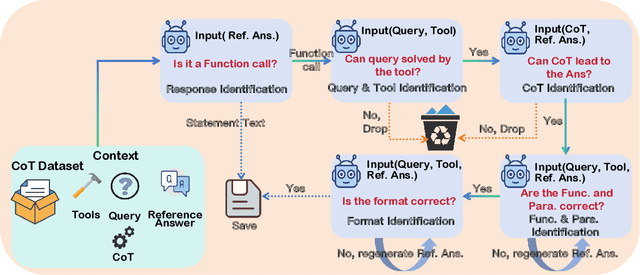
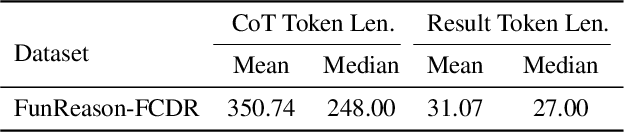
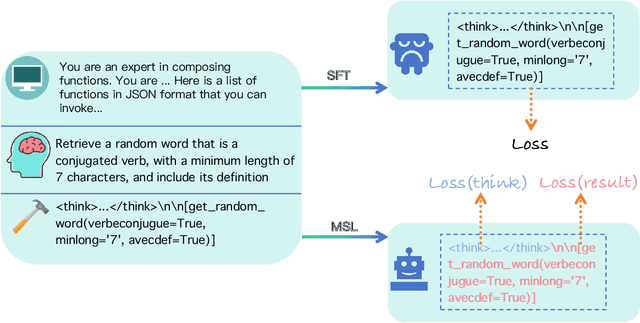

The integration of large language models (LLMs) with function calling has emerged as a crucial capability for enhancing their practical utility in real-world applications. However, effectively combining reasoning processes with accurate function execution remains a significant challenge. Traditional training approaches often struggle to balance the detailed reasoning steps with the precision of function calls, leading to suboptimal performance. To address these limitations, we introduce FunReason, a novel framework that enhances LLMs' function calling capabilities through an automated data refinement strategy and a Self-Refinement Multiscale Loss (SRML) approach. FunReason leverages LLMs' natural reasoning abilities to generate high-quality training examples, focusing on query parseability, reasoning coherence, and function call precision. The SRML approach dynamically balances the contribution of reasoning processes and function call accuracy during training, addressing the inherent trade-off between these two critical aspects. FunReason achieves performance comparable to GPT-4o while effectively mitigating catastrophic forgetting during fine-tuning. FunReason provides a comprehensive solution for enhancing LLMs' function calling capabilities by introducing a balanced training methodology and a data refinement pipeline. For code and dataset, please refer to our repository at GitHub https://github.com/BingguangHao/FunReason