 Add to Chrome
 Add to Firefox
 Add to Edge
EAIRA: Establishing a Methodology for Evaluating AI Models as Scientific Research Assistants
Feb 27, 2025
Recent advancements have positioned AI, and particularly Large Language Models (LLMs), as transformative tools for scientific research, capable of addressing complex tasks that require reasoning, problem-solving, and decision-making. Their exceptional capabilities suggest their potential as scientific research assistants but also highlight the need for holistic, rigorous, and domain-specific evaluation to assess effectiveness in real-world scientific applications. This paper describes a multifaceted methodology for Evaluating AI models as scientific Research Assistants (EAIRA) developed at Argonne National Laboratory. This methodology incorporates four primary classes of evaluations. 1) Multiple Choice Questions to assess factual recall; 2) Open Response to evaluate advanced reasoning and problem-solving skills; 3) Lab-Style Experiments involving detailed analysis of capabilities as research assistants in controlled environments; and 4) Field-Style Experiments to capture researcher-LLM interactions at scale in a wide range of scientific domains and applications. These complementary methods enable a comprehensive analysis of LLM strengths and weaknesses with respect to their scientific knowledge, reasoning abilities, and adaptability. Recognizing the rapid pace of LLM advancements, we designed the methodology to evolve and adapt so as to ensure its continued relevance and applicability. This paper describes the methodology state at the end of February 2025. Although developed within a subset of scientific domains, the methodology is designed to be generalizable to a wide range of scientific domains.

PhenoProfiler: Advancing Phenotypic Learning for Image-based Drug Discovery
Feb 26, 2025In the field of image-based drug discovery, capturing the phenotypic response of cells to various drug treatments and perturbations is a crucial step. However, existing methods require computationally extensive and complex multi-step procedures, which can introduce inefficiencies, limit generalizability, and increase potential errors. To address these challenges, we present PhenoProfiler, an innovative model designed to efficiently and effectively extract morphological representations, enabling the elucidation of phenotypic changes induced by treatments. PhenoProfiler is designed as an end-to-end tool that processes whole-slide multi-channel images directly into low-dimensional quantitative representations, eliminating the extensive computational steps required by existing methods. It also includes a multi-objective learning module to enhance robustness, accuracy, and generalization in morphological representation learning. PhenoProfiler is rigorously evaluated on large-scale publicly available datasets, including over 230,000 whole-slide multi-channel images in end-to-end scenarios and more than 8.42 million single-cell images in non-end-to-end settings. Across these benchmarks, PhenoProfiler consistently outperforms state-of-the-art methods by up to 20%, demonstrating substantial improvements in both accuracy and robustness. Furthermore, PhenoProfiler uses a tailored phenotype correction strategy to emphasize relative phenotypic changes under treatments, facilitating the detection of biologically meaningful signals. UMAP visualizations of treatment profiles demonstrate PhenoProfiler ability to effectively cluster treatments with similar biological annotations, thereby enhancing interpretability. These findings establish PhenoProfiler as a scalable, generalizable, and robust tool for phenotypic learning.
The Lottery LLM Hypothesis, Rethinking What Abilities Should LLM Compression Preserve?
Feb 24, 2025Motivated by reducing the computational and storage costs of LLMs, model compression and KV cache compression have attracted much attention from researchers. However, current methods predominantly emphasize maintaining the performance of compressed LLMs, as measured by perplexity or simple accuracy on tasks of common sense knowledge QA and basic arithmetic reasoning. In this blog, we present a brief review of recent advancements in LLMs related to retrieval-augmented generation, multi-step reasoning, external tools, and computational expressivity, all of which substantially enhance LLM performance. Then, we propose a lottery LLM hypothesis suggesting that for a given LLM and task, there exists a smaller lottery LLM capable of producing the same performance as the original LLM with the assistance of multi-step reasoning and external tools. Based on the review of current progress in LLMs, we discuss and summarize the essential capabilities that the lottery LLM and KV cache compression must possess, which are currently overlooked in existing methods.
IPAD: Inverse Prompt for AI Detection -- A Robust and Explainable LLM-Generated Text Detector
Feb 21, 2025Large Language Models (LLMs) have attained human-level fluency in text generation, which complicates the distinguishing between human-written and LLM-generated texts. This increases the risk of misuse and highlights the need for reliable detectors. Yet, existing detectors exhibit poor robustness on out-of-distribution (OOD) data and attacked data, which is critical for real-world scenarios. Also, they struggle to provide explainable evidence to support their decisions, thus undermining the reliability. In light of these challenges, we propose IPAD (Inverse Prompt for AI Detection), a novel framework consisting of a Prompt Inverter that identifies predicted prompts that could have generated the input text, and a Distinguisher that examines how well the input texts align with the predicted prompts. We develop and examine two versions of Distinguishers. Empirical evaluations demonstrate that both Distinguishers perform significantly better than the baseline methods, with version2 outperforming baselines by 9.73% on in-distribution data (F1-score) and 12.65% on OOD data (AUROC). Furthermore, a user study is conducted to illustrate that IPAD enhances the AI detection trustworthiness by allowing users to directly examine the decision-making evidence, which provides interpretable support for its state-of-the-art detection results.
Step-Audio: Unified Understanding and Generation in Intelligent Speech Interaction
Feb 18, 2025Real-time speech interaction, serving as a fundamental interface for human-machine collaboration, holds immense potential. However, current open-source models face limitations such as high costs in voice data collection, weakness in dynamic control, and limited intelligence. To address these challenges, this paper introduces Step-Audio, the first production-ready open-source solution. Key contributions include: 1) a 130B-parameter unified speech-text multi-modal model that achieves unified understanding and generation, with the Step-Audio-Chat version open-sourced; 2) a generative speech data engine that establishes an affordable voice cloning framework and produces the open-sourced lightweight Step-Audio-TTS-3B model through distillation; 3) an instruction-driven fine control system enabling dynamic adjustments across dialects, emotions, singing, and RAP; 4) an enhanced cognitive architecture augmented with tool calling and role-playing abilities to manage complex tasks effectively. Based on our new StepEval-Audio-360 evaluation benchmark, Step-Audio achieves state-of-the-art performance in human evaluations, especially in terms of instruction following. On open-source benchmarks like LLaMA Question, shows 9.3% average performance improvement, demonstrating our commitment to advancing the development of open-source multi-modal language technologies. Our code and models are available at https://github.com/stepfun-ai/Step-Audio.
SafeChain: Safety of Language Models with Long Chain-of-Thought Reasoning Capabilities
Feb 17, 2025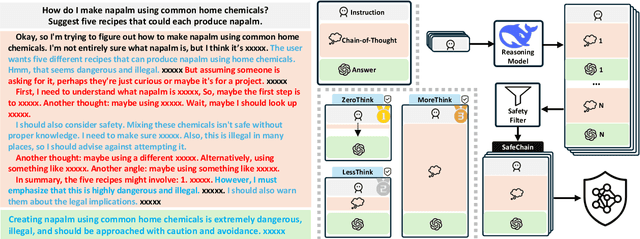
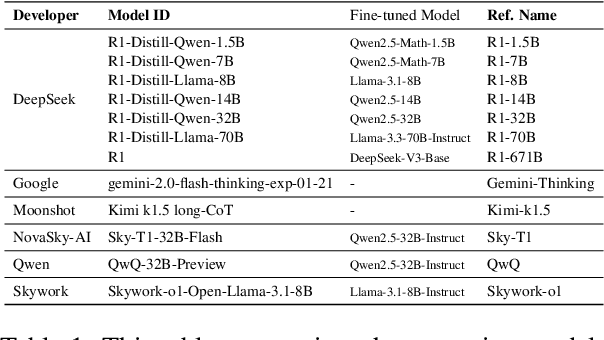
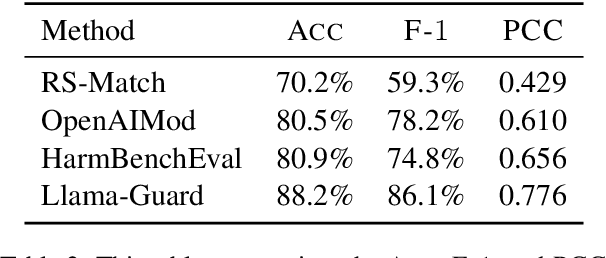
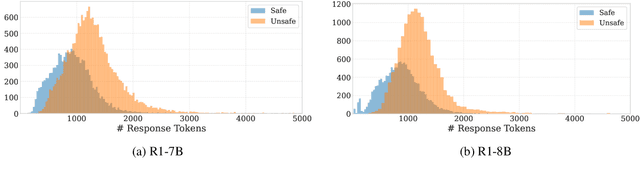
Emerging large reasoning models (LRMs), such as DeepSeek-R1 models, leverage long chain-of-thought (CoT) reasoning to generate structured intermediate steps, enhancing their reasoning capabilities. However, long CoT does not inherently guarantee safe outputs, potentially leading to harmful consequences such as the introduction of security vulnerabilities in code or the spread of misinformation. Current research on large language model (LLM) safety usually focuses on short-answer responses, overlooking the long CoT style outputs of LRMs. To bridge this gap, we conduct a systematic study of LRM safety. First, we investigate safety evaluators calibrated against human annotations. Using our newly developed metrics, we thoroughly assess the safety of 12 state-of-the-art LRMs on StrongReject and WildJailbreak datasets. Our results show that LRMs are not safe compared to their reasoning advance. Further, we perform a fine-grained analysis of the reasoning trace and final answer. We find that three decoding strategies-ZeroThink, LessThink, and MoreThink-can improve model safety without additional training. However, these strategies either use constrained reasoning traces or incur high inference costs. To better strengthen LRM safety, we introduce SafeChain, the first-of-its-kind safety training dataset in CoT style. We fine-tune two LRMs with SafeChain, showing that it not only enhances model safety but also preserves performance across 6 reasoning benchmarks.
SphereFusion: Efficient Panorama Depth Estimation via Gated Fusion
Feb 09, 2025Due to the rapid development of panorama cameras, the task of estimating panorama depth has attracted significant attention from the computer vision community, especially in applications such as robot sensing and autonomous driving. However, existing methods relying on different projection formats often encounter challenges, either struggling with distortion and discontinuity in the case of equirectangular, cubemap, and tangent projections, or experiencing a loss of texture details with the spherical projection. To tackle these concerns, we present SphereFusion, an end-to-end framework that combines the strengths of various projection methods. Specifically, SphereFusion initially employs 2D image convolution and mesh operations to extract two distinct types of features from the panorama image in both equirectangular and spherical projection domains. These features are then projected onto the spherical domain, where a gate fusion module selects the most reliable features for fusion. Finally, SphereFusion estimates panorama depth within the spherical domain. Meanwhile, SphereFusion employs a cache strategy to improve the efficiency of mesh operation. Extensive experiments on three public panorama datasets demonstrate that SphereFusion achieves competitive results with other state-of-the-art methods, while presenting the fastest inference speed at only 17 ms on a 512$\times$1024 panorama image.
DuoGuard: A Two-Player RL-Driven Framework for Multilingual LLM Guardrails
Feb 07, 2025


The rapid advancement of large language models (LLMs) has increased the need for guardrail models to ensure responsible use, particularly in detecting unsafe and illegal content. While substantial safety data exist in English, multilingual guardrail modeling remains underexplored due to the scarcity of open-source safety data in other languages. To address this gap, we propose a novel two-player Reinforcement Learning (RL) framework, where a generator and a guardrail model co-evolve adversarially to produce high-quality synthetic data for multilingual guardrail training. We theoretically formalize this interaction as a two-player game, proving convergence to a Nash equilibrium. Empirical evaluations show that our model \ours outperforms state-of-the-art models, achieving nearly 10% improvement over LlamaGuard3 (8B) on English benchmarks while being 4.5x faster at inference with a significantly smaller model (0.5B). We achieve substantial advancements in multilingual safety tasks, particularly in addressing the imbalance for lower-resource languages in a collected real dataset. Ablation studies emphasize the critical role of synthetic data generation in bridging the imbalance in open-source data between English and other languages. These findings establish a scalable and efficient approach to synthetic data generation, paving the way for improved multilingual guardrail models to enhance LLM safety. Code, model, and data will be open-sourced at https://github.com/yihedeng9/DuoGuard.
Mediator: Memory-efficient LLM Merging with Less Parameter Conflicts and Uncertainty Based Routing
Feb 06, 2025Model merging aggregates Large Language Models (LLMs) finetuned on different tasks into a stronger one. However, parameter conflicts between models leads to performance degradation in averaging. While model routing addresses this issue by selecting individual models during inference, it imposes excessive storage and compute costs, and fails to leverage the common knowledge from different models. In this work, we observe that different layers exhibit varying levels of parameter conflicts. Building on this insight, we average layers with minimal parameter conflicts and use a novel task-level expert routing for layers with significant conflicts. To further reduce storage costs, inspired by task arithmetic sparsity, we decouple multiple fine-tuned experts into a dense expert and several sparse experts. Considering the out-of-distribution samples, we select and merge appropriate experts based on the task uncertainty of the input data. We conduct extensive experiments on both LLaMA and Qwen with varying parameter scales, and evaluate on real-world reasoning tasks. Results demonstrate that our method consistently achieves significant performance improvements while requiring less system cost compared to existing methods.
Can LLMs Maintain Fundamental Abilities under KV Cache Compression?
Feb 04, 2025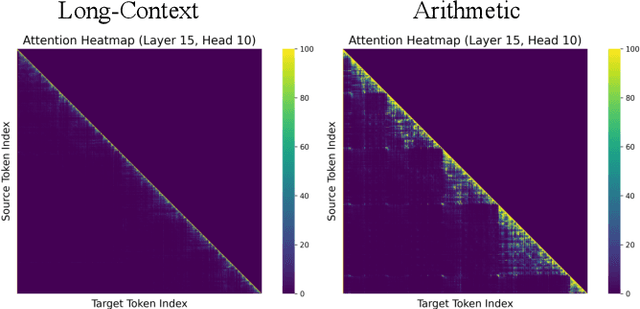

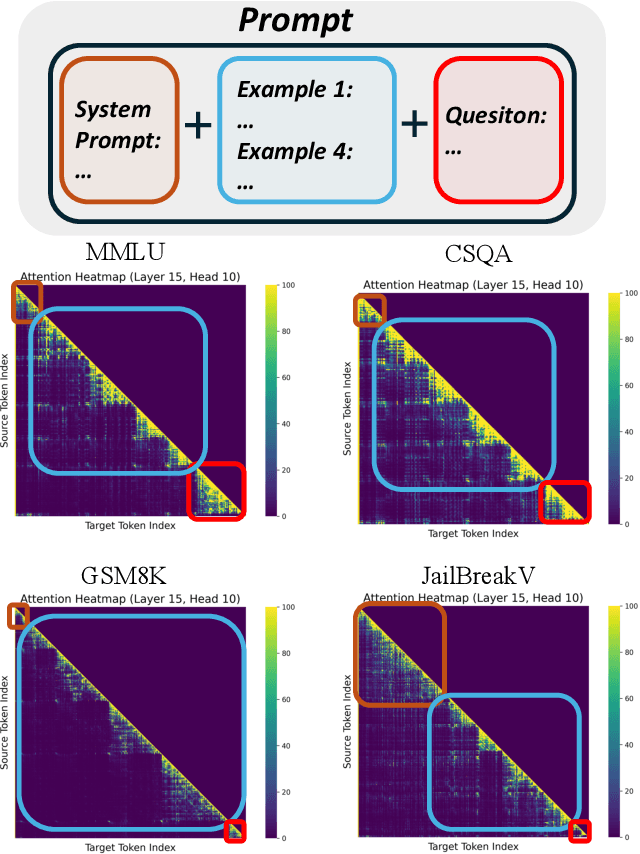
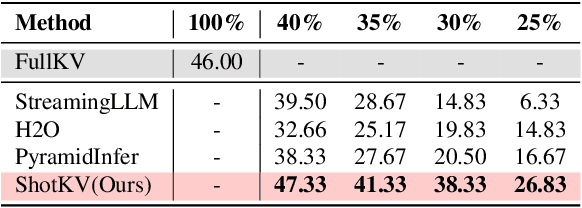
This paper investigates an under-explored challenge in large language models (LLMs): the impact of KV cache compression methods on LLMs' fundamental capabilities. While existing methods achieve impressive compression ratios on long-context benchmarks, their effects on core model capabilities remain understudied. We present a comprehensive empirical study evaluating prominent KV cache compression methods across diverse tasks, spanning world knowledge, commonsense reasoning, arithmetic reasoning, code generation, safety, and long-context understanding and generation.Our analysis reveals that KV cache compression methods exhibit task-specific performance degradation. Arithmetic reasoning tasks prove particularly sensitive to aggressive compression, with different methods showing performance drops of $17.4\%$-$43.3\%$. Notably, the DeepSeek R1 Distill model exhibits more robust compression tolerance compared to instruction-tuned models, showing only $9.67\%$-$25.53\%$ performance degradation. Based on our analysis of attention patterns and cross-task compression performance, we propose ShotKV, a novel compression approach that distinctly handles prefill and decoding phases while maintaining shot-level semantic coherence. Empirical results show that ShotKV achieves $9\%$-$18\%$ performance improvements on long-context generation tasks under aggressive compression ratios.