 Add to Chrome
 Add to Firefox
 Add to Edge
SP-ViT: Learning 2D Spatial Priors for Vision Transformers
Jun 15, 2022
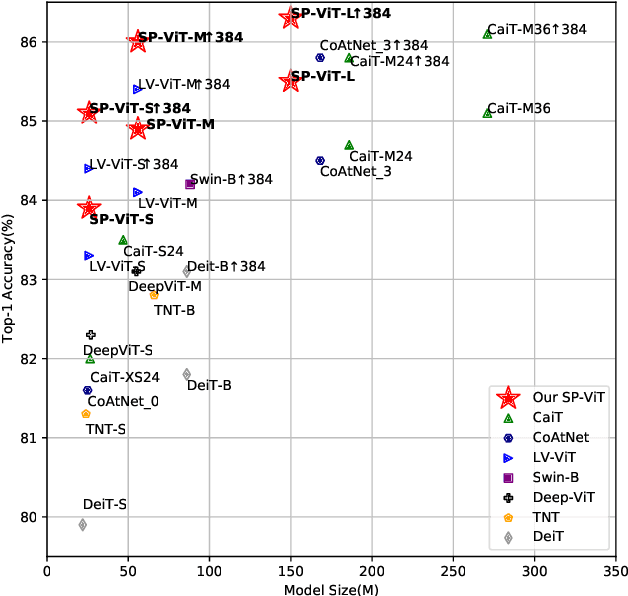
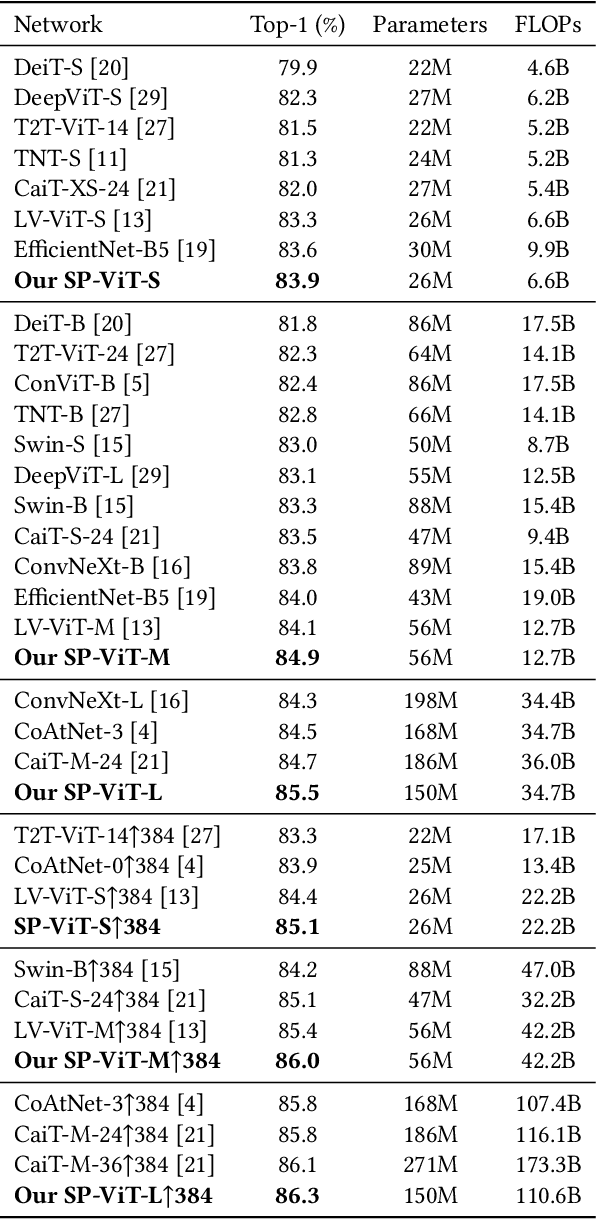
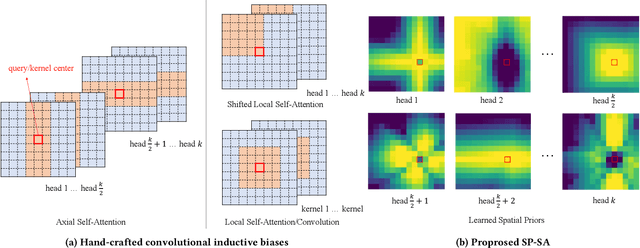
Recently, transformers have shown great potential in image classification and established state-of-the-art results on the ImageNet benchmark. However, compared to CNNs, transformers converge slowly and are prone to overfitting in low-data regimes due to the lack of spatial inductive biases. Such spatial inductive biases can be especially beneficial since the 2D structure of an input image is not well preserved in transformers. In this work, we present Spatial Prior-enhanced Self-Attention (SP-SA), a novel variant of vanilla Self-Attention (SA) tailored for vision transformers. Spatial Priors (SPs) are our proposed family of inductive biases that highlight certain groups of spatial relations. Unlike convolutional inductive biases, which are forced to focus exclusively on hard-coded local regions, our proposed SPs are learned by the model itself and take a variety of spatial relations into account. Specifically, the attention score is calculated with emphasis on certain kinds of spatial relations at each head, and such learned spatial foci can be complementary to each other. Based on SP-SA we propose the SP-ViT family, which consistently outperforms other ViT models with similar GFlops or parameters. Our largest model SP-ViT-L achieves a record-breaking 86.3% Top-1 accuracy with a reduction in the number of parameters by almost 50% compared to previous state-of-the-art model (150M for SP-ViT-L vs 271M for CaiT-M-36) among all ImageNet-1K models trained on 224x224 and fine-tuned on 384x384 resolution w/o extra data.

Estimation of Reliable Proposal Quality for Temporal Action Detection
Apr 25, 2022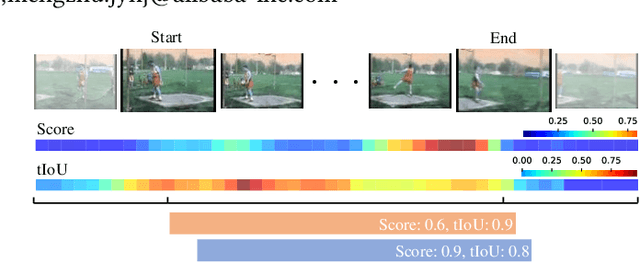
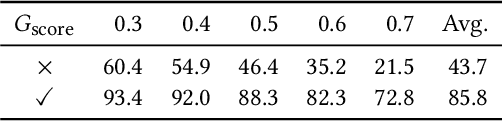
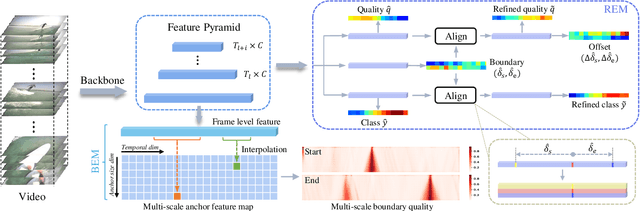
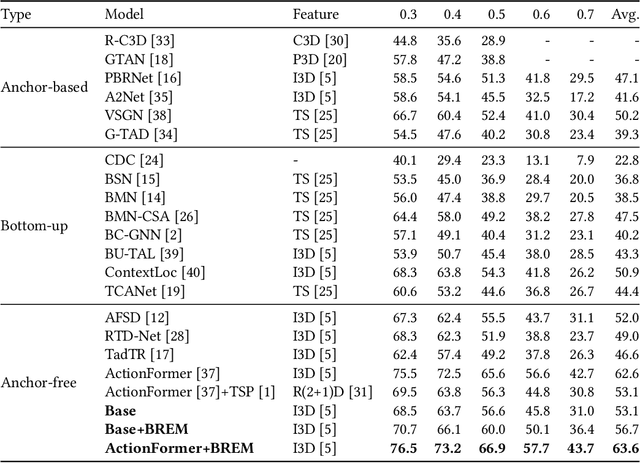
Temporal action detection (TAD) aims to locate and recognize the actions in an untrimmed video. Anchor-free methods have made remarkable progress which mainly formulate TAD into two tasks: classification and localization using two separate branches. This paper reveals the temporal misalignment between the two tasks hindering further progress. To address this, we propose a new method that gives insights into moment and region perspectives simultaneously to align the two tasks by acquiring reliable proposal quality. For the moment perspective, Boundary Evaluate Module (BEM) is designed which focuses on local appearance and motion evolvement to estimate boundary quality and adopts a multi-scale manner to deal with varied action durations. For the region perspective, we introduce Region Evaluate Module (REM) which uses a new and efficient sampling method for proposal feature representation containing more contextual information compared with point feature to refine category score and proposal boundary. The proposed Boundary Evaluate Module and Region Evaluate Module (BREM) are generic, and they can be easily integrated with other anchor-free TAD methods to achieve superior performance. In our experiments, BREM is combined with two different frameworks and improves the performance on THUMOS14 by 3.6$\%$ and 1.0$\%$ respectively, reaching a new state-of-the-art (63.6$\%$ average $m$AP). Meanwhile, a competitive result of 36.2\% average $m$AP is achieved on ActivityNet-1.3 with the consistent improvement of BREM.
Dense Learning based Semi-Supervised Object Detection
Apr 15, 2022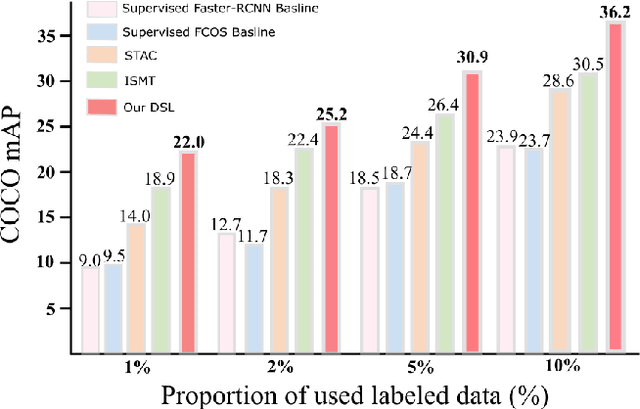
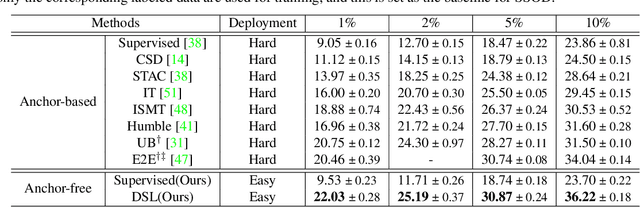
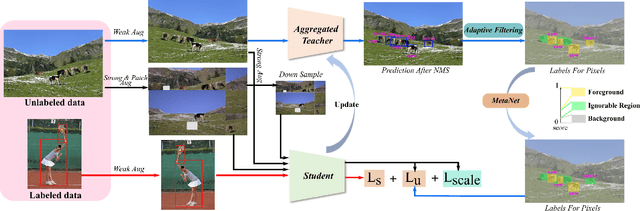
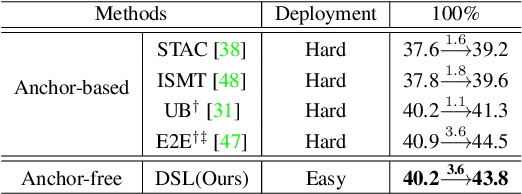
Semi-supervised object detection (SSOD) aims to facilitate the training and deployment of object detectors with the help of a large amount of unlabeled data. Though various self-training based and consistency-regularization based SSOD methods have been proposed, most of them are anchor-based detectors, ignoring the fact that in many real-world applications anchor-free detectors are more demanded. In this paper, we intend to bridge this gap and propose a DenSe Learning (DSL) based anchor-free SSOD algorithm. Specifically, we achieve this goal by introducing several novel techniques, including an Adaptive Filtering strategy for assigning multi-level and accurate dense pixel-wise pseudo-labels, an Aggregated Teacher for producing stable and precise pseudo-labels, and an uncertainty-consistency-regularization term among scales and shuffled patches for improving the generalization capability of the detector. Extensive experiments are conducted on MS-COCO and PASCAL-VOC, and the results show that our proposed DSL method records new state-of-the-art SSOD performance, surpassing existing methods by a large margin. Codes can be found at \textcolor{blue}{https://github.com/chenbinghui1/DSL}.
Structure-Aware Motion Transfer with Deformable Anchor Model
Apr 11, 2022
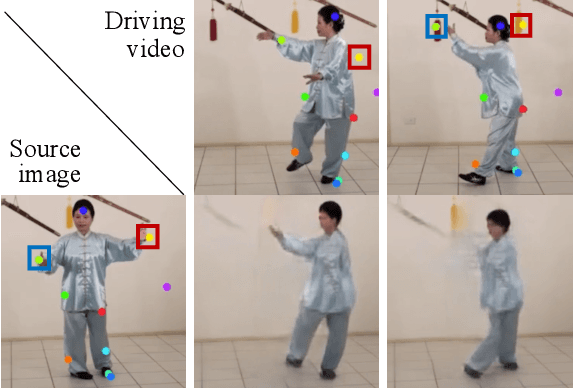
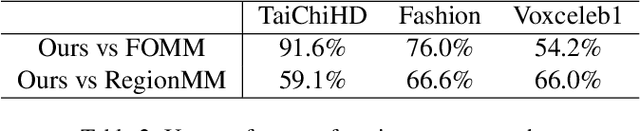
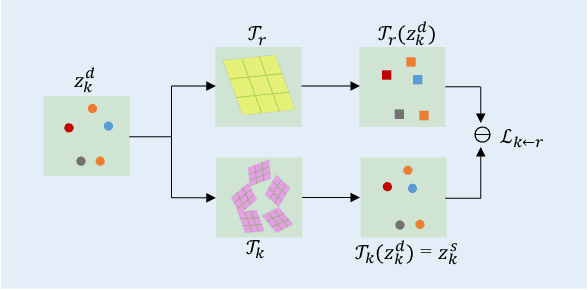
Given a source image and a driving video depicting the same object type, the motion transfer task aims to generate a video by learning the motion from the driving video while preserving the appearance from the source image. In this paper, we propose a novel structure-aware motion modeling approach, the deformable anchor model (DAM), which can automatically discover the motion structure of arbitrary objects without leveraging their prior structure information. Specifically, inspired by the known deformable part model (DPM), our DAM introduces two types of anchors or keypoints: i) a number of motion anchors that capture both appearance and motion information from the source image and driving video; ii) a latent root anchor, which is linked to the motion anchors to facilitate better learning of the representations of the object structure information. Moreover, DAM can be further extended to a hierarchical version through the introduction of additional latent anchors to model more complicated structures. By regularizing motion anchors with latent anchor(s), DAM enforces the correspondences between them to ensure the structural information is well captured and preserved. Moreover, DAM can be learned effectively in an unsupervised manner. We validate our proposed DAM for motion transfer on different benchmark datasets. Extensive experiments clearly demonstrate that DAM achieves superior performance relative to existing state-of-the-art methods.
Learning Pixel-Level Distinctions for Video Highlight Detection
Apr 10, 2022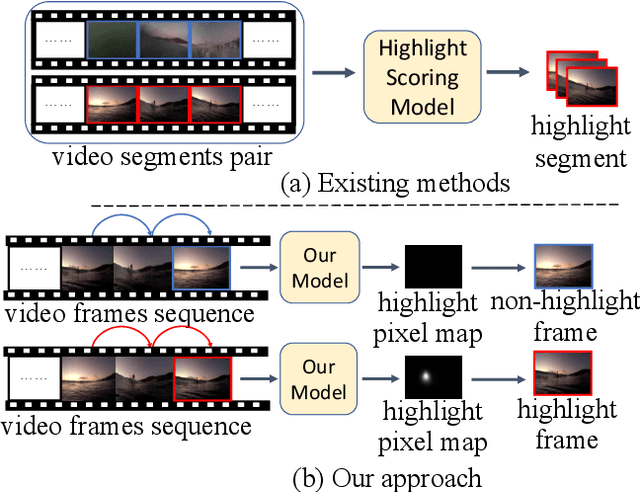

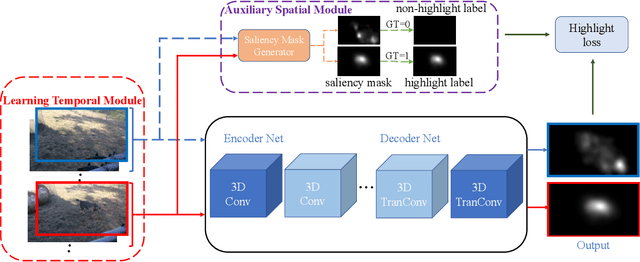
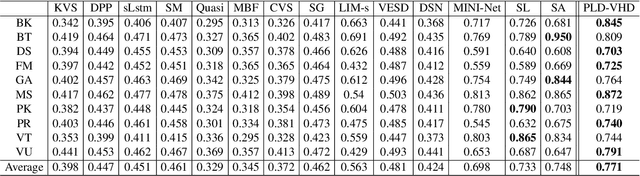
The goal of video highlight detection is to select the most attractive segments from a long video to depict the most interesting parts of the video. Existing methods typically focus on modeling relationship between different video segments in order to learning a model that can assign highlight scores to these segments; however, these approaches do not explicitly consider the contextual dependency within individual segments. To this end, we propose to learn pixel-level distinctions to improve the video highlight detection. This pixel-level distinction indicates whether or not each pixel in one video belongs to an interesting section. The advantages of modeling such fine-level distinctions are two-fold. First, it allows us to exploit the temporal and spatial relations of the content in one video, since the distinction of a pixel in one frame is highly dependent on both the content before this frame and the content around this pixel in this frame. Second, learning the pixel-level distinction also gives a good explanation to the video highlight task regarding what contents in a highlight segment will be attractive to people. We design an encoder-decoder network to estimate the pixel-level distinction, in which we leverage the 3D convolutional neural networks to exploit the temporal context information, and further take advantage of the visual saliency to model the spatial distinction. State-of-the-art performance on three public benchmarks clearly validates the effectiveness of our framework for video highlight detection.
Deep Multi-Branch Aggregation Network for Real-Time Semantic Segmentation in Street Scenes
Mar 08, 2022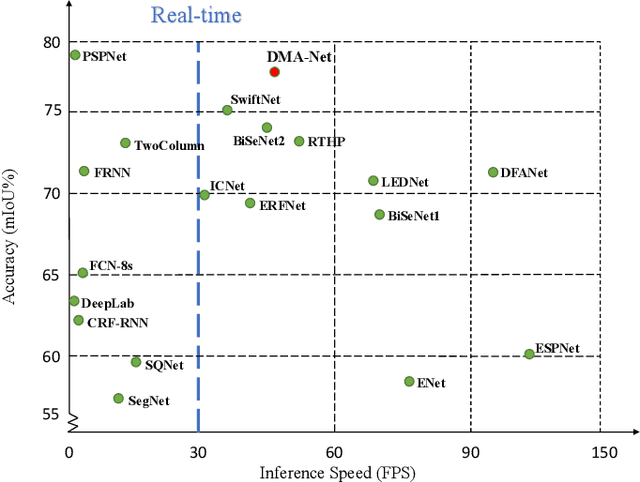
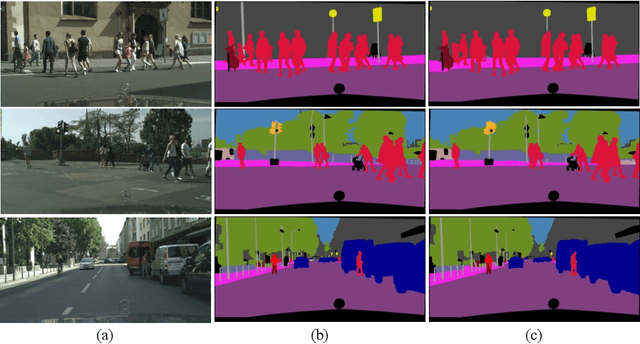
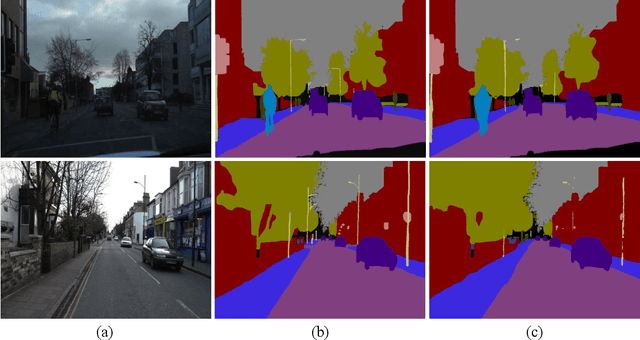
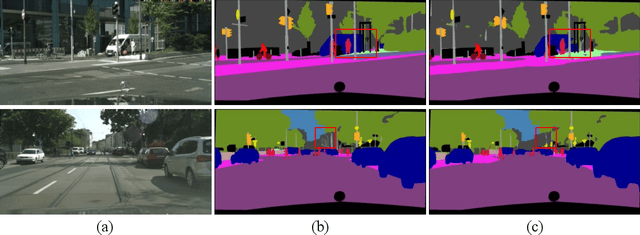
Real-time semantic segmentation, which aims to achieve high segmentation accuracy at real-time inference speed, has received substantial attention over the past few years. However, many state-of-the-art real-time semantic segmentation methods tend to sacrifice some spatial details or contextual information for fast inference, thus leading to degradation in segmentation quality. In this paper, we propose a novel Deep Multi-branch Aggregation Network (called DMA-Net) based on the encoder-decoder structure to perform real-time semantic segmentation in street scenes. Specifically, we first adopt ResNet-18 as the encoder to efficiently generate various levels of feature maps from different stages of convolutions. Then, we develop a Multi-branch Aggregation Network (MAN) as the decoder to effectively aggregate different levels of feature maps and capture the multi-scale information. In MAN, a lattice enhanced residual block is designed to enhance feature representations of the network by taking advantage of the lattice structure. Meanwhile, a feature transformation block is introduced to explicitly transform the feature map from the neighboring branch before feature aggregation. Moreover, a global context block is used to exploit the global contextual information. These key components are tightly combined and jointly optimized in a unified network. Extensive experimental results on the challenging Cityscapes and CamVid datasets demonstrate that our proposed DMA-Net respectively obtains 77.0% and 73.6% mean Intersection over Union (mIoU) at the inference speed of 46.7 FPS and 119.8 FPS by only using a single NVIDIA GTX 1080Ti GPU. This shows that DMA-Net provides a good tradeoff between segmentation quality and speed for semantic segmentation in street scenes.
Move As You Like: Image Animation in E-Commerce Scenario
Dec 19, 2021
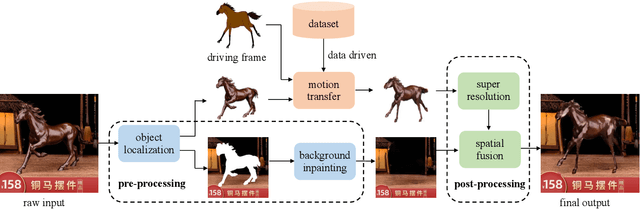

Creative image animations are attractive in e-commerce applications, where motion transfer is one of the import ways to generate animations from static images. However, existing methods rarely transfer motion to objects other than human body or human face, and even fewer apply motion transfer in practical scenarios. In this work, we apply motion transfer on the Taobao product images in real e-commerce scenario to generate creative animations, which are more attractive than static images and they will bring more benefits. We animate the Taobao products of dolls, copper running horses and toy dinosaurs based on motion transfer method for demonstration.
* 3 pages, 3 figures, ACM MM 2021 demo session
Variational Attention: Propagating Domain-Specific Knowledge for Multi-Domain Learning in Crowd Counting
Aug 18, 2021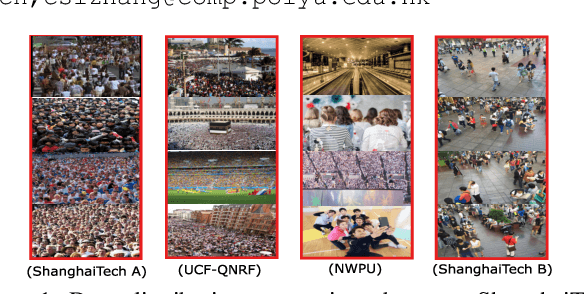
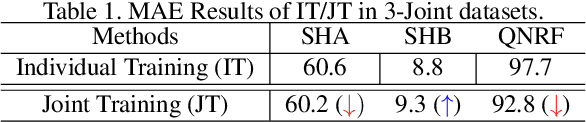
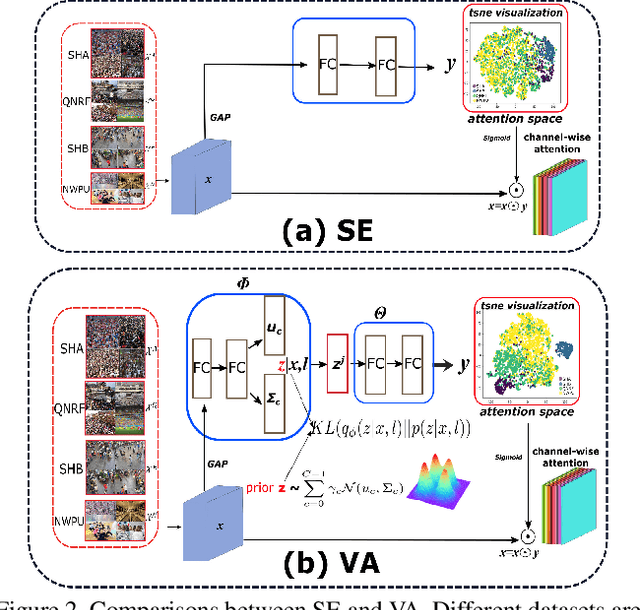
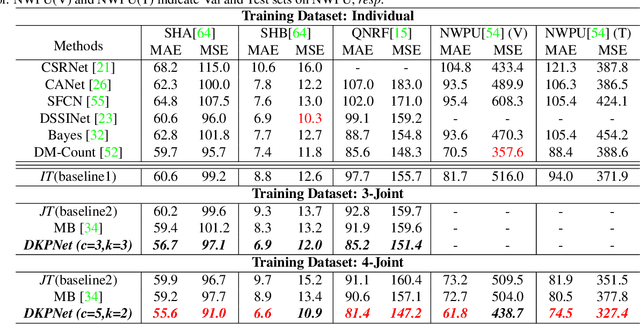
In crowd counting, due to the problem of laborious labelling, it is perceived intractability of collecting a new large-scale dataset which has plentiful images with large diversity in density, scene, etc. Thus, for learning a general model, training with data from multiple different datasets might be a remedy and be of great value. In this paper, we resort to the multi-domain joint learning and propose a simple but effective Domain-specific Knowledge Propagating Network (DKPNet)1 for unbiasedly learning the knowledge from multiple diverse data domains at the same time. It is mainly achieved by proposing the novel Variational Attention(VA) technique for explicitly modeling the attention distributions for different domains. And as an extension to VA, Intrinsic Variational Attention(InVA) is proposed to handle the problems of over-lapped domains and sub-domains. Extensive experiments have been conducted to validate the superiority of our DKPNet over several popular datasets, including ShanghaiTech A/B, UCF-QNRF and NWPU.
AIBench: An Industry Standard AI Benchmark Suite from Internet Services
Apr 30, 2020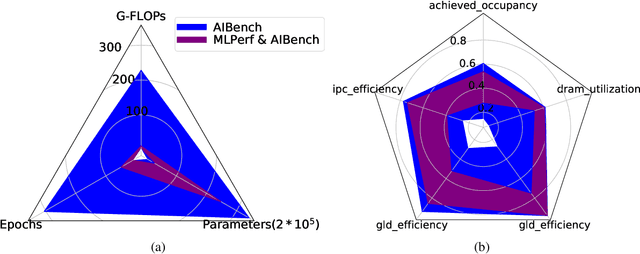
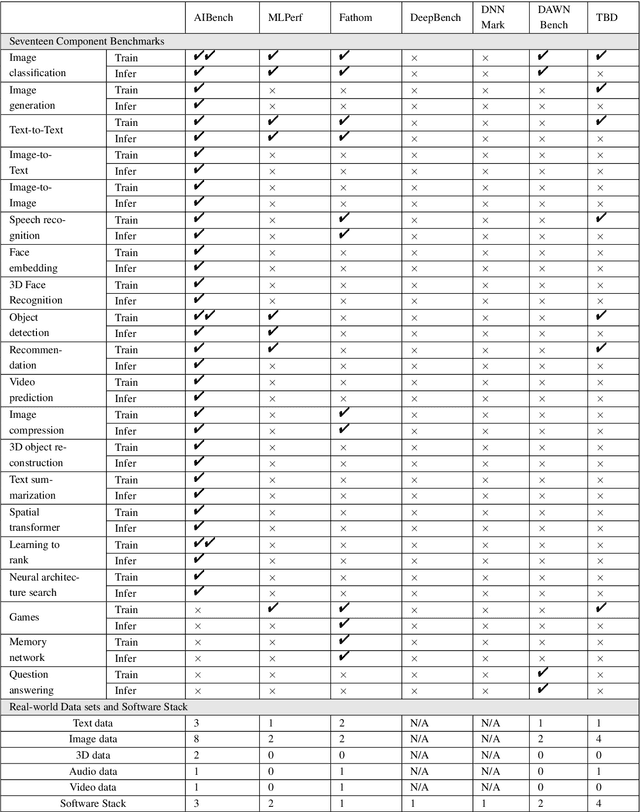
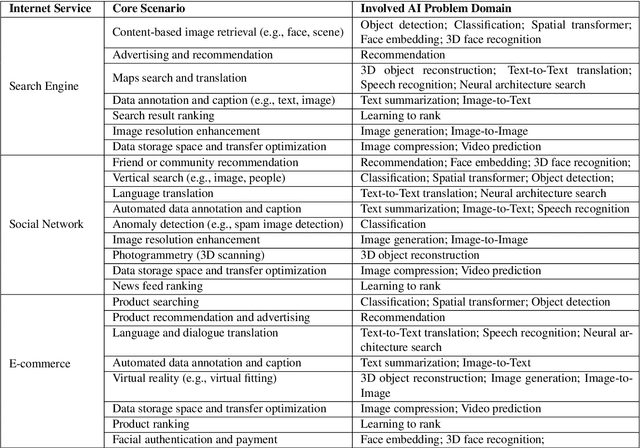
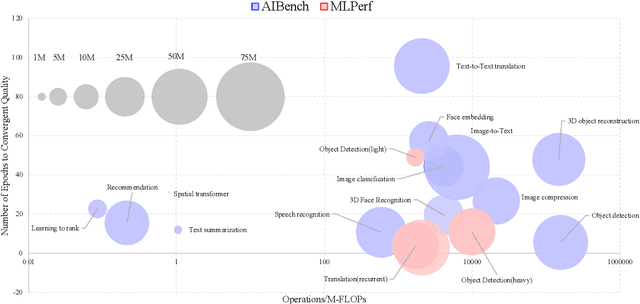
The booming successes of machine learning in different domains boost industry-scale deployments of innovative AI algorithms, systems, and architectures, and thus the importance of benchmarking grows. However, the confidential nature of the workloads, the paramount importance of the representativeness and diversity of benchmarks, and the prohibitive cost of training a state-of-the-art model mutually aggravate the AI benchmarking challenges. In this paper, we present a balanced AI benchmarking methodology for meeting the subtly different requirements of different stages in developing a new system/architecture and ranking/purchasing commercial off-the-shelf ones. Performing an exhaustive survey on the most important AI domain-Internet services with seventeen industry partners, we identify and include seventeen representative AI tasks to guarantee the representativeness and diversity of the benchmarks. Meanwhile, for reducing the benchmarking cost, we select a benchmark subset to a minimum-three tasks-according to the criteria: diversity of model complexity, computational cost, and convergence rate, repeatability, and having widely-accepted metrics or not. We contribute by far the most comprehensive AI benchmark suite-AIBench. The evaluations show AIBench outperforms MLPerf in terms of the diversity and representativeness of model complexity, computational cost, convergent rate, computation and memory access patterns, and hotspot functions. With respect to the AIBench full benchmarks, its subset shortens the benchmarking cost by 41%, while maintaining the primary workload characteristics. The specifications, source code, and performance numbers are publicly available from the web site http://www.benchcouncil.org/AIBench/index.html.
AIBench: An Agile Domain-specific Benchmarking Methodology and an AI Benchmark Suite
Feb 17, 2020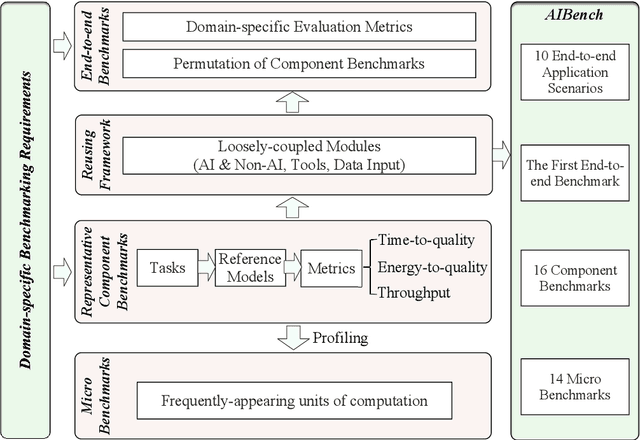
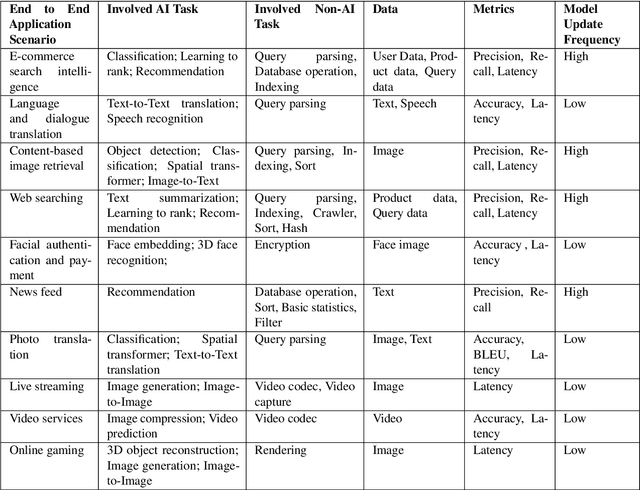
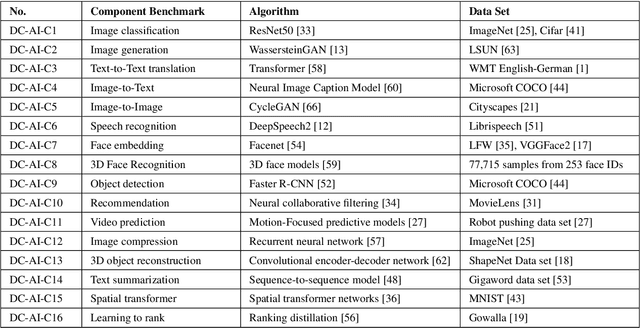
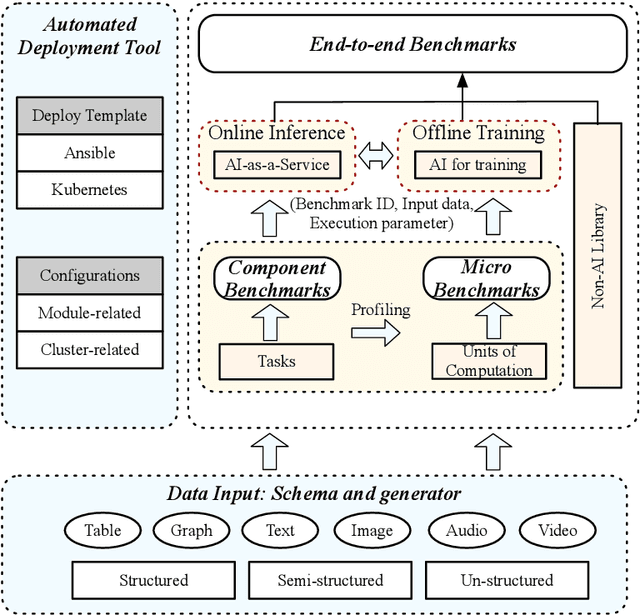
Domain-specific software and hardware co-design is encouraging as it is much easier to achieve efficiency for fewer tasks. Agile domain-specific benchmarking speeds up the process as it provides not only relevant design inputs but also relevant metrics, and tools. Unfortunately, modern workloads like Big data, AI, and Internet services dwarf the traditional one in terms of code size, deployment scale, and execution path, and hence raise serious benchmarking challenges. This paper proposes an agile domain-specific benchmarking methodology. Together with seventeen industry partners, we identify ten important end-to-end application scenarios, among which sixteen representative AI tasks are distilled as the AI component benchmarks. We propose the permutations of essential AI and non-AI component benchmarks as end-to-end benchmarks. An end-to-end benchmark is a distillation of the essential attributes of an industry-scale application. We design and implement a highly extensible, configurable, and flexible benchmark framework, on the basis of which, we propose the guideline for building end-to-end benchmarks, and present the first end-to-end Internet service AI benchmark. The preliminary evaluation shows the value of our benchmark suite---AIBench against MLPerf and TailBench for hardware and software designers, micro-architectural researchers, and code developers. The specifications, source code, testbed, and results are publicly available from the web site \url{http://www.benchcouncil.org/AIBench/index.html}.