 Add to Chrome
 Add to Firefox
 Add to Edge
AUCH-Net: Action Unit-Based Consistency-Aware Hypergraph Network for Cross-Domain Few-Shot Facial Expression Recognition
Jul 23, 2026
Recently, cross-domain few-shot facial expression recognition (CF-FER) has received considerable attention. However, the performance of existing CF-FER methods is still unsatisfactory due to inferior transferable feature learning under large domain discrepancy and limited target samples. Fortunately, the action units (AUs), which indicate the movements of different facial muscles, provide consistent conceptual semantics for describing expressions within and across domains. Inspired by this, we propose a novel Action Unit-based Consistency-aware Hypergraph Network (AUCH-Net), which constructs consistency-aware hypergraphs on AUs, for CF-FER. Specifically, AUCH-Net presents a new AU feature learning (AFL) module and a new visual feature learning (VFL) module. The AFL module learns AU features under the guidance of a novel relation consistency loss and an AU regularization loss, while the VFL module learns visual features supervised by a relation consistency loss and a classification loss. By learning consistent AU features, AUCH-Net effectively models the connections between AUs and expression categories. As a result, we can bridge the gap between fine-grained facial variations and high-level expression categories, greatly facilitating the learning of transferable feature representations.Extensive experiments on both in-the-lab and in-the-wild datasets show that our method consistently outperforms several state-of-the-art methods. Our results clearly show that modeling the relationships among AUs holds significant potential for FER under cross-domain few-shot scenarios.

Ling and Ring 2.6 Technical Report: Efficient and Instant Agentic Intelligence at Trillion-Parameter Scale
Jun 13, 2026Efficient and scalable agentic intelligence requires models that can deliver both low-latency responses and strong reasoning capabilities while remaining practical to train, serve, and deploy. In this report, we present Ling-2.6 and Ring-2.6, a family of models designed to address this challenge at scale. Ling-2.6 is optimized for instant response generation and high capability per output token, whereas Ring-2.6 is tailored for deeper reasoning and more advanced agentic workflows. Instead of training from scratch, we upgrade the Ling-2.0 base model through architectural migration pre-training and large-scale post-training. This upgrade is guided by a unified co-design of model architecture, optimization objectives, serving systems, and agent training environments, enabling improvements in both model capability and deployment efficiency. At the architectural level, we introduce a hybrid linear attention design that integrates Lightning Attention with MLA, improving the efficiency of long-context training and decoding. To further enhance token efficiency, we optimize capability per output token through Evolutionary Chain-of-Thought, Linguistic Unit Policy Optimization, bidirectional preference alignment, and shortest-correct-response distillation. For agentic capabilities, we propose KPop, a reinforcement learning framework designed to support stable training of Ring-2.6-1T on large-scale environment-grounded data. KPop improves training efficiency through asynchronous scheduling across coding, search, tool use, and workflow execution, enabling scalable learning from complex agent-environment interactions. Together, Ling-2.6 and Ring-2.6 provide a practical pathway toward efficient, scalable, and open agentic systems. We open-source all checkpoints in the 2.6 family to support further research and development in practical agentic intelligence.
Is Spurious Correlation Removal Always Learnable?
Jun 11, 2026Invariant learning can fail even when the invariant structure is statistically identifiable. We show a conditional computational barrier: under a black-box samplable supervised sparse recovery primitive motivated by average-case sparse-recovery reductions, there exist \emph{samplable} multi-environment instances with a one-dimensional predictive invariant subspace ($k=1$) that are learnable with polynomial samples by exhaustive search, while any polynomial-time constant-accuracy recovery algorithm would contradict the primitive. We further quantify environment diversity by a separation parameter $γ$, which controls identifiability and the curvature of invariance objectives. Under sufficient diversity and local Gaussian regularity, the minimax risk is $\mathbb{E}[\dist(\hat{V},V_{\mathrm{inv}})^2]=Θ(k(d-k)/(n|\mathcal{E}|))$, and under label-induced shifts a phase transition occurs at $n^*\propto k(d-k)/(|\mathcal{E}|γ^2)$ with refined estimation error scaling proportional to $1/γ^2$. Synthetic and real datasets illustrate the predicted gaps and transitions and motivate simple diversity diagnostics.
CMCC-ReID: Cross-Modality Clothing-Change Person Re-Identification
Apr 03, 2026Person Re-Identification (ReID) faces severe challenges from modality discrepancy and clothing variation in long-term surveillance scenario. While existing studies have made significant progress in either Visible-Infrared ReID (VI-ReID) or Clothing-Change ReID (CC-ReID), real-world surveillance system often face both challenges simultaneously. To address this overlooked yet realistic problem, we define a new task, termed Cross-Modality Clothing-Change Re-Identification (CMCC-ReID), which targets pedestrian matching across variations in both modality and clothing. To advance research in this direction, we construct a new benchmark SYSU-CMCC, where each identity is captured in both visible and infrared domains with distinct outfits, reflecting the dual heterogeneity of long-term surveillance. To tackle CMCC-ReID, we propose a Progressive Identity Alignment Network (PIA) that progressively mitigates the issues of clothing variation and modality discrepancy. Specifically, a Dual-Branch Disentangling Learning (DBDL) module separates identity-related cues from clothing-related factors to achieve clothing-agnostic representation, and a Bi-Directional Prototype Learning (BPL) module performs intra-modality and inter-modality contrast in the embedding space to bridge the modality gap while further suppressing clothing interference. Extensive experiments on the SYSU-CMCC dataset demonstrate that PIA establishes a strong baseline for this new task and significantly outperforms existing methods.
WarpGAN: Warping-Guided 3D GAN Inversion with Style-Based Novel View Inpainting
Nov 11, 20253D GAN inversion projects a single image into the latent space of a pre-trained 3D GAN to achieve single-shot novel view synthesis, which requires visible regions with high fidelity and occluded regions with realism and multi-view consistency. However, existing methods focus on the reconstruction of visible regions, while the generation of occluded regions relies only on the generative prior of 3D GAN. As a result, the generated occluded regions often exhibit poor quality due to the information loss caused by the low bit-rate latent code. To address this, we introduce the warping-and-inpainting strategy to incorporate image inpainting into 3D GAN inversion and propose a novel 3D GAN inversion method, WarpGAN. Specifically, we first employ a 3D GAN inversion encoder to project the single-view image into a latent code that serves as the input to 3D GAN. Then, we perform warping to a novel view using the depth map generated by 3D GAN. Finally, we develop a novel SVINet, which leverages the symmetry prior and multi-view image correspondence w.r.t. the same latent code to perform inpainting of occluded regions in the warped image. Quantitative and qualitative experiments demonstrate that our method consistently outperforms several state-of-the-art methods.
FATE: A Prompt-Tuning-Based Semi-Supervised Learning Framework for Extremely Limited Labeled Data
Apr 14, 2025Semi-supervised learning (SSL) has achieved significant progress by leveraging both labeled data and unlabeled data. Existing SSL methods overlook a common real-world scenario when labeled data is extremely scarce, potentially as limited as a single labeled sample in the dataset. General SSL approaches struggle to train effectively from scratch under such constraints, while methods utilizing pre-trained models often fail to find an optimal balance between leveraging limited labeled data and abundant unlabeled data. To address this challenge, we propose Firstly Adapt, Then catEgorize (FATE), a novel SSL framework tailored for scenarios with extremely limited labeled data. At its core, the two-stage prompt tuning paradigm FATE exploits unlabeled data to compensate for scarce supervision signals, then transfers to downstream tasks. Concretely, FATE first adapts a pre-trained model to the feature distribution of downstream data using volumes of unlabeled samples in an unsupervised manner. It then applies an SSL method specifically designed for pre-trained models to complete the final classification task. FATE is designed to be compatible with both vision and vision-language pre-trained models. Extensive experiments demonstrate that FATE effectively mitigates challenges arising from the scarcity of labeled samples in SSL, achieving an average performance improvement of 33.74% across seven benchmarks compared to state-of-the-art SSL methods. Code is available at https://anonymous.4open.science/r/Semi-supervised-learning-BA72.
Mind the Gap: Confidence Discrepancy Can Guide Federated Semi-Supervised Learning Across Pseudo-Mismatch
Mar 17, 2025Federated Semi-Supervised Learning (FSSL) aims to leverage unlabeled data across clients with limited labeled data to train a global model with strong generalization ability. Most FSSL methods rely on consistency regularization with pseudo-labels, converting predictions from local or global models into hard pseudo-labels as supervisory signals. However, we discover that the quality of pseudo-label is largely deteriorated by data heterogeneity, an intrinsic facet of federated learning. In this paper, we study the problem of FSSL in-depth and show that (1) heterogeneity exacerbates pseudo-label mismatches, further degrading model performance and convergence, and (2) local and global models' predictive tendencies diverge as heterogeneity increases. Motivated by these findings, we propose a simple and effective method called Semi-supervised Aggregation for Globally-Enhanced Ensemble (SAGE), that can flexibly correct pseudo-labels based on confidence discrepancies. This strategy effectively mitigates performance degradation caused by incorrect pseudo-labels and enhances consensus between local and global models. Experimental results demonstrate that SAGE outperforms existing FSSL methods in both performance and convergence. Our code is available at https://github.com/Jay-Codeman/SAGE
Classifying Long-tailed and Label-noise Data via Disentangling and Unlearning
Mar 14, 2025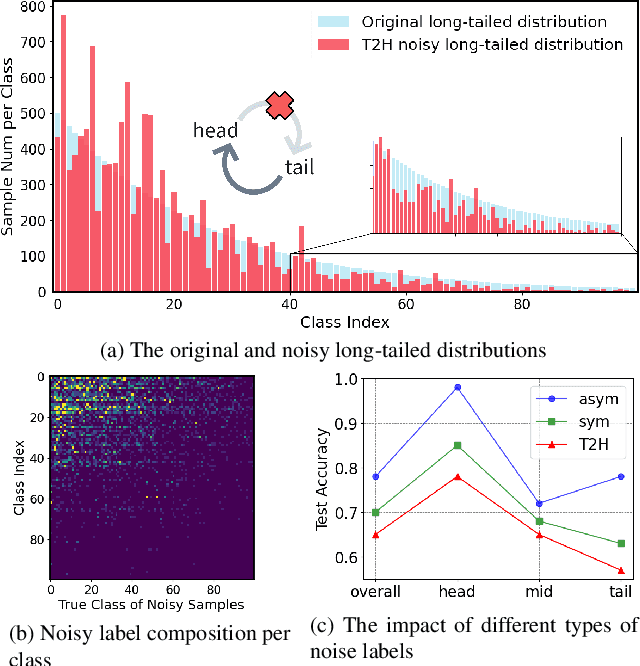
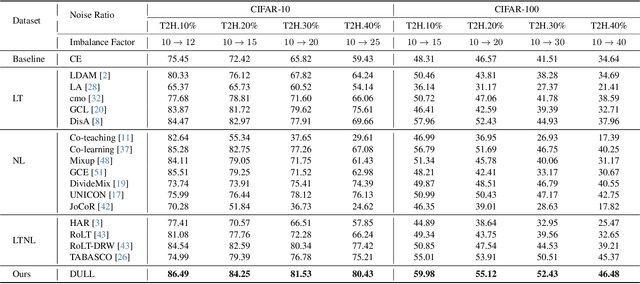
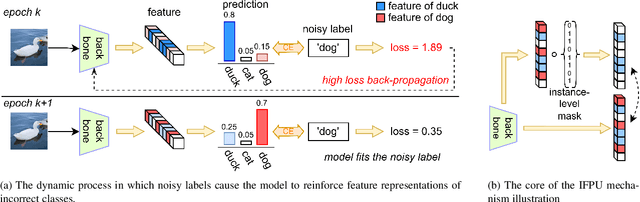

In real-world datasets, the challenges of long-tailed distributions and noisy labels often coexist, posing obstacles to the model training and performance. Existing studies on long-tailed noisy label learning (LTNLL) typically assume that the generation of noisy labels is independent of the long-tailed distribution, which may not be true from a practical perspective. In real-world situaiton, we observe that the tail class samples are more likely to be mislabeled as head, exacerbating the original degree of imbalance. We call this phenomenon as ``tail-to-head (T2H)'' noise. T2H noise severely degrades model performance by polluting the head classes and forcing the model to learn the tail samples as head. To address this challenge, we investigate the dynamic misleading process of the nosiy labels and propose a novel method called Disentangling and Unlearning for Long-tailed and Label-noisy data (DULL). It first employs the Inner-Feature Disentangling (IFD) to disentangle feature internally. Based on this, the Inner-Feature Partial Unlearning (IFPU) is then applied to weaken and unlearn incorrect feature regions correlated to wrong classes. This method prevents the model from being misled by noisy labels, enhancing the model's robustness against noise. To provide a controlled experimental environment, we further propose a new noise addition algorithm to simulate T2H noise. Extensive experiments on both simulated and real-world datasets demonstrate the effectiveness of our proposed method.
You Are Your Own Best Teacher: Achieving Centralized-level Performance in Federated Learning under Heterogeneous and Long-tailed Data
Mar 10, 2025Data heterogeneity, stemming from local non-IID data and global long-tailed distributions, is a major challenge in federated learning (FL), leading to significant performance gaps compared to centralized learning. Previous research found that poor representations and biased classifiers are the main problems and proposed neural-collapse-inspired synthetic simplex ETF to help representations be closer to neural collapse optima. However, we find that the neural-collapse-inspired methods are not strong enough to reach neural collapse and still have huge gaps to centralized training. In this paper, we rethink this issue from a self-bootstrap perspective and propose FedYoYo (You Are Your Own Best Teacher), introducing Augmented Self-bootstrap Distillation (ASD) to improve representation learning by distilling knowledge between weakly and strongly augmented local samples, without needing extra datasets or models. We further introduce Distribution-aware Logit Adjustment (DLA) to balance the self-bootstrap process and correct biased feature representations. FedYoYo nearly eliminates the performance gap, achieving centralized-level performance even under mixed heterogeneity. It enhances local representation learning, reducing model drift and improving convergence, with feature prototypes closer to neural collapse optimality. Extensive experiments show FedYoYo achieves state-of-the-art results, even surpassing centralized logit adjustment methods by 5.4\% under global long-tailed settings.
CAPT: Class-Aware Prompt Tuning for Federated Long-Tailed Learning with Vision-Language Model
Mar 10, 2025Effectively handling the co-occurrence of non-IID data and long-tailed distributions remains a critical challenge in federated learning. While fine-tuning vision-language models (VLMs) like CLIP has shown to be promising in addressing non-IID data challenges, this approach leads to severe degradation of tail classes in federated long-tailed scenarios. Under the composite effects of strong non-IID data distribution and long-tailed class imbalances, VLM fine-tuning may even fail to yield any improvement. To address this issue, we propose Class-Aware Prompt Learning for Federated Long-tailed Learning (CAPT), a novel framework that leverages a pre-trained VLM to effectively handle both data heterogeneity and long-tailed distributions. CAPT introduces a dual-prompt mechanism that synergizes general and class-aware prompts, enabling the framework to capture global trends while preserving class-specific knowledge. To better aggregate and share knowledge across clients, we introduce a heterogeneity-aware client clustering strategy that groups clients based on their data distributions, enabling efficient collaboration and knowledge sharing. Extensive experiments on various long-tailed datasets with different levels of data heterogeneity demonstrate that CAPT significantly improves tail class performance without compromising overall accuracy, outperforming state-of-the-art methods in federated long-tailed learning scenarios.