 Add to Chrome
 Add to Firefox
 Add to Edge
End-to-End Temporal Action Detection with 1B Parameters Across 1000 Frames
Nov 28, 2023
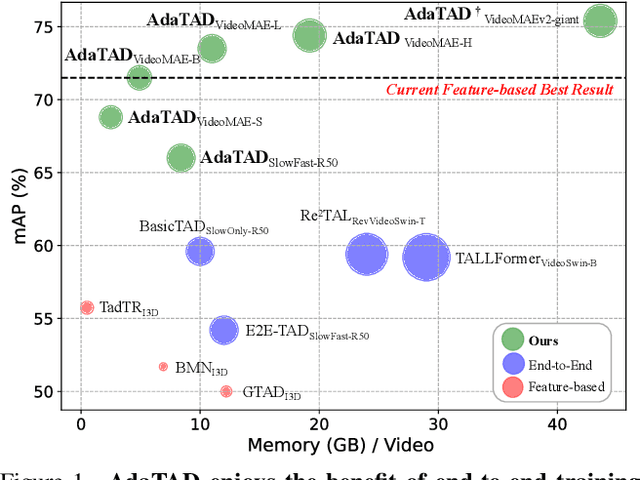
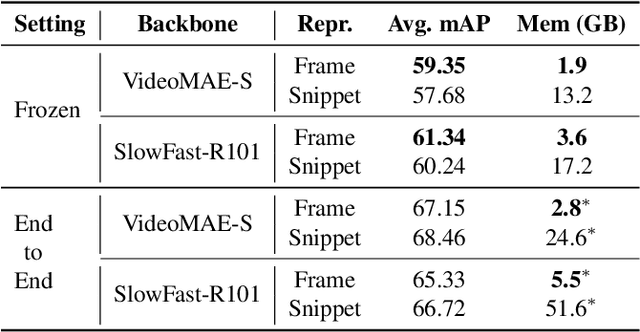
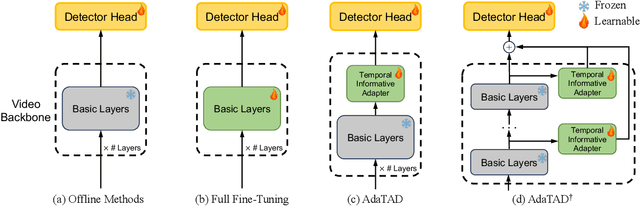
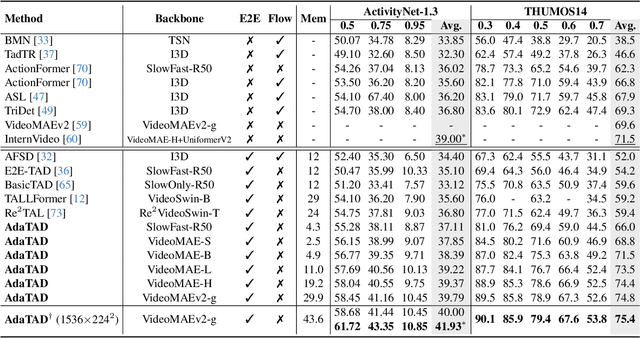
Recently, temporal action detection (TAD) has seen significant performance improvement with end-to-end training. However, due to the memory bottleneck, only models with limited scales and limited data volumes can afford end-to-end training, which inevitably restricts TAD performance. In this paper, we reduce the memory consumption for end-to-end training, and manage to scale up the TAD backbone to 1 billion parameters and the input video to 1,536 frames, leading to significant detection performance. The key to our approach lies in our proposed temporal-informative adapter (TIA), which is a novel lightweight module that reduces training memory. Using TIA, we free the humongous backbone from learning to adapt to the TAD task by only updating the parameters in TIA. TIA also leads to better TAD representation by temporally aggregating context from adjacent frames throughout the backbone. We evaluate our model across four representative datasets. Owing to our efficient design, we are able to train end-to-end on VideoMAEv2-giant and achieve 75.4% mAP on THUMOS14, being the first end-to-end model to outperform the best feature-based methods.

From Categories to Classifier: Name-Only Continual Learning by Exploring the Web
Nov 19, 2023Continual Learning (CL) often relies on the availability of extensive annotated datasets, an assumption that is unrealistically time-consuming and costly in practice. We explore a novel paradigm termed name-only continual learning where time and cost constraints prohibit manual annotation. In this scenario, learners adapt to new category shifts using only category names without the luxury of annotated training data. Our proposed solution leverages the expansive and ever-evolving internet to query and download uncurated webly-supervised data for image classification. We investigate the reliability of our web data and find them comparable, and in some cases superior, to manually annotated datasets. Additionally, we show that by harnessing the web, we can create support sets that surpass state-of-the-art name-only classification that create support sets using generative models or image retrieval from LAION-5B, achieving up to 25% boost in accuracy. When applied across varied continual learning contexts, our method consistently exhibits a small performance gap in comparison to models trained on manually annotated datasets. We present EvoTrends, a class-incremental dataset made from the web to capture real-world trends, created in just minutes. Overall, this paper underscores the potential of using uncurated webly-supervised data to mitigate the challenges associated with manual data labeling in continual learning.
Towards Demystifying the Generalization Behaviors When Neural Collapse Emerges
Oct 12, 2023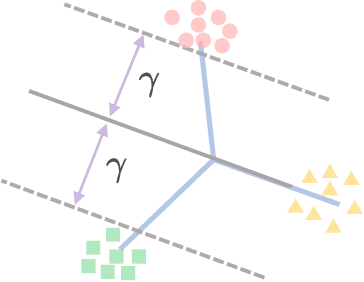
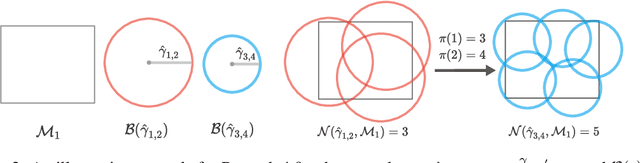
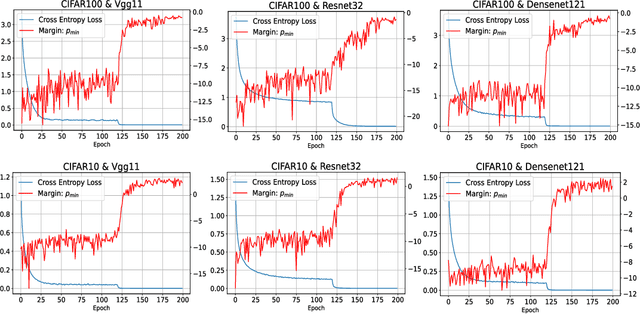
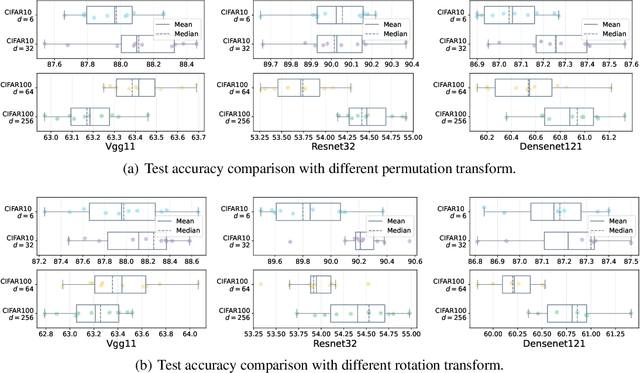
Neural Collapse (NC) is a well-known phenomenon of deep neural networks in the terminal phase of training (TPT). It is characterized by the collapse of features and classifier into a symmetrical structure, known as simplex equiangular tight frame (ETF). While there have been extensive studies on optimization characteristics showing the global optimality of neural collapse, little research has been done on the generalization behaviors during the occurrence of NC. Particularly, the important phenomenon of generalization improvement during TPT has been remaining in an empirical observation and lacking rigorous theoretical explanation. In this paper, we establish the connection between the minimization of CE and a multi-class SVM during TPT, and then derive a multi-class margin generalization bound, which provides a theoretical explanation for why continuing training can still lead to accuracy improvement on test set, even after the train accuracy has reached 100%. Additionally, our further theoretical results indicate that different alignment between labels and features in a simplex ETF can result in varying degrees of generalization improvement, despite all models reaching NC and demonstrating similar optimization performance on train set. We refer to this newly discovered property as "non-conservative generalization". In experiments, we also provide empirical observations to verify the indications suggested by our theoretical results.
Automatic Animation of Hair Blowing in Still Portrait Photos
Sep 25, 2023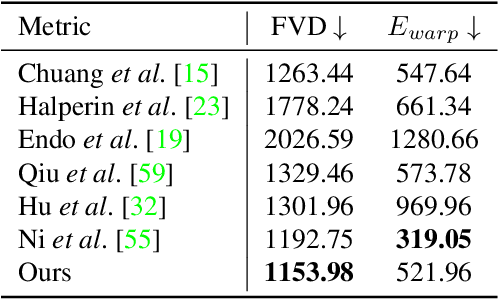
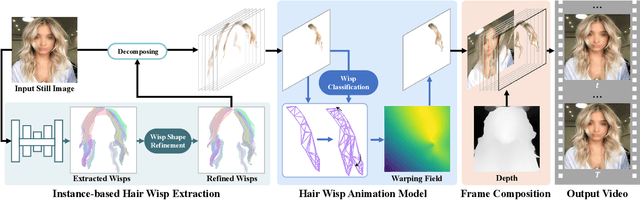
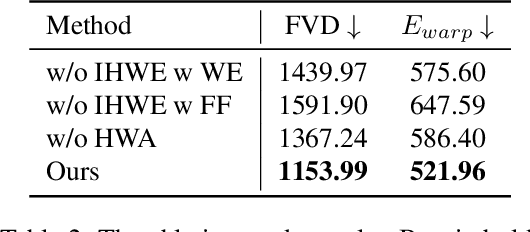
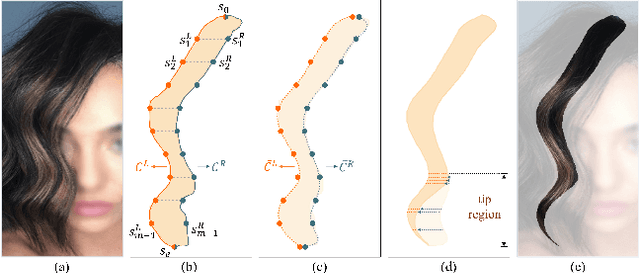
We propose a novel approach to animate human hair in a still portrait photo. Existing work has largely studied the animation of fluid elements such as water and fire. However, hair animation for a real image remains underexplored, which is a challenging problem, due to the high complexity of hair structure and dynamics. Considering the complexity of hair structure, we innovatively treat hair wisp extraction as an instance segmentation problem, where a hair wisp is referred to as an instance. With advanced instance segmentation networks, our method extracts meaningful and natural hair wisps. Furthermore, we propose a wisp-aware animation module that animates hair wisps with pleasing motions without noticeable artifacts. The extensive experiments show the superiority of our method. Our method provides the most pleasing and compelling viewing experience in the qualitative experiments and outperforms state-of-the-art still-image animation methods by a large margin in the quantitative evaluation. Project url: \url{https://nevergiveu.github.io/AutomaticHairBlowing/}
SoccerNet 2023 Challenges Results
Sep 12, 2023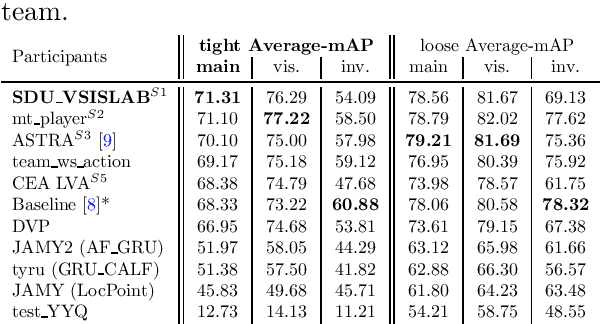
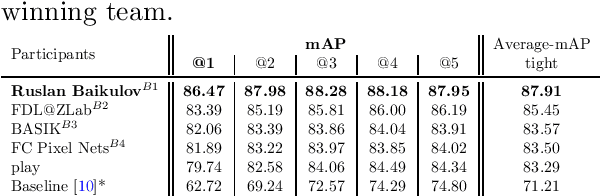
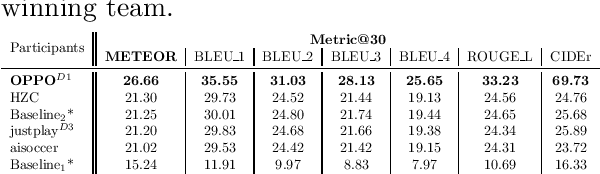
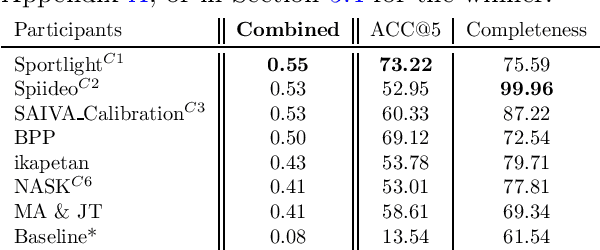
The SoccerNet 2023 challenges were the third annual video understanding challenges organized by the SoccerNet team. For this third edition, the challenges were composed of seven vision-based tasks split into three main themes. The first theme, broadcast video understanding, is composed of three high-level tasks related to describing events occurring in the video broadcasts: (1) action spotting, focusing on retrieving all timestamps related to global actions in soccer, (2) ball action spotting, focusing on retrieving all timestamps related to the soccer ball change of state, and (3) dense video captioning, focusing on describing the broadcast with natural language and anchored timestamps. The second theme, field understanding, relates to the single task of (4) camera calibration, focusing on retrieving the intrinsic and extrinsic camera parameters from images. The third and last theme, player understanding, is composed of three low-level tasks related to extracting information about the players: (5) re-identification, focusing on retrieving the same players across multiple views, (6) multiple object tracking, focusing on tracking players and the ball through unedited video streams, and (7) jersey number recognition, focusing on recognizing the jersey number of players from tracklets. Compared to the previous editions of the SoccerNet challenges, tasks (2-3-7) are novel, including new annotations and data, task (4) was enhanced with more data and annotations, and task (6) now focuses on end-to-end approaches. More information on the tasks, challenges, and leaderboards are available on https://www.soccer-net.org. Baselines and development kits can be found on https://github.com/SoccerNet.
Learning Semantic Segmentation with Query Points Supervision on Aerial Images
Sep 11, 2023
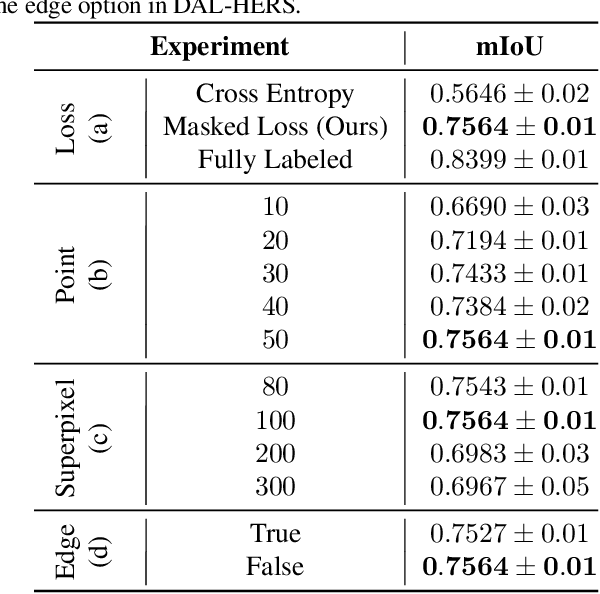

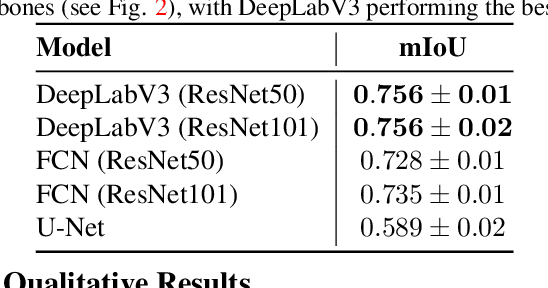
Semantic segmentation is crucial in remote sensing, where high-resolution satellite images are segmented into meaningful regions. Recent advancements in deep learning have significantly improved satellite image segmentation. However, most of these methods are typically trained in fully supervised settings that require high-quality pixel-level annotations, which are expensive and time-consuming to obtain. In this work, we present a weakly supervised learning algorithm to train semantic segmentation algorithms that only rely on query point annotations instead of full mask labels. Our proposed approach performs accurate semantic segmentation and improves efficiency by significantly reducing the cost and time required for manual annotation. Specifically, we generate superpixels and extend the query point labels into those superpixels that group similar meaningful semantics. Then, we train semantic segmentation models, supervised with images partially labeled with the superpixels pseudo-labels. We benchmark our weakly supervised training approach on an aerial image dataset and different semantic segmentation architectures, showing that we can reach competitive performance compared to fully supervised training while reducing the annotation effort.
Learning to Read Analog Gauges from Synthetic Data
Aug 28, 2023Manually reading and logging gauge data is time inefficient, and the effort increases according to the number of gauges available. We present a computer vision pipeline that automates the reading of analog gauges. We propose a two-stage CNN pipeline that identifies the key structural components of an analog gauge and outputs an angular reading. To facilitate the training of our approach, a synthetic dataset is generated thus obtaining a set of realistic analog gauges with their corresponding annotation. To validate our proposal, an additional real-world dataset was collected with 4.813 manually curated images. When compared against state-of-the-art methodologies, our method shows a significant improvement of 4.55 in the average error, which is a 52% relative improvement. The resources for this project will be made available at: https://github.com/fuankarion/automatic-gauge-reading.
ShadowNet for Data-Centric Quantum System Learning
Aug 22, 2023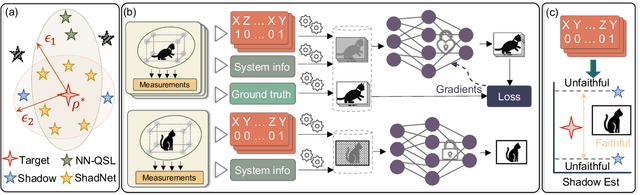
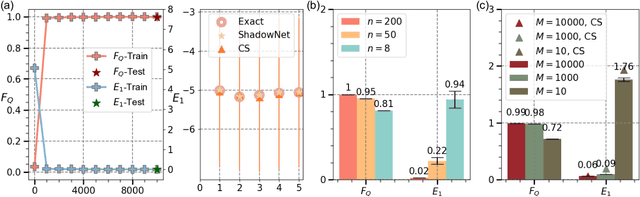
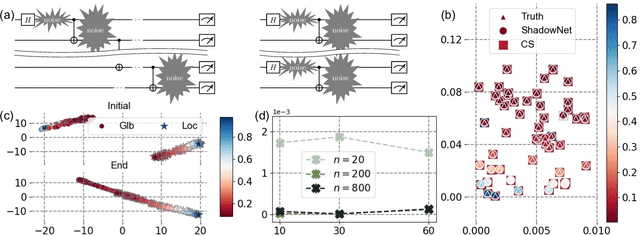
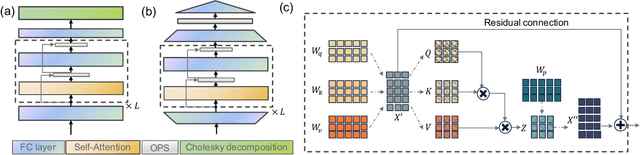
Understanding the dynamics of large quantum systems is hindered by the curse of dimensionality. Statistical learning offers new possibilities in this regime by neural-network protocols and classical shadows, while both methods have limitations: the former is plagued by the predictive uncertainty and the latter lacks the generalization ability. Here we propose a data-centric learning paradigm combining the strength of these two approaches to facilitate diverse quantum system learning (QSL) tasks. Particularly, our paradigm utilizes classical shadows along with other easily obtainable information of quantum systems to create the training dataset, which is then learnt by neural networks to unveil the underlying mapping rule of the explored QSL problem. Capitalizing on the generalization power of neural networks, this paradigm can be trained offline and excel at predicting previously unseen systems at the inference stage, even with few state copies. Besides, it inherits the characteristic of classical shadows, enabling memory-efficient storage and faithful prediction. These features underscore the immense potential of the proposed data-centric approach in discovering novel and large-scale quantum systems. For concreteness, we present the instantiation of our paradigm in quantum state tomography and direct fidelity estimation tasks and conduct numerical analysis up to 60 qubits. Our work showcases the profound prospects of data-centric artificial intelligence to advance QSL in a faithful and generalizable manner.
Learning to Identify Critical States for Reinforcement Learning from Videos
Aug 15, 2023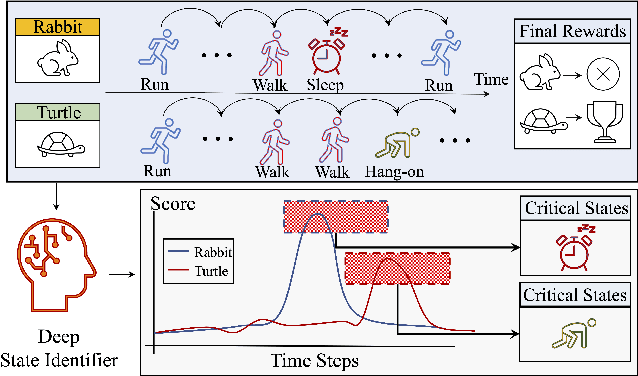
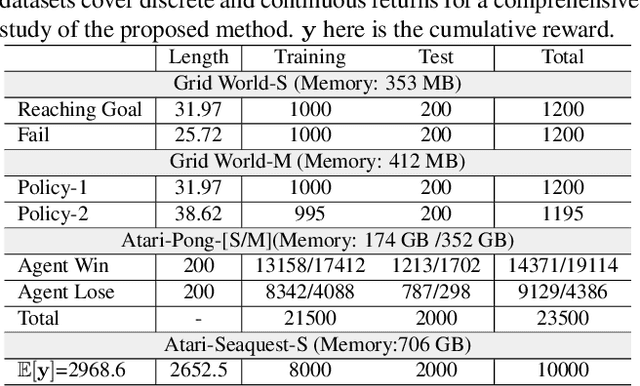
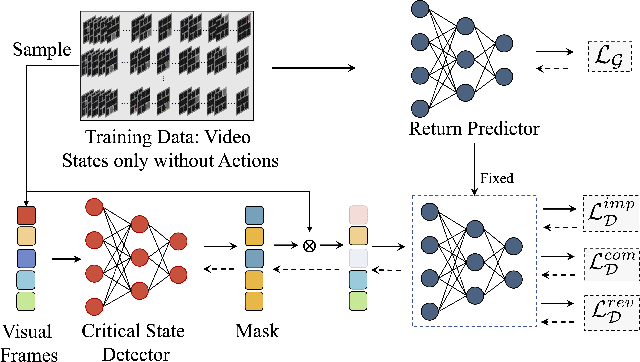
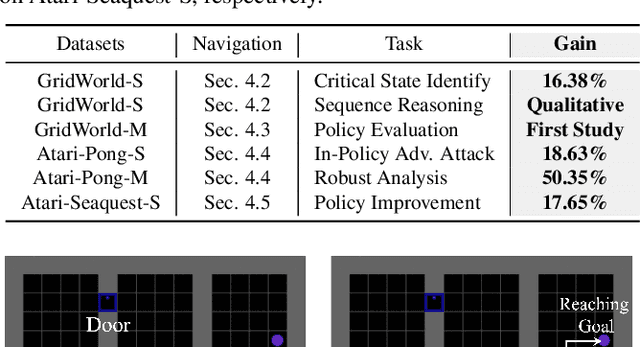
Recent work on deep reinforcement learning (DRL) has pointed out that algorithmic information about good policies can be extracted from offline data which lack explicit information about executed actions. For example, videos of humans or robots may convey a lot of implicit information about rewarding action sequences, but a DRL machine that wants to profit from watching such videos must first learn by itself to identify and recognize relevant states/actions/rewards. Without relying on ground-truth annotations, our new method called Deep State Identifier learns to predict returns from episodes encoded as videos. Then it uses a kind of mask-based sensitivity analysis to extract/identify important critical states. Extensive experiments showcase our method's potential for understanding and improving agent behavior. The source code and the generated datasets are available at https://github.com/AI-Initiative-KAUST/VideoRLCS.
Neural Collapse Terminus: A Unified Solution for Class Incremental Learning and Its Variants
Aug 03, 2023
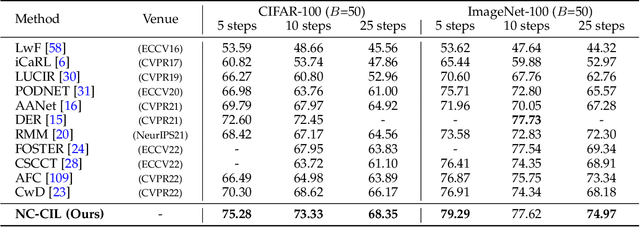
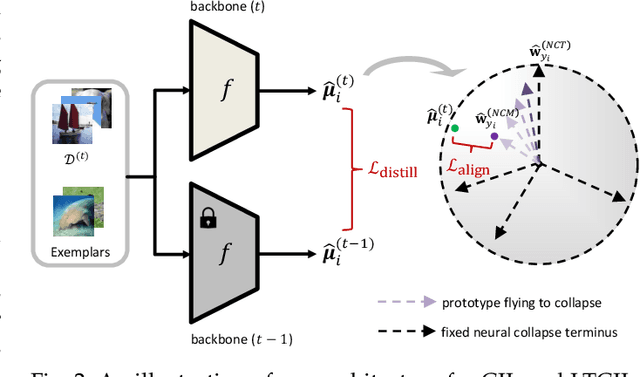
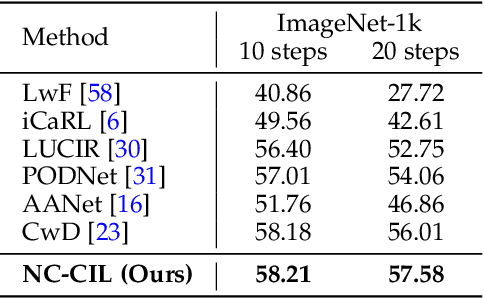
How to enable learnability for new classes while keeping the capability well on old classes has been a crucial challenge for class incremental learning. Beyond the normal case, long-tail class incremental learning and few-shot class incremental learning are also proposed to consider the data imbalance and data scarcity, respectively, which are common in real-world implementations and further exacerbate the well-known problem of catastrophic forgetting. Existing methods are specifically proposed for one of the three tasks. In this paper, we offer a unified solution to the misalignment dilemma in the three tasks. Concretely, we propose neural collapse terminus that is a fixed structure with the maximal equiangular inter-class separation for the whole label space. It serves as a consistent target throughout the incremental training to avoid dividing the feature space incrementally. For CIL and LTCIL, we further propose a prototype evolving scheme to drive the backbone features into our neural collapse terminus smoothly. Our method also works for FSCIL with only minor adaptations. Theoretical analysis indicates that our method holds the neural collapse optimality in an incremental fashion regardless of data imbalance or data scarcity. We also design a generalized case where we do not know the total number of classes and whether the data distribution is normal, long-tail, or few-shot for each coming session, to test the generalizability of our method. Extensive experiments with multiple datasets are conducted to demonstrate the effectiveness of our unified solution to all the three tasks and the generalized case.