 Add to Chrome
 Add to Firefox
 Add to Edge
MetaVideoAgent: Automated Video-Agent Evolution for Long-Form Video Understanding
Aug 05, 2026
Long-form video understanding requires locating sparse, question-relevant evidence in long, multimodal videos. Real-world video distributions differ in modality-specific information density, content structure, and evidence patterns, causing fixed video-agent designs to incur redundant processing or fail when mismatched. Extending automated agent evolution from text to video is challenging because full long-video execution makes candidate validation expensive, failures propagate across coupled evidence-processing stages, and complex preprocessing, perception tools, and localization strategies make code-level updates difficult to implement reliably. We introduce MetaVideoAgent, a framework that automatically evolves a video agent for a target distribution. It profiles information density and evidence requirements from sparsely sampled frames and associated queries to guide initial design, then compresses localized failures into independently executable minimal validation tasks. It constructs evidence-grounded Gold Paths, audits Student trajectories, aggregates recurring failures across samples, and attributes them to responsible modules. A modular agent representation constrains each update to the primary responsible module and its necessary dependencies. We further introduce VA-EvoBench, covering eight video distributions with separate evolution and held-out splits. With four evolution iterations per distribution, MetaVideoAgent improves every initial agent and raises macro-average accuracy from 38.44% to 51.47%, at an average evolution cost of 3.54M tokens per distribution. The evolved agents outperform the strongest prior fixed-design video agent by 6.39 percentage points while using the fewest tokens and video frames per question among the compared video agents. We will release all code and data to support reproducible research.

The Platonic Defense: Backdoor Defense for Self-Supervised Encoders in the Era of Large Scale Pre-training
Jun 28, 2026Self-supervised learning (SSL) pretrained models have become a dominant paradigm for visual representation learning, but they are vulnerable to backdoor attacks. Existing defenses struggle to defend against such attacks in a fully black-box setting because they often require access to labels, attack patterns, or training data. To tackle this issue, we propose a new attack-agnostic, model-agnostic, and modality-agnostic black-box test-time defense paradigm, called \emph{Platonic Representation Defense}. It is inspired by the Platonic Representation Hypothesis, which suggests that large-scale independently trained encoders converge toward compatible projections of the same underlying reality. We formalize this idea as a conditional energy function defined over source representations and a set of reference representations. The energy function is trained for detection through noise-contrastive estimation and for representation purification through denoising score matching. Theoretically, the energy gap between matched and mismatched samples is lower bounded by the mutual information between source and reference representations. We demonstrate the effectiveness of our method on multiple self-supervised encoders and more than 10 attacks. The method can perform both representation detection and purification, and achieves substantial performance gains across multiple attacks. Code is available \href{https://github.com/jsrdcht/Platonic-Representation-Defense}{here}.
Yuvion LLM: An Adversarially-Aware Large Language Model for Content And AI Safety
Jun 26, 2026As large language models are increasingly deployed in real-world systems, safety failures can still lead to harmful outputs and dangerous misuse. We argue that the essence of safety is adversarial: many failures arise not from natural inputs alone, but from strategic attempts to evade model policies and safeguards. However, existing general-purpose model development largely overlook this adversarial nature, and often remain insufficient for realistic safety scenarios involving planning, tool use, and multi-step reasoning, causing measured safety performance to overestimate real deployment robustness. To address this gap, we present Yuvion LLM, a large language model built for adversarially robust content safety and broader AI safety. Yuvion LLM treats adversarial robustness and agentic capability as first-class objectives. Its pipeline combines adversarially aware data construction, knowledge-enhanced continued pretraining, and policy-grounded multi-task safety post-training, including risk-aware supervised fine-tuning and reinforcement learning-based policy optimization, together with safety-aware agentic reinforcement learning for tool use and multi-step reasoning in complex safety scenarios. We further introduce the Yuvion LLM RiskEval (YLRE), a collection of 93 benchmarks across four evaluation categories, covering diverse open and internal evaluations with a focus on safety, adversarial robustness, and real-world capability requirements. Across these evaluations, Yuvion LLM demonstrates clear advantages on safety-focused benchmarks and particularly strong robustness under adversarial conditions, while maintaining solid overall capability. Notably, Yuvion-8B outperforms most state-of-the-art baselines, including substantially larger models such as GPT-5.4 and Qwen3-MAX, on several safety tasks.
Yuvion VL: A Multimodal Foundation Model for Adversarial Content and AI Safety
Jun 23, 2026General-purpose models often struggle to reliably identify and understand real-world multimodal risks, largely due to the inherent multimodal adversarial nature of content and AI safety. We present Yuvion VL, a family of multimodal large language models purpose-built for content and AI safety, with both instruction-tuned and reasoning-oriented variants. Yuvion VL addresses this gap by treating safety as an inherently adversarial and multimodal problem and designing the entire pipeline around adversarial robustness. For data construction, we develop an automated pipeline integrating adversarial-aware data synthesis with multi-stage quality control, producing large-scale, high-quality multimodal samples augmented with domain knowledge and reasoning annotations. For training, we adopt a three-stage pipeline that includes continued pretraining for risk-concept cross-modal alignment, instruct post-training for production-grade safety tasks, and reasoning post-training for enhanced interpretability and performance in complex tasks. We further introduce Confuse-then-Contrast Fine-Tuning, a contrastive framework that mines model-specific confusions and constructs multi-image contrastive groups to enforce explicit discrimination of fine-grained visual-semantic elements, enabling the model to distinguish between visually similar cases with different safety implications in adversarial safety tasks. To support rigorous evaluation, we further introduce Yuvion VL RiskEval (YVRE), a collection of benchmarks covering diverse open and internal evaluations, with a focus on content and AI safety, adversarial robustness, and real-world capability requirements. Experiments show that Yuvion VL-32B achieves industry-leading safety performance, surpassing comparably sized open-source models and best closed-source commercial models, while maintaining comparable general capabilities.
GUIDE: Interpretable GUI Agent Evaluation via Hierarchical Diagnosis
Apr 06, 2026Evaluating GUI agents presents a distinct challenge: trajectories are long, visually grounded, and open-ended, yet evaluation must be both accurate and interpretable. Existing approaches typically apply a single holistic judgment over the entire action-observation sequence-a strategy that proves unreliable on long-horizon tasks and yields binary verdicts offering no insight into where or why an agent fails. This opacity limits the utility of evaluation as a diagnostic tool for agent development. We introduce GUIDE (GUI Understanding and Interpretable Diagnostic Evaluation), a framework that decomposes trajectory assessment into three sequential stages mirroring the compositional structure of GUI tasks. Trajectory Segmentation partitions the full trace into semantically coherent subtask units. Subtask Diagnosis evaluates each unit in context, assigning a completion verdict and generating a structured error analysis with corrective recommendations. Overall Summary aggregates per-subtask diagnoses into a task-level judgment. By operating on bounded subtask segments rather than full trajectories, GUIDE mitigates the context overload that degrades existing evaluators as task complexity grows. We validate GUIDE on three benchmarks: an industrial e-commerce dataset of 932 trajectories, AGENTREWARDBENCH spanning five web agent tasks with 1302 trajectories, and AndroidBench for mobile device control. Across all settings, GUIDE substantially outperforms existing evaluators-achieving up to 5.35 percentage points higher accuracy than the strongest baseline-while producing structured diagnostic reports that directly inform agent improvement.
Diffusion Probe: Generated Image Result Prediction Using CNN Probes
Mar 05, 2026Text-to-image (T2I) diffusion models lack an efficient mechanism for early quality assessment, leading to costly trial-and-error in multi-generation scenarios such as prompt iteration, agent-based generation, and flow-grpo. We reveal a strong correlation between early diffusion cross-attention distributions and final image quality. Based on this finding, we introduce Diffusion Probe, a framework that leverages internal cross-attention maps as predictive signals. We design a lightweight predictor that maps statistical properties of early-stage cross-attention extracted from initial denoising steps to the final image's overall quality. This enables accurate forecasting of image quality across diverse evaluation metrics long before full synthesis is complete. We validate Diffusion Probe across a wide range of settings. On multiple T2I models, across early denoising windows, resolutions, and quality metrics, it achieves strong correlation (PCC > 0.7) and high classification performance (AUC-ROC > 0.9). Its reliability translates into practical gains. By enabling early quality-aware decisions in workflows such as prompt optimization, seed selection, and accelerated RL training, the probe supports more targeted sampling and avoids computation on low-potential generations. This reduces computational overhead while improving final output quality.Diffusion Probe is model-agnostic, efficient, and broadly applicable, offering a practical solution for improving T2I generation efficiency through early quality prediction.
TC-Padé: Trajectory-Consistent Padé Approximation for Diffusion Acceleration
Mar 03, 2026Despite achieving state-of-the-art generation quality, diffusion models are hindered by the substantial computational burden of their iterative sampling process. While feature caching techniques achieve effective acceleration at higher step counts (e.g., 50 steps), they exhibit critical limitations in the practical low-step regime of 20-30 steps. As the interval between steps increases, polynomial-based extrapolators like TaylorSeer suffer from error accumulation and trajectory drift. Meanwhile, conventional caching strategies often overlook the distinct dynamical properties of different denoising phases. To address these challenges, we propose Trajectory-Consistent Padé approximation, a feature prediction framework grounded in Padé approximation. By modeling feature evolution through rational functions, our approach captures asymptotic and transitional behaviors more accurately than Taylor-based methods. To enable stable and trajectory-consistent sampling under reduced step counts, TC-Padé incorporates (1) adaptive coefficient modulation that leverages historical cached residuals to detect subtle trajectory transitions, and (2) step-aware prediction strategies tailored to the distinct dynamics of early, mid, and late sampling stages. Extensive experiments on DiT-XL/2, FLUX.1-dev, and Wan2.1 across both image and video generation demonstrate the effectiveness of TC-Padé. For instance, TC-Padé achieves 2.88x acceleration on FLUX.1-dev and 1.72x on Wan2.1 while maintaining high quality across FID, CLIP, Aesthetic, and VBench-2.0 metrics, substantially outperforming existing feature caching methods.
CME-CAD: Heterogeneous Collaborative Multi-Expert Reinforcement Learning for CAD Code Generation
Dec 29, 2025Computer-Aided Design (CAD) is essential in industrial design, but the complexity of traditional CAD modeling and workflows presents significant challenges for automating the generation of high-precision, editable CAD models. Existing methods that reconstruct 3D models from sketches often produce non-editable and approximate models that fall short of meeting the stringent requirements for precision and editability in industrial design. Moreover, the reliance on text or image-based inputs often requires significant manual annotation, limiting their scalability and applicability in industrial settings. To overcome these challenges, we propose the Heterogeneous Collaborative Multi-Expert Reinforcement Learning (CME-CAD) paradigm, a novel training paradigm for CAD code generation. Our approach integrates the complementary strengths of these models, facilitating collaborative learning and improving the model's ability to generate accurate, constraint-compatible, and fully editable CAD models. We introduce a two-stage training process: Multi-Expert Fine-Tuning (MEFT), and Multi-Expert Reinforcement Learning (MERL). Additionally, we present CADExpert, an open-source benchmark consisting of 17,299 instances, including orthographic projections with precise dimension annotations, expert-generated Chain-of-Thought (CoT) processes, executable CADQuery code, and rendered 3D models.
Erase Diffusion: Empowering Object Removal Through Calibrating Diffusion Pathways
Mar 10, 2025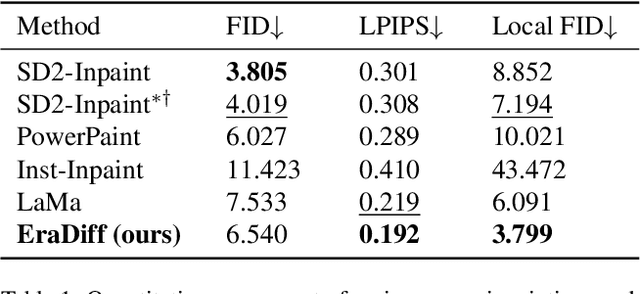
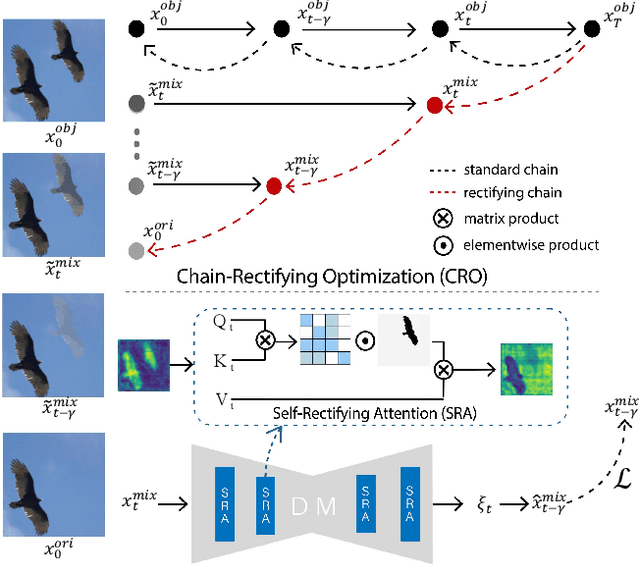
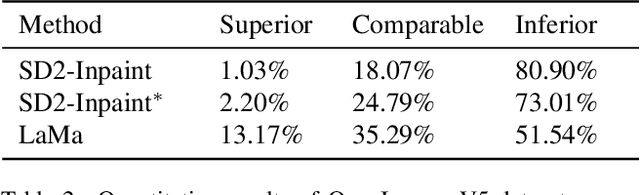

Erase inpainting, or object removal, aims to precisely remove target objects within masked regions while preserving the overall consistency of the surrounding content. Despite diffusion-based methods have made significant strides in the field of image inpainting, challenges remain regarding the emergence of unexpected objects or artifacts. We assert that the inexact diffusion pathways established by existing standard optimization paradigms constrain the efficacy of object removal. To tackle these challenges, we propose a novel Erase Diffusion, termed EraDiff, aimed at unleashing the potential power of standard diffusion in the context of object removal. In contrast to standard diffusion, the EraDiff adapts both the optimization paradigm and the network to improve the coherence and elimination of the erasure results. We first introduce a Chain-Rectifying Optimization (CRO) paradigm, a sophisticated diffusion process specifically designed to align with the objectives of erasure. This paradigm establishes innovative diffusion transition pathways that simulate the gradual elimination of objects during optimization, allowing the model to accurately capture the intent of object removal. Furthermore, to mitigate deviations caused by artifacts during the sampling pathways, we develop a simple yet effective Self-Rectifying Attention (SRA) mechanism. The SRA calibrates the sampling pathways by altering self-attention activation, allowing the model to effectively bypass artifacts while further enhancing the coherence of the generated content. With this design, our proposed EraDiff achieves state-of-the-art performance on the OpenImages V5 dataset and demonstrates significant superiority in real-world scenarios.
Attentive Eraser: Unleashing Diffusion Model's Object Removal Potential via Self-Attention Redirection Guidance
Dec 17, 2024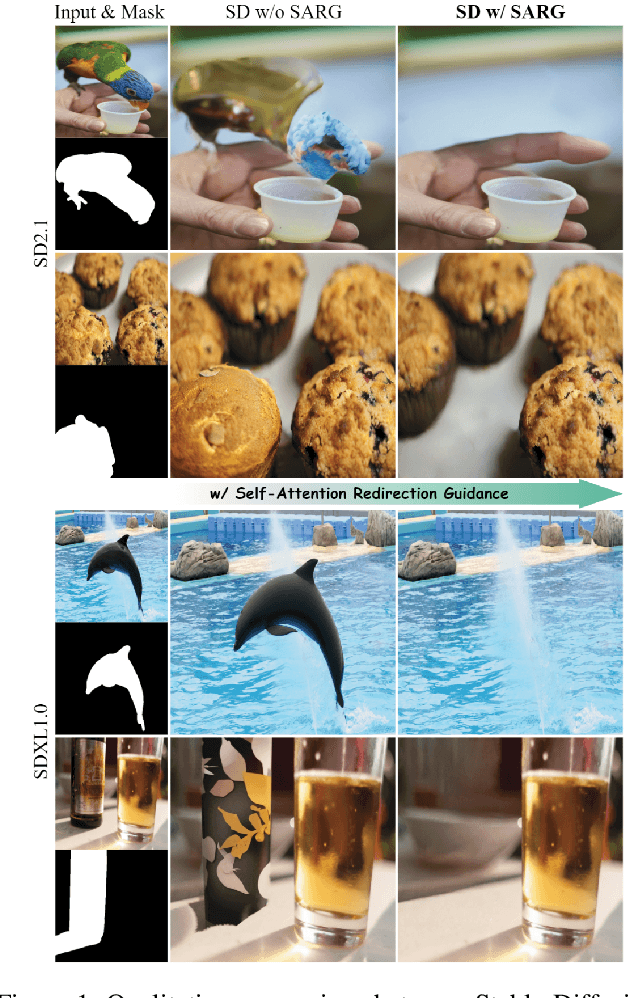
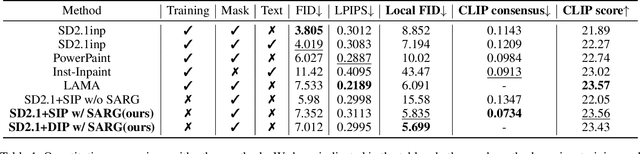
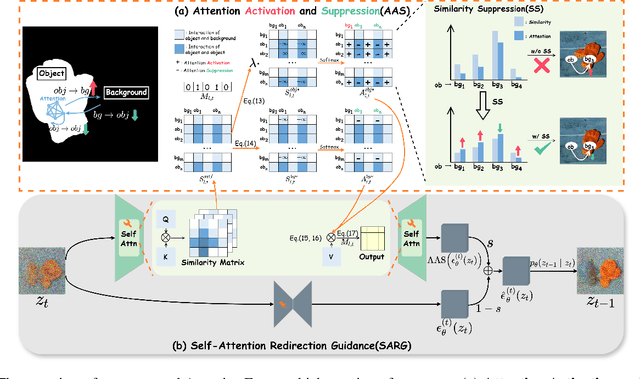
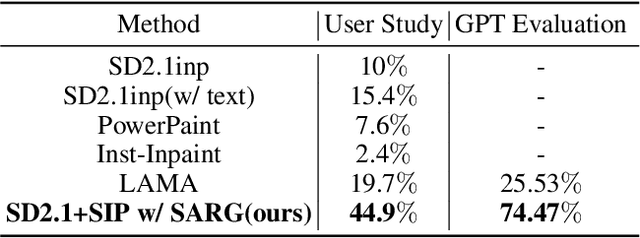
Recently, diffusion models have emerged as promising newcomers in the field of generative models, shining brightly in image generation. However, when employed for object removal tasks, they still encounter issues such as generating random artifacts and the incapacity to repaint foreground object areas with appropriate content after removal. To tackle these problems, we propose Attentive Eraser, a tuning-free method to empower pre-trained diffusion models for stable and effective object removal. Firstly, in light of the observation that the self-attention maps influence the structure and shape details of the generated images, we propose Attention Activation and Suppression (ASS), which re-engineers the self-attention mechanism within the pre-trained diffusion models based on the given mask, thereby prioritizing the background over the foreground object during the reverse generation process. Moreover, we introduce Self-Attention Redirection Guidance (SARG), which utilizes the self-attention redirected by ASS to guide the generation process, effectively removing foreground objects within the mask while simultaneously generating content that is both plausible and coherent. Experiments demonstrate the stability and effectiveness of Attentive Eraser in object removal across a variety of pre-trained diffusion models, outperforming even training-based methods. Furthermore, Attentive Eraser can be implemented in various diffusion model architectures and checkpoints, enabling excellent scalability. Code is available at https://github.com/Anonym0u3/AttentiveEraser.