 Add to Chrome
 Add to Firefox
 Add to Edge
Tac4Loco: Learning Spatiotemporal Plantar Pressure Representations for Humanoid Locomotion
Aug 16, 2026
Humanoid robots are expected to traverse complex terrains, where the plantar support may vary dramatically due to foot placement errors, ground properties, and transient dynamics. To achieve robust locomotion, the robots are required to adapt to uneven terrain and uncertain foot--ground interactions. Existing locomotion policies rely primarily on proprioception or exteroceptive terrain perception, where the former provides only indirect evidence of plantar support, while the latter predicts contact conditions before touchdown but cannot observe the actual support in real-time. Although some studies incorporate plantar contacts as an auxiliary perception, they rely mainly on summary statistics, overlooking the spatial topology of plantar pressure, which provides a more direct characterization of the realized contact state. To bridge this gap, we present Tac4Loco, a tactile-perceptive framework that incorporates multi-array plantar pressure as direct feedback for humanoid locomotion. We formulate a topology-preserving ordinal representation to map simulated and physical sensor signals into a shared observation space, with a dual-branch encoder for extracting their spatial and temporal representations. Subsequently, the learned spatiotemporal features are integrated with augmented proprioception including terrain estimation cues, and provided to an asymmetric actor-critic architecture for policy learning. Extensive simulation and real-world experiments demonstrate improved tracking performance and support adaptation on terrains with inclined, partial, asymmetric, and changing support. We further demonstrate its zero-shot deployment on unseen compliant and unstructured terrains, including a foam platform and a gravel road. All code and experimental configurations will be released as open-source to facilitate reproducibility.

FT-WBC: Learning Fault-Tolerant Whole-Body Control for Legged Loco-Manipulation
Jun 23, 2026Legged manipulators combine the mobility of legged platforms with the manipulation capability of robotic arms. However, arm-induced Center-of-Mass shifts and dynamic disturbances make the system more prone to instability under actuator failures, potentially leading to falls, task failures, or safety risks. Existing fault-tolerant control methods mainly focus on locomotion alone, leaving the coupled problem of whole-body stability and arm reachability in fault-tolerant loco-manipulation largely unaddressed. To bridge this gap, we propose FT-WBC, a fault-tolerant loco-manipulation framework for robust whole-body control of legged manipulators under actuator failures. FT-WBC adopts a decoupled upper- and lower-body policy architecture and introduces two key modules: a Fault Estimator (FE) and a Posture Adaptation Module (PAM). The FE predicts faulty joints from lower-body proprioceptive histories, while the PAM uses this fault information to adapt the base posture plan generated by the arm policy, converting potentially unstable posture requests into safe and executable base posture commands. Through this fault-aware posture adaptation mechanism, FT-WBC synthesizes compensatory gaits under actuator failures and preserves as much arm workspace as possible while maintaining whole-body stability. Simulation and real-world experiments show that FT-WBC significantly improves survival rate and workspace under weakening or locked failures, and transfers zero-shot to a real legged manipulator in the real world.
Learning Terrain-Aware Whole-Body Control for Perceptive Legged Loco-Manipulation
May 29, 2026Legged manipulators integrate exceptional terrain adaptability along with mobile manipulation capabilities, which make them highly promising for deployment in human-centric environments. By coordinating the control of both legs and arms, a whole-body controller can significantly expand the operational workspace of legged manipulators. However, many existing whole-body controllers primarily depend on proprioception and do not incorporate the critical exteroception required for effective terrain topology perception. This limitation can hinder their ability to adapt to varying environmental conditions and navigate complex terrains effectively. In this paper, we introduce TA-WBC, a terrain-aware whole-body control framework for legged manipulators, which features a novel RL-based unified policy tailored to whole-body loco-manipulation tasks in various terrains. Specifically, we employ a hybrid exteroception encoder to extract terrain features, providing an essential basis for the robot to proactively adapt posture and footholds. Furthermore, to facilitate stable cross-terrain loco-manipulation, we propose a novel end-effector sampling method based on the foot contact plane, decoupling manipulation target from base fluctuations. Moreover, a dual-policy distillation module is introduced to integrate expansive whole-body motion with terrain adaptability without catastrophic forgetting. The simulation and real-world experiments validate the robustness of our proposed controller, which leads to a larger reachable space, less tracking error, and reduced unexpected stumbles. This unified policy highlights the promising capabilities of legged manipulators in performing loco-manipulation tasks across complex terrains.
Real-to-Sim for Highly Cluttered Environments via Physics-Consistent Inter-Object Reasoning
Feb 13, 2026Reconstructing physically valid 3D scenes from single-view observations is a prerequisite for bridging the gap between visual perception and robotic control. However, in scenarios requiring precise contact reasoning, such as robotic manipulation in highly cluttered environments, geometric fidelity alone is insufficient. Standard perception pipelines often neglect physical constraints, resulting in invalid states, e.g., floating objects or severe inter-penetration, rendering downstream simulation unreliable. To address these limitations, we propose a novel physics-constrained Real-to-Sim pipeline that reconstructs physically consistent 3D scenes from single-view RGB-D data. Central to our approach is a differentiable optimization pipeline that explicitly models spatial dependencies via a contact graph, jointly refining object poses and physical properties through differentiable rigid-body simulation. Extensive evaluations in both simulation and real-world settings demonstrate that our reconstructed scenes achieve high physical fidelity and faithfully replicate real-world contact dynamics, enabling stable and reliable contact-rich manipulation.
RoboDexVLM: Visual Language Model-Enabled Task Planning and Motion Control for Dexterous Robot Manipulation
Mar 03, 2025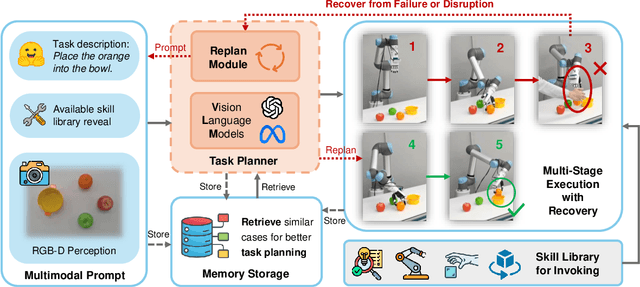
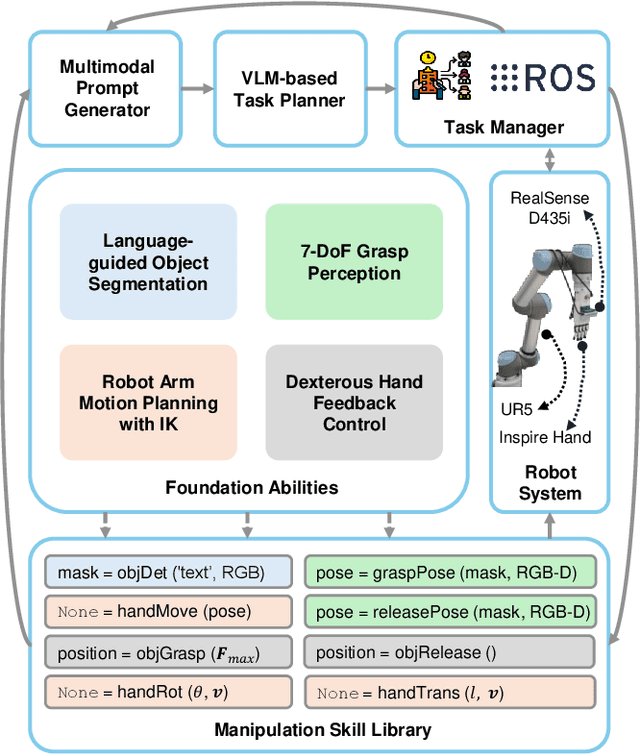
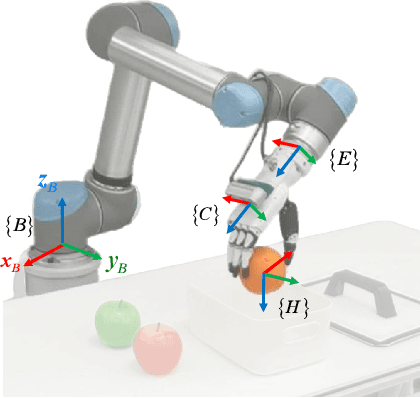
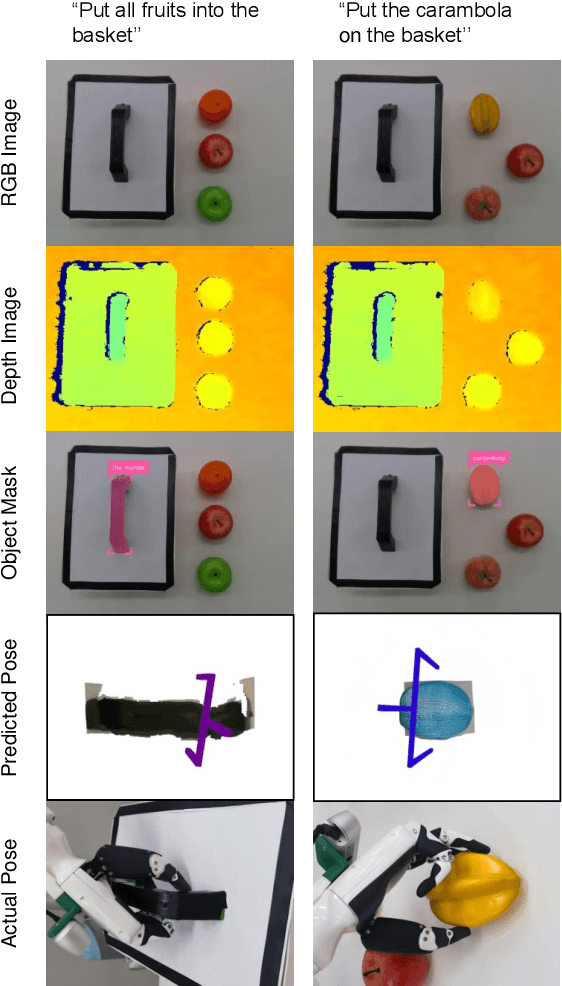
This paper introduces RoboDexVLM, an innovative framework for robot task planning and grasp detection tailored for a collaborative manipulator equipped with a dexterous hand. Previous methods focus on simplified and limited manipulation tasks, which often neglect the complexities associated with grasping a diverse array of objects in a long-horizon manner. In contrast, our proposed framework utilizes a dexterous hand capable of grasping objects of varying shapes and sizes while executing tasks based on natural language commands. The proposed approach has the following core components: First, a robust task planner with a task-level recovery mechanism that leverages vision-language models (VLMs) is designed, which enables the system to interpret and execute open-vocabulary commands for long sequence tasks. Second, a language-guided dexterous grasp perception algorithm is presented based on robot kinematics and formal methods, tailored for zero-shot dexterous manipulation with diverse objects and commands. Comprehensive experimental results validate the effectiveness, adaptability, and robustness of RoboDexVLM in handling long-horizon scenarios and performing dexterous grasping. These results highlight the framework's ability to operate in complex environments, showcasing its potential for open-vocabulary dexterous manipulation. Our open-source project page can be found at https://henryhcliu.github.io/robodexvlm.
Dynamic Object Tracking for Quadruped Manipulator with Spherical Image-Based Approach
Jul 14, 2023Exactly estimating and tracking the motion of surrounding dynamic objects is one of important tasks for the autonomy of a quadruped manipulator. However, with only an onboard RGB camera, it is still a challenging work for a quadruped manipulator to track the motion of a dynamic object moving with unknown and changing velocities. To address this problem, this manuscript proposes a novel image-based visual servoing (IBVS) approach consisting of three elements: a spherical projection model, a robust super-twisting observer, and a model predictive controller (MPC). The spherical projection model decouples the visual error of the dynamic target into linear and angular ones. Then, with the presence of the visual error, the robustness of the observer is exploited to estimate the unknown and changing velocities of the dynamic target without depth estimation. Finally, the estimated velocity is fed into the model predictive controller (MPC) to generate joint torques for the quadruped manipulator to track the motion of the dynamical target. The proposed approach is validated through hardware experiments and the experimental results illustrate the approach's effectiveness in improving the autonomy of the quadruped manipulator.