 Add to Chrome
 Add to Firefox
 Add to Edge
Slot Filling
Papers and Code
Explainable and Accurate Natural Language Understanding for Voice Assistants and Beyond
Sep 25, 2023
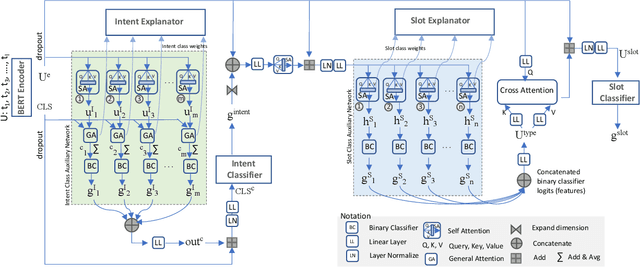
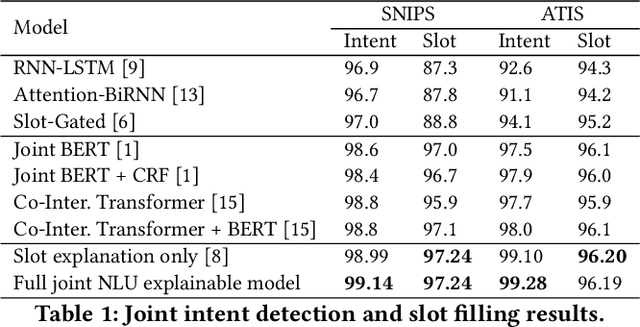
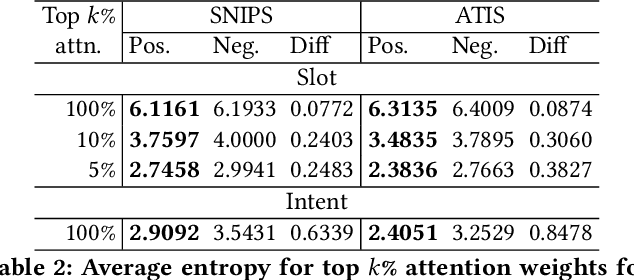
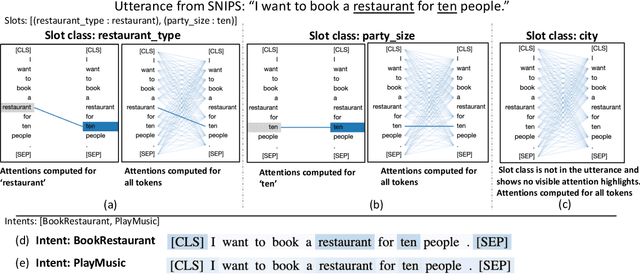
Joint intent detection and slot filling, which is also termed as joint NLU (Natural Language Understanding) is invaluable for smart voice assistants. Recent advancements in this area have been heavily focusing on improving accuracy using various techniques. Explainability is undoubtedly an important aspect for deep learning-based models including joint NLU models. Without explainability, their decisions are opaque to the outside world and hence, have tendency to lack user trust. Therefore to bridge this gap, we transform the full joint NLU model to be `inherently' explainable at granular levels without compromising on accuracy. Further, as we enable the full joint NLU model explainable, we show that our extension can be successfully used in other general classification tasks. We demonstrate this using sentiment analysis and named entity recognition.

Knowledge-Aware Audio-Grounded Generative Slot Filling for Limited Annotated Data
Jul 04, 2023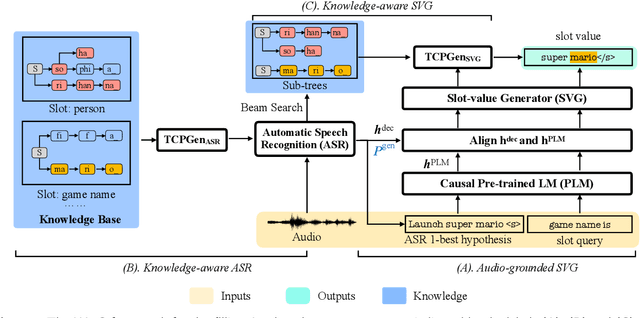

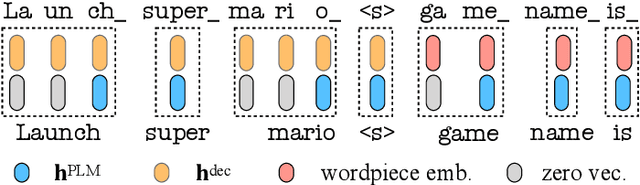

Manually annotating fine-grained slot-value labels for task-oriented dialogue (ToD) systems is an expensive and time-consuming endeavour. This motivates research into slot-filling methods that operate with limited amounts of labelled data. Moreover, the majority of current work on ToD is based solely on text as the input modality, neglecting the additional challenges of imperfect automatic speech recognition (ASR) when working with spoken language. In this work, we propose a Knowledge-Aware Audio-Grounded generative slot-filling framework, termed KA2G, that focuses on few-shot and zero-shot slot filling for ToD with speech input. KA2G achieves robust and data-efficient slot filling for speech-based ToD by 1) framing it as a text generation task, 2) grounding text generation additionally in the audio modality, and 3) conditioning on available external knowledge (e.g. a predefined list of possible slot values). We show that combining both modalities within the KA2G framework improves the robustness against ASR errors. Further, the knowledge-aware slot-value generator in KA2G, implemented via a pointer generator mechanism, particularly benefits few-shot and zero-shot learning. Experiments, conducted on the standard speech-based single-turn SLURP dataset and a multi-turn dataset extracted from a commercial ToD system, display strong and consistent gains over prior work, especially in few-shot and zero-shot setups.
Generalized Multiple Intent Conditioned Slot Filling
May 18, 2023


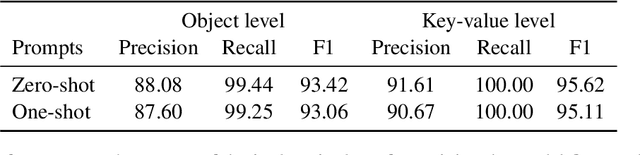
Natural language understanding includes the tasks of intent detection (identifying a user's objectives) and slot filling (extracting the entities relevant to those objectives). Prior slot filling methods assume that each intent type cannot occur more than once within a message, however this is often not a valid assumption for real-world settings. In this work, we generalize slot filling by removing the constraint of unique intents in a message. We cast this as a JSON generation task and approach it using a language model. We create a pre-training dataset by combining DBpedia and existing slot filling datasets that we convert for JSON generation. We also generate an in-domain dataset using GPT-3. We train T5 models for this task (with and without exemplars in the prompt) and find that both training datasets improve performance, and that the model is able to generalize to intent types not seen during training.
Task Conditioned BERT for Joint Intent Detection and Slot-filling
Aug 11, 2023
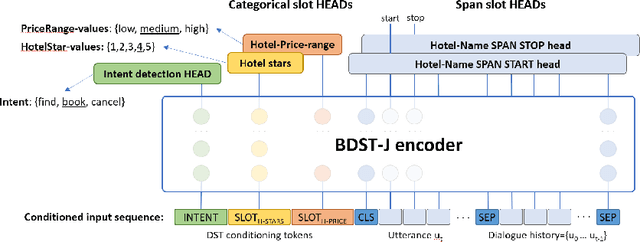
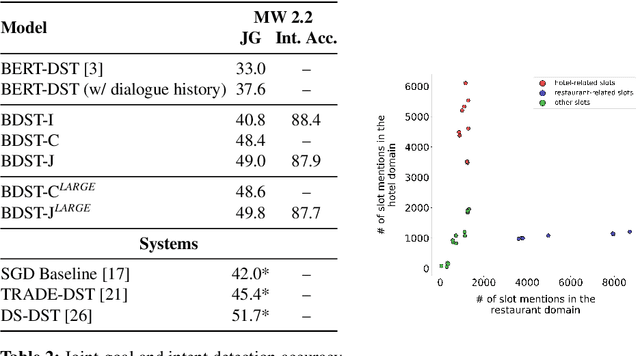

Dialogue systems need to deal with the unpredictability of user intents to track dialogue state and the heterogeneity of slots to understand user preferences. In this paper we investigate the hypothesis that solving these challenges as one unified model will allow the transfer of parameter support data across the different tasks. The proposed principled model is based on a Transformer encoder, trained on multiple tasks, and leveraged by a rich input that conditions the model on the target inferences. Conditioning the Transformer encoder on multiple target inferences over the same corpus, i.e., intent and multiple slot types, allows learning richer language interactions than a single-task model would be able to. In fact, experimental results demonstrate that conditioning the model on an increasing number of dialogue inference tasks leads to improved results: on the MultiWOZ dataset, the joint intent and slot detection can be improved by 3.2\% by conditioning on intent, 10.8\% by conditioning on slot and 14.4\% by conditioning on both intent and slots. Moreover, on real conversations with Farfetch costumers, the proposed conditioned BERT can achieve high joint-goal and intent detection performance throughout a dialogue.
Leveraging Multilingual Self-Supervised Pretrained Models for Sequence-to-Sequence End-to-End Spoken Language Understanding
Oct 09, 2023A number of methods have been proposed for End-to-End Spoken Language Understanding (E2E-SLU) using pretrained models, however their evaluation often lacks multilingual setup and tasks that require prediction of lexical fillers, such as slot filling. In this work, we propose a unified method that integrates multilingual pretrained speech and text models and performs E2E-SLU on six datasets in four languages in a generative manner, including the prediction of lexical fillers. We investigate how the proposed method can be improved by pretraining on widely available speech recognition data using several training objectives. Pretraining on 7000 hours of multilingual data allows us to outperform the state-of-the-art ultimately on two SLU datasets and partly on two more SLU datasets. Finally, we examine the cross-lingual capabilities of the proposed model and improve on the best known result on the PortMEDIA-Language dataset by almost half, achieving a Concept/Value Error Rate of 23.65%.
Improving End-to-End Speech Processing by Efficient Text Data Utilization with Latent Synthesis
Oct 24, 2023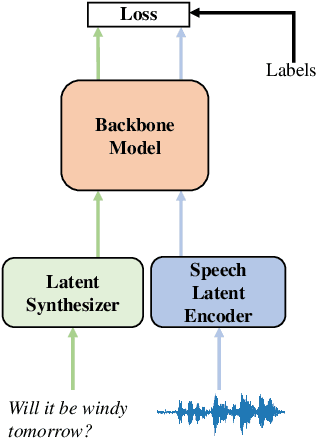
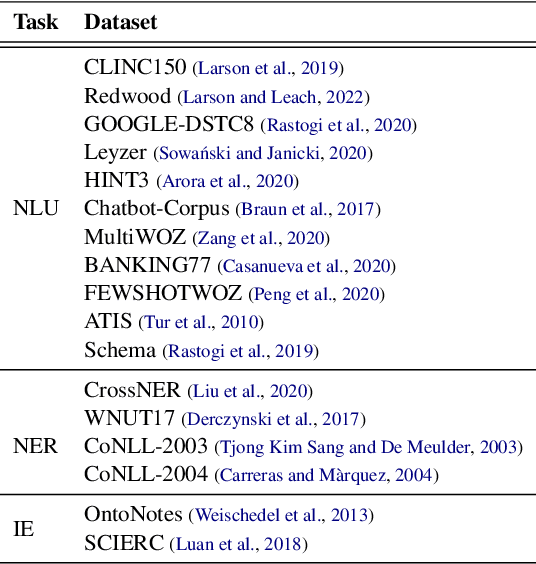
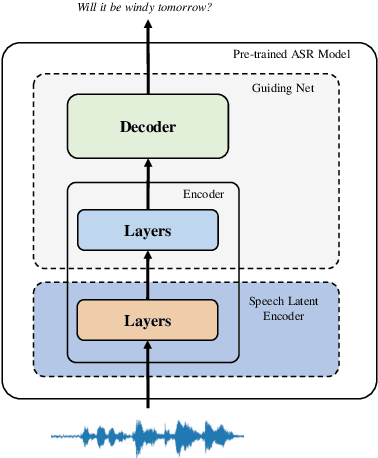
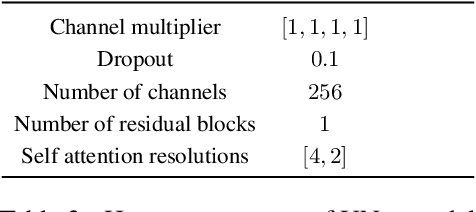
Training a high performance end-to-end speech (E2E) processing model requires an enormous amount of labeled speech data, especially in the era of data-centric artificial intelligence. However, labeled speech data are usually scarcer and more expensive for collection, compared to textual data. We propose Latent Synthesis (LaSyn), an efficient textual data utilization framework for E2E speech processing models. We train a latent synthesizer to convert textual data into an intermediate latent representation of a pre-trained speech model. These pseudo acoustic representations of textual data augment acoustic data for model training. We evaluate LaSyn on low-resource automatic speech recognition (ASR) and spoken language understanding (SLU) tasks. For ASR, LaSyn improves an E2E baseline trained on LibriSpeech train-clean-100, with relative word error rate reductions over 22.3% on different test sets. For SLU, LaSyn improves our E2E baseline by absolute 4.1% for intent classification accuracy and 3.8% for slot filling SLU-F1 on SLURP, and absolute 4.49% and 2.25% for exact match (EM) and EM-Tree accuracies on STOP respectively. With fewer parameters, the results of LaSyn are competitive to published state-of-the-art works. The results demonstrate the quality of the augmented training data.
Prompting and Adapter Tuning for Self-supervised Encoder-Decoder Speech Model
Oct 04, 2023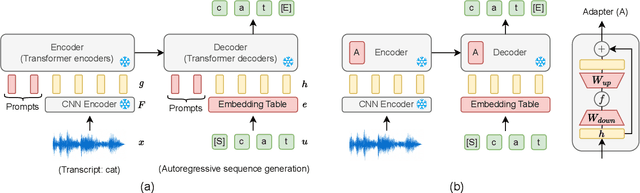
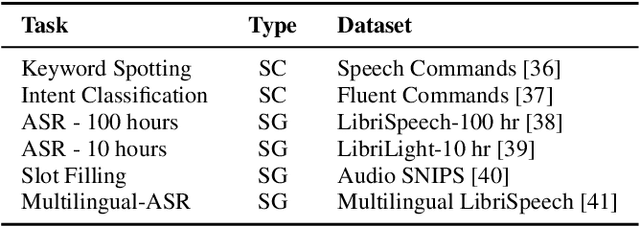
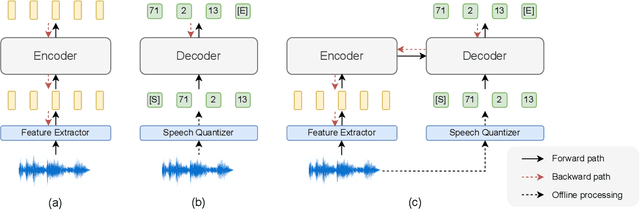

Prompting and adapter tuning have emerged as efficient alternatives to fine-tuning (FT) methods. However, existing studies on speech prompting focused on classification tasks and failed on more complex sequence generation tasks. Besides, adapter tuning is primarily applied with a focus on encoder-only self-supervised models. Our experiments show that prompting on Wav2Seq, a self-supervised encoder-decoder model, surpasses previous works in sequence generation tasks. It achieves a remarkable 53% relative improvement in word error rate for ASR and a 27% in F1 score for slot filling. Additionally, prompting competes with the FT method in the low-resource scenario. Moreover, we show the transferability of prompting and adapter tuning on Wav2Seq in cross-lingual ASR. When limited trainable parameters are involved, prompting and adapter tuning consistently outperform conventional FT across 7 languages. Notably, in the low-resource scenario, prompting consistently outperforms adapter tuning.
Leveraging Pretrained ASR Encoders for Effective and Efficient End-to-End Speech Intent Classification and Slot Filling
Jul 13, 2023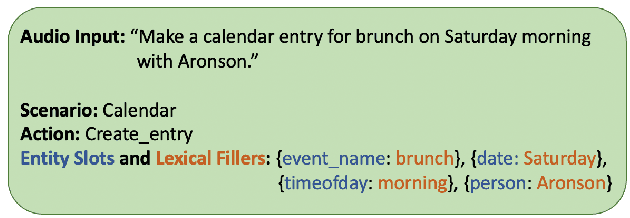
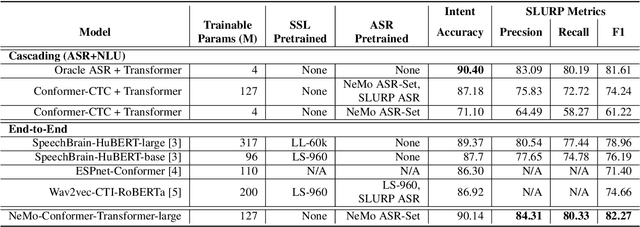

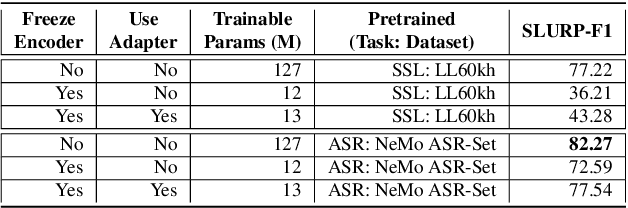
We study speech intent classification and slot filling (SICSF) by proposing to use an encoder pretrained on speech recognition (ASR) to initialize an end-to-end (E2E) Conformer-Transformer model, which achieves the new state-of-the-art results on the SLURP dataset, with 90.14% intent accuracy and 82.27% SLURP-F1. We compare our model with encoders pretrained on self-supervised learning (SSL), and show that ASR pretraining is much more effective than SSL for SICSF. To explore parameter efficiency, we freeze the encoder and add Adapter modules, and show that parameter efficiency is only achievable with an ASR-pretrained encoder, while the SSL encoder needs full finetuning to achieve comparable results. In addition, we provide an in-depth comparison on end-to-end models versus cascading models (ASR+NLU), and show that E2E models are better than cascaded models unless an oracle ASR model is provided. Last but not least, our model is the first E2E model that achieves the same performance as cascading models with oracle ASR. Code, checkpoints and configs are available.
SALMONN: Towards Generic Hearing Abilities for Large Language Models
Oct 20, 2023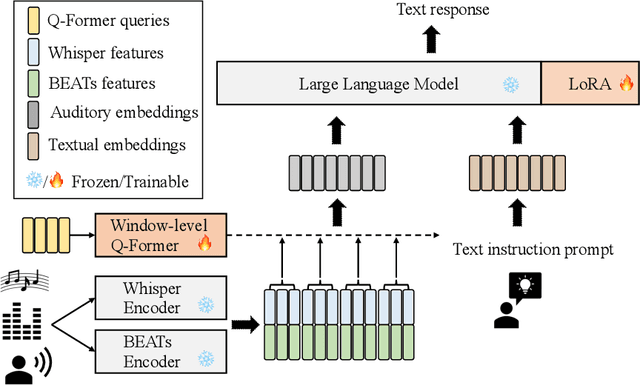

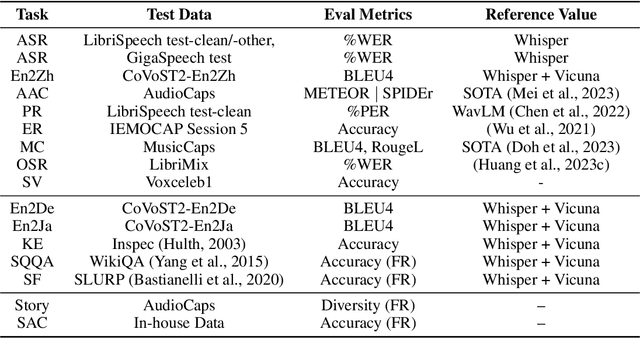

Hearing is arguably an essential ability of artificial intelligence (AI) agents in the physical world, which refers to the perception and understanding of general auditory information consisting of at least three types of sounds: speech, audio events, and music. In this paper, we propose SALMONN, a speech audio language music open neural network, built by integrating a pre-trained text-based large language model (LLM) with speech and audio encoders into a single multimodal model. SALMONN enables the LLM to directly process and understand general audio inputs and achieve competitive performances on a number of speech and audio tasks used in training, such as automatic speech recognition and translation, auditory-information-based question answering, emotion recognition, speaker verification, and music and audio captioning \textit{etc.} SALMONN also has a diverse set of emergent abilities unseen in the training, which includes but is not limited to speech translation to untrained languages, speech-based slot filling, spoken-query-based question answering, audio-based storytelling, and speech audio co-reasoning \textit{etc}. The presence of the cross-modal emergent abilities is studied, and a novel few-shot activation tuning approach is proposed to activate such abilities of SALMONN. To our knowledge, SALMONN is the first model of its type and can be regarded as a step towards AI with generic hearing abilities. An interactive demo of SALMONN is available at \texttt{\url{https://github.com/bytedance/SALMONN}}, and the training code and model checkpoints will be released upon acceptance.
Slot Induction via Pre-trained Language Model Probing and Multi-level Contrastive Learning
Aug 09, 2023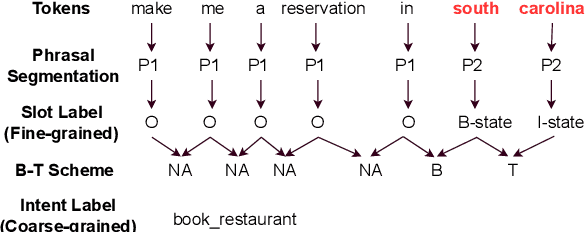

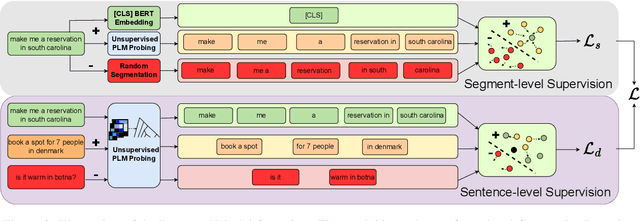

Recent advanced methods in Natural Language Understanding for Task-oriented Dialogue (TOD) Systems (e.g., intent detection and slot filling) require a large amount of annotated data to achieve competitive performance. In reality, token-level annotations (slot labels) are time-consuming and difficult to acquire. In this work, we study the Slot Induction (SI) task whose objective is to induce slot boundaries without explicit knowledge of token-level slot annotations. We propose leveraging Unsupervised Pre-trained Language Model (PLM) Probing and Contrastive Learning mechanism to exploit (1) unsupervised semantic knowledge extracted from PLM, and (2) additional sentence-level intent label signals available from TOD. Our approach is shown to be effective in SI task and capable of bridging the gaps with token-level supervised models on two NLU benchmark datasets. When generalized to emerging intents, our SI objectives also provide enhanced slot label representations, leading to improved performance on the Slot Filling tasks.