 Add to Chrome
 Add to Firefox
 Add to Edge
ZSL
Papers and Code
Incentivizing Generative Zero-Shot Learning via Outcome-Reward Reinforcement Learning with Visual Cues
Mar 22, 2026
Recent advances in zero-shot learning (ZSL) have demonstrated the potential of generative models. Typically, generative ZSL synthesizes visual features conditioned on semantic prototypes to model the data distribution of unseen classes, followed by training a classifier on the synthesized data. However, the synthesized features often remain task-agnostic, leading to degraded performance. Moreover, inferring a faithful distribution from semantic prototypes alone is insufficient for classes that are semantically similar but visually distinct. To address these and advance ZSL, we propose RLVC, an outcome-reward reinforcement learning RL framework with visual cues for generative ZSL. At its core, RL empowers the generative model to self-evolve, implicitly enhancing its generation capability. In particular, RLVC updates the generative model using an outcome-based reward, encouraging the synthesis of task-relevant features. Furthermore, we introduce class-wise visual cues that (i) align synthesized features with visual prototypes and (ii) stabilize the RL training updates. For the training process, we present a novel cold-start strategy. Comprehensive experiments and analyses on three prevalent ZSL benchmarks demonstrate that RLVC achieves state-of-the-art results with a 4.7% gain.

Mutually Causal Semantic Distillation Network for Zero-Shot Learning
Mar 18, 2026Zero-shot learning (ZSL) aims to recognize the unseen classes in the open-world guided by the side-information (e.g., attributes). Its key task is how to infer the latent semantic knowledge between visual and attribute features on seen classes, and thus conducting a desirable semantic knowledge transfer from seen classes to unseen ones. Prior works simply utilize unidirectional attention within a weakly-supervised manner to learn the spurious and limited latent semantic representations, which fail to effectively discover the intrinsic semantic knowledge (e.g., attribute semantic) between visual and attribute features. To solve the above challenges, we propose a mutually causal semantic distillation network (termed MSDN++) to distill the intrinsic and sufficient semantic representations for ZSL. MSDN++ consists of an attribute$\rightarrow$visual causal attention sub-net that learns attribute-based visual features, and a visual$\rightarrow$attribute causal attention sub-net that learns visual-based attribute features. The causal attentions encourages the two sub-nets to learn causal vision-attribute associations for representing reliable features with causal visual/attribute learning. With the guidance of semantic distillation loss, the two mutual attention sub-nets learn collaboratively and teach each other throughout the training process. Extensive experiments on three widely-used benchmark datasets (e.g., CUB, SUN, AWA2, and FLO) show that our MSDN++ yields significant improvements over the strong baselines, leading to new state-of-the-art performances.
CLIP-driven Zero-shot Learning with Ambiguous Labels
Mar 05, 2026Zero-shot learning (ZSL) aims to recognize unseen classes by leveraging semantic information from seen classes, but most existing methods assume accurate class labels for training instances. However, in real-world scenarios, noise and ambiguous labels can significantly reduce the performance of ZSL. To address this, we propose a new CLIP-driven partial label zero-shot learning (CLIP-PZSL) framework to handle label ambiguity. First, we use CLIP to extract instance and label features. Then, a semantic mining block fuses these features to extract discriminative label embeddings. We also introduce a partial zero-shot loss, which assigns weights to candidate labels based on their relevance to the instance and aligns instance and label embeddings to minimize semantic mismatch. As the training goes on, the ground-truth labels are progressively identified, and the refined labels and label embeddings in turn help improve the semantic alignment of instance and label features. Comprehensive experiments on several datasets demonstrate the advantage of CLIP-PZSL.
ZeroDiff++: Substantial Unseen Visual-semantic Correlation in Zero-shot Learning
Feb 12, 2026Zero-shot Learning (ZSL) enables classifiers to recognize classes unseen during training, commonly via generative two stage methods: (1) learn visual semantic correlations from seen classes; (2) synthesize unseen class features from semantics to train classifiers. In this paper, we identify spurious visual semantic correlations in existing generative ZSL worsened by scarce seen class samples and introduce two metrics to quantify spuriousness for seen and unseen classes. Furthermore, we point out a more critical bottleneck: existing unadaptive fully noised generators produce features disconnected from real test samples, which also leads to the spurious correlation. To enhance the visual-semantic correlations on both seen and unseen classes, we propose ZeroDiff++, a diffusion-based generative framework. In training, ZeroDiff++ uses (i) diffusion augmentation to produce diverse noised samples, (ii) supervised contrastive (SC) representations for instance level semantics, and (iii) multi view discriminators with Wasserstein mutual learning to assess generated features. At generation time, we introduce (iv) Diffusion-based Test time Adaptation (DiffTTA) to adapt the generator using pseudo label reconstruction, and (v) Diffusion-based Test time Generation (DiffGen) to trace the diffusion denoising path and produce partially synthesized features that connect real and generated data, and mitigates data scarcity further. Extensive experiments on three ZSL benchmarks demonstrate that ZeroDiff++ not only achieves significant improvements over existing ZSL methods but also maintains robust performance even with scarce training data. Code would be available.
Adversarial Robustness in Zero-Shot Learning:An Empirical Study on Class and Concept-Level Vulnerabilities
Dec 21, 2025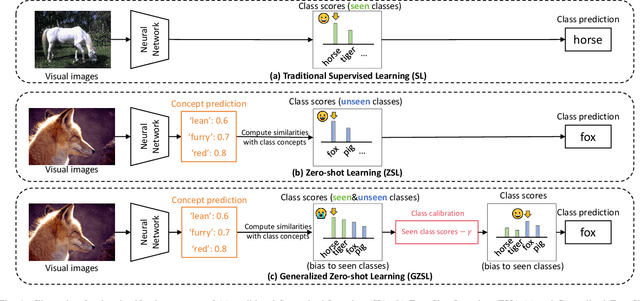
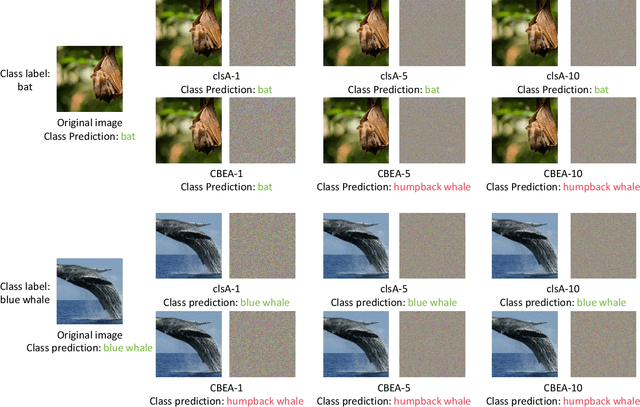
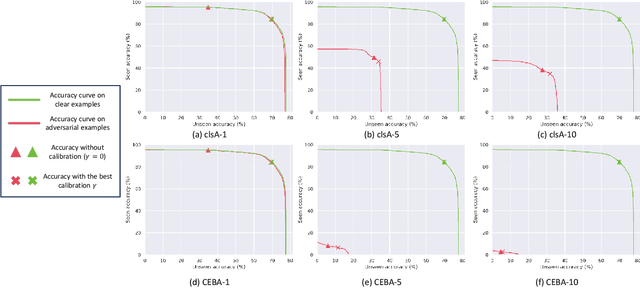
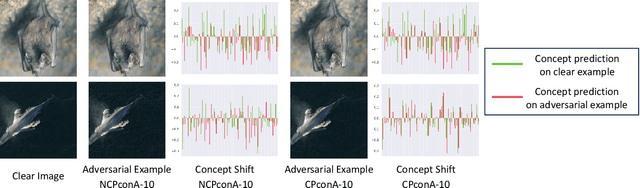
Zero-shot Learning (ZSL) aims to enable image classifiers to recognize images from unseen classes that were not included during training. Unlike traditional supervised classification, ZSL typically relies on learning a mapping from visual features to predefined, human-understandable class concepts. While ZSL models promise to improve generalization and interpretability, their robustness under systematic input perturbations remain unclear. In this study, we present an empirical analysis about the robustness of existing ZSL methods at both classlevel and concept-level. Specifically, we successfully disrupted their class prediction by the well-known non-target class attack (clsA). However, in the Generalized Zero-shot Learning (GZSL) setting, we observe that the success of clsA is only at the original best-calibrated point. After the attack, the optimal bestcalibration point shifts, and ZSL models maintain relatively strong performance at other calibration points, indicating that clsA results in a spurious attack success in the GZSL. To address this, we propose the Class-Bias Enhanced Attack (CBEA), which completely eliminates GZSL accuracy across all calibrated points by enhancing the gap between seen and unseen class probabilities.Next, at concept-level attack, we introduce two novel attack modes: Class-Preserving Concept Attack (CPconA) and NonClass-Preserving Concept Attack (NCPconA). Our extensive experiments evaluate three typical ZSL models across various architectures from the past three years and reveal that ZSL models are vulnerable not only to the traditional class attack but also to concept-based attacks. These attacks allow malicious actors to easily manipulate class predictions by erasing or introducing concepts. Our findings highlight a significant performance gap between existing approaches, emphasizing the need for improved adversarial robustness in current ZSL models.
On-Premise SLMs vs. Commercial LLMs: Prompt Engineering and Incident Classification in SOCs and CSIRTs
Nov 18, 2025In this study, we evaluate open-source models for security incident classification, comparing them with proprietary models. We utilize a dataset of anonymized real incidents, categorized according to the NIST SP 800-61r3 taxonomy and processed using five prompt-engineering techniques (PHP, SHP, HTP, PRP, and ZSL). The results indicate that, although proprietary models still exhibit higher accuracy, locally deployed open-source models provide advantages in privacy, cost-effectiveness, and data sovereignty.
Multi-Granularity Mutual Refinement Network for Zero-Shot Learning
Nov 11, 2025Zero-shot learning (ZSL) aims to recognize unseen classes with zero samples by transferring semantic knowledge from seen classes. Current approaches typically correlate global visual features with semantic information (i.e., attributes) or align local visual region features with corresponding attributes to enhance visual-semantic interactions. Although effective, these methods often overlook the intrinsic interactions between local region features, which can further improve the acquisition of transferable and explicit visual features. In this paper, we propose a network named Multi-Granularity Mutual Refinement Network (Mg-MRN), which refine discriminative and transferable visual features by learning decoupled multi-granularity features and cross-granularity feature interactions. Specifically, we design a multi-granularity feature extraction module to learn region-level discriminative features through decoupled region feature mining. Then, a cross-granularity feature fusion module strengthens the inherent interactions between region features of varying granularities. This module enhances the discriminability of representations at each granularity level by integrating region representations from adjacent hierarchies, further improving ZSL recognition performance. Extensive experiments on three popular ZSL benchmark datasets demonstrate the superiority and competitiveness of our proposed Mg-MRN method. Our code is available at https://github.com/NingWang2049/Mg-MRN.
Evaluating Compositional Generalisation in VLMs and Diffusion Models
Aug 28, 2025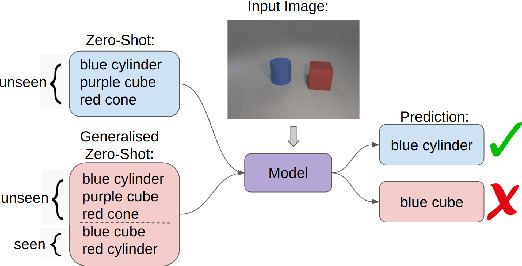
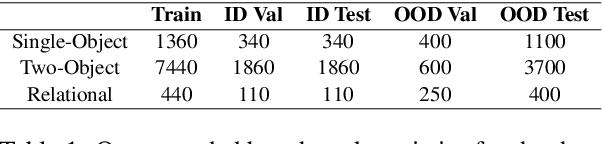
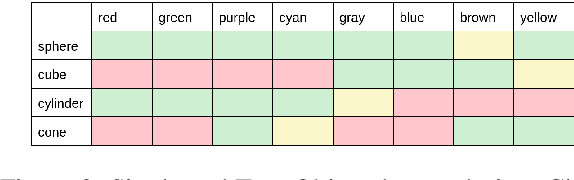
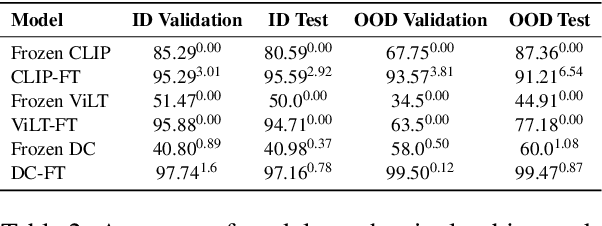
A fundamental aspect of the semantics of natural language is that novel meanings can be formed from the composition of previously known parts. Vision-language models (VLMs) have made significant progress in recent years, however, there is evidence that they are unable to perform this kind of composition. For example, given an image of a red cube and a blue cylinder, a VLM such as CLIP is likely to incorrectly label the image as a red cylinder or a blue cube, indicating it represents the image as a `bag-of-words' and fails to capture compositional semantics. Diffusion models have recently gained significant attention for their impressive generative abilities, and zero-shot classifiers based on diffusion models have been shown to perform competitively with CLIP in certain compositional tasks. In this work we explore whether the generative Diffusion Classifier has improved compositional generalisation abilities compared to discriminative models. We assess three models -- Diffusion Classifier, CLIP, and ViLT -- on their ability to bind objects with attributes and relations in both zero-shot learning (ZSL) and generalised zero-shot learning (GZSL) settings. Our results show that the Diffusion Classifier and ViLT perform well at concept binding tasks, but that all models struggle significantly with the relational GZSL task, underscoring the broader challenges VLMs face with relational reasoning. Analysis of CLIP embeddings suggests that the difficulty may stem from overly similar representations of relational concepts such as left and right. Code and dataset are available at: https://github.com/otmive/diffusion_classifier_clip
Prototype-Guided Curriculum Learning for Zero-Shot Learning
Aug 11, 2025In Zero-Shot Learning (ZSL), embedding-based methods enable knowledge transfer from seen to unseen classes by learning a visual-semantic mapping from seen-class images to class-level semantic prototypes (e.g., attributes). However, these semantic prototypes are manually defined and may introduce noisy supervision for two main reasons: (i) instance-level mismatch: variations in perspective, occlusion, and annotation bias will cause discrepancies between individual sample and the class-level semantic prototypes; and (ii) class-level imprecision: the manually defined semantic prototypes may not accurately reflect the true semantics of the class. Consequently, the visual-semantic mapping will be misled, reducing the effectiveness of knowledge transfer to unseen classes. In this work, we propose a prototype-guided curriculum learning framework (dubbed as CLZSL), which mitigates instance-level mismatches through a Prototype-Guided Curriculum Learning (PCL) module and addresses class-level imprecision via a Prototype Update (PUP) module. Specifically, the PCL module prioritizes samples with high cosine similarity between their visual mappings and the class-level semantic prototypes, and progressively advances to less-aligned samples, thereby reducing the interference of instance-level mismatches to achieve accurate visual-semantic mapping. Besides, the PUP module dynamically updates the class-level semantic prototypes by leveraging the visual mappings learned from instances, thereby reducing class-level imprecision and further improving the visual-semantic mapping. Experiments were conducted on standard benchmark datasets-AWA2, SUN, and CUB-to verify the effectiveness of our method.
Knowledge Graph-Based Explainable and Generalized Zero-Shot Semantic Communications
Jul 03, 2025Data-driven semantic communication is based on superficial statistical patterns, thereby lacking interpretability and generalization, especially for applications with the presence of unseen data. To address these challenges, we propose a novel knowledge graph-enhanced zero-shot semantic communication (KGZS-SC) network. Guided by the structured semantic information from a knowledge graph-based semantic knowledge base (KG-SKB), our scheme provides generalized semantic representations and enables reasoning for unseen cases. Specifically, the KG-SKB aligns the semantic features in a shared category semantics embedding space and enhances the generalization ability of the transmitter through aligned semantic features, thus reducing communication overhead by selectively transmitting compact visual semantics. At the receiver, zero-shot learning (ZSL) is leveraged to enable direct classification for unseen cases without the demand for retraining or additional computational overhead, thereby enhancing the adaptability and efficiency of the classification process in dynamic or resource-constrained environments. The simulation results conducted on the APY datasets show that the proposed KGZS-SC network exhibits robust generalization and significantly outperforms existing SC frameworks in classifying unseen categories across a range of SNR levels.